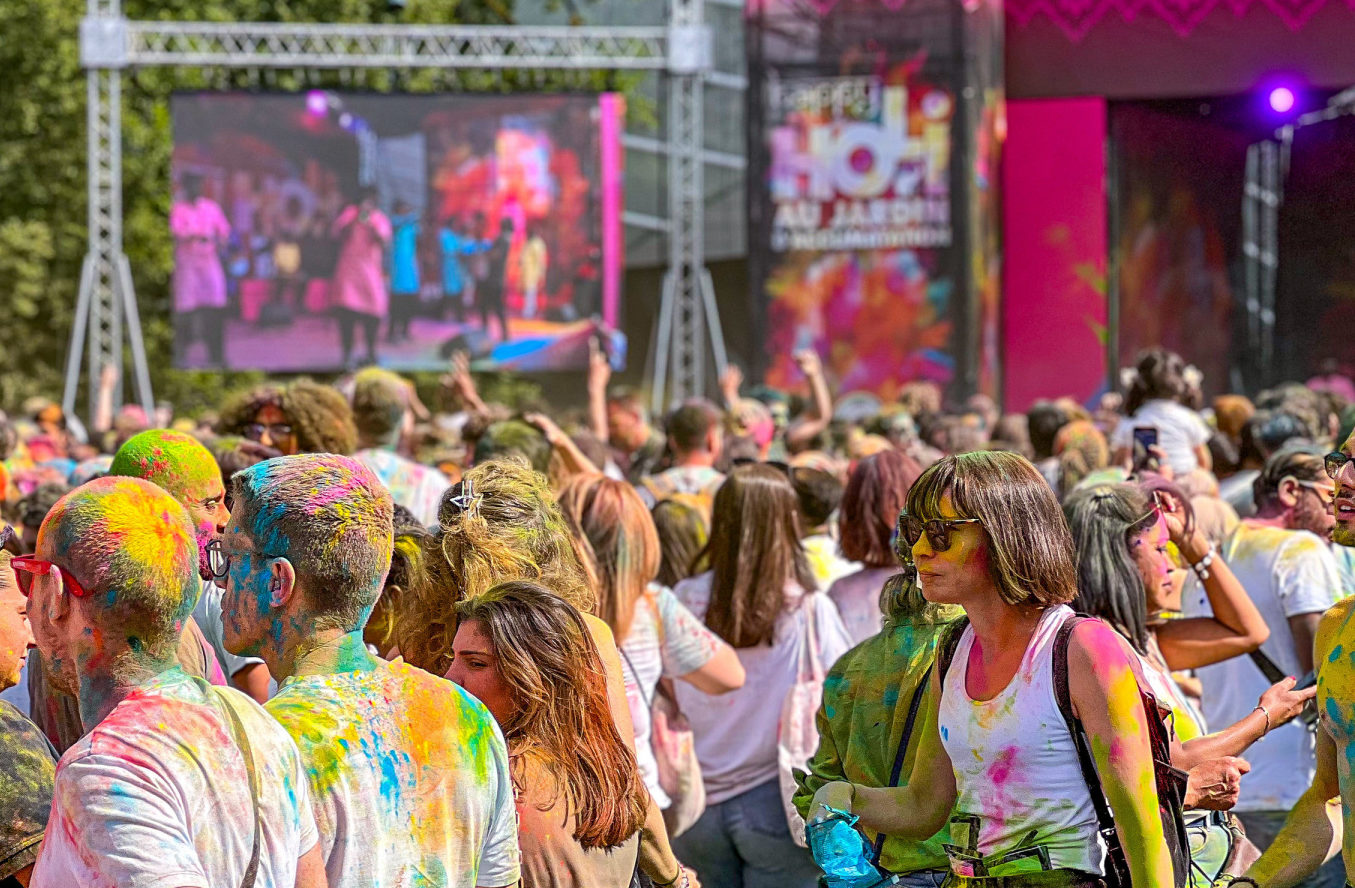
Holi 2026 at the Jardin d’Acclimatation in Paris.
In spring 2026, Paris is establishing itself as a prime arena for the projection of Asian culture. Driven by effective cultural diplomacy and dynamic diasporas, East and South Asia are wielding growing influence there, one that extends well beyond festivities and forms part of an openly acknowledged strategy of political and cultural influence.
India settles in for the long term
On 31 May, the Jardin d’Acclimatation, run by the LVMH group, hosted a Holi celebration attended by the Indian Ambassador to France. The event was the occasion for a twofold announcement: a forthcoming Diwali festival at the same venue, and the official launch of the Swami Vivekananda Cultural Center (SVCC), a new Indian cultural centre under the aegis of the ICCR, a body attached to India’s Ministry of External Affairs. It is a clear sign of New Delhi’s determination to give its cultural presence in Paris a lasting foothold.
China: between diaspora and academic diplomacy
On the Chinese side, the strategy rests on two complementary levers. On the one hand, the diaspora and its associations enliven Parisian cultural life: Lunar New Year celebrations in the 13th arrondissement, calligraphy workshops, promotion of Hanfu. On the other, an openly embraced academic diplomacy, illustrated by the Chinese universities fair held at INALCO on 6 June, where major institutions, including the prestigious Tsinghua University, attended by Xi Jinping, current General Secretary of the Communist Party of China, sought to attract future foreign students. The China Cultural Centre, for its part, is stepping up efforts to draw new learners to its Mandarin classes, turning language learning into a vehicle for cultural affinity.
The 13th arrondissement, epicentre of growing visibility
This ferment is firmly anchored in the 13th arrondissement, which has become a genuine cultural destination. Alongside the Chinese communities are other Asian presences, such as the Vietnamese community, which will take to the streets on 27 June for a traditional parade. Social media amplify this visibility, turning these neighbourhoods into spontaneous showcases of Asian soft power.
Cultural centres, openly acknowledged tools of influence
It is in the cultural centres, however, that the political dimension of soft power is most clearly revealed. The Korean Cultural Centre has been particularly active this year, marking 140 years of Franco-Korean relations, punctuated by high-profile diplomatic events such as Emmanuel Macron’s visit to Seoul in April and Lee Jae-myung’s attendance at the G7 summit in Évian in June.
The Japanese Cultural Centre, for its part, made a lasting impression in late 2025 with an exhibition devoted to Isao Takahata, co-founder of Studio Ghibli, combining artistic prestige with mass appeal.
But the phenomenon extends beyond Asia. Against an unstable geopolitical backdrop, cultural centres are establishing themselves as indispensable spaces for dialogue. The Pouya centre, devoted to Persian culture, illustrates this trend discreetly but effectively, offering concerts, lectures and workshops in a particularly sensitive Iranian context. Even the Mission bretonne in Paris, a centre dedicated to a regional culture, is a reminder that soft power is not the preserve of the great powers: any cultural identity can seek to extend its reach and secure its future by this means.
In Paris, these cultural institutions thus form a discreet but structured ecosystem of influence, in which language, art and diplomacy come together in the service of very real interests.
Translated from French. The French original prevails.