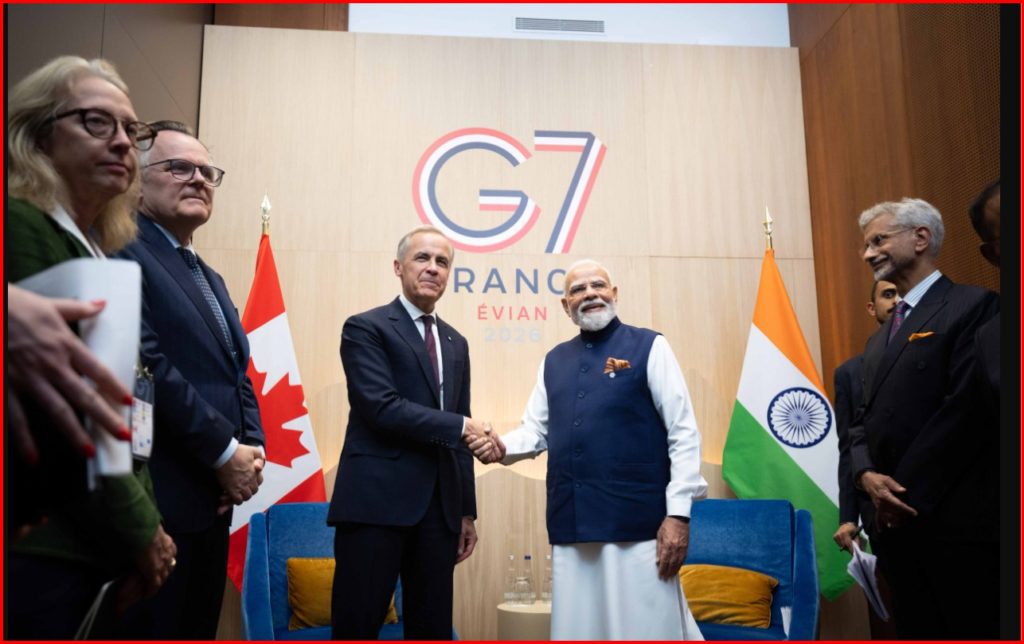
Mark Carney, Prime Minister of Canada, meeting Narendra Modi, Prime Minister of India, in Davos this year.
Ottawa wants to sign a trade agreement with New Delhi before Christmas. The case of the four men accused of killing Hardeep Singh Nijjar in Surrey, meanwhile, is still before the courts. It is possible to do both at once. But that needs to be said.
Some speeches are applauded and then forgotten. Mark Carney’s address in Davos on 20 January was not one of them. Before the cream of the World Economic Forum, the Canadian Prime Minister said out loud what many foreign ministries were thinking privately: the international order we have known is not going through a period of transition, it is breaking apart. And he coined an image that went around the world: if you are not at the table, you end up on the menu. Nine months on, the real question is no longer whether Canada should sit at other tables. It is what Canada is prepared to leave at the cloakroom in order to be invited. And on that point, the case that speaks volumes is neither in Washington nor in Beijing. It is in New Delhi.
Beijing first, to set the tone
It is worth remembering the sequence of events. Four days before Davos, on 16 January, Mark Carney was in Beijing, face to face with Xi Jinping. He came away with an agreement that he himself described as historic: Canada will allow in up to 49,000 Chinese electric vehicles a year at a tariff of 6.1%, instead of the 100% imposed until then. In exchange, China is cutting its duties on Canadian canola (a variety of rapeseed) from around 84% to around 15%. The Prime Minister even let slip that China had become a more predictable partner than the United States. In Toronto, Doug Ford saw red, and understandably so: it is Ontario that builds the cars.
It was no snap decision. The Global Affairs figures bear this out: in 2025, exports to countries other than the United States rose by 11.1%, and their share had not been so high since 1981. Americans still buy 72% of exported goods, and National Bank points out that this diversification rests mainly on gold, energy and a handful of large companies. Ottawa wants to double its non-US exports within ten years. It is a target, not yet a reality. In this shift, China is a tactical move. India is something else: a growing market, nuclear power stations to supply and an enormous appetite for critical minerals. In short, everything Canada has beneath its soil.
New Delhi: a whirlwind honeymoon
Things moved very quickly. On 23 November 2025, Mark Carney and Narendra Modi launched negotiations on a Comprehensive Economic Partnership Agreement (CEPA). On 28 February 2026, in Mumbai, Carney set out his stall before business leaders: he wanted to sign before the end of the year and double trade by 2030. He then put trade between the two countries at more than $30 billion a year, and cross-investment at more than $100 billion. Then everything sped up. In March, Cameco, the Saskatchewan uranium giant, signed a $2.6 billion contract with India’s Department of Atomic Energy: nearly 22 million pounds of uranium to be delivered between 2027 and 2035. The two governments are now talking of raising their trade to $70 billion by 2030. In May, India’s Commerce Minister, Piyush Goyal, arrived in Canada with more than 120 companies in tow. According to “Global Affairs Canada”, it was the largest trade mission India had ever sent abroad.
On 16 June, in Évian, on the sidelines of the G7, the two men went further still. They agreed to open negotiations on an information security agreement, and India backed Canada’s admission as a dialogue partner of the Indian Ocean Rim Association. On 22 September, in New York, Carney announced the next step: Narendra Modi would visit Canada in December, with the aim of concluding the CEPA before the G20 summit in Miami in mid-December.
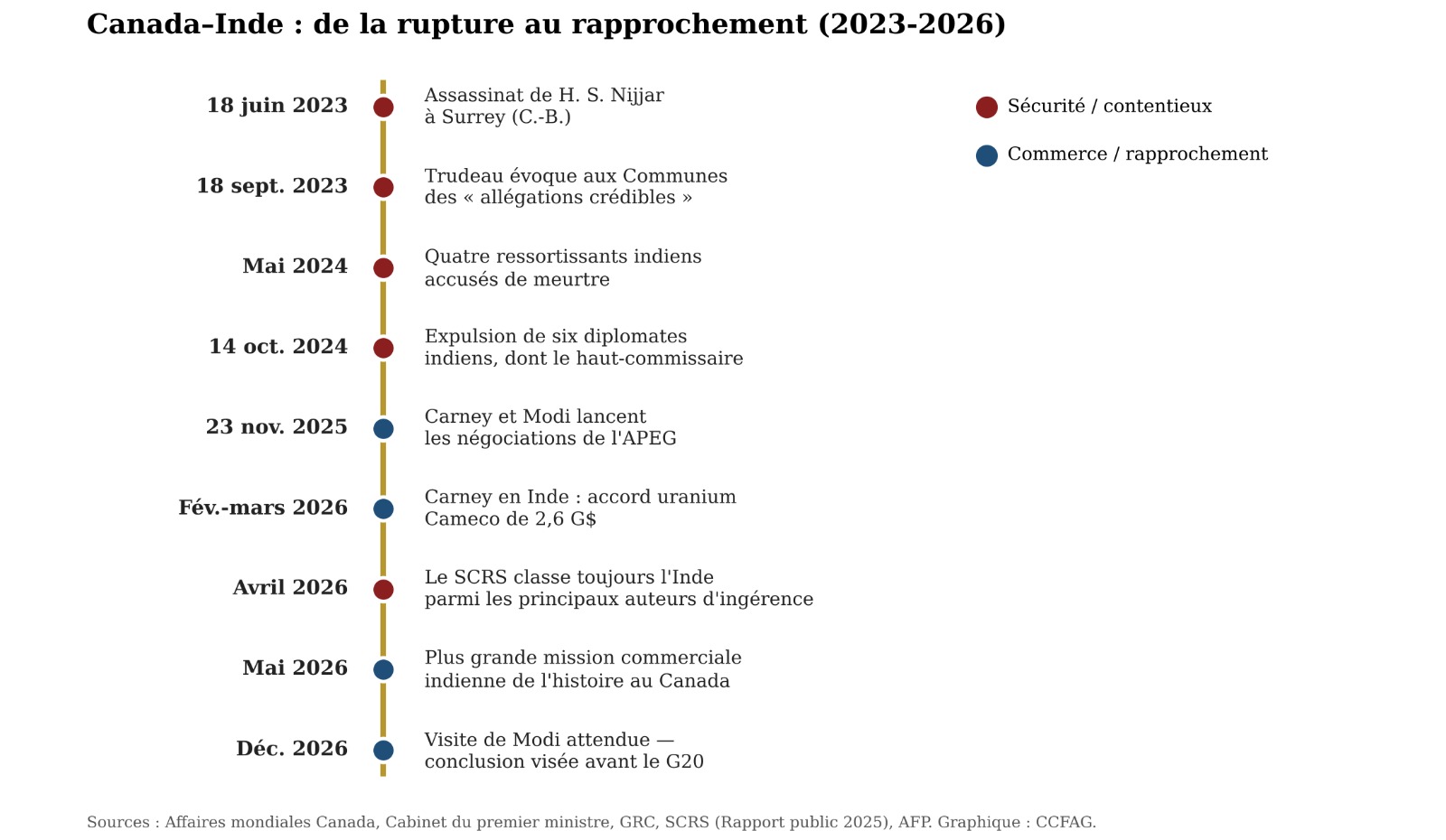
Timeline of Canada–India relations, 2023-2026. Original graphic by CCFAG.
Meanwhile, in Surrey
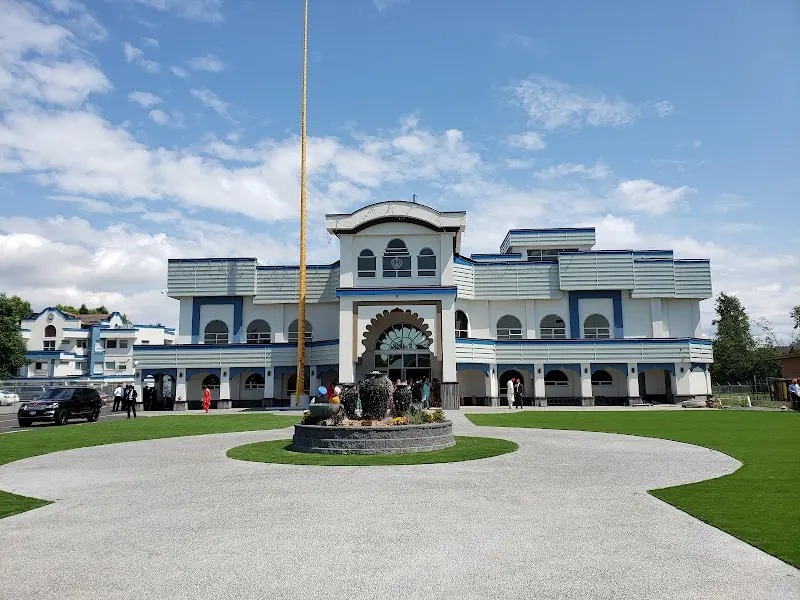
So much for the trade agenda. There is another one, and it will not be settled in a diplomatic reception room. On 18 June 2023, Hardeep Singh Nijjar, a Canadian citizen and president of the Guru Nanak Sikh Gurdwara in Surrey, British Columbia, was shot dead in the car park of his temple. Three months later, Justin Trudeau rose in the House of Commons and declared that Canadian agencies were investigating credible allegations linking agents of the Indian government to the killing. New Delhi denied it. In May 2024, four Indian nationals were charged with first-degree murder and conspiracy. In October that year, Ottawa expelled six Indian diplomats and consular officials, including the High Commissioner, Sanjay Kumar Verma, citing a targeted campaign against Canadian citizens. The RCMP spoke of a wider network of intimidation and violence. India retaliated by expelling six Canadian diplomats. Relations hit rock bottom.
The case is not closed. The trial of the four accused is continuing before the Supreme Court of British Columbia in New Westminster. Last February, the Attorney General of Canada asked that certain information be withheld on grounds of national security. Let us pause for a moment to consider what this means. The Canadian state believes the evidence touches on its most sensitive secrets. And that same state is, at the same time, negotiating a free trade agreement with the country implicated.
The intelligence service, for its part, has not changed its view. In its 2025 public report, published last April, CSIS still ranks India among the main perpetrators of foreign interference and espionage in Canada, alongside China, Russia, Iran and Pakistan. It describes repression that reaches into our very cities: surveillance, pressure and intimidation, targeting voices within the diaspora that are critical of New Delhi, in particular supporters of the pro-Khalistan movement.
Silence as the official line
That is the crux of the problem. Before Mark Carney left for India in February, a senior official told journalists that the trip would not have gone ahead if Ottawa still believed Indian agents were involved in extortion or threats of violence in Canada. Once in Mumbai, the Minister of Foreign Affairs, Anita Anand, was asked about the issue several times. She did not answer. Nor did the Prime Minister. That same day, CSIS told “The Canadian Press” that its assessment of the main foreign interference threats had not changed. The Minister of Public Safety, Gary Anandasangaree, acknowledged that a great deal of work remained to be done. Vincent Rigby, a former national security and intelligence adviser to the federal government, considered it hardly credible that India had ceased its activities. And a Liberal MP, Sukh Dhaliwal, publicly criticised the minister for contradicting her own government’s security agencies.
So in Ottawa there are two narratives that do not speak to each other. That of the intelligence services, which document a threat. And that of diplomacy, which refuses to name it. It is a choice. Mark Carney put it that way himself in Mumbai, with a candour for which he deserves credit: not all our partners share our values, and we have to deal with the world as it is. Fair enough. But a choice that is owned behind the scenes and hushed up at press conferences is no longer quite a choice that is owned.
What the world is watching
Seen from Geneva, the affair goes well beyond a stand-off between Ottawa and New Delhi. Canada is one of the few Western democracies to have publicly accused a partner country of ordering an assassination on its soil. The way it turns the page will be closely watched, both by countries that host diasporas under pressure and by governments tempted to silence their opponents abroad. If the lesson drawn is that a good uranium contract wipes the slate clean, it will be heard far beyond India.
Between now and December, three things bear watching. First, the information security agreement that nobody is talking about. Sharing intelligence with a country that Canada’s own service ranks among the main perpetrators of interference warrants, at the very least, a public explanation. Second, the timetable for the trial in New Westminster. It would take only a piece of evidence emerging in court during Narendra Modi’s visit for the finely tuned diplomatic machinery to seize up. Finally, if Bill C-70, passed in 2024 to combat foreign interference and transnational repression, is not enforced, it protects no one.
Mark Carney is right: a middle power that stands alone ends up being told how to behave. But finding new friends brings no greater freedom if each of them also secures, as a bonus, silence on whatever is inconvenient. Having a seat at the table is good. Arriving there with one’s sovereignty intact is better. In December, if the agreement is signed while the Nijjar trial is still under way, Ottawa will have shown that it can do business in the world as it is. It will still have to show that it can also protect its own people there.
Sources
1. “Building something better”: Mark Carney’s full speech at Davos
Full text of the speech delivered on 20 January 2026 at the World Economic Forum.
Source: legrandcontinent.eu
2. Carney strikes deal with China on electric vehicles and canola
The Canadian Press, 16 January 2026: quota of 49,000 EVs at 6.1%, lower duties on canola.
Source: noovo.info
3. Canada agrees to cut tariff on Chinese EVs in break with US
Dispatch of 16 January 2026: Carney’s statement on China’s predictability.
Source: irishnews.com
4. Trade update 2026 — Canada is exporting more to the world
Global Affairs Canada, 9 September 2026: +11.1% excluding the United States, 72% share of goods going to the United States.
Source: international.gc.ca
5. Ottawa’s diversification goal suffers from a problem of scale
National Bank, Economics & Strategy, 26 May 2026 (Statistics Canada data).
Source: bnc.ca
6. Canada-India Comprehensive Economic Partnership Agreement (CEPA)
Global Affairs Canada: negotiations launched on 23 November 2025.
Source: international.gc.ca
7. Carney hopes to conclude a trade deal with India this year
The Canadian Press, 28 February 2026: Mumbai speech, refusal by Minister Anand, statements by CSIS and Vincent Rigby.
Source: noovo.info
8. Canada-India relations
Global Affairs Canada: March 2026 visit, Goyal mission of May 2026 (more than 120 companies).
Source: international.gc.ca
9. Canada welcomes India’s Minister of Commerce and Industry
Global Affairs Canada, 29 May 2026: merchandise trade of $13.6 billion in 2025.
Source: canada.ca
10. Prime Minister Carney meets Prime Minister Modi
Prime Minister’s Office, readout of 16 June 2026: information security agreement, IORA.
Source: pm.gc.ca
11. Ottawa prepares for Narendra Modi’s visit to finalise a trade deal
AFP, 22 September 2026: visit expected in December, $2.6 billion Cameco agreement, $70 billion target.
Source: connaissancedesenergies.org
12. Minister Joly announces the expulsion of Indian diplomats
Global Affairs Canada, news release of 14 October 2024.
Source: canada.ca
13. New arrest and charges in the killing of Hardeep Singh Nijjar
RCMP, May 2024: identities of the four accused and the charges against them.
Source: grc.ca
14. Federal lawyers seek to shield information in Nijjar murder case on security grounds
The Canadian Press, 19 February 2026: case before the Supreme Court of British Columbia.
Source: panow.com
15. CSIS Public Report 2025 — Operations and analysis
Canadian Security Intelligence Service, April 2026.
Source: canada.ca
16. Understanding foreign interference
Public Safety Canada: transnational repression and Bill C-70 (2024).
Source: publicsafety.gc.ca
Translated from French. The French original prevails.