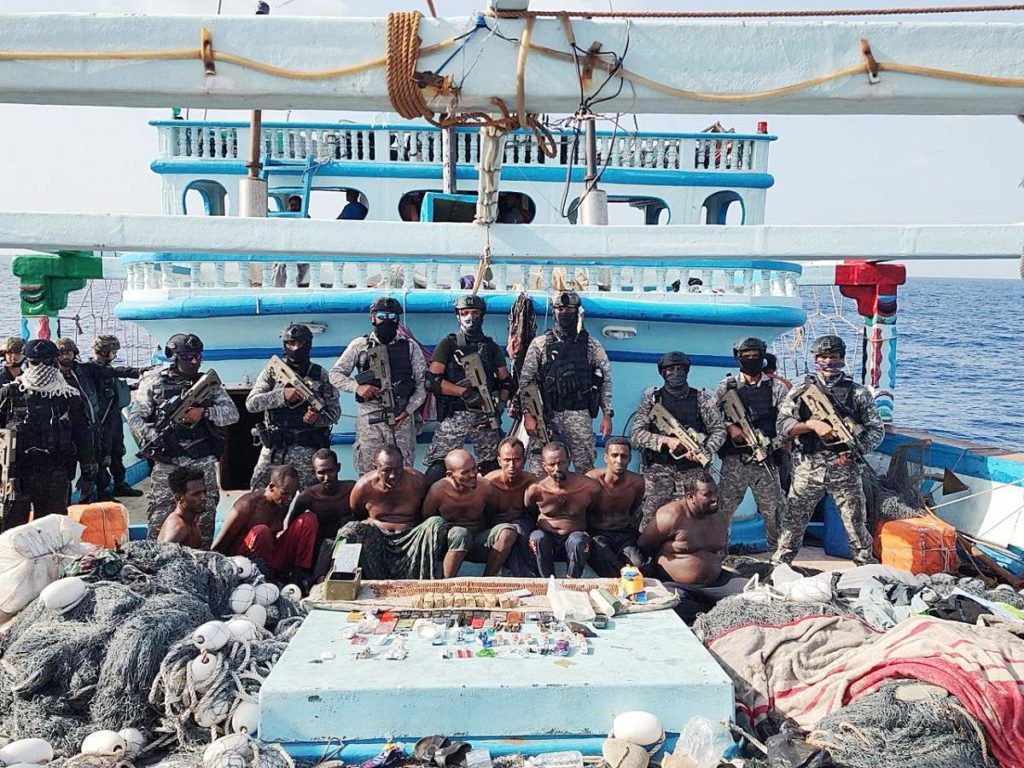
Somali pirates arrested by the Indian Navy in 2024.
With the war over Iran drawing attention and naval resources to the Strait of Hormuz and the Red Sea, Somali piracy is undergoing a sharp resurgence in the Gulf of Aden and the western Indian Ocean. Six vessels are now being held and more than 90 seafarers are in captivity. For the energy flows linking the Gulf to Europe and Asia, this return adds a criminal risk to a route already fragmented by geopolitical tensions.
The Strait of Hormuz is no longer the only chokepoint worrying shipowners. Bab el-Mandeb remains exposed to attacks and threats linked to the conflict in Yemen. Now, further south, a danger thought to have been contained for more than a decade is re-emerging: Somali piracy. On 20 August, the product tanker Sibu 1, also identified as Seamull, was boarded some 136 nautical miles east of Al-Mukalla, Yemen, and then diverted towards Somalia. The vessel, already under US sanctions, was at least the thirteenth ship targeted since the start of the year off Somalia or in the Gulf of Aden. Reuters notes that there had been only five such attacks in the whole of 2025.
The profile of the Sibu 1 makes the case particularly revealing. Its crew of 20 seafarers includes 16 Indian nationals; on 22 August the Indian authorities said they had been reported safe and well. Before losing control of the vessel, the crew reportedly changed the “destination” field of the AIS to send a final distress message: “PIRATE ONBOARD HELP”. The attackers then steered the ship towards Bosaso, in Puntland.
The Iranian link, for its part, is more firmly established than a mere reference to US sanctions would suggest. On 18 December 2025, OFAC designated SEAMULL (IMO 9204776) as blocked property linked to Qatrat Alnada Almasi Ship Management, a company based in the United Arab Emirates. The US Treasury says the tanker had repeatedly carried Iranian petroleum products, including naphtha and gasoil, and called at Yemeni ports controlled by the Houthis. The hijacking of the Sibu 1 thus brings together piracy, sanctions and the networks of Iran’s “shadow fleet” on a single vessel.
A threat once thought contained
The current sequence of events is therefore no longer a string of isolated incidents. Three days before the Sibu 1, the cargo ship Lutuf had already been seized off Somalia. The International Maritime Organization (IMO) said on 24 August that six vessels were being held by pirates or armed groups and that more than 90 seafarers were in captivity. Captivity can last several months.
As early as 6 July, the IMO reported that 44 seafarers held aboard three vessels hijacked between April and May — the MT Honour 25, the Eureka and the Sward — were running out of food and water and living under the constant threat of violence. By the end of August, more than 90 seafarers were being held captive aboard six vessels, often with limited access to adequate food, drinking water, medical care and other essential services.
The comparison with the great wave of piracy of 2008-2014 must nevertheless be handled with caution. The number of attacks remains far lower than during that period. But the pirates have regained several of the capabilities that once made them so formidable: the use of mother ships, attacks far from the coast, the diversion of hijacked vessels to the Somali coastline and the establishment of a ransom economy.
The paradox of 2026 is particularly telling. According to the International Maritime Bureau (IMB), the global number of acts of piracy and armed robbery against ships fell in the first half of the year to its lowest level since 1992: 38 incidents, compared with 90 over the same period in 2025. Yet Somali pirates were responsible for 94% of the seafarers taken hostage during those six months. The threat is therefore shrinking overall while abruptly becoming concentrated once again in a strategic area.
The Iran war is also shifting the risks
This resurgence stems first and foremost from long-standing Somali factors: a weak state, poverty in coastal regions, trafficking, illegal fishing and the persistence of criminal networks capable of regrouping. Piracy had been contained, but never truly eradicated. Yet a new element has been added to these structural causes: the redeployment of military assets in the region. Experts quoted by Reuters point out that the war against Iran has drawn towards Hormuz and the Red Sea naval assets that were previously available for patrolling the Gulf of Aden and the western Indian Ocean. Rising oil prices are also increasing the potential value of cargoes and the appeal of tankers as targets. It would be going too far to see this as a mechanical cause-and-effect relationship.
Somali piracy is not re-emerging because Western forces are fighting Iran. But the regional crisis is creating a window of opportunity: navies must simultaneously protect straits, escort vessels, track drones and missiles, maintain the blockade or interdiction operations and carry out counter-piracy missions. The maritime space is becoming too vast for every risk to be addressed with the same intensity.
The links sometimes alleged between Somali pirates and the Houthis also remain difficult to establish. The seizure of a tanker associated with Iranian exports even calls for caution. On the other hand, long-standing criminal ties between the two shores of the Gulf of Aden — arms trafficking, smuggling and people-smuggling networks — provide fertile ground for occasional cooperation.
This development extends two trends already analysed by La Tribune des Nations: the transformation of Bab el-Mandeb into a new front in the energy war and Iran’s ability to turn Hormuz into an instrument of political and economic pressure.
An energy route now facing three kinds of threat
For energy companies and shipowners, the problem is not merely the existence of an additional danger. It is the way dangers are piling up along a single route. An LNG carrier or tanker leaving the Gulf for Europe may now face three distinct environments in succession. In Hormuz, the risk is primarily state-driven and military: control of the passage, mines, interceptions, strikes and sanctions. At Bab el-Mandeb, the threat stems from the capabilities of the Houthis and the regional war. In the Gulf of Aden and off Somalia, it becomes criminal once again: boarding, hijacking, hostage-taking and ransom.
These threats have neither the same perpetrators nor the same logic. Yet they all call for protective measures, intelligence, alert procedures, higher insurance premiums and the ability to change routes quickly. Even if large LNG carriers and modern tankers are less vulnerable than slow, low-freeboard cargo ships, the return of piracy drives up the risk across the entire chain. Detours must also be taken into account. A vessel that avoids the Red Sea and sails around Africa via the Cape of Good Hope remains exposed to the western Indian Ocean for a long time. Securing a single strait is therefore no longer enough to guarantee the security of the energy route as a whole.
Regional response attempts to regroup
A response is beginning to take shape. On 13 August, the signatory states of the Djibouti Code of Conduct announced that they were working towards the creation of a combined task force dedicated to maritime security in the western Indian Ocean and the Gulf of Aden. The plan provides in particular for closer cooperation between coastal states and for regional officers to be embarked on deployed vessels in order to facilitate interceptions and prosecutions.
This architecture would complement existing arrangements, notably Combined Task Force 151 and the European Union’s Operation Atalanta. The IMO, for its part, stresses the need to maintain sustained international naval cooperation and for merchant ships to apply the recommended protective measures.
The problem is that this anti-piracy mechanism is being rebuilt at the very moment when Western and regional navies are stretched across several theatres. The question, therefore, is not whether the resources exist, but whether they can be concentrated in the same place for long enough.
From a war of straits to a war of routes
The Somali resurgence does not turn the Gulf of Aden into a third Hormuz. The pirates have neither the means of a state nor the capacity to close a major shipping lane for any length of time. But they add a fresh layer of uncertainty to an energy system already under exceptional strain. That is precisely what changes the nature of the risk. For decades, energy security in the Gulf was conceived around a handful of chokepoints: Hormuz, Bab el-Mandeb, Suez. The current crisis shows that vulnerability is no longer confined to the straits themselves. It is now spreading along the routes that connect them.
A tanker can leave Hormuz without incident and pass through Bab el-Mandeb, only to be hijacked in the Gulf of Aden. Conversely, a detour intended to avoid a missile zone can leave a vessel more exposed to criminal threats, or sharply increase costs and delays. The regional war has thus produced an effect that its protagonists do not fully control: the more military resources are concentrated on the major confrontations, the more secondary actors can exploit the spaces left on the margins. Somali piracy is not a new front in the war against Iran. It is nonetheless becoming one of its most telling peripheral effects.
Read in La Tribune des Nations
Iran–United States: war redraws the strategic architecture of the Middle East
Sources
Reuters — Iran-linked oil tanker falls victim to Somali piracy surge, 21 August 2026
Djibouti Code of Conduct — Combined DCoC Task Force project, 13 August 2026
Translated from French. The French original prevails.