By Didier Aubrais
Last Monday, the Canadian Prime Minister travelled to Kuujjuaq, a village of three thousand people in northern Quebec, accompanied by six of his ministers. Six. To meet Inuit leaders and talk sovereignty, security and defence. The event earned a few wire reports, and then the world went back to watching Hormuz, the Red Sea, Tehran. That is a mistake. And I would like to explain why, because what is unfolding in the Far North at this very moment is probably the most important strategic shift — and the least discussed — of the decade.
A ship nobody saw go by
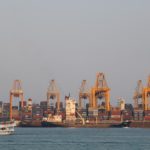
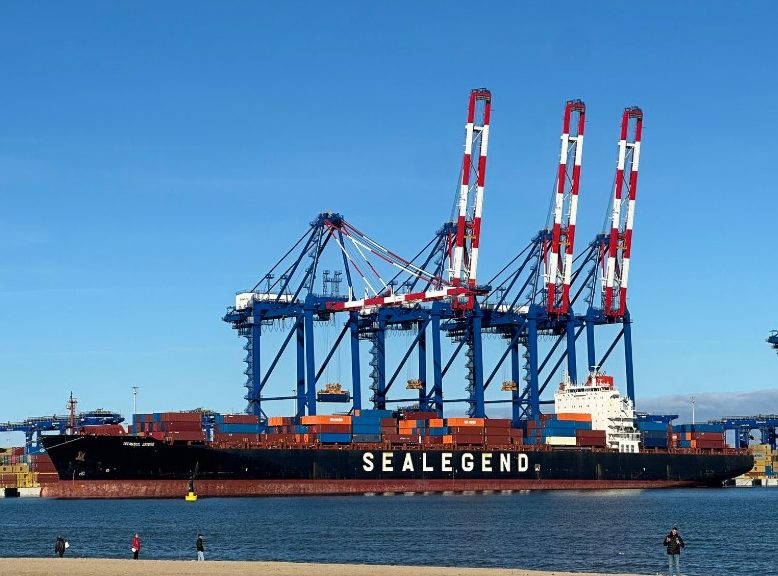
The Istanbul Bridge at the Baltic Hub terminal in Gdańsk on 19 October 2025, at the end of its maiden Arctic crossing — 26 days from Ningbo.
Let us go back to last September. A 300-metre container ship, the Istanbul Bridge, leaves the Chinese port of Ningbo with nearly five thousand containers of solar panels, batteries and e-commerce parcels. Twenty days later, it docks at Felixstowe, in England. Then Hamburg. Then Gdańsk. Twenty days, where the Suez Canal takes forty and the Cape of Good Hope fifty. It went by the north — along the Siberian coast, via the “Polar Silk Road” that Beijing wrote into its plans as early as 2018.
It was not an experiment. It was the launch of a commercial line, named “ArcticExpress”. And here is the detail that should make you look up from your newspaper: the regular service — weekly or fortnightly — starts this summer. This one. As you read these lines, the first regular commercial season in the history of the Arctic is opening.
The crises of the South are financing the northern route
There is a link I have not seen made anywhere, yet it strikes me as glaringly obvious: every missile fired in the Red Sea, every flare-up in the Strait of Hormuz, every week spent detouring via the Cape of Good Hope makes the polar route more profitable. The crises the whole world is watching are the best salesman for the route nobody is watching. Beijing does not even need to say so: marine insurers and shippers are doing the maths on their own.
I have spent my career observing how positions of influence are established, and here I recognise a method I know well. You do not conquer the Arctic with warships. You enter it through trade, science and investment. A research station in Iceland. Stakes in ports. Seabed mapping campaigns. Loans. Each piece is civilian, legitimate, defensible. It is the whole that sketches something else — an infrastructure that serves trade today and will serve whatever one wishes tomorrow. China, moreover, describes itself as a “near-Arctic state”, a remarkable phrase for a country whose northernmost port lies at the latitude of Naples.
And behind China stands Russia, which controls the route and owns more than half of the world’s icebreaker fleet, eleven of them nuclear-powered. Canada, for its part, is still waiting for delivery of its own.
The American paradox
Now for the strangest part. Ottawa has always claimed the Northwest Passage — the Canadian version of this route, through our Arctic archipelago — as internal waters. Washington, for its part, maintains that it is an international strait, open to all. The two allies had learned to live with this disagreement thanks to a cooperation agreement signed in 1988. That agreement now appears to have been set aside, and the US administration is talking about sending a warship through the passage without Canadian authorisation.
Take a second to consider the strategic absurdity: if Washington won its case and the passage legally became an international strait, who would benefit? Not the United States, which already sails through it. Chinese and Russian ships would, gaining an enforceable right of passage in North America’s backyard. In the name of firmness, we would be opening the door to those we claim to be containing. In my line of work, that’s called an own goal.
Forty billion that nobody has explained
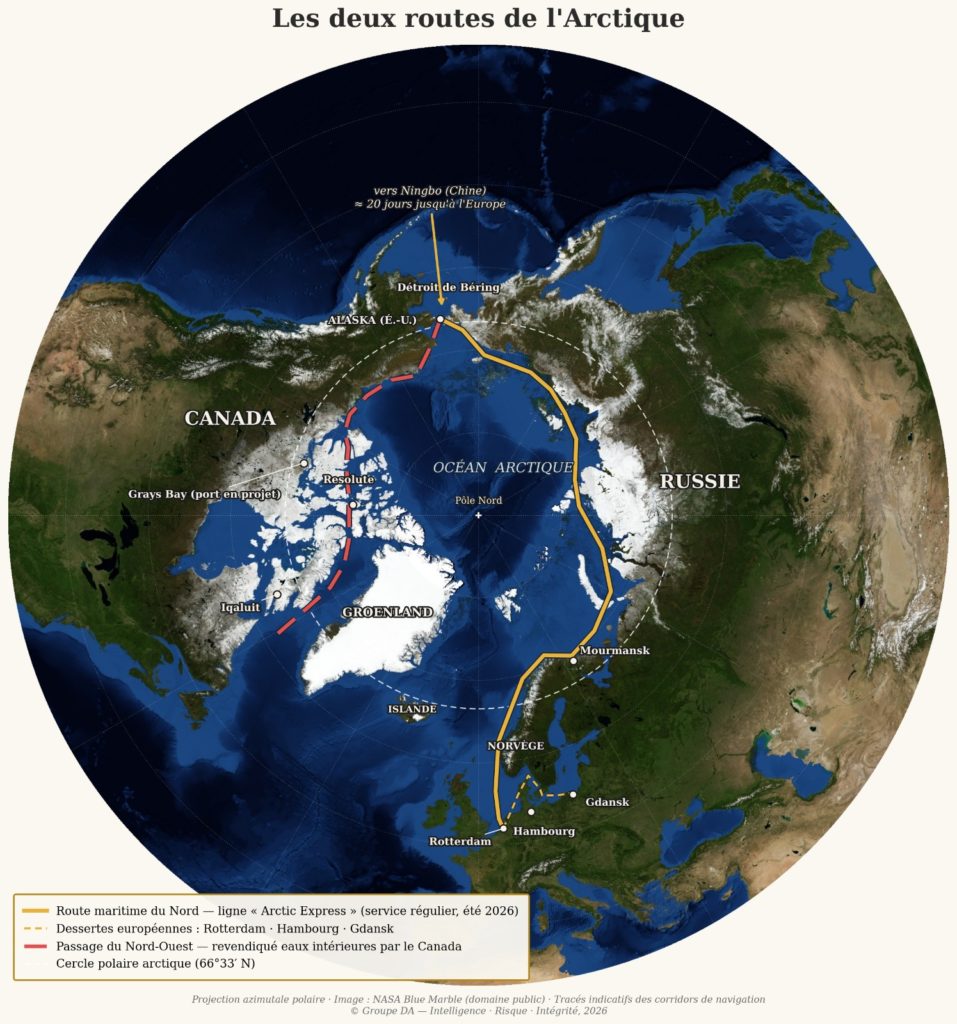
The two Arctic routes: the Northern Sea Route, used by China’s “ Arctic Express”, and Canada’s Northwest Passage. Map: Groupe DA, 2026.
It is in this context — and only in this context — that Canada’s recent decisions make sense. In March, in Yellowknife, Mark Carney announced a plan worth more than forty billion dollars for the Arctic, including thirty-two billion for forward bases, declaring: “Canada is taking full responsibility for defending its sovereignty in the Arctic.” He put forward for fast-track approval a deep-water port on the Arctic Ocean, at Grays Bay, and a four-hundred-kilometre road corridor to reach it. Then he flew to Norway to observe NATO exercises and meet the Nordic countries. Yellowknife, Oslo, Kuujjuaq: the triangle is no coincidence.
The media covered these announcements as just more military spending. Almost nobody made the connection with the container ship from Ningbo. Yet it is the same story: a country that understands that its northern frontage — forty per cent of its territory, three-quarters of its coastline — is ceasing to be a wall of ice and becoming a thoroughfare. And that an unpatrolled thoroughfare belongs to whoever uses it.
What Europe should understand
European readers might think this issue a distant one. It is not: Europe is the terminus of this route. Rotterdam, Hamburg and Gdansk are becoming the arrival stations of a network conceived, financed and timetabled elsewhere. The European Parliament has grasped this in its own way, voting last November to revise an Arctic strategy deemed outdated. But between a parliamentary resolution and five thousand containers coming into port lies the difference between watching and acting.
The Far North is melting, opening up and filling with competing interests. Those who wait for this issue to make the headlines before paying attention will find that, in the meantime, positions will have been staked out — the ports, the corridors, the contracts, the legal precedents. In the Far North as elsewhere, geography does not wait for the inattentive.
We are all watching Hormuz. We should also be watching the ice. That is where tomorrow’s world is taking shape — and it is moving at fifteen knots.
Didier Aubrais is President and Founder of Groupe DA Détection-Action, a business intelligence and specialist investigations firm (Laval, Quebec — Geneva), and President of the Cercle Canadien Francophone d’Analyse Géostratégique (CCFAG).
Sources and references
1. La Presse — “Mark Carney rencontre des dirigeants inuits à Kuujjuaq”, 30 June 2026. Meeting of the Inuit-Crown Partnership Committee with six ministers; Arctic sovereignty, security and defence on the agenda; statement: “We take full responsibility for our security and our sovereignty in the Arctic”.
2. RTBF — “L’Arctique, la nouvelle route maritime entre la Chine et l’Europ”, October 2025. Maiden voyage of the Istanbul Bridge (Ningbo → Felixstowe in 18-20 days vs 40 days via Suez); plans for a regular “Arctic Express” service; link with the attacks in the Red Sea.
3. Mer et Marine — “A container ship has opened a new route between China and Europe via the Arctic”, October 2025. Technical details: 4,843 TEU, 20 days for 7,850 miles, without icebreaker escort; calls at Felixstowe, Hamburg; first regular seasonal China–Europe service via the Northern Sea Route.
4. Global Times / Xinhua — “China-Europe Arctic route to enter regular summer operation in 2026″, October 2025. 4,890 containers (photovoltaic modules, energy storage, e-commerce); plan for regular weekly or fortnightly services from 2026, with the aim of year-round navigation.
5. France-Soir — “Arctic Express: when a Chinese container ship crosses the Arctic”, October 2025. Russian icebreaker fleet: more than 50% of the world fleet, 11 nuclear icebreakers, 40 diesel-electric, 4 nuclear under construction.
6. Policy Options / IRPP — “Arctique: pourquoi Washington soutient-il les intérêts chinois?” (“The Arctic: why is Washington supporting Chinese interests?”), February 2026. An analysis of the American legal paradox: the “international strait” position on the Northwest Passage objectively benefits China; unauthorised transits in 1969, 1985 and 2005; the 1988 Arctic Cooperation Agreement.
7. Radio-Canada (OHdio) — “La lutte du Canada pour la souveraineté sur les eaux arctiques” (“Canada’s fight for sovereignty over Arctic waters”), 2026. The 1988 Arctic Cooperation Agreement set aside by the Trump administration; US plan to send a warship through the Northwest Passage.
8. NATO Association of Canada — “La souveraineté canadienne à l’épreuve du Passage du Nord-Ouest” (“Canadian sovereignty put to the test by the Northwest Passage”), April 2026. Shipping traffic in the Canadian Arctic almost tripled in 25 years; risk of de facto internationalisation; the Arctic = 40% of Canadian territory; estimated reserves (USGS: 13% of the world’s undiscovered oil and 30% of its undiscovered gas).
9. Office of the Prime Minister of Canada — Press release, 12 March 2026: “Prime Minister Carney announces an ambitious new plan to defend, develop and transform the North”. A plan worth more than $40 billion (including $35 billion for the Arctic); $32 billion for the forward operating locations in Yellowknife, Inuvik, Iqaluit and Goose Bay; Arctic Infrastructure Fund ($1 billion).
10. La Presse — “Défense de l’Arctique : Mark Carney annonce des investissements de 32 milliards” (Arctic defence: Mark Carney announces 32 billion in investment), 12 March 2026. Announcement made in Yellowknife before departing for Norway (NATO’s Cold Response exercises, Nordic-Canadian Council summit); projects submitted to the Major Projects Office: Grays Bay deep-water port, Arctic Economic and Security Corridor (400 km).
11. Le Taurillon — “Quand les Nouvelles Routes de la Soie investissent l’Arctique” (When the New Silk Roads move into the Arctic), March 2026. Polar Silk Road part of Chinese strategy since 2018; investment methods, technology transfers and loans; China-Iceland Arctic Science Observatory; European Parliament vote (November 2025) calling for a revision of the EU’s Arctic strategy.
12. Global Affairs Canada — “Canada’s Arctic Foreign Policy” (2024, accessed 2026). Canada’s legal position (internal waters by virtue of historic title); acquisition of 8 icebreakers, including 2 polar icebreakers; up to 12 submarines capable of operating under ice.
Translated from French. The French original prevails.