In the space of half a century, the United Arab Emirates has established itself as one of the most influential players in the Middle East. Long seen as a mere oil power, the federation has gradually built an original model founded on control of maritime routes, logistics infrastructure, cutting-edge technologies and major global economic flows. This transformation is the result neither of chance nor of energy wealth alone. It reflects a long-term strategy aimed at steadily reducing every dependency liable to threaten national sovereignty.
The interventions abroad in Yemen and Libya, the rivalry with Turkey, the 2017 Qatar crisis, the tensions with Iran and the massive investment in ports, the defence industry, cybersecurity and artificial intelligence all stem from the same logic. Behind the diversity of these policies lies a constant ambition: to make the United Arab Emirates a state capable of protecting its vital interests on its own while remaining an indispensable partner of the major powers.
The recent history of the Emirates is therefore not one of accumulating wealth, but of methodically reducing vulnerabilities. From maritime straits to digital networks, from hydrocarbons to critical technologies, Abu Dhabi is striving to turn every dependency into a lever of strategic autonomy.
From the shores of the Gulf to maritime power
To understand the United Arab Emirates’ current strategy, one must go back to its geography. Located at the mouth of the Strait of Hormuz, the federation occupies one of the most sensitive areas on the planet. Every day, a considerable share of the world’s hydrocarbon trade passes close to its shores. This position is an exceptional asset, but also a permanent vulnerability. Emirati leaders understood very early on that their country’s prosperity would depend less on possessing resources than on their ability to secure the routes along which those resources travel.
Long before oil was discovered, the peoples settled along the shores of the Gulf already lived facing the sea. Fishing, pearl diving, coastal shipping and trade with Persia, India and East Africa formed the bedrock of their economy. The sea was not a border; it was their main space for living and trading.
The discovery of hydrocarbons in the second half of the 20th century profoundly transformed the Emirates, but it did not alter this maritime culture. Oil revenues were used to fund a project far more ambitious than mere economic modernisation. They made possible the construction of deep-water ports, free zones, international airports, energy terminals and logistics infrastructure intended to turn the federation into a global trading hub.
Unlike many producer states, the Emirates understood very early on that oil was not an end in itself. It was capital to be used to prepare for the post-oil era. This vision explains the massive investments made in international trade, shipping, civil aviation, financial services, new technologies and infrastructure. Little by little, the federation ceased to be merely an exporter of hydrocarbons and became a central player in globalisation.
This shift already reflected the philosophy that would guide Emirati policy as a whole. The aim was not to accumulate wealth but to reduce dependencies. Dependence on oil, dependence on a single strait, dependence on foreign technologies or on the security guarantees of others: each of these vulnerabilities would gradually become the subject of a specific strategy. It is this methodical pursuit of strategic autonomy that forms the real common thread in the rise of the United Arab Emirates.
The strategy of the straits
For Emirati leaders, geography is neither destiny nor a mere inheritance. It is a permanent challenge that calls for a strategic response. Located on the shores of the Persian Gulf, only a few dozen kilometres from the Iranian coast, the United Arab Emirates has lived since its creation under the constraint of the Strait of Hormuz. A genuine chokepoint for global trade, this passage carries a considerable share of the world’s hydrocarbon exports and is one of the most sensitive areas on the planet.
This situation gives the federation a considerable economic advantage, but it also exposes it to a major vulnerability. Every crisis between Iran and the Western powers, every threat to close the strait, every attack on shipping or on oil installations serves as a reminder that part of the Emirates’ prosperity depends on a sea passage that the country does not fully control.
Early on, Abu Dhabi’s leaders grasped that no power can base its security for long on so critical a dependence. Their response is neither to seek a direct confrontation with Iran nor to challenge the international law of navigation. It rests instead on a far subtler strategy: gradually reducing Hormuz’s strategic importance to the national economy while strengthening the capabilities needed to guarantee that it stays open.
This policy has found expression first and foremost in the spectacular development of the port of Fujairah, located on the Gulf of Oman, outside the Strait of Hormuz. The choice is anything but trivial. The aim is not simply to have a fallback option in the event of a crisis, but to break free as far as possible from the risks inherent in a strategic chokepoint. By opening a seaboard directly connected to the Indian Ocean, the Emirates are reducing their dependence on Hormuz and equipping themselves with an export capacity less vulnerable to regional tensions. The port is gradually becoming one of the world’s leading hubs for hydrocarbon storage and bunkering, while establishing itself as a major logistics node in international trade.
The construction of the pipeline linking Abu Dhabi’s oilfields to Fujairah follows the same logic. More than a mere energy investment, this infrastructure is an instrument of strategic autonomy. By making it possible to export a significant share of national output without passing through the Strait of Hormuz, it reduces the ability of any outside actor to put pressure on the Emirati economy by threatening freedom of navigation.
But the Emirates’ strategic thinking does not stop at their borders. Their leaders quickly realise that the security of their trade also depends on the other chokepoints linking the Gulf to world markets. The Bab el-Mandeb Strait, between the Arabian Peninsula and the Horn of Africa, thus emerges as the natural extension of Hormuz. Any disruption in that area could harm Emirati interests just as much.
That is why Abu Dhabi is gradually developing a strategy of presence along the main sea routes linking the Gulf to the Red Sea and on to the Mediterranean. Port investments, logistics agreements, regional partnerships and, in some cases, military interventions follow a common logic: securing the lines of communication on which national prosperity depends.
This approach marks a profound shift in the very notion of power. The Emirates are not seeking to control territory through conventional military expansion. Instead, they favour control of infrastructure, logistical footholds and supply chains. In their view, a modern port, an energy terminal, an oil pipeline or a logistics hub can carry greater strategic value than territorial conquest.
This straits strategy is thus the first stage of a far broader ambition. The Emirates do not merely want to protect their hydrocarbon exports. They are seeking to become an indispensable player in the global movement of goods, energy and capital. By turning a geographical vulnerability into a strategic advantage, they are laying the foundations of their quest for autonomy and preparing to master an even larger challenge: control of the great global flows.
Mastering global flows
The straits strategy is in fact only the first stage of a much broader ambition. The Emirati leadership quickly grasped that power in the 21st century no longer lay solely in the possession of natural resources or the conquest of territory, but in the ability to master the great flows that shape the global economy.
This shift marks a profound break with conventional conceptions of power. For centuries, states sought to control geographical space in order to guarantee their security and prosperity. The Emirates are pursuing a different goal. They are seeking less to control territory than to become indispensable to the movement of goods, energy, capital, travellers, data and, in the future, technologies.
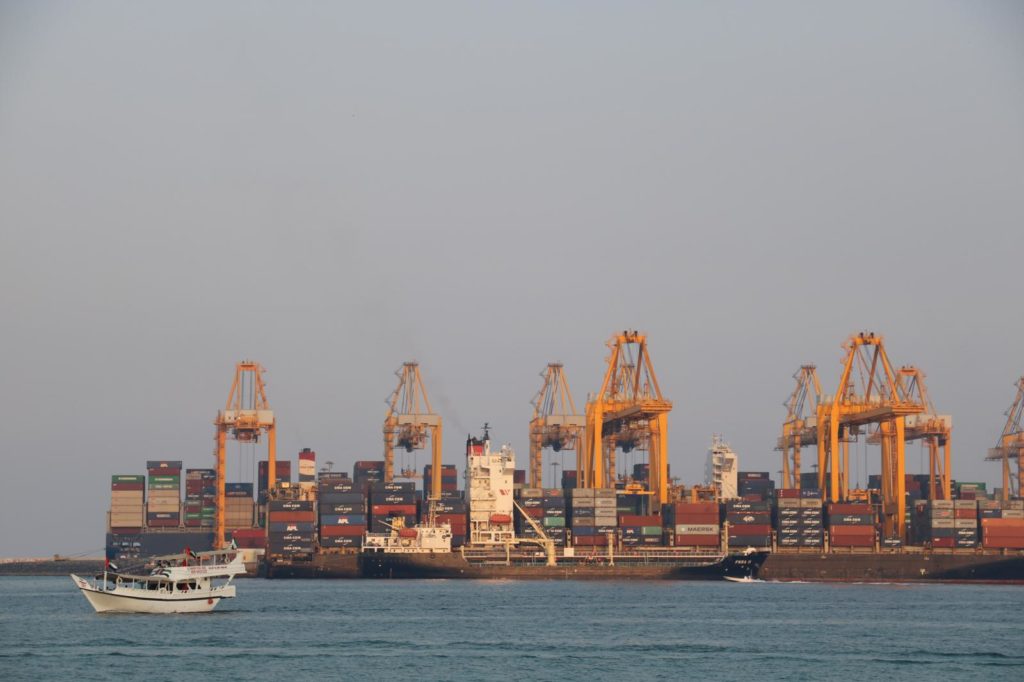
This strategy rests first and foremost on a world-class network of ports. The ports of Jebel Ali and Fujairah are not mere national infrastructure; they are part of a global supply chain linking Asia, Africa, Europe and the Middle East. The Emirates realised very early on that a port is not simply a place of transit. It becomes an industrial, financial and digital platform around which free zones, distribution centres, processing activities and high value-added services develop.
This vision finds its natural extension in the international expansion of DP World. The company is far more than a port operator. It is one of the main instruments of the Emirates’ economic reach. The acquisition in 2006 of the British operator P&O Ports marked a major turning point. It propelled DP World into the ranks of the world’s leading port operators and illustrated Abu Dhabi’s ambition no longer to content itself with developing its own infrastructure, but to take a direct part in organising the major international supply chains.
By investing in dozens of ports, terminals and logistics hubs across several continents, the company helps to secure international supply chains while strengthening Abu Dhabi’s economic influence. The Emirates do not seek to exercise territorial sovereignty over this infrastructure; they want to become indispensable partners in its operation.
The same logic underpins the development of air transport. With Emirates and Etihad Airways, the Emirates have turned their geographical position into a vast hub linking Europe, Asia, Africa and Oceania. Here too, the aim extends far beyond aviation. The national carriers are part of an overarching strategy to channel travellers, goods, investment and skills through the Emirates.
The sovereign wealth funds follow the same dynamic. Their investments in infrastructure, new technologies, energy, property, healthcare and industry serve a dual purpose. They diversify revenue for the post-oil era while creating economic interdependencies that strengthen the Emirates’ international standing.
This control of flows is no longer confined to physical infrastructure alone. The Emirates are investing heavily in data centres, telecommunications cables, artificial intelligence, financial technology and cybersecurity. Data, digital transactions and information networks are in turn becoming strategic flows that must be protected and controlled.
In just a few decades, the United Arab Emirates have thus profoundly reshaped their conception of power. They do not seek to dominate globalisation; they strive to become one of its main crossing points. This strategy enables them to turn their geographical position into a lasting comparative advantage and to extend their influence far beyond their demographic or military weight.
Control of flows is therefore far more than an economic policy. It is becoming the very foundation of the strategic autonomy Abu Dhabi is seeking. The more international trade passes through Emirati infrastructure, companies and technologies, the more closely the country’s prosperity is tied to that of its partners, thereby reducing its own vulnerability to regional crises.
Securing the flows
Control of global flows would make little sense if the United Arab Emirates were unable to guarantee their security. Ports, airports, oil terminals, pipelines, undersea cables, data centres and financial centres are all critical infrastructure on which the country’s prosperity depends. For Abu Dhabi, protecting these assets has become a strategic imperative.
This approach reflects a profound shift in the notion of national security. For a long time, defence consisted mainly of protecting territory against external aggression. The Emirates have gradually broadened this conception. It is no longer simply a matter of defending borders, but of securing all the flows that sustain the national economy. The security of infrastructure has thus become inseparable from economic security.
This requirement explains the considerable investment made in the armed forces over several decades. Despite a relatively small national population, the Emirates now possess one of the most modern military apparatuses in the Middle East. The aim, however, is not to rival the major regional powers in numbers of troops or equipment, but to have technologically advanced capabilities able to intervene rapidly to protect the country’s vital interests.
The same logic has also led the Emirates to develop a navy suited to their strategic environment. Though modest in size, it is highly modern and specialises in maritime surveillance, the protection of energy terminals, the escort of commercial convoys and securing the approaches to the Strait of Hormuz. Its role is not to seek regional naval dominance, but to ensure the continuity of the trade on which the national economy depends.
Emirati leaders have also understood that genuine strategic autonomy cannot rest solely on the acquisition of foreign equipment. Buying the most advanced weapons systems is a first step; mastering the technologies needed to design, produce, maintain and upgrade them is a far more ambitious goal.
This thinking has led the Emirates to invest heavily in their defence industrial and technological base. Partnerships with the leading Western manufacturers are no longer aimed solely at acquiring modern equipment, but also at securing technology transfers, developing national expertise and fostering the emergence of an industry capable of innovating in fields such as drones, autonomous systems, artificial intelligence, electronic warfare, space technologies and cybersecurity.
This build-up of the defence industry finds its most fully realised expression in the creation of EDGE Group. Within a few years, the group has become one of the leading defence manufacturers in the Middle East, bringing together under a single structure activities spanning autonomous systems, missiles, electronic warfare, naval technologies, cybersecurity and artificial intelligence. More than a mere industrial conglomerate, EDGE reflects the Emirates’ determination to master the critical technologies on which military superiority will depend in the coming decades. Much like DP World in the field of logistics, EDGE is thus becoming one of the instruments of Emirati strategic autonomy.
This shift extends far beyond the military sphere. The Emirati authorities now regard financial networks, payment systems, port infrastructure, logistics platforms and data centres as strategic infrastructure on a par with oil installations. Cyberattacks can today produce effects comparable to those of a conventional military attack by paralysing trade, communications or financial transactions.
The announcement in July 2026 by the UAE Cyber Security Council that it had thwarted several cyberattacks targeting the financial sector illustrates this shift. Protecting flows is no longer just a matter of ships or goods; it now extends to data, digital transactions and the technological infrastructure that underpins the national economy.
Ultimately, security is the natural extension of the Emirates’ economic strategy. Ports, pipelines, airlines, financial centres, digital networks and critical technologies now form an inseparable whole. Protecting them means not only safeguarding the country’s prosperity but also guaranteeing its freedom of action in a regional environment marked by chronic instability.
Foreign interventions: the test of reality
The strategy devised by the United Arab Emirates could not remain confined within its own borders. If national prosperity depends on the security of the major sea lanes linking the Gulf to the Mediterranean, the country must also be capable of acting when those routes come under threat. It is this logic that explains the foreign interventions Abu Dhabi has conducted since the early 2010s.
Far from reflecting a desire for territorial expansion, these engagements reflect a particular conception of power. The Emirates are not seeking to build a regional empire. Their aim is to maintain a strategic environment conducive to the commercial, energy and financial flows on which their economy depends.
The first testing ground for this doctrine is Yemen. Officially, the military commitment alongside the Saudi-led coalition reflects a desire to restore the internationally recognised government and to contain the expansion of the Iran-backed Houthis. But Abu Dhabi’s priorities very quickly prove to be different from those of Riyadh.
While Saudi Arabia concentrates its efforts on restoring the authority of the central government, the Emirates focus on controlling the south of the country, the ports of Aden and Mocha, and the coastline along the Gulf of Aden and the Bab el-Mandeb Strait. Their support for the Southern Transitional Council is part of this approach. For Abu Dhabi, the security of shipping lanes takes precedence over rebuilding a unified Yemeni state.
Emirati forces achieve several tactical successes. They help to retake Aden, take part in securing part of the coastline and display a high level of professionalism. Yet these military victories fail to deliver the hoped-for strategic outcome. The Houthis hold on to their main strongholds, the conflict becomes bogged down and the differences with Riyadh come out into the open. From 2019, the Emirates scale back their direct military presence while retaining local partners capable of defending their interests.
The picture is similar in Libya. By backing Field Marshal Khalifa Haftar, Abu Dhabi hopes to foster the emergence of a stable partner, hostile to Islamist movements and likely to strengthen its influence on the southern shore of the Mediterranean. But the Libyan civil war soon spills beyond national borders. Turkey’s intervention in support of the government in Tripoli profoundly alters the military balance and thwarts Haftar’s offensive.
Libya thus reveals another dimension of the Emirati strategy. Behind the domestic conflict lies a far broader regional rivalry between Abu Dhabi and Ankara. The two powers champion different visions of the Middle East and back opposing partners in several regional crises.
This competition is also playing out in the Horn of Africa, particularly in Somalia. Here too, the approaches diverge sharply. Turkey is concentrating its efforts on the federal government in Mogadishu, investing in the training of the Somali army and strengthening its diplomatic and economic presence. The Emirates favour a different strategy. They are expanding their port investments, strengthening their relations with Somaliland and Puntland and, above all, seeking to secure infrastructure located on the main shipping routes linking the Indian Ocean to the Red Sea.
This difference in approach is telling. Ankara invests primarily in state-building. Abu Dhabi invests first and foremost in infrastructure, logistics corridors and supply chains. Two conceptions of power are thus pitted against each other on either side of the Red Sea.
In hindsight, these foreign interventions appear to be a strategic laboratory. They demonstrate the operational capabilities of the Emirati forces, but they also highlight the limits of military power when it comes up against regional rivalries, local dynamics and the involvement of other international actors. Tactical successes are not always enough to deliver lasting political results.
This lesson would profoundly shape the strategic thinking of the Emirati leadership. Without giving up on defending their interests, they would gradually come to understand that control over infrastructure, technology, investment and economic partnerships can sometimes produce more lasting effects than the use of force.
The Qatar crisis: the limits of coercion
The interventions in Yemen, Libya and the Horn of Africa are not the only experiences that led the Emirates to rethink their strategy. The crisis with Qatar that erupted in June 2017 was, in many respects, another defining moment. Alongside Saudi Arabia, Bahrain and Egypt, the United Arab Emirates decided to sever diplomatic relations with Doha and to impose a land, sea and air embargo on the small emirate. Officially, the decision was based on accusations that Qatar supported Islamist movements, was close to the Muslim Brotherhood, had ties with Iran deemed too close and pursued a foreign policy regarded as destabilising for the Gulf monarchies.
Beyond these grievances, the crisis above all exposed a deep divergence between two visions of the regional order. The Emirates sought to build an environment founded on the stability of states, the fight against Islamist movements and close cooperation among the Gulf monarchies. Qatar, for its part, asserted a far more independent diplomacy, based on mediation, maintaining relations with a wide range of actors and an openly acknowledged closeness to several movements rooted in political Islam.
The crisis quickly takes on a broader geopolitical dimension. Turkey provides immediate support to Qatar, strengthens its military presence in the emirate and organises airlifts to limit the effects of the blockade. Iran also opens its airspace and facilitates supplies. The initial aim of isolating Doha thus produces the opposite of the intended effect: Qatar accelerates the diversification of its supplies, develops its domestic production, strengthens its ties with Ankara and deepens certain forms of cooperation with Tehran.
For the Emirates, this crisis proves a highly instructive experience. As in Yemen and Libya, instruments of coercion yield limited results against actors able to adapt their strategy rapidly. Military or diplomatic leverage is not always enough to bring about a lasting change in an adversary’s behaviour when that adversary manages to forge new partnerships and reduce its own vulnerabilities.
The reconciliation begun in 2021 marks not so much a retreat as an evolution in Emirati strategic thinking. Without abandoning their fundamental objectives, the leaders in Abu Dhabi appear to be gradually favouring more lasting instruments of influence: investment, economic partnerships, technological cooperation, pragmatic diplomacy and a growing web of interdependencies. This approach does not replace military power, but it redefines its role. Coercion ceases to be the preferred instrument of regional action; it becomes one element of a far broader strategy.
In hindsight, the Qatar crisis thus appears to be far more than a dispute between Gulf monarchies. It marks a turning point in the evolution of the United Arab Emirates’ foreign policy. It confirms that, in a deeply interdependent regional environment, creating mutual dependencies and controlling major flows often yields more influence than political or economic pressure alone.
The strategic shift: from coercion to influence
The experience gained in Yemen, Libya and Somalia, and during the Qatar crisis, has left a deep mark on the strategic thinking of the Emirati leadership. It has not called their ambitions into question, but it has led them to reconsider which instruments are most effective for defending national interests in an increasingly complex regional environment.
Over the years, Abu Dhabi appears to have reached a fundamental conclusion: military and diplomatic successes do not always deliver the hoped-for political results. A tactical victory may prove insufficient if it is not accompanied by a lasting transformation of the strategic environment. Conversely, infrastructure, investment, industrial partnerships and economic interdependence often exert a deeper and more stable influence.
This shift explains the rapprochement with several actors with whom relations had previously been highly strained. The reconciliation with Qatar, the gradual normalisation of relations with Turkey and the resumption of dialogue with Iran do not signal that the Emirates have abandoned their fundamental interests. On the contrary, they reflect a more pragmatic approach to power, based on reducing risk rather than systematically seeking to assert dominance.
This shift in no way means that the Emirates are giving up their military capabilities. They continue to invest in their armed forces, their defence industry and critical technologies. These assets, however, now form part of a broader strategy in which economic power, diplomacy, technological innovation and control over flows play an increasingly important role.
The growth of DP World, the rise of EDGE Group, the expansion of sovereign wealth funds and investment in artificial intelligence, space technologies and cybersecurity all stem from the same logic. The Emirates are seeking not so much to impose their will through coercion as to become an indispensable partner in the major global economic and technological balances.
This strategy also rests on an increasingly firm conviction: in an interdependent world, creating shared interests is often a more solid guarantee of security than the mere accumulation of military resources. The more essential Emirati infrastructure becomes to the functioning of international trade, the more its stability becomes an interest shared by a growing number of states and economic actors.
The announcement in July 2026 that the Emirati authorities had succeeded in thwarting several cyberattacks targeting the financial sector illustrates this new reality. Strategic infrastructure is no longer limited to ports, pipelines or straits. It now encompasses digital networks, financial systems, data centres and the technologies that ensure the continuity of global trade. Protecting these assets has now become an essential component of the strategic autonomy sought by Abu Dhabi.
At the end of this journey, the United Arab Emirates stands out as one of the most accomplished examples of strategic transformation by a medium-sized state. Without abandoning its traditional alliances or its military capabilities, it has gradually shifted the centre of gravity of its power towards infrastructure, technology, investment and the great flows of globalisation.
The true originality of the Emirati model undoubtedly lies in this ability to turn every vulnerability into an opportunity. Dependence on oil, on the Strait of Hormuz, on foreign technology or on external security guarantees: each of these constraints has given rise to a policy designed to reduce it.
The Emirates did not build their power by seeking to dominate their neighbours. They built it by methodically reducing each of their dependencies. In a world where infrastructure, technology and flows now shape the international balance of power as much as territory does, this quest for strategic autonomy is undoubtedly their main comparative advantage and one of the keys to their growing influence.
In little more than half a century, the United Arab Emirates has undergone a remarkable transformation. Born into an environment marked by deep geographical, demographic and security weaknesses, the federation has gradually become one of the most influential players in the Middle East. This rise cannot be explained by oil wealth alone, nor by a policy of territorial expansion. It is the result of a long-term strategy aimed at methodically reducing the vulnerabilities likely to limit the country’s freedom of action.
A study of Emirati policy reveals a constant: every dependency identified has given rise to a specific strategic response. Dependence on hydrocarbons led to economic diversification unmatched in the region. The vulnerability of the Strait of Hormuz spurred the development of Fujairah and of infrastructure designed to limit the risks associated with this chokepoint. Dependence on foreign technology accelerated the building of a national defence industry and investment in the most innovative sectors. The fragility of supply chains led to the creation of a global network of port infrastructure and logistics hubs. Finally, the proliferation of cyber threats has made the protection of digital and financial networks an essential component of national security.
The experiences of Yemen, Libya, Somalia and the Qatar crisis also played a decisive role. They demonstrated that military power, however effective, is not always enough to bring about lasting change in a strategic environment. The Emirates have not abandoned their ambitions; they have gradually broadened the instruments of their influence, giving growing prominence to geoeconomics, technology, investment, industrial partnerships and pragmatic diplomacy.
This shift extends well beyond the regional context. It reflects a deeper transformation of international power. In a world where critical infrastructure, supply chains, digital data, artificial intelligence and disruptive technologies are becoming as decisive as territory or natural resources, states are being led to rethink their strategies for security and influence.
The United Arab Emirates offers a particularly instructive textbook case in this respect. A middle power in terms of population, it has become a global power through its ability to organise networks, secure flows and create economic and technological interdependencies. Its influence rests not on dominating vast expanses of territory, but on its ability to make itself indispensable to the workings of globalisation.
The main lesson of this trajectory therefore reaches well beyond the Emirati case alone. Power in the 21st century is no longer measured solely by the size of a territory, the strength of an army or the abundance of natural resources. It lies increasingly in a state’s ability to protect its critical infrastructure, master essential technologies, secure the major international flows and gradually reduce each of its dependencies.
The United Arab Emirates grasped this transformation very early on. Where others sought to increase their power by extending their sphere of territorial influence, the Emirates chose a different path: building their strategic autonomy by turning every vulnerability into an opportunity to grow stronger. It is doubtless this capacity for constant adaptation that explains the singular nature of their trajectory today and the place they now occupy in the broader international balance of power.
Further reading on La Tribune des Nations
• Nuclear programme, Hormuz: Tehran and Washington do not speak the same language — Jean-René Belliard, 24 June 2026.
• Oman: neutrality as a power strategy shaped by history and Ibadism — Jean-René Belliard, 29 June 2026.
• Yemen: a war on many fronts in which the Houthis remain the main beneficiaries — Jean-René Belliard, 24 June 2026.
• China in the Middle East: the long march towards influence — Jean-René Belliard, 23 June 2026.
• A Trumpian attack on Oman under Emirati influence — Jean-René Belliard, 30 May 2026.
. https://ltdn.org/nucleaire-ormuz-teheran-et-washington-ne-parlent-pas-la-meme-langue/
• https://ltdn.org/la-chine-au-moyen-orient-la-longue-marche-vers-linfluence/
• https://ltdn.org/une-attaque-trumpien-doman-sous-influence-emiratie/
Useful external references
• DP World – official portal — Global logistics and port network.
• DP World – Jebel Ali Port — Dubai’s hub port and a major piece of supply-chain infrastructure.
• Port of Fujairah – Oil & bunkering — Fujairah’s position in bunkering and oil storage.
• EDGE Group – official website — Defence industry, autonomous technologies and critical solutions.
• ADNOC – Investment, AI and freedom of navigation through the Strait of Hormuz — Infrastructure, AI and freedom of navigation in the Strait of Hormuz.
• Anadolu – UAE thwarts sophisticated cyberattacks targeting financial sector — Verification source on the cyberattacks of July 2026.
• https://www.dpworld.com/en/ports-terminals/uae/jebel-ali-port
• https://fujairahport.ae/business-activities/oil/
Translated from French. The French original prevails.