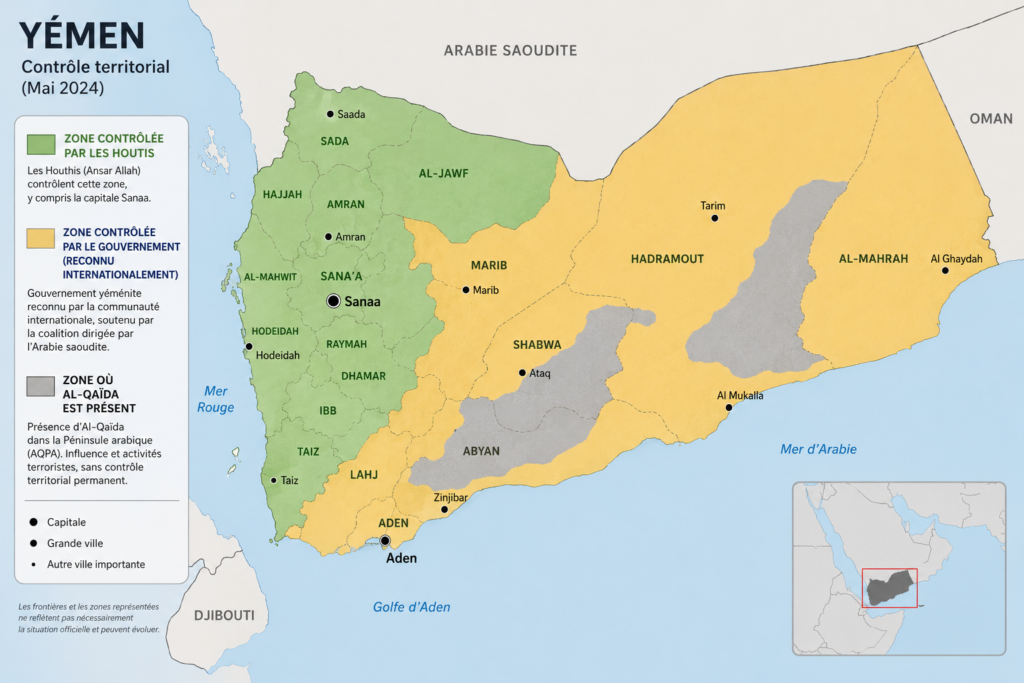
Ten years of conflict with no victor! More than ten years after the civil war began, Yemen remains one of the most complex conflicts in the Middle East. Often portrayed as a clash between the Iranian-backed Shia Houthi rebels and a Saudi-led coalition, the conflict in reality involves a multitude of local, regional and international actors whose interests sometimes diverge profoundly.
Despite the military campaigns launched since 2015, the Houthis have succeeded in consolidating their control over the capital, Sanaa, and much of the north of the country. Their resilience has surprised many observers. Benefiting from deep roots in the mountainous regions of the north, a structured political and military apparatus and a strong capacity for mobilisation, the movement has gradually become an unavoidable player on the Yemeni scene.
Why the coalition did not win the war
When Saudi Arabia intervened militarily, its stated aim was to restore the internationally recognised government and to prevent the emergence on its southern border of an armed movement seen as close to Iran. However, despite overwhelming technological superiority and a large-scale air campaign, the coalition never managed to secure a decisive victory.
The difficulties faced by the anti-Houthi forces stem in part from the very nature of the coalition. It brought together Saudi forces, Yemeni government units, local armed groups, forces backed by the United Arab Emirates and various foreign fighters recruited by certain regional partners. This diversity often complicated military and political coordination on the ground.
The Houthis, by contrast, have enjoyed the classic advantages of insurgent movements: knowledge of the mountainous terrain, local tribal networks, strong ideological cohesion and the ability to wage a war of attrition against a technologically superior adversary.
Attacks on Saudi Arabia changed the game
Over the years, the Houthis have demonstrated their ability to strike beyond Yemen’s borders. Missile and drone attacks on Saudi airports, energy facilities and strategic infrastructure have profoundly altered Riyadh’s calculations.
These operations showed that air superiority was not enough to guarantee the kingdom’s security. Faced with a costly conflict with no clear prospect of victory, Saudi Arabia gradually shifted its strategy towards de-escalation and securing its southern border.
Riyadh now puts stability first
This shift is also bound up with the kingdom’s economic ambitions. The “Vision 2030” programme championed by Crown Prince Mohammed bin Salman depends on regional stability and on attracting foreign investment. From that standpoint, seeking a compromise now looks more advantageous than a prolonged war. Before the Israel-United States-Iran war, the diplomatic rapprochement between Riyadh and Tehran helped to ease regional tensions. Although the two powers remain at odds on several issues, the opening of channels of dialogue has reduced the risk of a direct confrontation over Yemen.
Iran caught between strategic repositioning and regional uncertainty
Several officials in the Gulf states still regard the Houthis as an extension of Iranian influence in the region. From that standpoint, any economic or diplomatic strengthening of Tehran could increase its capacity for influence in the Middle East. The question is all the more sensitive because it forms part of a broader framework of negotiations between Iran and the United States, covering in particular Iran’s nuclear programme, economic sanctions and regional security.
The Houthis are not directly involved in these talks, but their role is regularly raised indirectly. Washington often includes Iran’s regional activities, including its alleged support for certain armed groups, in its overall approach to dialogue with Tehran. For its part, Iran does not officially acknowledge any direct control over the Houthis and insists on their autonomy. In practice, the Houthis therefore remain a peripheral issue in the negotiations: they are not at the table, but their situation helps to shape the general climate of relations between the two countries.
The Houthis: Iran’s allies, but not mere proxies
The relationship between the Houthis and Iran is one of the most debated aspects of the Yemeni conflict. For several years, Western powers and the Gulf monarchies have accused Tehran of providing the movement with political, financial and military support. The Houthis, for their part, acknowledge their ideological affinity with the Islamic Republic while asserting their independence in decision-making.
Recent tensions between Iran, Israel and the United States have highlighted this ambiguity. Despite belonging to what Tehran calls the “axis of resistance”, the Houthis have refrained from becoming fully involved in the direct confrontations pitting their allies against Washington or the Jewish state.
This restraint may seem surprising given their particularly hostile rhetoric towards Israel and the United States. Yet it is largely explained by the way the movement has evolved over the past decade.
Originally, the Houthis were above all a local insurgency rooted in northern Yemen. Ten years of war have transformed them into a genuine political and military authority that administers territory, collects revenue, controls institutions and governs several million people. This transformation has gradually changed their priorities.
Today, their main objective is no longer simply to resist their regional adversaries. It is also to preserve the gains made on the ground and to consolidate their hold over the territories they control. An open regional war would risk jeopardising those gains by triggering a large-scale military intervention against their infrastructure, their command centres and their military capabilities.
Houthi leaders have also taken note of the shift in the Saudi position. After years of conflict, Riyadh appears to have abandoned the goal of total military victory in favour of a more pragmatic approach based on de-escalation and securing its southern border. For the Houthis, preserving this momentum is a major strategic interest. Becoming too deeply involved in a regional confrontation could jeopardise the ongoing negotiations and push Saudi Arabia to adopt a more offensive stance.
The Houthis’ caution can also be explained by the military balance of power. The campaigns of American and British strikes against their positions have underlined the limits of their capabilities in the face of powers with overwhelming technological superiority. Although the movement has demonstrated its ability to withstand attacks and rebuild, its leaders know that a direct confrontation with the United States could cause considerable destruction with no obvious political gain.
This stance does not, however, signal any distancing from Iran. The Houthis continue to display their solidarity with Tehran and with the other members of the regional axis backed by the Islamic Republic. They have issued a stream of statements of support, staged shows of force and carried out a number of limited military operations intended to demonstrate their commitment, generally calibrated so as to avoid an uncontrollable escalation.
This strategy reflects the emergence of a new reality: the Houthis are no longer merely a movement allied with Iran. They have become a regional actor defending its own interests, with its own constraints and its own political objectives. Their behaviour now reflects the imperatives of Yemeni politics as much as the geopolitical logic of the axis to which they belong.
For many observers, this shift is one of the main lessons of the war. While the Houthis remain closely tied to Iran, they can no longer be analysed as a mere proxy for Iranian strategy. Their priority remains, above all, preserving their hold on power in Yemen and consolidating their status as an indispensable actor in any future settlement of the conflict.
Oman, the discreet but influential neighbour
Often absent from media analysis, Oman nonetheless plays a singular role in the Yemeni conflict. Unlike its Gulf neighbours, the sultanate chose not to take part in the Saudi-led military coalition and has maintained a position of relative neutrality. This stance has allowed it to keep channels of communication open with all the actors, including the Houthis. Muscat has thus become a favoured intermediary in several mediation attempts, notably facilitating indirect exchanges between the rebels, Riyadh and certain international actors.
The border between Oman and Yemen, particularly in the Mahra region, is also a strategic space. Less militarised than other border areas, it has served as a crossing point for commercial, humanitarian and sometimes political flows. This situation has strengthened Oman’s role as a stabilising actor, but also as a close observer of local dynamics.
The sultanate’s overriding aim is to avoid any destabilisation of its own internal security. A widening of the conflict or the growing strength of uncontrolled armed groups near its borders would pose a direct risk to its stability. Against this backdrop, Oman favours a pragmatic approach based on mediation, diplomatic discretion and the maintenance of balanced relations with the various parties. Although it lacks the military or financial clout of its neighbours, it has nonetheless established itself as a key player in any attempt at a political settlement of the conflict.
A conflict that is about more than the Houthis
Reducing the war to a rivalry between Saudi Arabia, Iran and the Houthis would, however, be an oversimplification. In the south of the country, the separatist movements grouped around the Southern Transitional Council continue to champion greater autonomy, or even the restoration of the former South Yemeni state. This demand considerably complicates any prospect of a national political settlement.
On top of these rivalries come the many tribal dynamics that still largely shape Yemeni society. In several regions, local alliances play just as important a role as ideologies or political affiliations.
The persistent threat of Al-Qaeda
The chaos wrought by the war has also enabled jihadist organisations to maintain a presence in the country. Al-Qaeda in the Arabian Peninsula (AQAP), long regarded as one of the most dangerous branches of the Al-Qaeda network, continues to exploit the weaknesses of the Yemeni state.
The Houthis and AQAP have clashed on several occasions during the conflict. This reality is a reminder that the war in Yemen is not limited to a confrontation between two camps, but involves a multitude of actors pursuing sometimes contradictory objectives.
Bab el-Mandeb: a global stake
What is at stake in the conflict extends far beyond Yemen’s borders. The Bab el-Mandeb Strait, located between the Red Sea and the Gulf of Aden, is one of the world’s main maritime trade routes. A significant share of trade between Asia, Europe and the Middle East passes through this strategic corridor.
The attacks on commercial shipping seen in recent years have shown that instability in Yemen can have repercussions well beyond the Arabian Peninsula. Ports, energy resources and sea lanes thus remain at the heart of the concerns of regional and international powers.
A forgotten humanitarian catastrophe
Behind the geopolitical calculations, Yemen continues to face a major humanitarian crisis. Millions of people have been displaced, infrastructure has been largely destroyed and the country’s economy remains deeply weakened. For a large part of the population, the priority is no longer the victory of one side over another, but an end to a war that has turned the country into one of the main hotbeds of instability in the Arab world.
Towards an inevitable compromise?
A decade after hostilities began, one conclusion is inescapable: no lasting solution can be imposed by force alone. The Houthis, the internationally recognised authorities, southern actors, the tribes, regional powers and the various components of Yemeni society will all have to find their place in a future political settlement. Whether they are regarded as a resistance movement, a revolutionary force or a security threat, the Houthis have today become an unavoidable player in Yemen. Any lasting solution will necessarily have to take this reality into account.
Translated from French. The French original prevails.