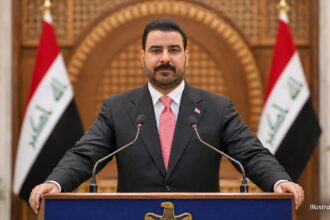
At a time when the multilateral system is going through one of the deepest crises in its history, conflicts are multiplying and artificial intelligence is upending the geopolitical balance, the Observatoire géostratégique de Genève intends to adapt its thinking to a changing world. Its president, Nicolas de Ziegler, discusses the challenges facing the United Nations, Geneva’s place in the new world order and the strategic issues surrounding artificial intelligence.
The Observatoire géostratégique de Genève was set up four years ago. What was its original ambition and how has it evolved?
The founding idea was simple: to move beyond an exclusively Western reading of international relations. All too often, geopolitical analysis is produced in Europe or North America and tends to view the world through its own interpretative frameworks.
We wanted, on the contrary, to develop an approach open to the perceptions of the Global South and to African, Asian, Middle Eastern and Latin American sensibilities. Understanding the world requires accepting that others do not necessarily think as we do.
I am happy to borrow a phrase dear to me, inspired by the work of the former French diplomat Maurice Gourdault-Montagne: “They do not think like us.” Yet this obvious truth is often forgotten.
Take the war in Ukraine. For Europeans, it is an existential conflict that calls into question the continent’s security architecture. But if you ask people in Sudan, the Middle East or parts of Africa, you find that their perception is different. Many see it as yet another illustration of the double standards applied by the major Western powers.
Indeed, the multilateral system is today under heavy criticism. The United Nations sometimes appears sidelined by power politics. How do you view this development?
I would happily paraphrase Churchill on democracy: the United Nations is probably the worst system, except for all the others.
It is easy today to point out the UN’s limitations. Yet imagine for a moment a world without the United Nations, without mediation mechanisms, without multilateral forums, without specialised agencies. It would be an even more unstable world.
The criticism is sometimes justified, but it must not obscure a fundamental reality: when a major crisis breaks out, states still turn to the United Nations. Even agreements negotiated outside its framework often end up seeking some form of international legitimacy, notably through the Security Council.
So I do not believe the multilateral system will disappear. It must, however, undergo a profound transformation.
Has reform of the Security Council, called for over decades, become unavoidable?
It has become inevitable.
The Security Council still largely reflects the balance of power that emerged in 1945. Yet the world of 2026 bears little resemblance to that of the post-war era.
It is hard to conceive that major demographic, economic or regional powers such as India, Brazil, Indonesia, Nigeria or South Africa should remain excluded from global governance. The Global South is now calling for representation that better reflects contemporary realities.
This change will naturally have to be carried out with caution and realism. But it would be dangerous to believe that the legitimacy of the international system can be preserved in the long term without bringing the major emerging powers further into the fold.
The Geneva Geostrategic Observatory now appears to be giving growing prominence to issues relating to artificial intelligence. Why?
Because artificial intelligence is no longer merely a technological issue. It is becoming a major geopolitical one.
We are already witnessing a fragmentation of the global AI landscape. The recent decisions by the US administration to control the export of certain advanced models clearly show that these technologies are now regarded as strategic assets.
AI is becoming an instrument of power comparable to what nuclear energy or space technologies were in other eras.
But it is also changing our very understanding of power. Recent conflicts demonstrate that conventional military superiority no longer necessarily guarantees strategic success. Control of information, data, autonomous systems and digital infrastructure is becoming just as decisive.
Can Geneva play a central role in the global governance of artificial intelligence?
It undeniably has the assets to do so.
Geneva is already home to a unique ecosystem bringing together international organisations, specialised agencies, diplomats, researchers, NGOs and private-sector players. Few places in the world have such a concentration of institutions.
But this position cannot be taken for granted. To remain relevant, Geneva will have to adapt to the new realities of the 21st century.
I like to quote a famous line from Giuseppe Tomasi di Lampedusa’s The Leopard on this: “Everything must change so that nothing changes.”
If Geneva is able to transform itself, bring in new technology players and keep pace with the great digital shifts, it can remain a global centre of governance. Otherwise, other hubs will take over.
Does this thinking explain the rapprochement under way between the Geneva Geostrategic Observatory and the Foundation for the Governance of Artificial Intelligence set up by Axel Mazolo?
Absolutely.
Today’s challenges are too complex to be tackled in isolation. Think tanks, foundations, universities, NGOs and international organisations need to work far more as a network.
This rapprochement is driven by the aim of pooling expertise and broadening analytical capacity. The issues raised by artificial intelligence concern global governance as much as international security, fundamental rights, the economy and the fight against disinformation.
We are also facing a fundamental question: that of free access to information. At a time marked by the rise of authoritarian regimes and digital control practices, this question is becoming central to the future of democratic societies.
Despite the crises international institutions are going through today, are you still optimistic about the future of International Geneva?
Yes, more so than a few years ago.
I was fairly pessimistic four or five years ago. I thought Geneva was at risk of gradually losing its influence in a world dominated by power politics.
Today, paradoxically, the successive crises have made me more optimistic, because they show just how much we need spaces for dialogue, mediation and cooperation.
International Geneva will admittedly have to reinvent itself. It will have to welcome more players from civil society, foundations, academia and the technology sector. NGOs already bring a kind of vitality and innovation that the institutions need.
But the more fragmented the world becomes, the more valuable places capable of bringing together players with divergent interests become.
And that is precisely what Geneva continues to embody.
Translated from French. The French original prevails.