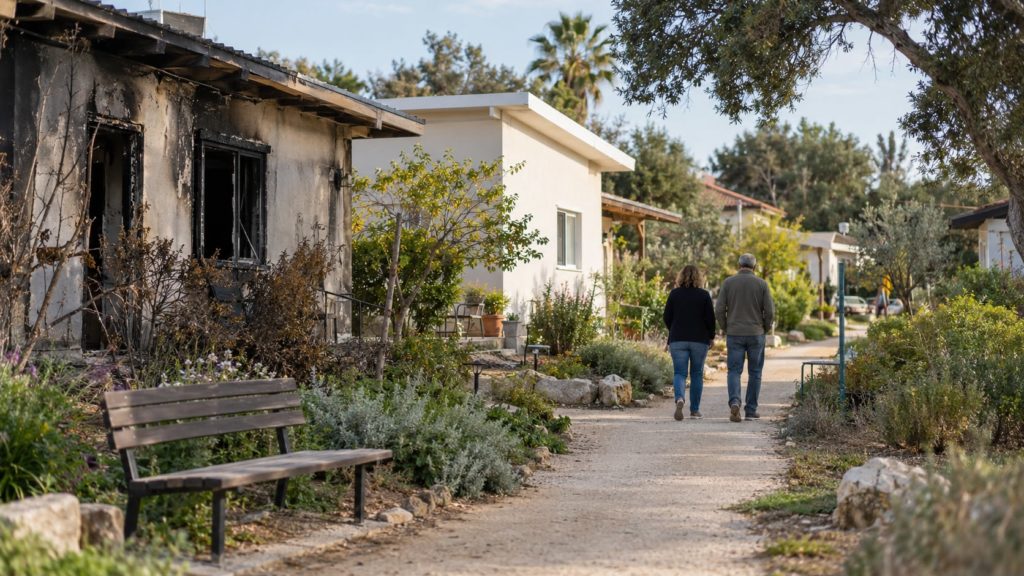
The assault by Hamas and its allies killed around 1,200 people and carried 251 hostages off to Gaza. Three years on, the security failures have been documented, but political accountability is still awaiting an independent inquiry. In the devastated kibbutzim, life is resuming at different paces, with confidence still fragile.
In Kfar Aza, the kindergartens reopened on 1 September. In Nahal Oz, a concert in May marked the revival of the community pub. In Nir Oz, most of the former residents had still not returned by the end of August. These situations capture the measure of the third anniversary of 7 October: communities are starting to live again, while many survivors are still searching for where and how to find a home once more. [1–3]
Their future depends on housing, services and work, but also on whether they can feel safe in the places where that protection abruptly vanished. Reconstruction is thus bound up with the question of accountability. Understanding why the state failed remains a demand of the families and a precondition for restoring trust.
An assault on soldiers and civilians
On 7 October 2023, a coordinated attack strikes southern Israel. The attackers cross the Gaza border and attack bases, communities and the Nova music festival. Hamas’s armed wing, the al-Qassam Brigades, leads the operation. The al-Quds Brigades of Palestinian Islamic Jihad take part, along with other armed groups whose presence Human Rights Watch has identified. [4] The report of the UN commission of inquiry also mentions the participation of some Gaza residents alongside the armed groups. [16]
Civilians are killed in their homes, on the roads or as they flee. Houses are set on fire and families abducted. The toll generally cited by Reuters remains around 1,200 dead, most of them civilians, and 251 people taken to Gaza, among them children, elderly people, foreign nationals and soldiers. The toll of the attack itself must be distinguished from deaths that subsequently occurred in captivity. [5]
In its investigation into the 7 October assault, Human Rights Watch describes the killings of civilians and the hostage-taking as war crimes and crimes against humanity. This documentation makes it possible to set out the nature of the acts without repeating the unverified accounts that circulated after the attack. [4]
Sexual violence calls for the same precision. In March 2024, the UN mission led by Pramila Patten concluded that there were reasonable grounds to believe that sexual violence, including rape, had been committed at several locations. It also gathered clear and convincing information on sexual violence suffered by some of the hostages. The mission called for further investigations. [6]
Security inquiries already carried out
Israel’s failings have been the subject of substantial work. Presented in February 2025, the military inquiry acknowledges the failure to protect civilians. It highlights the underestimation of Hamas’s capabilities and an excessive reliance on intelligence, barriers and defensive means. Commanders had not identified a threat urgent enough to reinforce the border before the assault. [7]
Local inquiries add to this picture. In Be’eri, the army acknowledged that it had failed in its duty to protect the community. Its report also highlights the role played by residents and the civilian defence squad in the first hours. These investigations shed light on specific sequences of events, including the conditions under which forces arrived and were deployed, without in themselves amounting to an inquiry into security policy as a whole. [8]
The Shin Bet, the domestic security service, published its own findings in March 2025. It acknowledges that it failed to provide the necessary warning. The public summary refers in particular to poor use of known invasion plans, insufficiently defined responsibilities between agencies, and signals received during the night of 6 to 7 October that did not lead to any significant action. Part of the findings remains classified. [9]
These reviews concern institutions examining their own decisions. They make it possible to draw operational lessons, but leave untouched the need for a cross-cutting investigation: how did information circulate, what decisions were taken, and how did political choices influence the assessment of the threat?
Political responsibility remains contested
Three years after the attack, an independent state commission of inquiry has still not been set up to examine responsibility in its entirety. Benjamin Netanyahu opposes such a body, whose creation is being demanded by families and by his political opponents. The debate concerns both the facts to be established and the independence of those tasked with examining them. [10]
On 7 July 2026, the Knesset passed at first reading a bill for a so-called “national state” commission. It provides for a parliamentary mechanism for appointing members, based on broad agreement or on a division between the coalition and the opposition. This legislative step amounts neither to the establishment of a commission nor to the publication of findings. [11]
The Israel Democracy Institute criticises this formula and stresses how it differs from a state commission whose members are appointed by the President of the Supreme Court. According to the institute, political appointment and the definition of the mandate risk compromising the independence of the inquiry. The bill’s backers, for their part, present the representation of both camps as a guarantee of trust. [11–12]
The acknowledged failings of the Israeli services in no way diminish the responsibility of the perpetrators of the massacres. The internal inquiry pursues a different aim: to establish why the prevention and rescue arrangements failed, and who was supposed to decide on adapting them.
Life returns unevenly to the kibbutzim
In Kfar Aza, a report published on 26 September found that around 50 families had returned out of some 300 pre-war households. Kindergartens are reopening, but 30 to 40% of families are still hesitating, while 10 to 15% say they will not come back. The leadership hopes that around 70% of residents will return by the end of 2027, depending on the security situation. [1]
Trauma is also shaping reconstruction. The fate of the young people’s neighbourhood, devastated in the attack, divides the community. Some want to preserve the traces; others wish to clear the site in order to rebuild. Bereaved families have gone to court to challenge the plan to move buildings to an outdoor memorial. The place where people live also remains a place of remembrance. [1]
In Nir Oz, the kibbutz chairman, Tzvi Tessler, explained at the end of August that many former residents would not be able to return, even if they wanted to. He linked this difficulty to trauma and voiced concerns about the protection of the border. In his account, the fear of a fresh incursion thus compounds the memory of the attack. [2]
In Be’eri, a report published on 6 October refers to around a hundred people living there again, while many residents remain in Hatzerim or elsewhere. Be’eri’s secretary also describes families in which one member wants to return while another cannot imagine sleeping there; psychologists support them in these decisions. In Nahal Oz, the reopening of the community pub marks another milestone: regaining a place to meet, listen to music and celebrate together. These signs of recovery do not allow the conclusion that the psychological wounds have healed. [3,13]
Trauma requiring long-term follow-up
Research confirms the diversity of trajectories. A study of 392 survivors of the Nova festival found that 54.6% of this sample showed persistently high or worsening symptoms during the first year. Other participants improved or maintained lower levels. This figure describes the people followed, during that period; it does not measure the condition of all survivors three years on. [14]
A longitudinal study published in 2026 follows 680 Israeli adults, both Jewish and Arab, with a measurement taken before the attack. The proportion with probable post-traumatic stress rises from 16.1% before 7 October to 29.8% one month later, then stands at 19.7% after 27 months. Distress therefore declines in this sample, although vulnerabilities persist among those most exposed. [15]
These are screening results, not individual diagnoses. They relate to the attack and the prolonged war that followed. They should be treated neither as a specific assessment of the kibbutzim nor as a clinical snapshot on the third anniversary. The research on Nova notably highlights the association between sleep disorders and unfavourable trajectories, as well as the need for long-term support. [14–15]
Reconstruction must therefore also be judged by the continuity of care and by whether each family is able to choose where to live. Returning may express a deep attachment to the community; staying elsewhere may be necessary to regain a bearable daily life. The start of a school year or a communal evening marks genuine progress, without setting a timetable for recovery.
The third anniversary brings this twofold requirement: establishing responsibility through a credible inquiry and enabling survivors to rebuild their lives. Building work is making homes habitable again. Confidence in the protection of the state will also depend on the answers given about 7 October.
7 October also unleashed a war whose consequences have been catastrophic for the civilian population of Gaza. Israel’s military campaign has devastated the territory; repeated displacement and deprivation have upended the lives of its inhabitants. In early October, the UN was still describing a critical health situation, shortages of medicines and difficulties in accessing drinking water. [17]
Acknowledging this catastrophe, like the suffering of the victims of 7 October, requires establishing the responsibilities specific to each actor. The protection of civilians remains an obligation for all belligerents.
Keywords:
Editorial notes and sources
[1] Ynet, 26 September 2026 — Returns to Kfar Aza and the future of the young people’s neighbourhood
[2] The Jerusalem Post, 28 August, updated 29 August 2026 — Nir Oz and the return of residents
[3] The Times of Israel, 23 May 2026 — Reopening of the Nahal Oz pub
[4] Human Rights Watch, 17 July 2024 — Participating groups and documented crimes
[5] Reuters, 7 October 2026 — Death toll and third anniversary
[6] UN, 4 March 2024 — Report of Pramila Patten’s mission
[7] Reuters, 27 February 2025 — Findings of the military inquiry
[8] Israel Defense Forces — Inquiry into the battle of Be’eri
[9] The Times of Israël, 4 March 2025 — Public summary of the Shin Bet inquiry
[10] The Jerusalem Post, 29 September 2026 — No state commission of inquiry
[11] Knesset, 7 July 2026 — Bill passed at first reading
[12] Israel Democracy Institute, 24 December 2025 — Comparison of inquiry mechanisms
[13] JNS, 6 October 2026 — Reconstruction and residents’ presence in Be’eri
[14] Scientific study, 2026 — Symptom trajectories among 392 Nova survivors
[15] eClinicalMedicine, 2026 — Follow-up of 680 adults over 27 months
[16] UN, 27 May 2024 — Report of the Commission of Inquiry on the attacks and the war
[17] OCHA, report of 2 October 2026 — Humanitarian situation in Gaza
Follow the author on X
LTDN articles worth rereading
Israel adrift in the Great Desert of Solitude — Jean-Noël Cuénod, 6 July 2026 — Political and diplomatic perspective, Opinion section.
Translated from French. The French original prevails.