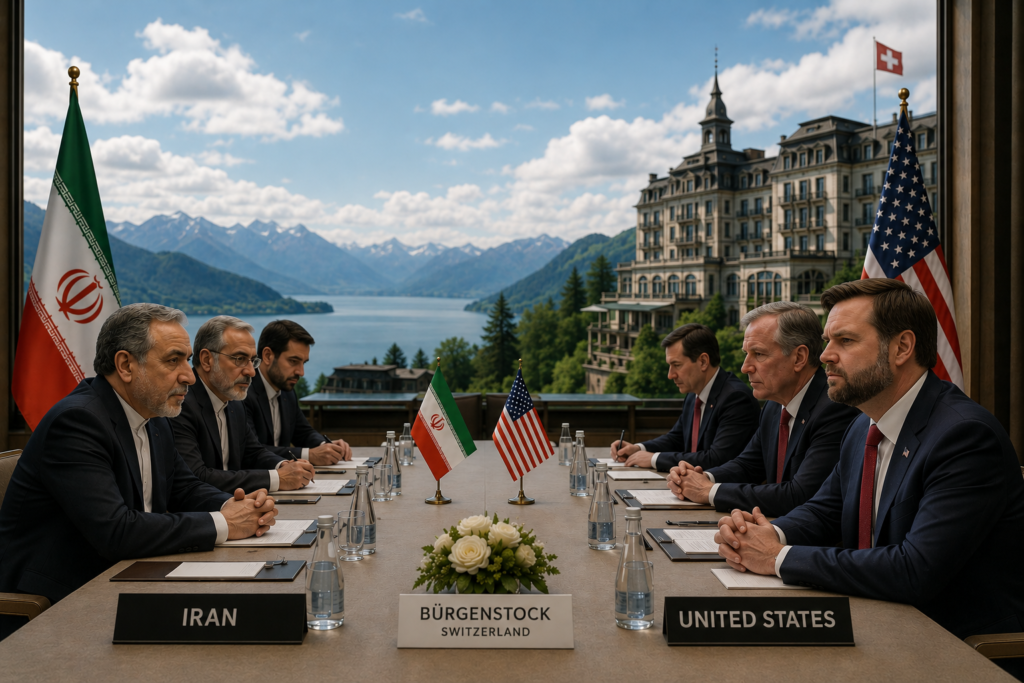
Image created with AI.
Iran reaffirmed on Tuesday its determination to retain a central role in the management of the Strait of Hormuz, as a first round of negotiations with the United States aimed at ending the conflict that has shaken the Middle East for several months drew to a close in Switzerland.
After an eighteen-hour diplomatic marathon at the Bürgenstock, in the Swiss Alps, the delegations led by US Vice-President JD Vance and the Speaker of the Iranian Parliament, Mohammad Bagher Ghalibaf, left on the evening of Monday 21 June, leaving teams of experts to continue the technical discussions.
According to Iran’s foreign ministry, the talks led to the creation of four working groups dealing with the lifting of sanctions, the nuclear issue, Iran’s economic reconstruction and the monitoring of the commitments made by both sides. They had nevertheless got off to a poor start, with the Iranian delegation walking out in protest at fresh threats made by Donald Trump on his Truth Social network.
Negotiations resumed an hour later thanks to the intervention of Qatari, Pakistani and Swiss mediators and to instructions from Mohammad Bagher Ghalibaf, who said that no account should be taken of Trump’s statements. They are now due to continue in the coming weeks, with the aim of drawing up a final document within an initial, renewable period of sixty days.
JD Vance said the discussions had laid “very solid foundations for reaching a successful final agreement”, while Washington promptly announced a temporary suspension of certain sanctions targeting Iranian oil exports.
Trump announces major progress
US President Donald Trump has claimed that Iran has agreed to submit to enhanced international nuclear inspections for an indefinite period. According to him, these inspections will guarantee genuine “nuclear honesty” and are an indispensable condition for continuing the talks. “Without this Iranian commitment, no further negotiations would have taken place,” the US President said.
Donald Trump also announced that he had agreed to keep the Strait of Hormuz open to international shipping and to end the naval blockade imposed during the conflict, following concessions obtained from Tehran. US warships will nevertheless remain stationed in the region so that control measures can be swiftly reinstated should circumstances require, even though Washington now considers such an eventuality unlikely.
POTUS also indicated that the Iranian assets unfrozen and the sanctions relief granted as part of the talks would be placed in escrow under US supervision. According to him, these resources will be used exclusively to purchase food and medical supplies, notably maize, wheat and soya from the United States.
“Iran is facing a humanitarian crisis requiring immediate assistance,” he said, before concluding: “The talks are going well.”
$12 billion unfrozen
Iran has indeed announced that it has secured an agreement providing for the immediate release of $12 billion in assets frozen abroad. According to Iran’s Deputy Foreign Minister Kazem Gharibabadi, the funds will be released in two tranches of $6 billion each. Iran has, however, disputed that the use of these resources will be subject to a monitoring mechanism designed to ensure that they are devoted exclusively to civilian and humanitarian needs.
As for oil, the Islamic Republic’s main economic resource, the US authorities have authorised, until 21 August, all transactions related to the production, sale and transport of Iranian hydrocarbons.
Hormuz at the heart of the negotiations
The Strait of Hormuz remains one of the main issues in the talks. Nearly 20% of the world’s oil usually passes through this waterway, as does a significant share of international trade in liquefied natural gas. Mohammad Bagher Ghalibaf reaffirmed that the situation would not return to what it was before the outbreak of the war.
“The administration of the Strait of Hormuz will never go back to what it was before the war,” he said. “Iran will henceforth administer this strategic passage.”
To that end, the Iranian delegation travelled to Muscat to hold specific consultations with the Sultanate of Oman.
According to Iranian officials, talks on the Strait of Hormuz will initially be held between Iran and Oman before being put to the other parties to the memorandum of understanding currently being drawn up. At the close of their talks, Tehran and Muscat issued a joint statement asserting that “all arrangements relating to the Strait of Hormuz must fully respect the sovereignty and sovereign rights of the two states bordering the strait”.
The two countries also stressed their commitment to freedom of navigation and respect for international law, while reiterating that any future security architecture must take account of their sovereign responsibilities in this strategic area. The conclusions of the bilateral talks are now to be presented to the other participants in the diplomatic process with a view to broader regional coordination.
Mixed messages on nuclear file
The nuclear file remains one of the main sticking points in the negotiations. According to Washington, Tehran has reportedly agreed to the return of inspectors from the International Atomic Energy Agency (IAEA), whose activities had been suspended after the Israeli-US strikes on several Iranian nuclear facilities in 2025.
Since the bombing, inspectors have had no access to the main sites concerned, fuelling questions about the state of the country’s stockpiles of highly enriched uranium. But Tehran firmly denies this account. The Iranian Foreign Ministry spokesman, Esmaeil Baghaei, said that Iran had no intention of allowing IAEA inspectors access to the nuclear facilities damaged by the strikes, adding that no meeting had taken place with the agency’s Director General and that no protocol existed for the inspection of these sites.
While rejecting any inspection of the facilities that were hit, Iran nevertheless says it will continue to honour its obligations under the Treaty on the Non-Proliferation of Nuclear Weapons (NPT) and its safeguards agreements, and maintains that its nuclear programme pursues exclusively civilian aims.
Lebanon, the first test for the agreement
The talks also covered Lebanon, at Tehran’s request.
The parties agreed to set up a conflict management unit intended to consolidate the ceasefire between Israel and Hezbollah. The Lebanese President, Joseph Aoun, said he had received a call from the US Vice-President, JD Vance, devoted to efforts to stabilise the security situation in Lebanon and to prevent any resumption of hostilities. For the Iranian Foreign Minister, Abbas Araghchi, compliance with this ceasefire will be “the first real test” of the strength of the memorandum of understanding currently being negotiated between Washington and Tehran.
Netanyahu says military objectives not yet achieved
As diplomatic talks continue, Israeli Prime Minister Benjamin Netanyahu stressed that his country’s military objectives had not yet been fully achieved. “Israel has struck Iran and its allies in the region, but the operation is not over yet. The battle is not yet won,” he said. The Israeli head of government also insisted that Israel needed to become more self-reliant in matters of defence.
“We appreciate American support, but Israel must free itself from this dependence,” he said, calling for the development of a national arms industry capable of independently producing the main military systems needed for the country’s security. These statements illustrate the persistent differences between the various regional players, despite the progress made in the negotiations.
A still fragile de-escalation
Despite the many obstacles that remain, the progress made during this first round of talks is fuelling hopes of a lasting settlement of the conflict. The continuation of negotiations on the nuclear issue, the lifting of sanctions, maritime security in the Strait of Hormuz and the stabilisation of Lebanon will be decisive in the coming weeks.
While several American and Iranian officials are now expressing cautious optimism, the uncompromising statements coming from Israel are a reminder that the regional balance remains fragile and that any agreement will still have to overcome major political and security challenges before it can be fully implemented.
Translated from French. The French original prevails.