

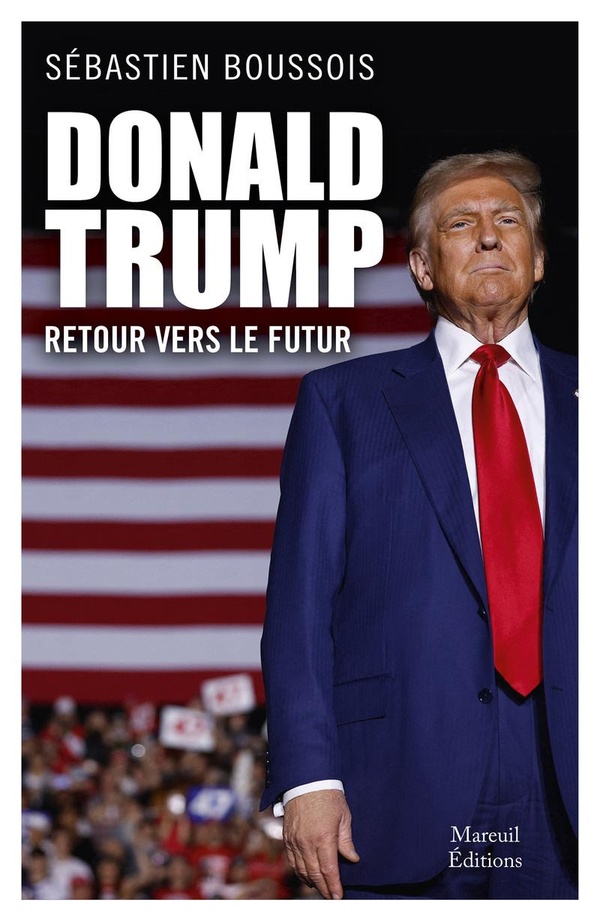
By Sébastien Boussois, political scientist and consultant, based on Donald Trump, retour vers le futur (Mareuil Editions, 2025)
One year after his return to the White House, Donald Trump has profoundly reshaped international balances. In Europe, reactions oscillate between indignation and shock, revealing above all a strategic impotence. Trump is criticized constantly, yet no credible alternative vision is offered, largely because Europe lacks the capacity to reverse the balance of power. Emotion dominates the debate, but it obscures a central reality: the United States has regained the initiative, while Europe remains dependent and hesitant.
The most significant shift of this first year is not merely Trump’s brutal style, but his doctrinal transformation. Elected on an anti-interventionist platform, he has nonetheless shown a willingness to act across multiple theaters, from Venezuela to Iran, via Cuba and even Greenland. This is not a return to American messianism or the export of democracy. Rather, it is an interventionism of security, framed as an extension of the protection of U.S. territory beyond its borders. The overthrow of Nicolás Maduro stands as the most striking example: Washington treated him not as a legitimate head of state, but as the hub of a narcotics network posing a direct threat to the United States.
The transatlantic relationship has changed in nature. It is no longer automatic, but contractual.
In this context, a new strategic grammar has emerged, often described as the “Donroe doctrine.” Trump has revived the logic of the Monroe Doctrine, but in a more coercive and transactional form: reasserting a sphere of influence in the Western Hemisphere and preventing China, Russia, and Iran from entrenching themselves there. Venezuela, Cuba, and even Greenland fit into this framework. Trump acts in the name of national security, even if that means challenging international law and unsettling allies.
Contrary to caricatures, Trump is not a passive president. He governs through administrative shocks, economic pressure, and demonstrations of force. This tempo creates a widening gap with Europe, which struggles to keep pace. He is not installing a dictatorship, but rather a governance of firmness that resonates strongly with his base, particularly on immigration and the fight against drug cartels. The transatlantic relationship has changed in nature. It is no longer automatic, but contractual. Trump will not pay for European security or for Ukraine if Europe fails to assume its responsibilities. He wants useful partners, not dependent ones.
Trump is obsessed with material sovereignty: energy, critical minerals, trade routes, and technology. This explains his moves in Latin America and the Arctic.
Economically, Trump favors tariffs, sanctions, and the weaponization of the dollar over military conflict. His goal is clear: reduce the trade deficit and reindustrialize America. This tough approach remains politically effective, at least for now. Culturally speaking, Trump is waging war against what he sees as progressive ideological dominance in universities and the media. The struggle is as much civilizational as geopolitical. American identity becomes the lens through which all policy, including foreign policy, is viewed.
Above all, Trump is obsessed with material sovereignty: energy, critical minerals, trade routes, and technology. This explains his moves in Latin America and the Arctic. Even the Greenland issue is rooted in the logic of controlling strategic resources and routes. He is also an unapologetic unilateralist. For him, multilateralism is costly and ineffective. The overthrow of Maduro epitomizes this stance: act alone or with a few partners rather than seek a paralyzing international consensus. Trump also speaks to the Global South differently from Europe. Where Brussels moralizes, Washington negotiates deals, investments, and security arrangements. This opens doors that Europeans often fail to enter. Crucially, Trump avoids long wars. He favors targeted, rapid, politically legible operations. This is the essence of his security interventionism: neutralize threats rather than remake societies.
For Europe, the challenge is existential.
After one year, the record is mixed. Trump has strengthened American power and repositioned the U.S. at the center of technological and industrial competition. Yet he has also weakened the multilateral order and distanced some historic allies. The decisive fact remains: America no longer seeks to save the world, it seeks to save itself. In an increasingly harsh and competitive global environment, Trump believes that inaction equals defeat.
For Europe, the challenge is existential. Can it continue to hide behind multilateralism and moral discourse without building real military, energy, and industrial power? If it fails to equip itself with credible means, it will not be an actor but a spectator. Whether one likes him or not, Trump is forcing Europe out of its comfort zone. The question is no longer whether to approve of him, but whether Europe is ready to become truly sovereign. In the world ahead, principles without power will not suffice