Last April, China exported three kilograms of gallium to the rest of the world. The month before, it had exported more than five tonnes. No earthquake at a mine, no strike, no industrial accident. Just a decision, taken in Beijing, to turn off the tap. Almost nobody talked about it. And that bothers me, because this gallium that China is doling out drop by drop, we have it here, at home, in Canada. Beneath our feet. And we are not getting it out of the ground.
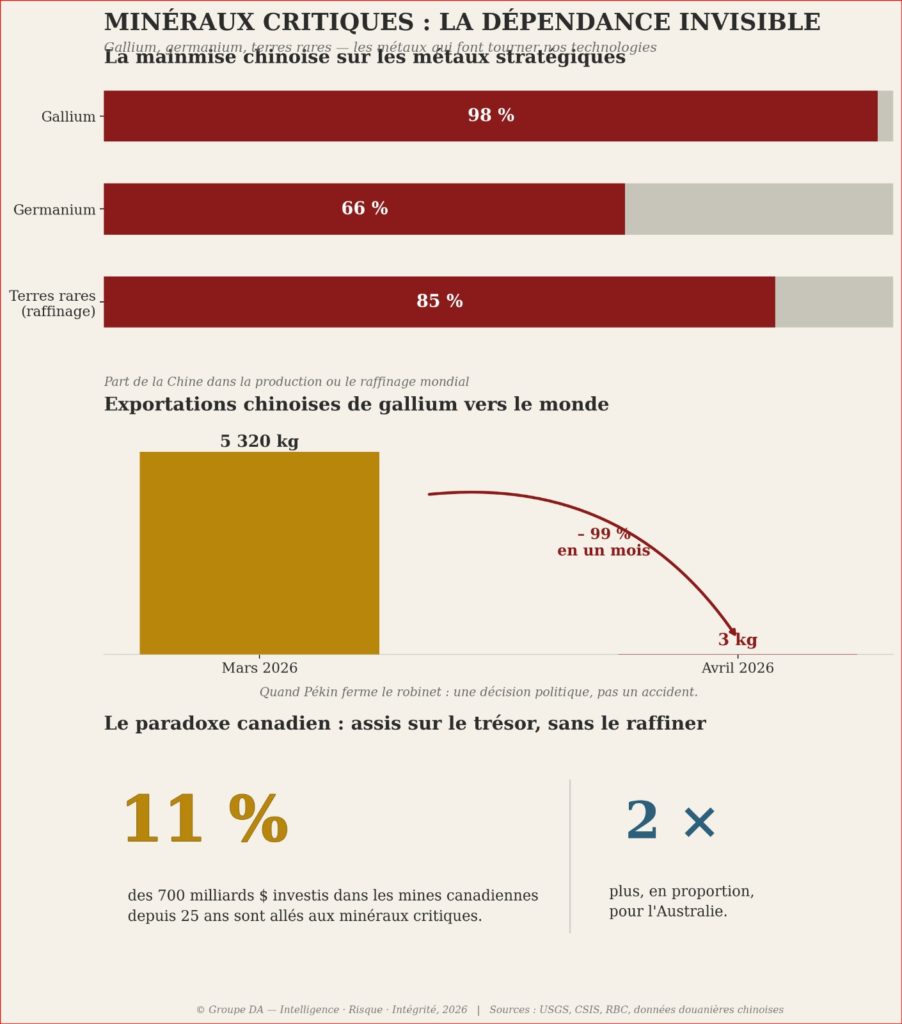
Critical minerals: the invisible dependence. Infographic: Groupe DA, 2026.
Two words you have never uttered in your life
Gallium. Germanium. Hardly the stuff of dreams, I know. Names from the periodic table that we forgot the day after chemistry class. And yet. Without them, your phone cannot pick up 5G. Your electric car does not run. Military radars are blind, as are night-vision cameras, and the fibre optics bringing you these lines simply do not exist. They are the hidden vitamins of all our technology: we need them only in minute quantities, but without them, nothing works.
And China holds a near-monopoly on them. Almost 98% of the world’s gallium. Two thirds of its germanium. In Europe, 94% of the gallium used comes from China. We let it happen for decades, quite simply because it was cheaper to buy Chinese than to refine at home. Today, the bill for that complacency is coming due, and it is a steep one.
A weapon nobody sees coming
Since 2023, Beijing has understood what it holds in its hands. July of that year: the first export controls on gallium and germanium. December 2024: an outright embargo on these metals, plus antimony, to the United States. A month later, in January 2025, it added tungsten, tellurium, bismuth, molybdenum and indium. In April of the same year: seven rare earths and the magnets made from them — precisely those on which Western arms manufacturers depend.
The price of germanium has climbed to nearly six thousand dollars a kilo. Every export now requires a licence, granted order by order, customer by customer. At this stage, it is no longer trade. It is intelligence-gathering disguised as an administrative form.
One figure stopped me in my tracks: in April 2026, Germany and Japan — two industrial giants — each received less than a kilogram of Chinese germanium. One kilo. Other countries no longer even appeared in the customs statistics. In my line of work, we call that a pure show of force. Without a shot being fired, China has just shown that it can bring entire swathes of Western industry to their knees with a mere signature.
And where does Canada stand in all this?
.Canada is not a powerless onlooker in this crisis. It is sitting on a good part of the solution — and it is only just beginning, tentatively, to realise it. Its subsoil is teeming with gallium, germanium, antimony, lithium, graphite, nickel, cobalt and rare earths.
Thirty-one minerals appear on Canada’s official list. The problem has never been whether the ore is there. It is the refining — turning it into pure, usable metal. And that stage we let slip away to China while we contented ourselves, quite comfortably, with digging up and exporting raw rock. Thirty years spent playing the raw-materials supplier while someone else pockets the added value, and the power that comes with it.
A single figure sums up this blindness: of the 700 billion dollars invested in Canadian mines over the past 25 years, barely 11 per cent went to critical minerals. Australia, for its part, put in more than twice as much, proportionally. We preferred gold, a safe and reassuring haven, while the world was shifting elsewhere.
Things are finally starting to move
The good news, and it is very recent: the wake-up call has sounded. Barely a week ago, on 7 July, Ottawa, the Canada Growth Fund and Teck Resources signed an agreement worth up to 850 million dollars to expand production of germanium, gallium and antimony at the Trail smelter in British Columbia, one of the largest polymetallic metallurgical complexes in the world. The agreement could double our germanium and antimony capacity and launch genuine gallium production. A telling detail: Ottawa has reserved a right to purchase part of the future output. We are no longer subsidising into a void. We are securing supply.
In Quebec, meanwhile, Rio Tinto succeeded in May 2025 in extracting its first gallium from its alumina refinery in Jonquière, with a helping hand from the federal and provincial governments. Eventually, the plant could produce up to forty tonnes a year — around five per cent of global output. And the best part is that not a single new mine had to be dug. The process already existed. It was simply a matter of thinking of it, and of wanting to do it.
That, for me, is the real lesson of this story. We do not need to start from scratch. We have the mines, the smelters, the expertise. What we have lacked is the will to refine at home rather than outsourcing to Beijing without giving it much thought. That will is only just beginning to emerge.
What is really at stake
Let us not kid ourselves: this is not merely a question of economics. Whoever controls these metals will, in time, control the industrial, technological and military infrastructure of everyone who depends on them. Semiconductors, 5G networks, satellites, night vision, artificial intelligence — all of it relies on a handful of metals whose tap is today controlled by a single country.
Canada holds a rare card, and I choose my words carefully. Our European allies, burnt by their own dependence, are desperately looking for a reliable supplier that shares their values. We can be that supplier: the trusted partner of a West that has grasped, a little late but not too late, I hope, the cost of its own naivety.
The question is whether we will really play that card, or let it slip away as we let refining slip away for thirty years. The treasure is there, beneath our feet. That is not in doubt. The real question is whether we will finally have the nerve to extract it ourselves — rather than waiting, once again, for someone else to decide the price and the timing for us.
Didier Aubrais is President and Founder of Groupe DA Détection-Action, a business intelligence and specialist investigations firm (Laval, Quebec — Geneva), and President of the Cercle Canadien Francophone d’Analyse Géostratégique (CCFAG).
Sources and references
1. Canada.ca — The Canadian Critical Minerals Strategy. — List of 31 critical minerals (including gallium, germanium, antimony, lithium, graphite, nickel, cobalt and rare earth elements); six priority minerals; refining and dependency issues. Source: canada.ca (critical minerals campaign)
2. RBC — “Dig and Refine: Closing Canada’s Critical Minerals Capital Gap”, February 2026. — Canada remains focused on extraction and export, with the added value captured by China; of the C$700bn raised by mining markets over 25 years, only 11% went to critical minerals (vs twice that for Australia); market expected to reach US$500bn by 2040. Source: rbc.com (Climate Action Institute)
3. Xpert.digital — “A 99% drop in one month”, May 2026. — In April 2026, China exported only 3 kg of gallium worldwide (compared with 5,320 kg in March); Germany and Japan each received less than 1 kg of germanium in April; Europe’s structural dependency. Source: xpert.digital
4. Xpert.digital — “Why China is right”, May 2026. — 94% of Europe’s gallium and most of its germanium come from China; timeline of restrictions (2023-2025); Germany has stopped producing germanium. Source: xpert.digital
5. CSIS — “Beyond Rare Earths: China’s Growing Threat to Gallium SupplyChains“, July 2025. — China accounts for ~98% of global gallium production; controls introduced in July 2023; extension of extraterritorial jurisdiction; ban on transshipment to the United States. Source: csis.org
6. Swedish Institute of International Affairs (UI) — “China’s mineral export restrictions”, 2025. — Average monthly gallium exports 66% lower after the controls (January 2024-October 2025) than before; flows to the United States halted entirely; reductions for Japan and Germany. Source: ui.se
7. Sinoptix — “Is China banning germanium exports?”, September 2025. — China supplies ~2/3 of the world’s germanium; prices reaching nearly USD 6,000/kg in September 2025; licensing system (valid for 6 months, per order/customer/end use). Source: sinoptix.eu
8. Timeline of Chinese restrictions (Asia Pacific Foundation / CSIS).— July 2023: gallium and germanium. December 2024: embargo on gallium/germanium/antimony to the United States. January 2025: tungsten, tellurium, bismuth, molybdenum, indium. April 2025: seven rare earths and permanent magnets. Source: asiapacific.ca; csis.org
9. GlobeNewswire / Bloomberg — Teck–Canada Growth Fund agreement, 7 July 2026. — Investment of up to C$850m (including C$400m from the Canada Growth Fund) to expand germanium, gallium and antimony production at the Trail smelter (BC); potential to double germanium and antimony capacity; government right to purchase future output; first transaction of the Canada Critical Minerals Accelerator. Source: globenewswire.com; bloomberg.com
10. Rio Tinto / Natural Resources Canada — Jonquière gallium project, March 2026. — First gallium extracted at the Vaudreuil refinery (Jonquière, Quebec) in May 2025, in partnership with Indium Corporation; federal contribution of C$18.95m (GPI) and C$7m from Quebec; potential output of up to 40 t/year (~5% of global production). Source: riotinto.com; informeaffaires.com
11. Rio Tinto (press release), March 2026. — Gallium, a critical mineral used in high-performance radar, smartphones, electric cars and laptops; the Vaudreuil refinery as a strategic North American asset. Source: riotinto.com
12. International Mining / Rare Earth Exchanges — Trail Strategic MetalsInitiative, July 2026. — Trail = one of the world’s largest integrated polymetallic complexes and Canada’s only germanium producer; “brownfield” modernisation strategy (no new mine) as a fast track to rebuilding Western supply chains. Source: im-mining.com; rareearthexchanges.com
Translated from French. The French original prevails.