By Dr Paul KANANURA, geopolitical analyst, President of the Institut AFRIKA
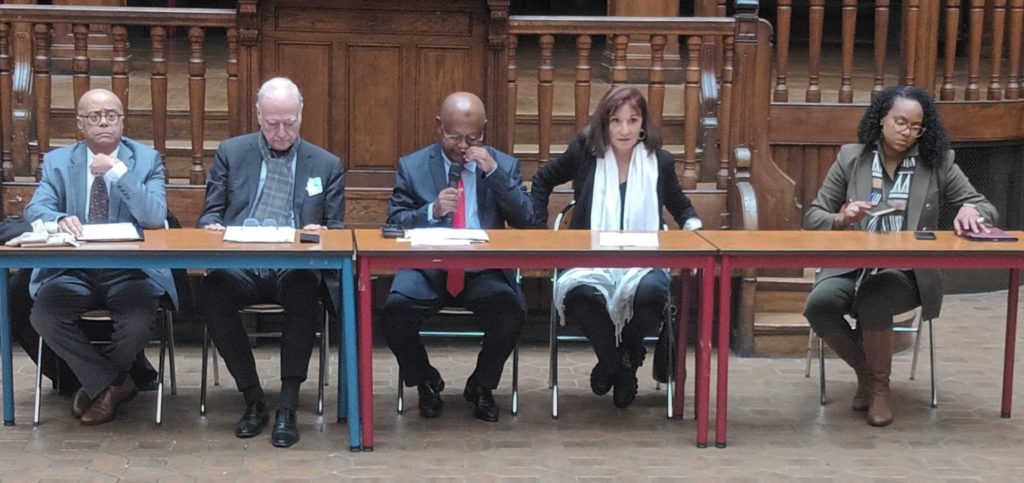
From left to right: Ezzeddine Zayani, former ambassador and expert to the African Union; General Jacques Perget, President of the Institut Sully; His Excellency Hamada Madi Bolero, former Interim President of the Union of the Comoros and Secretary-General of the Indian Ocean Commission; Leslie Varenne, Director of IVERIS; and Trycia Nyota, moderator.
This article summarises the key points of the Institut AFRIKA conference held on 14 January 2026 at the Bourse du Travail in Paris on “Africa’s geopolitical shift“, attended by diplomats from the embassies of China, Russia, Australia, Romania, Cameroon, the Gambia, Guinea, Libya, Morocco, Mozambique, Tunisia and Zambia, as well as representatives of the Permanent Delegation of Mauritania and the Permanent Mission of the Holy See to UNESCO.
A world on the brink of strategic chaos
The world has entered an era of “strategic chaos”. The reshaping of the international order – marked by the emergence of a multipolar world, the return of “might makes right”, the challenge to Western double standards, the rise of the Global South and intensifying strategic rivalries – places Africa at the heart of new power dynamics.
These developments open up unprecedented opportunities for cooperation, but they also heighten the risks of political vulnerability, strategic tension and asymmetric conflict. The central challenge for the continent is now whether it can position itself as a fully fledged strategic actor in a deeply fragmented international environment.
The fundamental question: what can Africa do in the face of these geopolitical ruptures and realignments? The speakers at the conference offered frameworks for analysis and possible solutions in a spirit of predictive and pragmatic geopolitics, with the aim of preparing African states to navigate the fog of a global reconfiguration driven by force.
Geopolitics, the raw driving force of the world
The illusion of international law and the return of realpolitik
Governance of the world belongs to those who take the initiative to change the international order. The idyllic vision of international relations founded on law and treaties is contradicted by the reality of conflict. From the Kellogg-Briand Pact (1928) to the Charter of the United Nations (1945), attempts to outlaw war have run up against the persistence of conflicts, often initiated by the very powers that drafted those charters.
International law, notably the principle of peaceful cooperation (UN Resolution 2625, 1970), is today invoked only by the weak. It has been supplanted by the “law of force”. The announced creation of a “Peace Council” in 2026, an initiative intended to replace a UN deemed to be in its death throes, illustrates this dynamic. By presenting itself as a more “agile and pragmatic” alternative, this Council, championed by the United States, is blowing apart the foundations of multilateralism and replacing them with a logic of power.
In this context, Africa must learn the lessons of history: the League of Nations failed, and the UN is being bypassed. It should see this realignment as an opportunity to rid itself of institutions inherited from the colonial era that have failed to solve its problems (UNAMIR, MONUSCO, MINUSMA…), and to support any new international architecture in which its demographic weight and resources would give it a prominent place.
The re-emergence of empires and the end of absolute sovereignty
We are witnessing the rebirth of imperial spheres founded on strategic and cultural affiliations. This reconfiguration is calling into question the political balances that emerged from the Cold War. The African and Arab worlds find themselves caught between these blocs, unable to break free of them entirely.
The lesson is clear: as Phaedrus taught, one should never trust an alliance with the powerful. A regime’s best protection remains its people. The examples of Syria, Venezuela, Cuba and Iran show that foreign backing, however flattering, proves illusory in the event of a major conflict. The spectacular capture of Venezuelan President Nicolás Maduro in January 2026 is the perfect illustration of this new coercive diplomacy, in which might prevails over law and national sovereignty is stripped of its sanctity in the name of the strategic interests of the powerful.
Africa at the heart of a game of ruptures and influence
From blind spot to coveted central arena
Long regarded as a blind spot in geopolitics, Africa has become a central arena of the realignments under way. Its geopolitical shift is a major issue. No global actor can now build a strategy without factoring in the continent, because of its natural resources and its strategic position.
Yet Africa remains more a playing field than a sovereign actor. The unfinished decolonisation of 1960 did not cut the “umbilical cord” with the former colonial powers. Today, in a fragmenting world, the existential question for African leaders is this: how can we use new alliances to strengthen our strategic autonomy without becoming a battleground?
The new laboratories of sovereignty
Examples of resilience are emerging. Tanzania, Namibia, Botswana and, above all, the Confederation of Sahel States (AES – Burkina Faso, Mali, Niger) are becoming laboratories of African sovereignty. By creating a unified force and a coordinated diplomacy, and by planning a common currency, the AES is redefining the regional balance and embodies a renewed drive for emancipation. This break with the post-colonial order, reflected in military partnerships with Moscow and economic ones with Beijing, illustrates a “de-Westernisation” of the world of which Africa is an epicentre.
Great-power competition: a risky opportunity
Strategic rivalries are intensifying on the continent, including through students. China, Turkey, Russia, the United States and others are deploying massive influence strategies there:
- China has 53 embassies and colossal investments ($39 billion in 2025), and hosted 90,000 African scholarship students in 2024.
- Turkey has quadrupled its embassies (from 8 in 2002 to 35 today) and increased its flight destinations ninefold (from 6 in 2004 to 55 today), and hosts 37,000 African students.
- The United States, under the Trump doctrine, is pursuing transactional diplomacy, offering strategic partnerships in exchange for secure access to critical minerals.
As one striking formula puts it: “China offers infrastructure, India agricultural projects, Russia security, the United States strategic partnerships, Turkey drones, Brazil South-South cooperation, and Europe… the values of liberal democracy.”
The challenge for Africa is twofold: to take advantage of this competition to negotiate favourable terms for liveable development, while avoiding becoming the battleground for proxy conflicts that would exacerbate instability and the plundering of resources.
The law of the jungle and its consequences for Africa
Law follows power
The world is cynical. Law follows power; it never precedes it. The powers use it when it suits them and disregard it when their vital interests are at stake. The examples of Iraq, Libya and, more recently, Ukraine, Venezuela and Greenland show an international community that is more spectator than actor.
Believing in international law as a higher norm is “strategic naivety”. A condemnation without the force to enforce it is no more than an opinion. Africa must come to terms with this harsh reality: there is no supranational authority capable of imposing a norm on a sovereign state against its will. Peace is born not of treaties, but of the balance of power.
Africa’s strategic vulnerability
Africa, a giant with feet of clay, is vulnerable. Divided into 54 states, economically dependent, an exporter of raw commodities and in debt, it is easy prey. Interference is made easier by internal political divisions, recurring conflicts and a lack of strategic governance.
In this context, the maritime dimension is becoming crucial. Africa’s 13 million km² of Exclusive Economic Zones (EEZs), rich in polymetallic nodules and rare earths (the oil of the 21st century), will fuel Sino-American competition. Africa must prepare to defend these vital spaces.
Africa’s existential choice: vassalisation or sovereignty
Faced with this turmoil, Africa is confronted with two radical options:
- Vassalisation and powerlessness, leading to the gradual disappearance of its influence and its interests.
- Political union and strategic autonomy, the only way to survive in a world dominated by the law of the strongest.
As General Abdourahamane Tiani, Head of State of Niger, has stated: “The AES’s struggle is a struggle for the sovereignty of Africa, of which the AES is the embryo.”
The pillars of a strategic renaissance
To stop being a periphery and become a centre of the world, Africa must undertake a profound transformation:
- Continental political unity: Sovereignty cannot be fully exercised by 54 separate states. The borders inherited from colonisation are a handicap. The long-term objective must be a form of federal governance, enabling Africa to carry weight in global governance and to obtain, for example, a permanent seat on the UN Security Council.
- Military and economic sovereignty: A state without an independent army is a playground. It is imperative to strengthen collective military capabilities and to break economic dependencies by processing resources locally. The example of Botswana, whose president requires buyers of minerals to come to Gaborone to negotiate, is a model of reasserted sovereignty.
- A revolution in mindsets: Africa’s awakening requires an “inner and collective transformation”. It means rediscovering pride in its culture and its languages, and placing trust in African ingenuity and entrepreneurship, as advocated by the spirit of Captain Thomas Sankara and as embodied by the current resilience of Burkina Faso under the enlightened leadership of Captain Ibrahim Traoré.
Winning African sovereignty
The military interventions of 2011 in Libya and Côte d’Ivoire sent a shockwave across the African continent, giving rise to a powerful sense of anger. They brutally exposed the persistent limits of the postcolonial order and crystallised a deep and now unavoidable aspiration: the conquest of sovereignty. How, indeed, can one seriously contemplate the sovereignty of a continent that alone hosts 5 of the 11 United Nations peacekeeping missions worldwide?
Faced with the artificiality of the borders inherited from colonisation, strategic clear-sightedness is essential. It calls for the construction of a continental federal state. Only such a union will allow Africa to stop being subjected to the global agenda and instead to take an active part in shaping it. Against the logic of war, it must set the strength of diplomacy. To predatory appetites, it must respond by asserting a collective sovereignty. Against fear of the future, it must set a forward-looking vision. And finally, against division, it must set unity.
It is imperative to develop tools for cross-cutting analysis — geotechnological, geostrategic and geopolitical — in order to gain a comprehensive view of the issues and realities at stake. Mastering these analytical frameworks means equipping oneself to anticipate and make strategic predictions, so as to take full ownership of the direction of global governance.
Regaining military sovereignty and reasserting a political identity on a continental scale are the sine qua non for Africa to cease being a theatre of external rivalries and a coveted territory. On the contrary, they will allow it to place itself at the heart of the global contest for power. By asserting its sovereignty over its strategic resources and diversifying its partnerships, the continent will establish itself as a major geostrategic player.
Africa’s destiny now rests on its capacity to:
- Build strong and legitimate federal governance.
- Free itself from external tutelage and interference.
- Construct a strategic state, supported by intelligent and educated nations.
It is time for African leaders to abandon any spirit of obstruction or division that hinders the continent’s progress. Their historic responsibility is to bring about a lasting change in the geostrategic environment of Africa’s political and economic systems.
Africa holds its destiny in its own hands
The geopolitical reversal is gathering pace. The forceful return of the Pax Americana (in hybrid, hard or soft forms) and the re-emergence of empires are dampening hopes of a peaceful multilateralism. Europe is relative, while Latin America, the Middle East and Africa are becoming the strategic adjustment variables.
Amid this chaos, Africa concentrates the world’s fragilities but also has every asset it needs to move from being an arena for competing influences to becoming a major geopolitical actor. As Kofi Annan put it, its future will depend on its ability to seize its opportunities.
Will Africa relive its “strange defeat” or witness its rebirth?
Building strategic autonomy, through deep regional integration (as exemplified by the AES), local processing of resources and an equidistant diplomacy, is the only path to salvation. Africa will be the strategic centre of the world, either as prey or as an actor. It is up to every leader and every people to choose action and unity.
Next conference in Paris, early July: The United Nations today: current challenges and prospects for tomorrow.
We will examine the foundations of the UN in the face of the emergence of the Board of Peace, the re-emergence of empires, the return of “the law of force” and the weakening of multilateralism. In this world without compass or rudder, how can peace and collective security be reinvented? How can the initiative be regained through education and a culture of peace ?
Translated from French. The French original prevails.