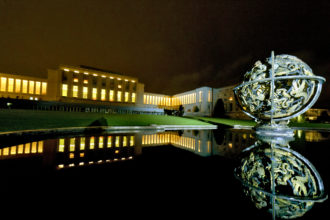
The Zin Valley in Israel’s Negev Desert, seen from David Ben-Gurion’s grave at Midreshet Ben-Gurion.
By staking everything on a single powerful ally, Israel has put all its eggs in one basket. It is a gross error of judgement that no grandmother doing her shopping at the market would ever have made. And the Jewish State is preparing to serve itself a thoroughly indigestible omelette, because its American ally is beginning to distance itself. For Israel, the Great Desert of Solitude looms on the horizon.
Ever since Donald Trump allowed himself to be dragged by Netanyahu into the adventurous – or rather “misadventurous” – war in Iran, the first cracks have been appearing in broad daylight. In early June, Agent Orange heaped insults on his “best friend”, accusing the Israeli prime minister of torpedoing the laborious negotiations with the Iranian government.
That said, Goofy Donald insults everyone at every turn. And since he switches from abuse to effusive praise as easily as he fires off his tweets, everyone quickly moved on.
The “holy-water toad” takes the stage
Except that now it is his “sanctimonious bigot” of a vice-president who is launching a frontal attack on the Israeli government: “Donald Trump is the only head of state in the world who is well disposed towards the nation of Israel at this precise moment. And he happens to be the head of state of the world’s superpower. If I were part of the Israeli government’s cabinet, I might not attack the only powerful ally I still have left”. The implication: “but for how much longer?”
The Catholic fundamentalist J.D. Vance was thus responding to the two fundamentalist Israeli ministers, Itamar Ben Gvir and Bezalel Smotrich, who had vilified the ceasefire agreement between Trump and the Iranian government – or rather the Revolutionary Guards, who evidently hold real power in Tehran.
Israel’s image collapses in the United States
If the Israeli right in power hopes these storm clouds will soon clear, it may well be mistaken. The collapse of the Jewish state’s image among the American public shows how deep the rift between Washington and Jerusalem runs.
According to a poll (1) conducted by the Pew Research Center:
– 60% of American adults have an unfavourable view of Israel, compared with 53% last year;
– 59% have little or no confidence in Netanyahu to do the right thing regarding world affairs – compared with 52% last year;
– in both major political parties – Democrats and Republicans – a majority of adults under 50 now view Israel and Netanyahu unfavourably.
A particularly worrying finding for the Israeli government is Israel’s growing unpopularity among young Americans. And it was an Israeli institute, the INSS (Institute for National
Security Studies), that reached it:
– 75% of 18- to 29-year-olds hold an unfavourable opinion of Israel, compared with 67% of 30- to 49-year-olds;
– among Democrats aged 18 to 29, the figure reaches 85%, compared with 83% among 30- to 49-year-olds;
– among Republicans (traditionally pro-Israel) aged 18 to 29, the percentage reaches 64%, compared with 52% among 30- to 49-year-olds.
Trump’s Iran policy rejected
Already in an awkward position in public opinion, Trump and his Republican Party have been hit hard by another poll (AP-NORC), conducted between 11 and 17 June: 65% of Americans disapprove of their president’s policy on Iran.
However much Dingo Donald gesticulates at Versailles to promote the ceasefire agreement with Iran, presenting it as his resounding victory, even Americans are beginning to have serious doubts. Hence Trump’s anger at the Israeli prime minister, who had persuaded him to strike Iran.
Will this war, which was supposed to secure Netanyahu re-election in four months’ time and lasting glory, prove to be his political grave?
For Israelis are coming to realise that nothing lasts in this world, least of all geopolitical alliances.
All the more so as they are seized with vertigo at this new development. Netanyahu no longer has Trump in the palm of his hand. The special bond between the two men, presented as unbreakable, now looks as fragile as a frayed piece of string.
Washington holds the keys to the arsenal
As long as they could count on the unwavering and unconditional support of the United States, the Israelis cared little about antagonising most of the world’s states by rejecting the so-called “two-state” solution (Israeli and Palestinian) and any prospect of peace in the region. This was the era of the strategy of perpetual war against their Palestinian neighbours, with the odd very temporary respite here and there.
But without US backing, this strategy falls apart. It is Washington that holds the keys to the arsenal. Yet neither Trump nor Vance – soon to be a candidate for the White House – will take the risk of supporting a country that has become unpopular in the eyes of their voters. The Trump-Vance duopoly has no qualms whatsoever: all that counts is the power that makes predation possible.
Return of the two-state solution?
From then on, it is Israel’s very existence that is at stake. The Jewish state risks setting out on its march into the Desert of Great Solitude with very few provisions. Jerusalem will finally be forced to take its Arab neighbours into account. And the “two-state” solution – which was thought to be dead and buried for good – may well prove its lifeline. But will those neighbours still want it, this solution?
1 Conducted between 23 and 29 March among 3,507 American adults
Translated from French. The French original prevails.