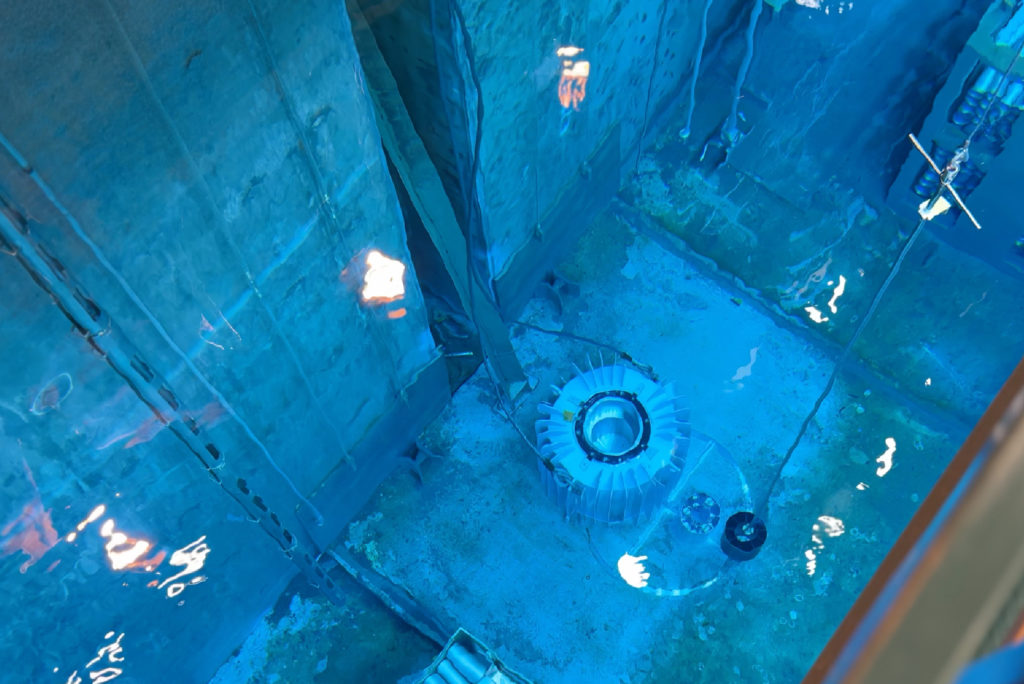
A transport container holding cobalt-60, recovered during the shutdown of Unit 8, is stored in the auxiliary irradiated fuel bay. Photo Nordion.
Sixteen billion American medical devices pass through a handful of Ontario reactors every year. Nobody talks about it — and it is the second blind spot that ought to worry Ottawa. The balance of power between Canada and the United States is measured in steel, aluminium, softwood lumber and oil. The billions in threatened exports are tallied up. Overlooked is a dependency of another kind: without an isotope produced in a handful of Canadian reactors, much of the sterile medical equipment used in American hospitals would not be sterile. Canada holds an unavoidable chokepoint here. It has never counted it — and, without ever having decided to, it is letting it slip away.
Since trade talks broke down on 21 August and 50% US tariffs came into force, Canada has been searching for leverage. The inventory that gets drawn up never varies: electricity, potash, uranium, the heavy crude feeding Midwest refineries. These are real levers. They are also widely discussed, which means they are anticipated. There is another one, which neither Ottawa nor Washington ever mentions in their statements, and which appears in no analysis of the balance of power. It comes down to a word diplomats do not use: cobalt-60.
Sixteen billion items
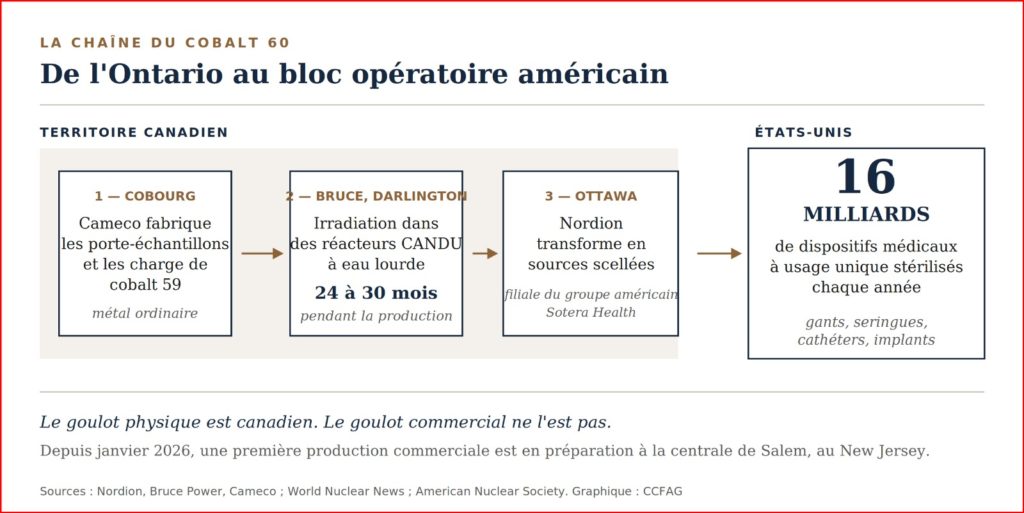
Cobalt-60 is a radioisotope. Its gamma radiation has three uses: sterilising single-use medical equipment, treating certain cancers through radiosurgery, and decontaminating food. The first application is on a massive scale. According to industry figures, cobalt-60 sterilises more than sixteen billion single-use medical devices every year in the United States, and around 40% of all disposable devices produced worldwide. Gloves, syringes, gowns, catheters, implants, surgical drapes: the everyday inventory of an operating theatre.
The second application is narrower but no less sensitive. So-called high specific activity cobalt-60 powers the Gamma Knife, a stereotactic radiosurgery device used against complex brain tumours. Yet this material cannot be bought on a fluid global market. It is made in nuclear reactors, and not just any reactors.
A short, precise and almost entirely Canadian supply chain
The process is long-established and has remarkably little redundancy. Rods of cobalt-59 — the stable, commonplace isotope, mined as an ordinary metal — are loaded into sample holders manufactured by Cameco Fuel Manufacturing in Cobourg, Ontario. The rods are then inserted into CANDU heavy-water reactors, where they remain for between twenty-four and thirty months, sometimes up to three years, while the reactor goes on generating electricity as normal. They emerge transformed into cobalt-60.
The reactors in question are those of Bruce Power, in Bruce County, and those of Ontario Power Generation at Darlington and Pickering. The irradiated material is then transported to a Nordion facility in Ottawa, where it is turned into sealed sources before being shipped to more than forty countries.
The concentration of this supply chain is the decisive factor. The World Nuclear Association estimates that virtually all of the world’s supply for medical use and sterilisation comes from CANDU reactors — a Canadian technology, operated mainly in Canada, and also in Argentina, China, India, South Korea and Romania.
Between a surgical procedure performed in Boston and a metal rod slid into a reactor in southern Ontario, there are just twenty-four months and very few intermediaries.
On the figures
Sources differ on Canada’s share, and this should be acknowledged. The Canadian Nuclear Association, an industry body, claims that more than 70% of global supply is produced in Canadian power stations and that Canada refines more than 90% of it. World Nuclear News, more cautious, puts the Canadian share of global supply at around half. The gap probably stems from the distinction between raw production and refining, and from the fact that the first figure comes from an interested party. Let us take the lower end of the range: even at 50%, no other source could absorb a Canadian shutdown in the short term, since irradiation itself takes two to three years.
The second blind spot: we hold the reactors, not the order book
This is where the part of the analysis begins that ought to catch Ottawa’s attention, and which, to my knowledge, has never been set out publicly. Nordion, the Ottawa-based company that processes and distributes this cobalt-60, is a subsidiary of Sotera Health — an American group listed in the United States. Nordion (Canada) Inc. is Canadian by its address, its facilities and its employees. It is not Canadian by its controlling shareholding. The distinction is not theoretical. It separates two forms of power that are all too often confused.
Canada controls the physical bottleneck: the reactors, the CANDU technology, the irradiation capacity, the decades of regulatory expertise. None of that can be offshored. A country wishing to do without it would have to build reactors, obtain licences and wait several years. Canada does not control the commercial bottleneck: the customer relationships, the distribution network spanning more than forty countries, the brand, the long-term contracts. That layer belongs to a foreign group.
In other words, Canada produces the material and someone else decides who it is sold to. This is precisely the kind of arrangement that creates the illusion of leverage while hollowing it out. On paper, Canada is indispensable. In practice, it is a supplier.
January 2026: the window begins to close
And while Ottawa was not counting this lever, someone in Washington was. On 27 January 2026 — seven months before the rupture, in the midst of the tariff war — Westinghouse, Nordion and PSEG Nuclear announced the signing of long-term commercial agreements aimed at establishing the very first commercial production of cobalt-60 in American pressurised water reactors, at the Salem plant in New Jersey. The technique relies on absorber inserts that irradiate cobalt targets during normal reactor operation, with a harvest every eighteen months. The US Nuclear Regulatory Commission is reviewing the licence amendment request; implementation is targeted for 2026.
The statement is explicit about the objective: to build a reliable and scalable domestic cobalt-60 supply chain in the United States. It is worth grasping what this means. The United States, which has never produced this isotope commercially, is now taking it up — in the very months in which it was imposing on Canada the heaviest tariffs in the history of the relationship. Washington does not present this as a trade manoeuvre, and nothing suggests that it is one: global demand is rising and diversifying sources has long been a concern for the sector. But the effect will be the same.
The one Canadian lever that nobody ever mentioned is being methodically neutralised, and Canada has not had to debate the matter, since it never acknowledged having it.
One detail sums up the situation perfectly: the American project is being carried out with Nordion, and the cobalt 60 produced at Salem is to be supplied to Nordion. America’s exit from dependence runs through the Canadian company — a subsidiary of an American group — that benefited from that dependence. Everyone is acting rationally. Nobody is defending Canada’s interest, because it is nobody’s mandate.
What should be done about it, and what must on no account be done
Let us be unambiguous, since the subject lends itself to misreading: there can be no question of using medical isotopes as a means of pressure. Restricting the supply of cobalt 60 would mean delaying sterilisations and cancer treatments. It would be morally indefensible, contrary to Canada’s international nuclear commitments, and probably more damaging to our reputation than any tariff. No serious Canadian government will contemplate it, and rightly so.
That is not the point. A lever does not need to be pulled to matter. It matters because it exists, because it is recognised on both sides of the table, and because it reminds everyone that interdependence is never a one-way street. What this case reveals is that Canada does not even know what it holds.
Three practical consequences follow.
First, take stock. To my knowledge, no one in the federal government keeps an up-to-date map of the chokepoints where Canada is hard to replace for the US economy. Cobalt-60 is one; there are certainly others, and they will not be found by chance.
Second, distinguish production from commercialisation. Industrial sovereignty that stops at the factory gate is not sovereignty. The question of who controls the commercial layer of a strategic sector should form part of the screening of foreign investment, just as the ownership of physical assets does.
Finally, stop treating these sectors as public health matters with no strategic dimension. Cobalt-60 falls at once within medicine, energy, trade and national security. In Canada, above all, it falls within no one’s remit in particular.
The tariffs are now in force and Canada’s retaliation is taking shape. There will be talk of steel, aluminium and dairy products. There will be no talk of the sixteen billion sterile items that, once again this year, will have passed through Ontario before entering an American operating theatre.
A country that does not know what it holds does not lose it in a negotiation. It loses it without ever having had one.
References
01 Westinghouse / Nordion / PSEG — press release of 27 January 2026 : first commercial production of cobalt-60 in a US PWR, at Salem; 16 billion devices sterilised annually in the United States; application under review by the NRC.
02 American Nuclear Society — Nuclear Newswire — 28 January 2026: technical details of the absorber inserts ; harvesting every 18 months; 40% of single-use devices. 03 World Nuclear News — process for irradiating cobalt-59 in CANDU reactors; around half of global supply comes from Canada; almost all medical supply comes from CANDU reactors. world-nuclear-news.org/articles/bruce-completes-largest-to-date-radioisotope-deliv
04 Nordion / Bruce Power / Cameco — production chain : target holders manufactured in Cobourg, insertion into the reactor, a stay of 24 to 30 months, processing in Ottawa.
05 Canadian Nuclear Association — more than 70% of global supply produced in Canada; more than 90% refined in Canada; 40% of the world’s disposable devices. Industry figures.
06 Bruce Power — 31 March 2026: cobalt-60 harvest at Unit 8; high specific activity cobalt intended for the Gamma Knife.
07 Nordion — February 2026: support for the refurbishment of Ontario’s producing reactors ; Darlington Units 1 and 4 brought into production; evaluation agreement with Romania (Cernavodă).
08 Quartz / Radio-Canada — US tariffs of 50% in force from 19 August 2026; Section 338 of the Tariff Act of 1930; around C$20 billion of imports affected.
Didier Aubrais is the founding president of the Cercle Canadien Francophone d’Analyse Géostratégique (CCFAG). Trained in criminology and forensic science, he has nearly thirty years’ experience in state security and private intelligence. The views expressed here are the author’s own.
Translated from French. The French original prevails.