Türkiye will host the 31st United Nations Climate Change Conference (COP31) in Antalya from 9 to 20 November 2026. It wants this international gathering to be more than just another climate summit marked by ambitious declarations and unresolved funding gaps. Its stated aim is to make it an “implementation COP”: a conference that moves from pledges to projects capable of attracting investors, from capital to actual investment, and from global commitments to building local capacity.
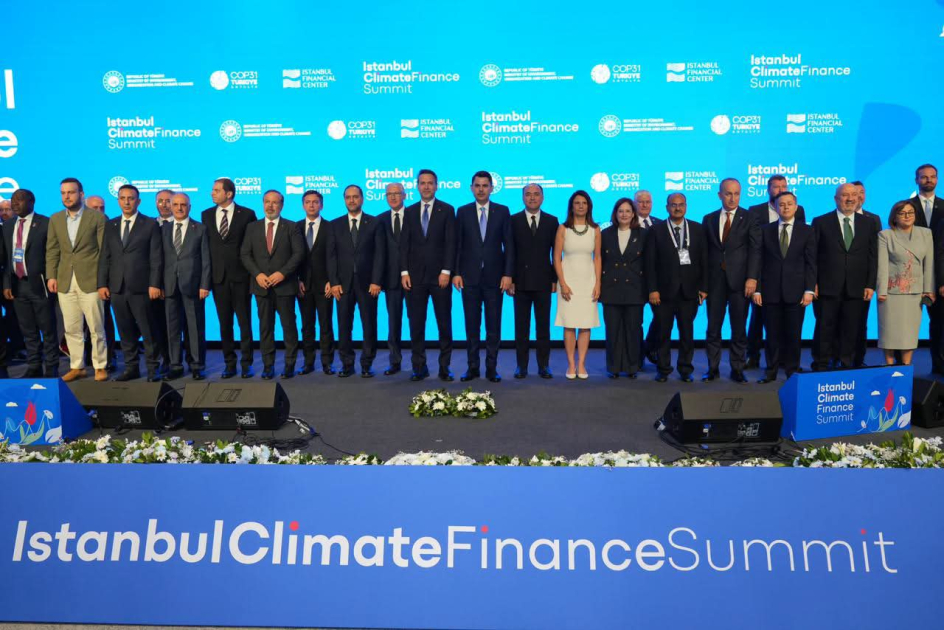
Istanbul Climate Finance Summit.
The proposal comes at a pivotal moment. Climate change is no longer presented merely as an environmental challenge; it is increasingly regarded as a systemic risk affecting energy security, trade, industrial competitiveness, employment, cities and financial stability. For countries grappling simultaneously with the consequences of climate change, high borrowing costs and constrained public budgets, the central question is not only how much climate finance is needed. It is also how the capital available can be channelled into projects that reduce vulnerability before the next disaster strikes.
Turning commitments into finance
At the Istanbul Climate Finance Summit, held under the theme “From the COP31 Vision to Financing Climate Action”, Murat Kurum, Türkiye’s Minister of Environment, Urbanisation and Climate Change, argued that the task was no longer to multiply climate targets through fresh pledges. The aim now is to turn them into “feasible investments, robust financing models and measurable results”. The emphasis is significant. It places finance, urban resilience and infrastructure at the heart of Türkiye’s case for hosting COP31.
Murat Kurum’s message was reinforced by contributions from representatives of the Turkish financial sector, who stressed that public finance alone could not support the green transition at the scale required. They argued for blended finance, risk-sharing mechanisms and new financing structures capable of mobilising private and international capital. This reasoning is familiar from climate negotiations, but putting it into practice remains problematic: public money may be needed to reduce risk, while private investment must be steered towards sectors in which commercial returns are often uncertain or materialise only in the long term.
This question is particularly important in the field of infrastructure. Clean energy systems, electricity grids, low-carbon industries, sustainable transport, water supply networks and climate-resilient cities all require long-term investment. They do not, however, face the same obstacles. In some cases, the problem lies in insufficient technical preparation; in others, it stems from public policy uncertainty, exposure to currency risk, weak project design or an inability to share risks fairly between public and private actors.
This distinction was highlighted by the Vice-President of the Asian Infrastructure Investment Bank, Ajay Bhushan Pandey, who set out the practical conditions required for implementation. In his view, finance can be mobilised only when credible projects and programmes are ready to be funded. It is therefore necessary to engage early enough, to identify national and sectoral priorities, and to address shortcomings in project preparation and investment readiness before proposals are submitted to lenders. Above all, he stressed, financial instruments must be tailored to the actual needs of the investment — not the other way round.
It is this gap that the Antalya conference will have to tackle. The international system has no shortage of climate commitments. What it lacks are reliable implementation mechanisms capable of turning those commitments into operational infrastructure and lasting services on the ground. For vulnerable populations, this difference is not merely semantic. It is the difference between preventive investment in resilient housing, flood defences, water supply systems and early warning capacity, and costly emergency assistance deployed after disaster has struck.
The example of post-earthquake reconstruction
Türkiye’s experience following the earthquake of 6 February 2023 lends particular weight to its case. Around a year after the disaster, I travelled to Hatay and Gaziantep, two of the hardest-hit provinces. The scars of the destruction were still visible, as was the sheer scale of the reconstruction effort. I visited housing developments still under construction in 2024, part of a programme that moved from widespread destruction to the handover of new homes in less than two years.
The significance of this reconstruction is not limited to its speed or scale. It also lies in the opportunity to rebuild urban systems differently: with earthquake-resistant housing, more modern infrastructure, more sustainable neighbourhoods and services that take account of residents’ social and urban needs. According to the Turkish authorities, the earthquake affected 11 provinces and some 14 million people, while more than 455,000 independent units were delivered within two years.
In the long run, however, the true measure of success is not the number of keys handed over. It is whether people can return to functioning communities, with access to water, transport, healthcare, schools, jobs and affordable services. Resilience cannot be reduced to stronger concrete or newer buildings. It also depends on whether reconstruction can preserve social ties, livelihoods and people’s right to remain in their neighbourhoods.
The same applies to the energy transition. At the summit, Turkish speakers linked climate policy to industrial strategy, exports and national competitiveness, at a time when carbon intensity is playing an increasingly decisive role in global trade. They stressed the need for “transition finance” for sectors such as steel, cement, transport, energy and agriculture — industries that cannot decarbonise through simple or immediate solutions.
This recognition matters. Expanding renewable energy and strengthening electricity grids are necessary, but not sufficient on their own. The credibility of the transition will depend on whether clean energy can replace dependence on coal and fossil fuels, rather than merely adding to it. It will also rest on how governments manage the social and regional consequences of this transformation for workers and for areas dependent on carbon-intensive industries.
A matter of strategic security
For Geneva-based institutions and, more broadly, for the multilateral system, Türkiye’s proposal matters because it goes to the heart of the main fault line in the climate finance debate: the problem lies not only in the volume of funds pledged, but in whether that finance can be accessed on affordable terms, channelled early enough towards credible projects and structured so that the risks do not fall disproportionately on the most vulnerable countries and populations. Multilateral development banks, national financial institutions, climate funds and private investors all have a role to play, but their resources must be coordinated around investment portfolios that are technically sound, tailored to social needs and ready for implementation.
Türkiye is thus seeking to position itself not only as a recipient of climate finance, but also as a country able to help shape the financial architecture for its implementation: by designing models to mobilise capital, combine public and private finance, share risk and deploy practical solutions at scale. Its proposed “Climate Implementation Bridge” (Climate Implementation Bridge) aims to turn national climate commitments into project portfolios capable of attracting investors, in order to bring the priorities of developing countries closer to funding bodies and speed up the flow of funds on the ground.
The political rhetoric surrounding the initiative has grown more ambitious. Murat Kurum, Turkey’s Minister of Environment, Urbanisation and Climate Change and COP31 President-designate, has called on governments to treat climate finance as a matter of strategic security. Drawing a parallel with the pledge by NATO members to raise their spending on defence and, more broadly, on security to 5% of GDP by 2035, he argued that climate security should inspire ambition on a comparable scale. The point is not literally to propose a uniform environmental levy or an equivalent 5% allocation, but to call for a financial commitment commensurate with the threat — notably in clean energy, electrification, water security, resilient cities and green industry.
For Turkey, the argument is not entirely abstract. The reconstruction under way since the earthquakes of February 2023 has now become part of its diplomatic narrative in the run-up to the Antalya conference: it serves as a test case for whether post-disaster recovery can go hand in hand with safer, more resilient and lower-carbon urban development. The Turkish authorities say that 455,000 homes, business premises and village houses have been rebuilt across the 11 affected provinces, with the programme incorporating criteria for resilience and compatibility with renewable energy.
The value of COP31 will therefore be determined not by the elegance of its final declaration but by its ability to create operational mechanisms that allow funding to reach the projects, populations and countries that need it most urgently. The real test of success will be whether climate finance can protect vulnerable populations before the next disaster, rather than intervening only in its aftermath. In this sense, Turkey’s reconstruction after the earthquakes and its diplomacy around COP31 converge on a single question that remains unanswered: can the lessons learnt from the disaster be turned into better planning, fairer funding and more resilient cities — or will implementation once again fall short of ambition?
Translated from French. The French original prevails.