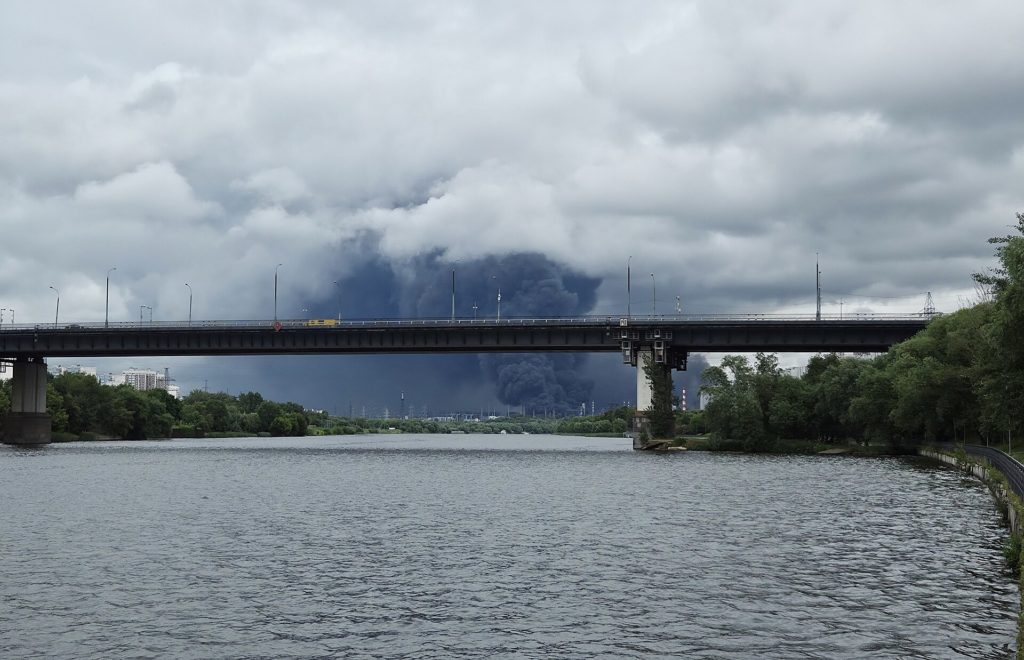
A Ukrainian drone struck the Kapotnya oil refinery, south-east of Moscow, on 18 June 2026.
An internal memo attributed to Sberbank and leaked by hackers sets out eight scenarios for an end to the war in Ukraine. While it gives Moscow only a 7% chance of total victory, the most likely scenario is said to be a frozen conflict. Above all, however, these projections reveal one conviction: the Kremlin can still pursue the war, but it must now play for time, drawing on its financial reserves and the resilience of its economy. This reasoning could explain the current military escalation.
At the end of August, a group of hackers calling itself “Black Mirror”, a reference to the famous American speculative-fiction series, published screenshots of an internal memo found in the email correspondence of German Gref, the head of Sberbank, Russia’s largest bank. The document, entitled “Scenarios for an exit from the war in the Russia-Ukraine conflict”, reportedly dates from April. Several details caught the attention of the journalists who examined it: some of the data match earlier public statements by German Gref on the outlook for the Russian economy. This makes the memo entirely credible and in all likelihood authentic. The website Le Grand Continent has published it in full.
The document is of interest less because it might predict the future than because it sheds light on how part of Russia’s economic elite views the various possible outcomes of the war. And that reading is particularly revealing. Of the eight scenarios examined, a total Russian victory is given only a 7% chance of materialising. Conversely, a peace serving the interests of Europe and Ukraine is given just 2%. In between lies a multitude of scenarios involving a freeze, exhaustion and negotiation. But one constant emerges: time has become a weapon.
7% chance of total Russian victory
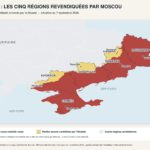
The first scenario envisages an outright Russian victory. Moscow would then control all the territory it claims in the Donetsk and Luhansk oblasts, the Zaporizhzhia and Kherson regions, as well as the Kharkiv region. But the authors of the note identify a fundamental problem: the size of its army. To achieve such a victory, Russia would have to carry out a fresh mobilisation of at least 300,000 men. Losses are currently estimated at around 25,000 to 30,000 soldiers a month, while the roughly 80,000 contract soldiers recruited each quarter are barely enough to offset losses and meet the need for reinforcements.
A fresh mobilisation would therefore be a considerable gamble for the Kremlin. In this respect, the queues of cars seen at the Georgian border are as much a political signal as a military one. They reflect fear of a new mobilisation among part of the population liable to be called up, and its desire to escape it.
The Russian authorities officially deny any plan for a general mobilisation. But should one become necessary, the Kremlin would have to run the risk of its population refusing to comply. Sign-up bonuses are reported to have fallen sharply in recent months, when they are actually paid at all. Having relied on money to attract volunteers and foreign mercenaries (Africans, Koreans and so on), the military recruitment system appears to be reaching the limits of its model. And Russia must now contend with another difficulty: Ukraine is able to strike far behind the front line.
Russia’s hinterland is no longer a safe haven
Ukraine’s long-range strikes on refineries, energy facilities, military sites, logistics infrastructure and storage depots are a major obstacle to any scenario of a Russian victory. Ukraine’s aim is clear: to make the war costly enough that Russia’s numerical superiority loses some of its effectiveness.
Drones have changed the geography of the conflict. The front line no longer marks a boundary between a war zone and a relatively protected rear area. Russian refineries, fuel depots, logistics hubs and military infrastructure can now be struck several hundred kilometres from the line of contact, where a drone-dominated “kill zone” restricts the advance of troops.
Russia certainly has considerable means at its disposal to respond to these attacks. But it faces a new equation: the more it steps up its military effort, the more it exposes its economy to attacks that can cut its revenues and increase its spending. The paper nonetheless identifies a possible technological leap that could radically alter this balance: swarms of drones coordinated by artificial intelligence.
Such an innovation could enable one of the two sides to overwhelm the other’s defences and concentrate its forces on two or three axes of penetration. But a technological revolution on this scale would also come at a price. For Moscow, it would mean a substantial increase in military spending, at a time when Russia’s budget deficit had already reached 4,580 billion roubles in the first quarter of 2026. This is where the war meets its other battlefield: the economy.
Game theory versus the reality of the battlefield
The authors of the memo implicitly draw on a classic piece of game-theory reasoning: in a war of attrition, the side willing to bear the heaviest costs should, in theory, eventually gain the upper hand. But this theory runs up against a fundamental limit. The side prepared to pay the highest price is not necessarily the richest. Above all, in an existential war, those defending their territory, their sovereignty and their identity may be more motivated than those seeking to conquer. That is the main risk in Russia’s strategy.
Moscow has more resources than Kyiv. But Ukraine does not need to win a classic conventional war. It must prevent Russia from securing a decisive victory and ensure that the cost of conquest rises steadily. That is why the war of attrition could turn into a war of economic exhaustion.
12%: the scenario of Western abandonment
A second scenario favourable to Moscow, given a 12% probability, rests on a different assumption: not the military collapse of Ukraine, but the collapse of Western support. Russia would then secure a freeze on the territories it has conquered, without a formal treaty, a partial lifting of sanctions and guarantees that Ukraine would not join NATO. This scenario would depend less on Russia’s military capability than on Moscow’s ability to wait. It presupposes growing weariness among Western publics, an energy crisis, economic difficulties and a political crisis in Ukraine.
It could also be encouraged by political change in Europe, particularly if parties hostile to military support for Kyiv came to power in key countries such as France or Germany. The war would then become a “game of chicken”: each side tries to convince the other that it is prepared to go further, and waits for its opponent to back down first. For Moscow, the aim would be to turn Western fatigue into a geopolitical advantage.
32%: a frozen conflict, the most likely scenario
However, it is the third scenario that the note considers the most likely: 32% for a frozen conflict. This would involve an agreement negotiated at the instigation of Donald Trump, using American aid – both its suspension and its possible reinforcement – as a means of exerting pressure on Moscow and Kyiv simultaneously. The front would be frozen along the lines established by the fighting.
Russia would keep the territories it controls. Some of the sanctions would be lifted. Ukraine would not join NATO, but would seek security guarantees from Washington and the Europeans robust enough to prevent a fresh Russian offensive. The “coalition of the willing”, bringing together several dozen states, could play a peacekeeping role – unless contingents “deemed neutral”, from India or Turkey (albeit a NATO member), for example, were to take on that role instead.
This scenario resembles a Korean-style peace: no genuine peace treaty, but a demarcation line, a halt to the fighting and a standoff set to last. For Moscow, it would be a political success: the Kremlin could present control of the occupied territories to its population as the culmination of a war intended to protect Russian-speaking populations and push back NATO. That narrative is, of course, contradicted by the bombing of Russian-speaking populations in Mariupol and Kharkiv, among other places. But for Ukraine and Europe, this pause would mean something else. It would allow Kyiv to rearm, deepen its European integration and rebuild its military economy. Europe and NATO would also have the time they need to replenish their arsenals. In other words, freezing the war could amount to a tactical victory for Russia but a strategic defeat in the longer term.
22%: a war that fizzles out without real peace
The fourth scenario, put at 22%, is one in which the conflict gradually peters out without a formal agreement. The fighting would ease in intensity. The front line would remain stable. The drone war would continue, but at a lower level. This scenario would presuppose mutual exhaustion. For Russia, the benefits would be considerable: cutting military spending and devoting more resources to rebuilding the occupied territories and to the domestic economy. For Ukraine, it would be a time of “strategic patience”. Kyiv could use this period to speed up its rapprochement with the European Union, modernise its army and strengthen its defence industry. But the absence of a genuine agreement would make this peace extremely fragile. Such an “unstable armistice” could simply be a further stage before hostilities resume.
15%: war to the outer limits of the economy
It is the fifth scenario that probably deserves the most attention. It envisages neither victory, nor genuine negotiations, nor a permanent freeze. It envisages the war continuing at its current level of intensity. Russian losses would reach between 20,000 and 25,000 men a month for territorial gains of just 100 to 200 metres a day. The drone war would continue to sustain a permanent danger zone along the front, while infrastructure would be struck deep inside both countries. It is a genuine strategy of attrition.
The logic is brutal: whoever runs out of steam first loses. And it is precisely here that the phrase “war to the very limits of the economy” takes on its full meaning. Russia is reportedly prepared to pay a considerable human and economic price to keep advancing, even at an extremely slow pace. Yet this strategy comes at a time when Russia’s progress on the front has become particularly slow. Russia has reportedly never advanced so little in almost three years. Military frustration could therefore fuel escalation.
Moscow steps up pressure as time runs short
Taking advantage of Ukraine’s shortage of interceptors and the emergence of new jet-powered drones, Russia is intensifying its bombardments. Major Ukrainian cities are being struck day and night. Energy and military infrastructure is being targeted. The civilian death toll is rising. Russia is thus seeking to achieve through air power what it cannot quickly achieve on the ground.
At the same time, Moscow is pursuing a strategy of hybrid pressure in Europe: cyberattacks, sabotage, provocations and covert operations. The aim is to test the resilience of Western societies and, above all, to drive up the political cost of supporting Ukraine. This strategy fits a war of attrition perfectly: if Russia cannot break Ukraine militarily, it must try to break the coalition that enables Ukraine to keep fighting.
The sovereign wealth fund as a countdown clock
Russia’s military effort amounts to around €130 billion a year, or roughly 6% of GDP according to the estimates cited in the note. At the same time, energy revenues are falling as a result of sanctions and Ukrainian strikes on oil infrastructure. Russia’s budget deficit is reported to have already reached around €43 billion in the first quarter of 2026. The Kremlin can still finance the war. But it must now finance a war that is gradually eroding the economic capacity that allows it to be financed. That is the fundamental paradox of this strategy.
Russia still has financial reserves and can issue debt. But these mechanisms have their limits. The liquid reserves of the sovereign wealth fund could be sharply depleted, or even exhausted, by the end of the year, according to some projections. Meanwhile, issuing bonds makes it possible to finance the deficit, but at the cost of mounting debt. Under the assumptions cited in the note, debt could reach 35 to 40% of GDP in 2028.
That level does not in itself spell bankruptcy for the Russian state. But it reflects a fundamental shift: Moscow could no longer rely indefinitely on its reserves to fund the war effort. Added to this are inflation, high interest rates and stagnating civilian activity. The war economy can keep turning out missiles, drones and munitions while gradually destroying its ability to produce anything else. That is the hidden cost of the war.
Can Russia hold out for another two years?
According to Ukrainian sources, the Russian economy could sustain the military effort for roughly another two years. In a war of attrition, two years is a considerable length of time. But two years is also a short enough horizon to explain the Kremlin’s sense of urgency. If Moscow believes that its economic position will deteriorate sharply from 2027 or 2028, it may have an interest in maximising its territorial gains before the window closes. This may be one of the keys to the current escalation. Russia would not necessarily be seeking to win tomorrow. It would be seeking to win before its economy prevents it from doing so.
And Ukraine?
The Ukrainian equation is obviously different. Kyiv has far fewer financial and demographic resources. Its recruitment difficulties are also set to worsen. The Ukrainian state is already in economic survival mode and depends on the financial, military and industrial support of its allies. But Ukraine has one essential advantage: it does not need to maintain the same level of military spending as Russia to impose considerable costs on its adversary. Drones, precision strikes and electronic warfare make it possible to turn relatively limited means into significant economic damage. The Ukrainians have, moreover, proved innovative and quick to respond in finding solutions to their shortage of weaponry, using drones but also autonomous robots and artificial intelligence.
Europe becomes the third protagonist
All of this explains why the war is no longer being fought solely between Moscow and Kyiv. It is also being played out in Washington, Berlin, Paris and Brussels, and in European public opinion. If Europe continues to increase its aid, Moscow will have to endure a longer war. If Europe slows down, Russia may conclude that its strategy of attrition is working. European rearmament is, however, gradually changing this equation. Europe is increasing its military spending, replenishing its ammunition stocks and developing its own industrial capacity. But it needs time to catch up, particularly in the production of drones and ammunition.
Yet this rearmament is taking place at the very moment that several European countries face elections in which far-right parties opposed to continued aid to Ukraine could make gains.For Moscow, then, waiting is becoming a strategy. For Vladimir Putin, defeating the Ukrainian army is not enough: he must wait for the democracies that support it to tire.
The breakthrough scenarios
The final scenarios in the note are less likely but more dramatic. A compromise peace could come about as a result of political change in Russia or Ukraine. This could happen if Beijing judges that Putin is going too far and pushes him to negotiate. Moscow might then agree to return some of the territory it has seized in exchange for recognition of its sovereignty over Crimea and part of the Donbas. For Kyiv, this would be an extremely painful concession, but it could pave the way for accelerated European integration and security guarantees.
But a peace on terms acceptable to Europe and Ukraine is given only 2% by the authors of the memo. It would entail a Russian strategic defeat, a withdrawal from conquered territory, or even a return to the 1991 borders, Ukraine’s accession to NATO and the payment of reparations. That would presuppose a Russian economic collapse, with a 15% contraction in GDP, runaway inflation and a default on foreign debt. In their reading, this would amount to a fresh trauma, like the one Russians lived through after the fall of the Soviet Union in 1991. The Russian analysts naturally consider this unwelcome scenario highly improbable.
De-escalation through escalation
Finally, there are events that defy all rational models. The use of a tactical nuclear weapon is one. The doctrine of “de-escalation through escalation”, championed in particular by some Russian strategists, could push Moscow to contemplate a limited nuclear strike in order to force Ukraine and its allies to negotiate. For now, Moscow has merely threatened such use as a scare tactic. Were the operational decision actually taken, it would probably trigger a major rupture: Russia’s deeper international isolation, new sanctions on the scale of those imposed on North Korea, and a possible Western conventional response.
A nuclear accident would be another disruptive scenario. A power plant hit by missiles, or a major incident, could cause a disaster reaching far beyond the borders of the conflict, with a radioactive cloud contaminating Ukraine but also its neighbours, Russia included. Lastly, a major technological breakthrough — notably in autonomous drones, artificial intelligence or missile defence — could upend the military balance.
Negotiate before the balance tips
The implicit conclusion of the memo is particularly revealing. The analysts recommend seeking a negotiated settlement before the end of 2026, while keeping up military pressure. This paradox lies at the heart of Russian strategy: to keep fighting in order to strengthen its hand in any eventual negotiations, but without waiting until the economy makes that position untenable. Moscow reportedly still has room for manoeuvre. But that room is shrinking.
The Russian state is now spending hundreds of billions of additional roubles every quarter to sustain its war economy. At the same time, Europe is beginning to rebuild its military and industrial strength. Time may therefore become Moscow’s ally — but it could also turn against it.
Ultimately, the memo’s eight scenarios all tell the same story. Russia does not currently have the means to achieve a swift military victory. Nor does Ukraine have the means to rapidly retake all the occupied territories. The conflict has therefore become a war of attrition. Who will be the first to run out of men to send to the front? Who will be the first to run out of money to fund the war effort? Who will be the first to buckle under pressure from public opinion or from its foreign backers? Who will see its allies turn away from the conflict? Who will be forced to negotiate?
Translated from French. The French original prevails.