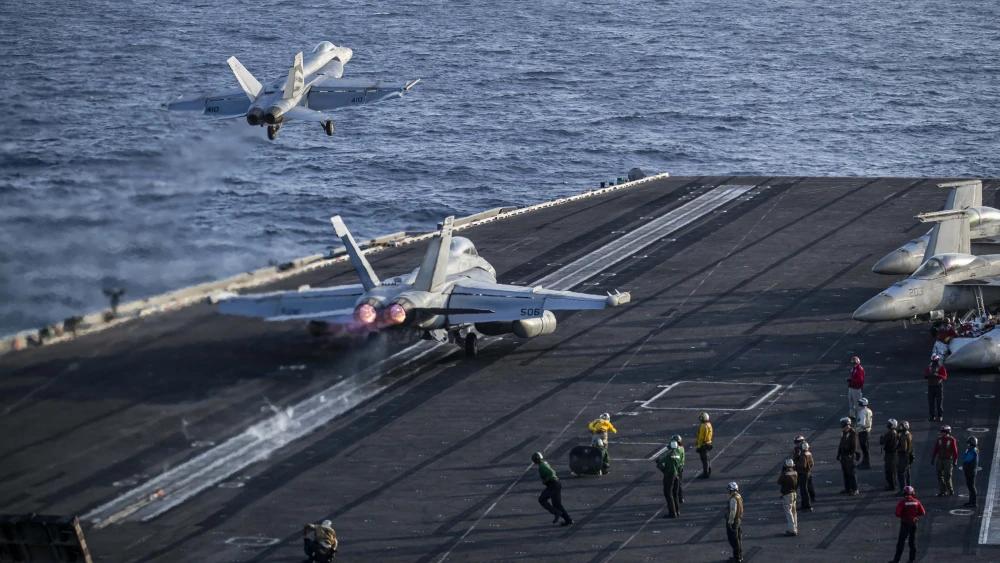
US aircraft carrier. DVIDS (Defense Visual Information Distribution Service)
The current sequence marks a turning point. Following the strike by the Islamic Revolutionary Guard Corps (IRGC) on a US base in Jordan and the resumption of US bombing in Iran, the conflict appears to be entering a new phase. Beyond the military escalation, several developments show that the war is gradually becoming internationalised, while the prospects of de-escalation are receding.
The new cycle of hostilities did not begin with the reported US strikes on north-western Iran, but with the decision by the Islamic Revolutionary Guard Corps (IRGC) to launch ballistic missiles at the US Muwaffaq Salti Air Base and CENTCOM installations in Jordan. The attack, the first claimed against a US installation since Donald Trump ordered the suspension of strikes, immediately prompted a response from Washington.
A few hours later, Iranian state media reported US strikes in the north-west of the country. At the same time, several reports pointed to a resumption of targeted killings of officials linked to Iran’s military apparatus. The operational pause seen in recent days now appears to be a thing of the past.
But beyond the exchanges of strikes, another development deserves attention: the war is gradually tending to spill beyond its original scope, drawing in new actors, new theatres and new strategic stakes.
Bab el-Mandeb: from disruption to control of shipping routes
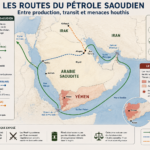
South of the Red Sea, the Houthis now appear to be pursuing a strategy that goes beyond mere maritime harassment. According to Reuters, the movement is reportedly considering imposing fees on commercial vessels using the Bab el-Mandeb Strait. Were this development to be confirmed, it would signal a profound shift in approach.
The aim would no longer be solely to disrupt shipping or strike at their adversaries’ interests, but to exert a form of political and economic control over one of the world’s main trade chokepoints. This strategy echoes the one pursued by Tehran in the Strait of Hormuz: turning control of a strategic maritime passage into a lever of regional and international pressure.
From the Caspian Sea to the Ukrainian front
A second development could also shift the balance of the conflict. The reported attack on an Iran-linked vessel in the Caspian Sea, suspected of involvement in deliveries of drones or components to Russia, could open a new chapter. The Iranian Minister of Foreign Affairs, Abbas Araghchi, has already asserted that the attack “cannot go unanswered”, clearly signalling an intention to retaliate.
The attack on an Iran-linked vessel in the Caspian Sea could also have another consequence. Beyond the logic of retaliation, an escalation of tensions with Ukraine could also serve Tehran’s interests on another level. Several signs suggest that Iran’s leaders consider Russian support to have been insufficient since the resumption of US and Israeli strikes. By creating a new source of tension between Moscow and Kyiv, Iran may hope to push Russia to step up its assistance, not through direct intervention, but through deliveries of more sophisticated weaponry, greater intelligence sharing, technological support or closer military cooperation.
The nature of Iran’s response will therefore be particularly telling. Action against a Ukrainian or Ukraine-linked vessel would remain consistent with a logic of graduated retaliation. A ballistic strike on Ukrainian territory, on the other hand, would cross a new threshold, one likely to sharply increase the pressure on Moscow to define more clearly its level of commitment alongside Tehran.
For Kyiv, such a development could also strengthen the argument that Ukraine faces not only Russia’s military capabilities but also operational support from Tehran. Without prejudging US or allied decisions, the Ukrainian authorities could use this development to make the case for strengthening Western missile defence capabilities, particularly against ballistic threats.
Beijing’s discreet message
An Iranian order for several hundred Chinese man-portable air defence systems is another significant development. The models mentioned, notably the QW-12 and FN-16, are not designed to challenge American or Israeli air superiority. They do, however, considerably strengthen defences against helicopters, heliborne operations, special forces infiltration and low-altitude air support. This distinction is crucial.
The announced deliveries of Chinese man-portable air defence systems should not be read as military assistance from Beijing to Tehran. For several weeks, China has been sending increasingly insistent signals: in particular, it has made clear to Iran that any lasting challenge to freedom of navigation in the Strait of Hormuz runs counter to its interests. Its aim, therefore, is not to back Iran unconditionally but to preserve a regional balance compatible with its own interests.
The message to Washington is even clearer. Beijing does not appear willing to confront American air operations head-on. It is, however, signalling that it regards a ground intervention aimed at toppling the Iranian regime as a strategic red line. By bolstering the means likely to complicate such an operation, China raises the potential cost of a ground offensive without becoming directly involved in the conflict.
Markets begin to price in a longer war
Early market reactions reflect this anxiety. Brent crude rose by about 7% and stood at around $89.8 a barrel on Wednesday 29 July. Traders appear once again to have priced in the risk of a lasting deterioration in the security situation in the Middle East. The rise does not merely reflect the ongoing strikes. It reflects fears that the conflict will become entrenched, disrupt the major energy routes and gradually draw in a growing number of actors.
What could now stop the war?
The question is now less military than political. In Washington, a halt to operations remains theoretically possible if the objectives being pursued are achieved or if the costs of further escalation become too high. In Tehran, the situation appears more complex.
The new cycle of hostilities was triggered by a decision by the IRGC to strike a US base in Jordan. The figures who might favour de-escalation no longer appear to be those with decision-making power over the conduct of the war. Strategic choices remain concentrated around the Supreme Leader — if he is still alive — the IRGC and the security structures directly attached to it.
Finally, China is a special case. Its interest is probably not to bring about an Iranian victory, but to prevent the war waged by the US military from leading to a ground intervention or a lasting destabilisation of the region, the economic consequences of which would weigh directly on its own interests.
A war that is changing in nature
The events of the past few hours show that the conflict is not merely spreading geographically. It is gradually becoming a confrontation in which each actor seeks to alter its adversaries’ strategic calculations, to win new backing or to rule out certain military options. The real question, then, may no longer be who wants to stop the war, but whether the centres of power now driving the escalation still have any interest in doing so.
As long as Washington believes that greater military pressure can change Iran’s strategic calculus, and as long as the IRGC considers that continuing hostilities strengthens its position, the prospects for de-escalation will remain limited. In this context, the war between Iran and the United States is no longer simply a bilateral confrontation. It is gradually becoming a conflict whose repercussions are reshaping the strategic balance of the Middle East and beyond.
Also on La Tribune des Nations
• Iran–United States: war redraws the Middle East’s strategic architecture — 22 July 2026
• Hormuz: negotiation gives way to armed intimidation — 15 July 2026
• After Hormuz, Bab el-Mandeb: the new front in the energy war — 23 July 2026
• After Hormuz, Bab el-Mandeb: the land front that could reshuffle the deck — 24 July 2026
Articles and external sources
• Iran launches missiles at U.S. base for first time since Trump paused strikes — Axios, 28 July 2026
• Yemen’s Houthis considering fees for ships sailing through Red Sea, sources say — Reuters, 29 July 2026
• Iran foreign minister says Ukraine’s attack on Iranian vessel “cannot go unanswered” — Reuters, 26 July 2026
• Iran to get Chinese shoulder-launched missile systems in weeks, sources say — Reuters, 29 July 2026
• Oil jumps nearly 7% on escalating Middle East airstrikes — Reuters, 29 July 2026
Translated from French. The French original prevails.