A girl in Panama chats with her friends on her mobile phone. © UNICEF/ Pablo Schverdfinger
More than eight in ten young people aged 15 to 24 worldwide are now online. In low-income countries, their connection rate is almost twice that of the rest of the population. Yet this hyperconnected generation is particularly exposed to threats to information integrity, including disinformation, online harassment, algorithmic bias and the malicious use of artificial intelligence (AI), the UN warned on Monday.
In a new brief published ahead of International Youth Day, the Organization urges Member States, technology companies, advertisers, the media and researchers to make the protection and participation of children and young people a priority. Last month, UN Secretary-General António Guterres called for stronger safeguards for children in the face of AI, likening emerging technologies to untested medicines and arguing for stricter regulation.
“No child should be a guinea pig for unregulated AI… When a child is harmed, the response must never be ‘the algorithm did it’,” Mr Guterres said in July at the first Global Dialogue on AI Governance.
Harms that are no accident
The note stresses that the harms young people face online are not a matter of chance. They stem in particular from business models built on monetising attention and personal data, and from design choices intended to maximise engagement and spending. Algorithms designed to keep young users online, “dark patterns”, loot boxes and other mechanisms that encourage compulsive use are all practices that can expose them to particular risks. Children are all the more vulnerable because their habits, identities and relationships are still taking shape.
AI, the document goes on, is advancing faster than efforts to govern its adoption. It is thus amplifying risks ranging from the spread of AI-generated content to exploitation facilitated by these technologies. The note also warns of advertising practices that are increasingly hard to identify, which seek to influence children and increase their spending online. “Taken together, these practices normalise pervasive commercial surveillance and manipulative design at a time when children and young people are most impressionable,” the document states.
Agents, not just victims
Children and young people are not merely potential victims, however, the UN stresses. They are also creators, journalists, advocates and movement organisers who help to shape public debate and civic life. But the same digital spaces that allow these movements to grow expose those involved — often young women, members of minorities or activists — to online harassment and surveillance.
For the UN, young people must therefore be more closely involved in research and in the development of policies designed to respond to threats to information integrity. “Children and young people are among those most affected by the current information crisis, but also among those best placed to help resolve it,” said Charlotte Scaddan, the UN’s Senior Adviser on Information Integrity. “Protecting them and including them are not conflicting goals. We must do both.”
A closing window for action
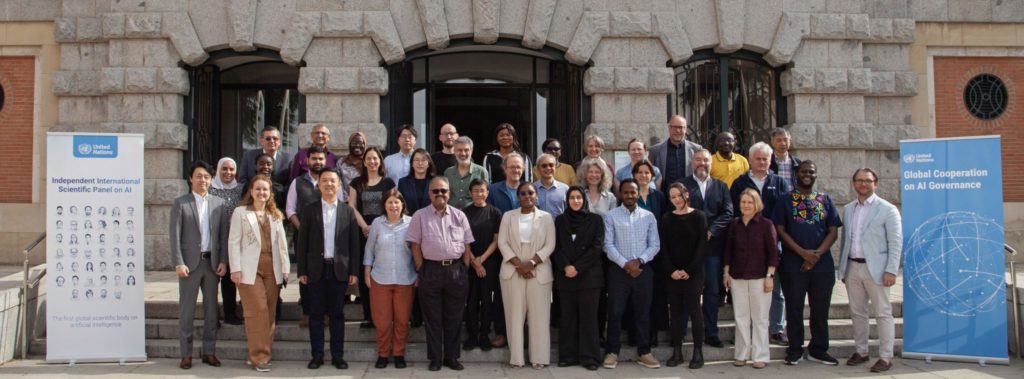
The Independent International Scientific Panel on Artificial Intelligence has delivered its first report.
Children’s online safety has moved to the heart of political debate, particularly around features that encourage addiction, behavioural advertising, content moderation and privacy protection. But with the rapid rise of AI, the UN believes that the window of opportunity to embed children’s rights in the governance frameworks for this technology is closing fast.
The note therefore calls on states to strengthen legislative frameworks, on technology companies to build children’s safety into their products from the design stage, on advertisers to respect children’s rights, on the media to engage better with young audiences and on researchers to fill existing gaps, particularly in the Global South.
At the same time, the UN is pursuing its efforts to contribute to better AI governance, notably through the Global Dialogue on AI Governance and the Independent International Scientific Panel on AI, tasked with assessing the opportunities and risks associated with the technology. “As digital technologies and information environments continue to evolve, the time has come to move, as a matter of urgency, from principles to concrete action,” the document concludes.
Translated from French. The French original prevails.