The Turkish Parliament has just adopted a historic framework for the disarmament, dissolution and reintegration of some members of the Kurdistan Workers’ Party (PKK). But Ankara’s vote raises a much broader question: what will become of the armed Kurdish architecture built up over four decades across Turkey, Iraq, Syria and Iran? The answer could reshape the regional balance of power and hasten the return of states to the centre of the game.
A historic law, but not a general amnesty
On 10 August 2026, the Turkish Parliament adopted by 468 votes out of 600 a text providing a legal basis for the PKK’s disarmament and reintegration process. The law provides for legal protections and the suspension or deferral of sentences and prosecutions for certain former fighters, while excluding, among others, those who have committed serious crimes. Abdullah Öcalan, who is serving a life sentence, is not freed under the scheme. Above all, the mechanism remains conditional: the Turkish authorities must confirm that the PKK has disarmed before it is fully applied. The text follows Öcalan’s call, issued in February 2025, to lay down arms and dissolve the organisation, and the PKK’s announcement, in May 2025, that it was ending its armed struggle.
The vote is politically remarkable. President Recep Tayyip Erdoğan’s AKP, its nationalist ally the MHP and the pro-Kurdish DEM have converged on a process that would have seemed almost unthinkable only a few years ago. But while a law can organise an exit from war, it cannot by itself guarantee the disappearance of all the military and political structures that claim the PKK’s legacy.
Will the whole of the PKK really lay down its arms?
That is the first unknown. Abdullah Öcalan, a historic figure of the Kurdish armed struggle and founder of the PKK, retains considerable authority over the movement. The PKK leadership has officially accepted the principle of dissolution, which makes large-scale disarmament credible. But the movement has long ceased to be a mere guerrilla force concentrated in south-eastern Turkey. It has cadres, networks and a cross-border presence. Nor does the text adopted in Ankara resolve the Kurdish dispute as a whole: political and cultural rights, anti-terrorism legislation and Öcalan’s status remain separate issues. There is therefore a risk that some militants will accept demobilisation while others seek to maintain a clandestine structure or join affiliated organisations.
The success of the process will have to be measured in concrete terms: the number of fighters disarmed, the evacuation of camps, the handover of arsenals, the dismantling of chains of command and the fate of cadres excluded from the Turkish framework.
Qandil: the real test lies in Iraq
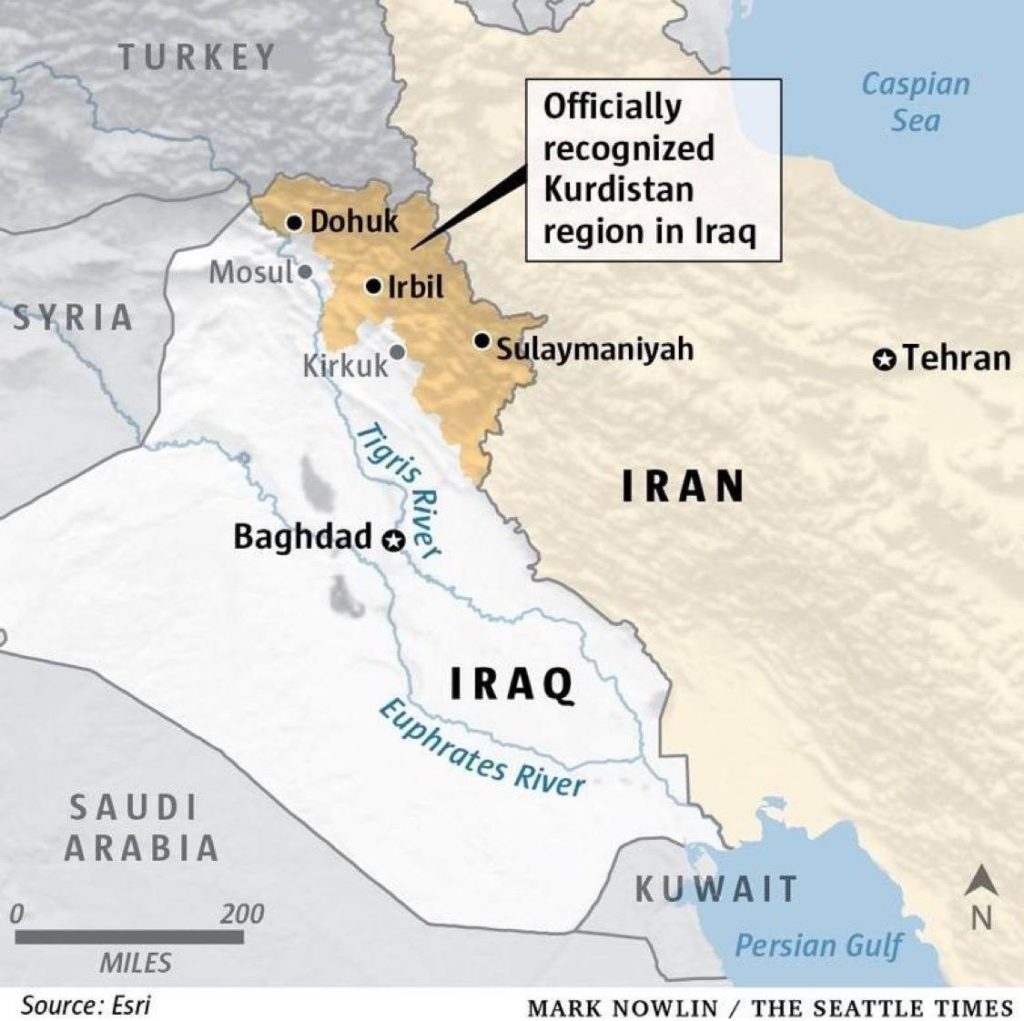
The PKK’s current military core lies largely outside Turkey, in the mountains of northern Iraq. A first symbolic weapons-destruction ceremony had already taken place in Iraq in July 2025. But a few rifles burned in front of the cameras are not enough to dismantle an organisation that has for decades enjoyed sanctuaries, logistical networks and positions in particularly difficult terrain. Iraqi Kurdistan could be one of the main beneficiaries of genuine disarmament. The war between Turkey and the PKK has brought strikes, ground operations, population displacement and the establishment of numerous Turkish military positions there. The gradual disappearance of the PKK’s sanctuaries would remove a major source of instability and give the Kurdistan Regional Government (KRG) greater control over its own territory.
But Iraqi Kurdistan is not a homogeneous political bloc. The Barzanis’ Kurdistan Democratic Party (KDP), dominant in Erbil and Duhok, has long maintained close relations with Ankara and remains a rival of the PKK. The Patriotic Union of Kurdistan (PUK), dominant around Sulaymaniyah, has historically had closer ties with the PKK and far more difficult relations with Turkey. A thaw has been under way since 2025, without erasing this strategic difference between the two main Iraqi Kurdish power centres.
This distinction will be decisive when it comes to dismantling the PKK’s networks, camps and supply chains. Erbil, Sulaymaniyah, Baghdad and Ankara will have neither the same priorities nor the same means of action. The disarmament of the PKK could therefore strengthen the KRG against autonomous armed groups, while reopening internal rivalries over control of the territories left vacant.
Baghdad and Erbil will then face an unavoidable question: if the PKK threat disappears, what becomes of the Turkish military bases in northern Iraq? Will Ankara scale them down, or will it consider that its presence now serves broader strategic interests? Peace with the PKK could thus open a new round of Turkish-Iraqi negotiations on sovereignty, the border and security.
Syria: the Kurds are no longer as indispensable as they once were
The fall of Bashar al-Assad’s regime has profoundly altered the equation. During the fight against Islamic State, the Syrian Democratic Forces (SDF) were the United States’ main ground partner in north-eastern Syria. Yet Islamic State has not disappeared: it retains clandestine cells, the capacity to carry out attacks and networks in both Syria and Iraq. The security of the prisons and camps holding thousands of jihadists and people linked to the organisation therefore remains a key argument for the Kurds when they defend keeping a military capability of their own.
The SDF is a Kurdish-Arab coalition in which Kurdish forces play a central role, notably the People’s Protection Units (YPG, Yekîneyên Parastina Gel) and the Women’s Protection Units (YPJ, YekîneyênParastina Jin). The Washington-backed agreement between Damascus and the SDF provides for the SDF’s integration into the structures of the Syrian state. The principle has been agreed, but disarmament, the chain of command, local security and control of certain infrastructure remain points of friction.
Another difficulty is less often mentioned: relations between the Kurdish structures and some of the Sunni Arab tribes of north-eastern Syria. In mixed areas, notably around Hasakah and in the area formerly controlled by the SDF in Deir ez-Zor, grievances over recruitment, local administration and power-sharing have not gone away. For Syrian Kurds, retaining security forces is also presented as a safeguard against these local tensions. This dispute could therefore slow full disarmament, even as integration into the Syrian state moves forward.
For Ankara, the dissolution of the PKK may therefore help it achieve a goal it has pursued for years: preventing a structure that Ankara regards as ideologically or organically linked to the PKK from becoming permanently established along its border with Syria. For the Syrian Kurds, the balance of power is becoming less favourable: the central Syrian government is growing stronger, Western countries are seeking to stabilise Damascus and Turkey wields growing influence over the new regional order.
Iran: could peace in Turkey shift the problem eastwards?
Iran is the other great unknown. PJAK, an Iranian Kurdish movement historically linked to the PKK’s orbit, has not automatically followed the call for dissolution. The situation in Iran is all the more sensitive given that armed Kurdish organisations have regained strategic importance in the context of the 2026 war.
US contacts with Iranian Kurdish groups based in Iraq were reported during the conflict. The American ambiguity was striking: Donald Trump claimed in April 2026 that the United States had channelled weapons intended for anti-government protesters through the Kurds, and accused the Kurds of keeping the guns. The commanders of the two largest militias interviewed by Reuters said they had received no American weapons. Tehran, for its part, continues to regard these organisations as a threat that could be used by its adversaries.
The most important scenario to watch is therefore not necessarily the physical disappearance of all PKK fighters, but their possible redistribution. What will those who refuse to return to Turkey, or who are excluded from reintegration, do? Will they remain clandestinely in Qandil? Will they demobilise? Could a faction join PJAK or other groups?
There is nothing today to suggest that a mass transfer to the Iranian front is under way. But the risk is enough to worry Ankara and Tehran alike. Paradoxically, success in the Turkish process could shift part of the centre of gravity of armed Kurdish dissent towards Iran.
The West and the end of the “Kurdish moment”
The most profound change perhaps concerns the West. After the collapse of Saddam Hussein’s Iraq and then the Syrian civil war, the Kurds had enjoyed an exceptional geopolitical window. Iraqi Kurdistan had consolidated its autonomy; the Syrian Kurds had built an administration and a military force; Washington needed the SDF against Islamic State; Damascus was too weak to retake the north-east of the country. That window is gradually closing. Baghdad is seeking to reassert its authority. Damascus is rebuilding a central state. Ahmed al-Sharaa has become an interlocutor for Washington, the Europeans and Arab capitals. Ankara is trying to turn the PKK from a military enemy into a problem of demobilisation and reintegration.
In practice, the Western umbrella is folding. Washington backed the agreement that brings north-east Syria back under Damascus’s authority and provides for the integration of the SDF into state structures. Western countries may continue to defend the rights and security of Kurdish populations, but they no longer appear willing to guarantee an autonomous military and territorial architecture over the long term. For Syria’s Kurds, this is indeed a form of strategic abandonment, even if it does not mean the end of all political support.
The question raised by the Turkish vote thus goes beyond the fate of the PKK: are we witnessing the end of the “Kurdish moment” opened up by the wars in Iraq and Syria? This is obviously neither the disappearance of the Kurdish question nor the end of the institutional autonomy of Iraqi Kurdistan. What seems to be closing is rather an interlude during which the weakening of states had allowed several Kurdish movements to build or maintain autonomous military apparatuses under external protection.
Erdoğan closes one front to open up his regional game
For Turkey, the stakes are immense. Since 1984, the conflict with the PKK has cost tens of thousands of lives, tied up considerable military resources and weighed on Ankara’s relations with its neighbours and its Western allies alike. If Erdoğan genuinely manages to close this front, he will not merely score a domestic success. He will free up part of Turkey’s political, military and diplomatic capacity at a time when the country is seeking to extend its influence in Syria, Iraq, the Gulf and beyond.
The law of 10 August could therefore mark much more than the beginning of the end of the PKK. It could signal a new stage in the reshaping of the Middle East: states are returning to centre stage, external protection is becoming less certain and cross-border armed movements are being pushed towards demobilisation, integration or marginalisation. Turkish peace does not yet mean Kurdish peace. But it is already reshuffling the cards.
Further reading in La Tribune des Nations
• Northern Iraq: Turkish military presence redraws the regional balance
• Turkey, Syria, Israel: the Levant’s new strategic balance
• Mecca Agreement: a new defence alliance redraws the Middle East
Further reading elsewhere
• Reuters — Turkish parliament passes landmark law to advance PKK peace process
• Associated Press — Turkey’s parliament approves a pardon-like bill for thousands of PKK militants
• Carnegie Endowment — A Sigh of Relief in Iraqi Kurdistan
• Reuters — Risk of missteps hangs over US-backed ceasefire deal in northeast Syria
Translated from French. The French original prevails.