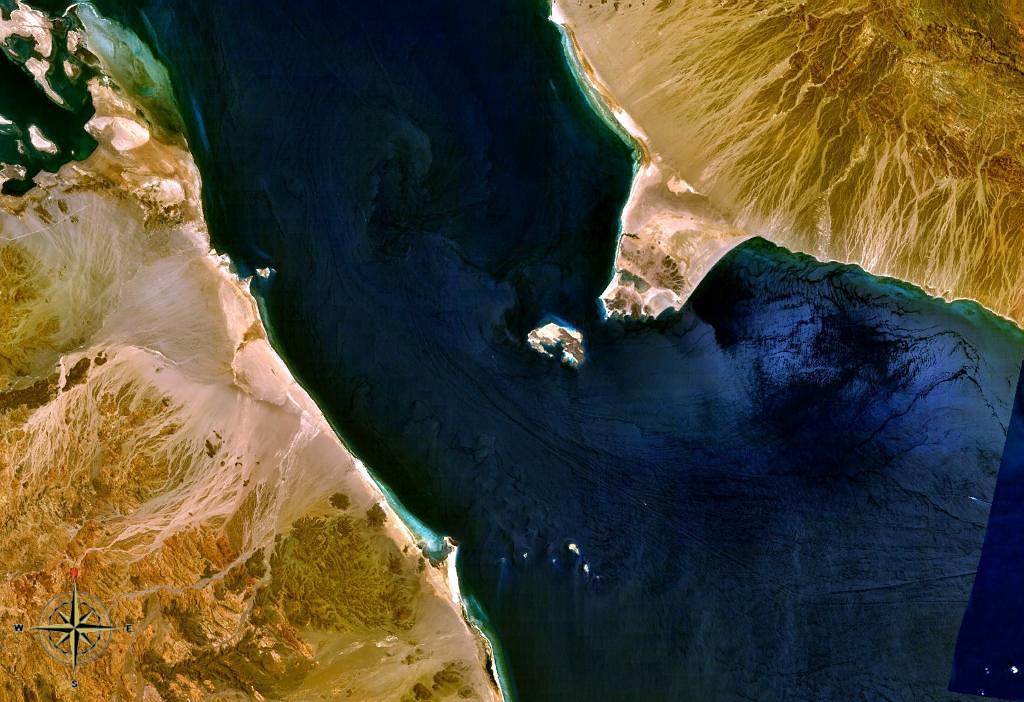
The Bab el-Mandeb Strait photographed by satellite (NASA image)
Having stepped up its exports through the port of Yanbu to get around the paralysis of the Strait of Hormuz, Saudi Arabia now sees this fallback option threatened by Ansar Allah, the armed wing of the Houthis, Yemen’s Shia rebels. They lack the means to impose on Bab el-Mandeb a military lockdown comparable to the one enforced by the Islamic Revolutionary Guard Corps in the Gulf. Their strategy is different: to convince shipowners, insurers and refiners that the passage has become too dangerous. Behind the first tankers turning back, a war against the resilience of the region’s energy networks is thus taking shape.
Yanbu was meant to bypass Hormuz
The paralysis of the Strait of Hormuz has forced the Gulf monarchies to urgently reassess their export routes. For Saudi Arabia, the most immediate response has been to make greater use of the East-West pipeline, which links the oilfields of the Eastern Province to the Yanbu terminal on the Red Sea.
In theory, this infrastructure can carry several million barrels a day from Saudi production areas to the kingdom’s west coast. It thus gives Riyadh the opportunity to avoid Hormuz and continue its exports despite Iranian pressure in the Gulf.
The Houthis take the war to the Red Sea
The use of Yanbu quickly took on strategic importance. By June, Saudi flows through the Red Sea had reached unprecedented levels. But this geographical shift in exports also created a new dependency: to reach Asian markets, tankers loaded at Yanbu must sail down the Red Sea and pass through the Bab el-Mandeb. By shifting their threats to this strait, the Houthis are therefore targeting not so much one shipping route among others as the main solution devised by Riyadh to bypass Hormuz.
On 20 July, the Houthi centre responsible for coordinating humanitarian operations issued a warning to shipping companies ordering them to stop loading or unloading goods at Saudi ports. Vessels ignoring this instruction could, according to the message, become targets. It was triggered by a specific event: forces of Yemen’s internationally recognised, Saudi-backed government struck the runway at Sanaa airport, which is under Houthi control, to prevent an Iranian aircraft from landing. The Houthis immediately condemned the action and vowed retaliation.
They presented the decision as the imposition of a naval blockade against Saudi Arabia. But the first consequences did not stem from a physical closure of the Bab el-Mandeb. They were caused by the immediate reaction of private actors.
Several tankers carrying Saudi crude to China and India turned back in the Red Sea before reaching the strait. The Xin Long Yang, the Rodos and the Amazon in particular changed course and headed back north towards the Suez Canal. Four other Saudi tankers reportedly followed a similar course afterwards.
These movements do not mean that Bab el-Mandeb is closed. They do show, however, that the Houthi threat is beginning to have the desired effect: changing shipowners’ behaviour without a naval blockade yet having actually been imposed.
And even into Saudi waters
The crisis in the Red Sea crossed a new threshold on Thursday 23 July with the targeting of two Saudi vessels, the tankers Layla and Seville, as they were sailing in the northern Red Sea. According to the information available, United Kingdom Maritime Trade Operations (UKMTO) reported an incident some 70 nautical miles off Shuqqiq, on the west coast of Saudi Arabia.
This location is particularly significant. The incident did not occur near Bab el-Mandeb, nor in international waters, but deep within Saudi territorial waters. The Houthis are thus demonstrating their ability to project their threat well beyond the strait and to strike the shipping lanes used by Saudi exports as far as the northern part of the Red Sea.
This development significantly alters the strategic reading of the crisis. Until now, Bab el-Mandeb appeared to be the main pressure point on maritime traffic. From now on, it is the entire Red Sea that is liable to become a risk zone, including the approaches to Saudi ports and to the Yanbu oil terminal, which has become essential since the disruption in the Strait of Hormuz.
This development lends particular weight to the statements of the Speaker of the Iranian Parliament, Mohammad Ghalibaf: “In a region where we do not sell oil, no one will sell it. Either everyone or no one.” The attacks are no longer aimed solely at a strategic passage ; they increasingly call into question the security of all the energy export routes of the Gulf monarchies.
In Hormuz, Iran seeks to control the strait; in Bab el-Mandeb, the Houthis seek to deter shipping The difference between the two straits is fundamental. In the Strait of Hormuz, Iran has a genuine capacity for maritime interdiction. The Islamic Revolutionary Guard Corps relies on batteries of anti-ship missiles, drones, fast attack craft, mines, coastal radars and several islands that allow it to monitor the approaches to the passage.
Geography also works in Tehran’s favour. The strait is only 55km wide, and 39km at its narrowest navigable point. It is bordered by the Iranian coastline to the north, while the islands of Qeshm, Larak and Abu Musa add depth to Iran’s defences. Even though a complete and lasting closure would remain difficult in the face of international intervention, the IRGC has the means to disrupt traffic directly and severely.
The Houthis do not enjoy a comparable position at Bab el-Mandeb, even though the strait is narrower at its tightest point than the Strait of Hormuz. It is just 27km wide between Djibouti and Yemen. The Houthis have anti-ship missiles, drones, explosive boats and probably mines. They can strike the occasional vessel, damage a tanker or stage an incident spectacular enough to alarm the markets. However, they control only one shore of the waterway and lack a navy capable of imposing lasting authority over the strait as a whole.
Their positions are also exposed to American, European, Saudi and potentially Israeli assets deployed in the region. The military bases in Djibouti likewise give the major powers surveillance and intervention capabilities close to the strait.The Houthis therefore cannot exactly replicate Iran’s Hormuz model. Their aim is not to close the strait. It is to convince shipowners that the risk has become high enough for them to choose another route of their own accord.
Perception of risk becomes a weapon
To achieve a strategic outcome, the Houthis do not need to physically stop every vessel. A few successful attacks, or even the credible threat of an imminent one, may be enough to trigger a chain reaction: rising insurance premiums, the suspension of some scheduled services, crews refusing to sail, charter contracts being put on hold and tankers being rerouted.
The growing number of diversions and a handful of incidents confirm that the Houthi strategy is beginning to have the desired effect. Since the attack on two Saudi tankers, the Encellia and the Layla, on 23 July, the list of tankers and merchant vessels choosing to change course rather than expose themselves to the threat has kept growing. Perceived risk is thus becoming an economic factor in its own right, even before a physical blockade of the Bab el-Mandeb Strait has been put in place.
Asian refiners are now considering several options. Some of the crude could be shipped north towards the Suez Canal, pass through Egypt’s SUMED pipeline and then be reloaded onto vessels in the Mediterranean. Other cargoes could go round Africa via the Cape of Good Hope.
These routes remain viable, but they are longer and more expensive. The detour around Africa can add several weeks to the voyage. As for the very large and ultra-large crude carriers (VLCCs and ULCCs), they cannot transit the Suez Canal fully laden and must transfer part of their cargo through the SUMED network. The Houthi threat thus acts as a strategic tax on global energy trade: oil keeps flowing, but more slowly, with greater difficulty and at a higher cost.
Two straits, one battle
Hormuz and Bab el-Mandeb should no longer be seen as two separate crises. The first blocks or restricts the direct export of oil produced in the Gulf. The second threatens the route used by Saudi Arabia to bypass that obstruction.
The logic is plain to see: the IRGC applies military pressure on Hormuz; Riyadh diverts more oil to Yanbu; the Houthis threaten ships calling at Saudi ports; tankers hesitate to pass through the Bab el-Mandeb; refiners look for longer routes via Suez, SUMED or the Cape of Good Hope.
Iran and its allies are therefore no longer merely seeking to control a strait. They are seeking to prevent the emergence of an alternative route reliable enough to neutralise their leverage. Meanwhile, the decline in traffic through Hormuz continues. On 22 July, only three tankers passed through the strait, with no very large crude carriers or LNG carriers observed. The simultaneous pressure on Hormuz and the Bab el-Mandeb partly explains the latest rise in oil prices, with Brent breaking through $100 a barrel on 23 July.
A difficult military intervention
Saudi Arabia has said it will protect its ports and maritime interests. The United States has also warned that it could intervene if the Houthis carry out their threats. The US President declared on Truth Social that if the Houthis attacked ships in the Red Sea again, the United States would inflict “major military punishment” on the Houthis and Iran.
A fresh military campaign against the Yemeni movement would, however, be difficult. The Houthis have shown that they can survive years of Saudi bombing, followed by the US and European operations launched to protect commercial shipping. Strikes can destroy radars, launchers or depots, but they cannot guarantee the lasting elimination of a mobile and dispersed capability.
Washington would also have to redeploy ships and air assets at a time when its forces are already heavily committed against Iran and in monitoring the Gulf. US officials acknowledge that a new front in the Red Sea would put further strain on munitions stockpiles, intelligence and available naval assets.
Nor does the issue concern only the United States and Saudi Arabia. France has forces in Djibouti and the United Arab Emirates. China has its first overseas military base in Djibouti and remains heavily dependent on energy imports from the Gulf. Turkey has a military presence in Somalia.
A new escalatory factor has emerged with Pakistan’s warning to the Houthis. Islamabad has cautioned that any hostile action targeting Pakistani vessels would trigger a response, “including the use of force”.
Bab el-Mandeb could thus become an arena where powers converge that do not necessarily share the same political objectives, but all have a common interest in keeping shipping moving.
The Iraqi overland solution
With both major straits vulnerable, a third route is gaining importance: exporting Iraqi oil overland to the Mediterranean. Baghdad and Damascus are considering bringing the Kirkuk–Baniyas pipeline, out of service for several decades, back into operation. The United States officially supports the project, which would give Iraq an export route independent of Hormuz. Iraq has already begun using Syrian ports for certain petroleum products and is considering extending the arrangement to crude.
A second route exists to the north, via the Kirkuk–Ceyhan pipeline. Turkey and Iraq must, however, renegotiate their agreement, with Ankara refusing to renew the existing arrangement without changes to its terms. These corridors offer important alternatives, but they carry a different vulnerability. The threat is no longer primarily maritime: it is now overland.
The pipelines run through areas that remain exposed to sabotage, residual jihadist groups, militias, drones and clandestine networks linked to Iran. The security situation is genuinely fragile: during his visit to Syria, the head of TotalEnergies said that some areas remained too dangerous for technical teams to be sent in. Repairing a pipeline will therefore not be enough. Hundreds of kilometres of pipes, pumping stations, depots and terminals will have to be protected.
A Turkey–Iraq–Syria–Mediterranean corridor
This vulnerability is not inevitable, however. If Ali al-Zaidi’s Iraqi government succeeds in restoring the state’s monopoly on arms and curbing the autonomy of the militias, Iraq could gradually regain control of the territory crossed by the future energy corridors.
Broader cooperation could then take shape: Iraq would control the production areas, the pumping stations and the main overland routes; Syria would secure the western section of the corridor as far as the Baniyas terminal; Turkey would protect and develop the northern route to Ceyhan; and the United States would provide intelligence, surveillance assets, technical assistance and a deterrent capability.
Such an architecture would profoundly transform the scope of the project. The Kirkuk–Baniyas pipeline would no longer be merely a piece of oil infrastructure. It would become the economic backbone of an area linking Iraq to the Mediterranean and gradually removed from the domination of Iranian-backed armed groups.
Protecting it could also foster security cooperation between Baghdad and Damascus. As early as April 2025, the two governments were already linking talks on restoring the pipeline to counter-terrorism, border control and the expansion of trade.
A war on energy resilience
The current confrontation now goes beyond the question of closing a strait. At Hormuz, Iran is using its geography and military capabilities to disrupt flows directly. At Bab el-Mandeb, the Houthis are exploiting the perception of risk to push private operators to withdraw of their own accord. In Iraq and Syria, the battle could shift to the protection or sabotage of overland corridors. Tehran’s real objective may be less to close a route permanently than to convince the markets that no bypass is entirely safe.
But this strategy also has its limits. Iran can threaten each route taken in isolation. It would find it far harder to neutralise Hormuz, Bab el-Mandeb, Ceyhan and Baniyas simultaneously if their protection were part of a coordinated strategy involving Iraq, Syria, Turkey, the United States and the Gulf states
The battle over energy corridors is thus becoming a political and territorial one. It will determine not only how Gulf oil reaches international markets, but also who controls the territories lying between the Gulf, the Red Sea and the Mediterranean.
The latest diversions show that this battle is already under way. Bab el-Mandeb has not yet been closed, but it is beginning to lose one of its essential qualities: predictability. In shipping, however, a loss of confidence can have effects almost as significant as a military blockade.
Read the La Tribune des Nations article:
• https://ltdn.org/iran-etats-unis-la-guerre-redessine-larchitecture-strategique-du-moyen-orient/
• https://ltdn.org/ormuz-la-negociation-a-cede-la-place-a-lintimidation-armee/
• https://ltdn.org/turquie-syrie-israel-les-nouveaux-equilibres-strategiques-du-levant/
External links:
Translated from French. The French original prevails.