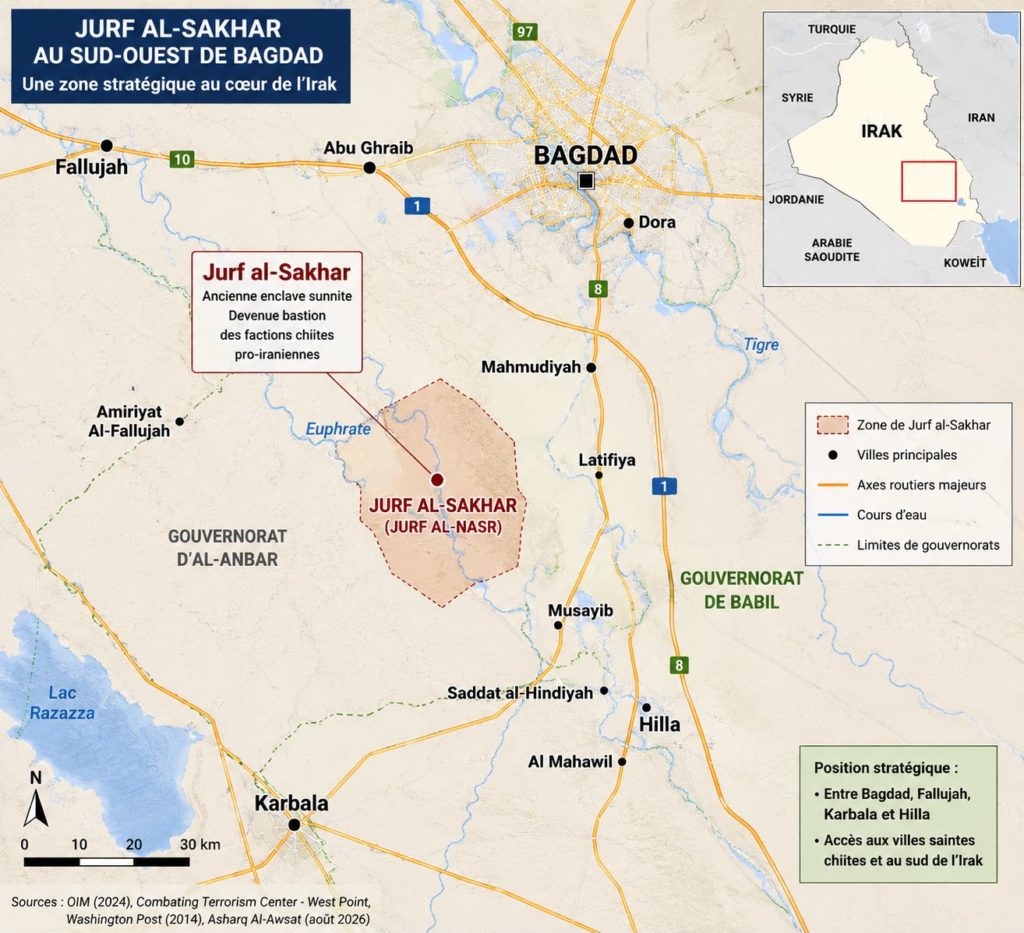
Some fifty kilometres south of Baghdad, the area of Jurf al-Sakhar remains almost unknown to Western audiences. This formerly Sunni area, emptied of most of its population during the war against Daesh in 2014, has become one of the most closed-off strongholds of pro-Iranian Shia factions. As the government of Ali al-Zaidi seeks to bring weapons under state control by 30 September, Jurf al-Sakhar could become the first concrete test of Iraq’s efforts to reclaim its sovereignty.
Jurf al-Sakhar — remember the name — was renamed Jurf al-Nasr, “the bank of victory”, after it was retaken in 2014 by government forces and Shia militias. Located in Babil Governorate, on a bend of the Euphrates, it commands a particularly sensitive transit area between Baghdad, Fallujah, Hilla and the Shia holy cities of Najaf and Karbala. Its value therefore lies not in its size but in its position. The area borders the Sunni west, the approaches to the capital and the routes leading to the country’s Shia heartland. Controlling Jurfal-Sakhar means being able to monitor roads used by Shia pilgrims, but also logistical corridors linking Baghdad to the western provinces and, further afield, to Syria.
This geography explains why the area was contested for years. Before 2014, Jurf al-Sakhar was already a foothold for Sunni jihadist groups capable of threatening Baghdad and the roads to Karbala. When Daesh seized it during its offensive in Iraq, retaking the area became a strategic priority.
2014: the victory over Daesh that transformed the area
In the autumn of 2014, after several months of fighting, Iraqi forces and several thousand Shia fighters retook Jurf al-Sakhar from the Islamic State group. Some of these fighters had been mobilised in the vast movement triggered by the call from Iraq’s Grand Ayatollah Ali al-Sistani to defend the country after the fall of Mosul. The ground offensive was also part of the broader campaign against Daesh backed by the US-led international coalition. The Hashd al-Shaabi, or Popular Mobilisation Forces, then took on decisive importance. It brings together a multitude of groups, mostly but not exclusively Shia, some of which predated 2014 and had long maintained close ties with Iran. The organisation was later legally integrated into Iraq’s security apparatus, without, however, doing away with the separate chains of command of several of its components.
The human cost is considerable. The “Washington Post”, which was on the ground after the fighting in October 2014, estimated at the time that around 80,000 people from the largely Sunni area of Jurf al-Sakhar had left. Later estimates vary depending on whether they refer to the town centre, the sub-district or the surrounding villages. The International Organization for Migration (IOM), for its part, documented the displacement of around 39,000 people from the town of Jurf al-Sakhar between June and July 2014.(Washington Post ; IOM)
The residents have gone, the militias remain
What sets Jurf al-Sakhar apart begins after the military victory. Across much of the Iraq retaken from Islamic State, the displaced have gradually returned to their towns. In Jurf al-Sakhar, the return of the Sunni population remains blocked. What was meant to be a temporary security measure has become a lasting situation. A study published by the IOM in 2024 describes Jurf al-Sakhar as one of the clearest cases of protracted displacement in Babil Governorate. Those interviewed identify the security set-up and the control exercised by the Popular Mobilisation Forces as the main obstacle to return. The report names Kataeb Hezbollah as the force controlling the area and stresses that the lack of returns can no longer be explained solely by the destruction or the explosive devices left behind by Islamic State: it has become a matter of power, security, property and reconciliation. (IOM report 2024)
Kataeb Hezbollah: an Iraqi stronghold at the heart of Iran’s network
The Hashd al-Shaabi is not a homogeneous organisation. Some of its units are closely tied to the Iraqi state, while others enjoy considerable political and military autonomy. Kataeb Hezbollah belongs to this second category and is one of the Iraqi factions closest to Tehran. Since 2020 the movement has been led by Ahmad al-Hamidawi, also known as Abu Hussein al-Hamidawi. Its history is closely bound up with the Quds Force of the Islamic Revolutionary Guard Corps (IRGC). The US Treasury considers that Kataeb Hezbollah has been funded, trained and supported by the Quds Force, the IRGC special unit responsible for external operations. It also documents training provided to its members by Lebanon’s Hezbollah, notably in explosives, rockets and combat tactics.
Kataeb Hezbollah and Lebanon’s Hezbollah therefore belong to the same Iranian strategic ecosystem, but they are not a single organisation and do not answer to a common chain of command. Public sources make it possible to establish that Kataeb Hezbollah is heavily dependent on the Quds Force for funding, training, weapons and coordination. They do not, however, make it possible to assert that Iranian officers formally hold the main command posts of the Iraqi militia.(US Treasury ; Reuters)
Jurf al-Sakhar has become one of Kataeb Hezbollah’s main military sanctuaries. Research by the Combating Terrorism Center at West Point describes the area as an important link in a strategic corridor connecting southern Baghdad with the routes of western Iraq and the Syrian border. For years, access for government institutions has been extremely limited, and there have been recurring reports of camps, depots, drone- and missile-related facilities and command centres.
Why is Zaidi turning his attention to Jurf al-Sakhar now?
The issue has been abruptly thrust back into the spotlight by the policy of the new Prime Minister, Ali al-Zaidi. His appointment was welcomed in Washington, which now openly backs his determination to strengthen the authority of the state. It would nonetheless be an overstatement to portray him as a leader simply “imposed” by the Americans: his rise to power is the product of the balance of power within Iraq, and it was also initially given an official welcome by Tehran. Since then, the standoff has hardened. Baghdad has set 30 September 2026 as the deadline for bringing weapons under state authority. Several pro-Iranian factions, among them Kataeb Hezbollah, Harakat Hezbollah al-Nujaba and Kataeb Sayyid al-Shuhada, have refused to give up their military capabilities.
Retaking the ground without triggering a war
The information published on 12 August by Asharq Al-Awsat casts the issue in a new light. According to several Iraqi sources, the government is preparing a strategy for the period after 30 September that would not rely on a frontal assault on the strongholds of the pro-Iranian Shia factions. Instead, the idea would be to deploy the army, the Counter-Terrorism Service and elite units around their operational centres and along the roads that lead to them.(Asharq Al-Awsat, 12 August 2026)
Checkpoints would gradually be set up to monitor movements of materiel, with drones and missiles the first priority for seizure. Asharq Al-Awsat reports that some trial checkpoints have already intercepted shipments of drones. The cordon would then be tightened until the factions faced a choice: hand over certain sites to the official institution, move their capabilities at the risk of having them seized, or take responsibility themselves for a confrontation.
Two areas are explicitly named among the first targets: Jurf al-Sakhar, a Kataeb Hezbollah stronghold, and Jurf al-Nadaf, south-east of Baghdad, where Harakat Hezbollah al-Nujaba has facilities. The same plan would eventually provide for the withdrawal of Hashd brigades from several cities and their redeployment according to decisions taken by the military chain of command rather than by faction leaderships.
The Qaani paradox
This strategy makes full sense in light of the unannounced visit to Baghdad on 10 August by Esmail Qaani, commander of the Quds Force, the IRGC unit responsible for external operations and for relations with Iran’s regional allies. Qaani met leaders of the Shia Coordination Framework and several heads of armed factions. According to consistent sources cited by Alhurra, Al Jazeera and The New Arab, his message was twofold: Tehran does not want the factions to hand their weapons over to the state now, but it also wants to prevent them from clashing with the Iraqi security forces.
The formula sums up Iran’s dilemma: preserving the military instrument that has for years been one of the pillars of Tehran’s influence in Iraq, without provoking open war with an Iraqi state that is seeking precisely to regain its sovereignty. (The New Arab; Al Jazeera)
Iraqi sources also claim that Qaani left Baghdad without meeting Ali al-Zaidi in person. This has not yet been independently confirmed to a degree sufficient for it to be presented as established fact. If confirmed, however, the symbolism would be powerful: the head of the Quds Force would have spoken to Tehran’s political and military proxies without being received by the Prime Minister, who is trying to bring those very same actors back under the authority of the state.
Weapons… and the shipping of oil Iraqi oil through the Strait of Hormuz
Qaani’s visit also revealed how closely the militia question is intertwined with Iraq’s economic vulnerabilities. The talks covered the possibility of guaranteeing passage for Iraqi oil tankers through the Strait of Hormuz, which has become a major strategic lever since the war against Iran. The New Arab reports that Iraqi officials asked Tehran for a firm commitment allowing Iraqi tankers to transit. Unverified Iraqi sources have put forward a more dramatic account: Qaani is said to have proposed that Baghdad postpone or abandon, after 30 September, its plan to bring weapons under state control in exchange for an Iranian green light for oil shipments. This precise wording has not been officially confirmed and should therefore be treated with caution. But even without assuming that an explicit bargain was struck, the fact that the two discussions took place at the same time is telling. Iraq is seeking to regain control of the weapons on its territory at the very moment when its economy remains exposed to a strait to which Iran can disrupt access. Weapons and oil thus find themselves at the heart of the same power struggle.
Jurf al-Sakhar: the territorial test
Jurf al-Sakhar could turn Qaani’s paradox into a practical test. If government forces control the roads, seize drones and missiles in transit and gradually erode the stronghold’s logistical autonomy without directly attacking its facilities, the factions will have to choose between ceding ground and crossing the threshold of confrontation themselves.
This may be where the real innovation in Baghdad’s strategy lies. Zaidi probably cannot disarm the whole of the Hashd al-Shaabi and the pro-Iranian groups within a few weeks. But he can try to reclaim the core functions of the state one by one: controlling the roads, deciding where weapons are moved, enforcing access for the security forces and preventing any part of the country from remaining permanently beyond the government’s authority.
A question of sovereignty, but also of people
The issue cannot, however, be reduced to a duel between Baghdad and Tehran. Behind the military stronghold lies a population that has been displaced — and, for many families, effectively driven out by the fighting and its aftermath — for more than a decade. The state’s reassertion of control over the area would only make sense if it finally opened a serious discussion on the return of Sunni residents, security, property rights, individual accountability and reconciliation. A hasty return, without security guarantees or a justice mechanism, could rekindle some of the tensions that fuelled the rise of Daesh. Yet keeping a population out of its homeland indefinitely in the name of security would entrench an exceptional situation that has become permanent.
Jurf al-Sakhar: a real-life test for the new Iraq
The battle ahead, then, is not necessarily a military one. It may instead be a test of control, patience and sovereignty. If Baghdad manages to bring the state back into Jurf al-Sakhar without triggering a war with Kataib Hezbollah, it will have shown that a monopoly on the use of force can begin with regaining territory, even before full disarmament.
Jurf al-Sakhar could thus become the place where the question that now dominates all of Iraqi politics is put to a concrete test: who really exercises sovereignty in Iraq, Baghdad or Tehran?
Further reading – La Tribune des Nations
• Facing the militias, Zaidi opens a front against corruption
• End of the international coalition and the future of US troops in Iraq
• Iran–United States: war redraws the strategic architecture of the Middle East
External sources and documents
• Reuters – Who is Kataib Hezbollah, the group blamed for killing US troops? (2024)
• U.S. Treasury – Kataeb Hezbollah, funding and training by the Quds Force and Lebanese Hezbollah
• The New Arab – Qaani holds secret Iraq talks on militias and Hormuz (11 August 2026)
Translated from French. The French original prevails.