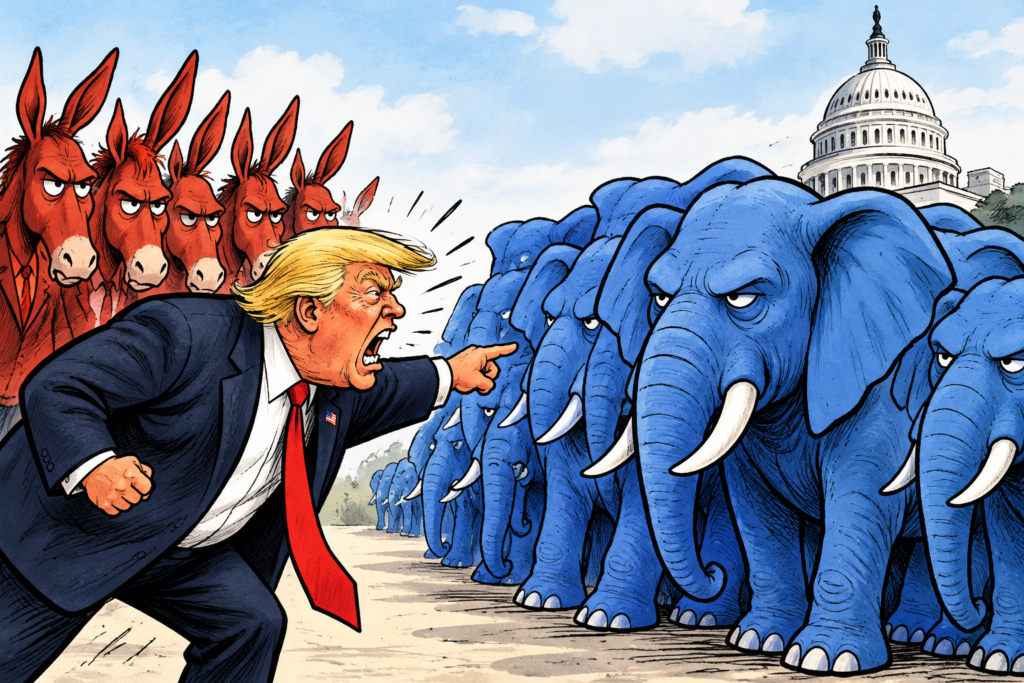
The relationship between citizens and the members of the House and of Congress lies at the heart of American representative democracy. It is no coincidence that one of Alexander Hamilton’s most famous quotations is inscribed above the entrance door of the House of Representatives: “Here they act by their immediate representatives”. Representatives and senators do not, however, share one and the same understanding of the political representation of citizens. Some believe that their primary role is to be the spokespeople of their voters; others hold that they must above all defend the interests of the nation as a whole […] The 1994 mid-term elections had given the Republicans a majority in both chambers of Congress following the 1994 “Republican Revolution” led by Newt Gingrich under Bill Clinton. This had not happened since the first part of Eisenhower’s term, between 1953 and 1955. As a result, the leadership of Congress changed, the committee structure and the rules evolved, and public policy itself would undergo a genuine revolution (Rieselbach, 1995).
Americans are due to return to the polls for the midterms this year. These are the mid-term elections that renew the House of Representatives (and a third of the Senate). They will take place on 3 November 2026. Given the president’s relationship with the law – he has not hesitated to declare: “When you think of it, there shouldn’t even be an election” – there is reason to worry about whether he will respect the election result. He has also sought to sway the vote through redistricting, a census designed to exclude immigrants, and purges within the administration (notably of the services responsible for monitoring the White House’s actions and democratic processes). Will Donald Trump try to override the election after doing everything he can to reshape the electorate in his favour? The question grows more pressing by the day (Le Clerc, 2026).
Record and presidential job approval rating
A little over three months after he moved into the Oval Office, the US president’s popularity rating had fallen to a degree rarely seen across the Atlantic. According to a poll by SSRS for the US network CNN, 41% of Americans then approved of Donald Trump’s policies, a drop of 7 points since February. Economic and financial instability, the war in Ukraine, budget cuts… There are many sources of tension. A record for the start of his term that is more than controversial (Chambon, 2025). A year after President Trump’s inauguration, Chuck Schumer, the Democratic leader in the Senate, declared: “Trump wants to rule like a king. The further he goes, the more unhinged and unpopular he becomes.”
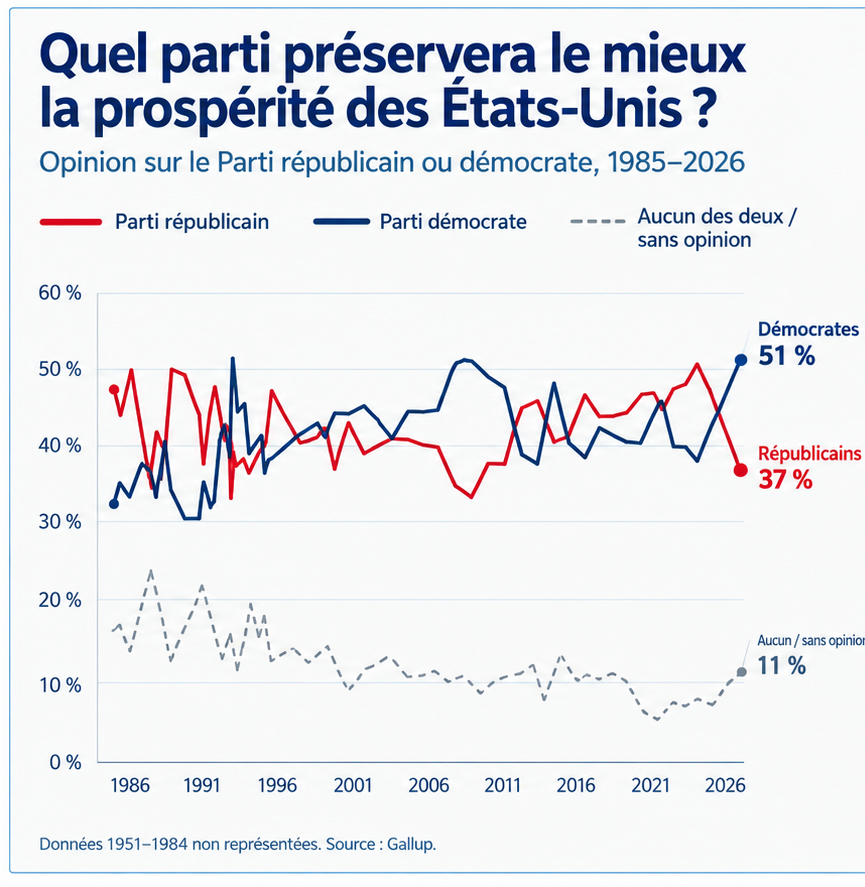
The Democratic opposition hopes to capitalise on Americans’ discontent to wrest control of Congress, where it is currently in the minority, at the midterm elections. In a recent CBS/You Gov opinion poll, 74 % of respondents said the president was not doing enough about prices, and 53 % thought he was spending too much time on foreign policy (Le Parisien and AFP, 2026). On 13 October, Gallup reported that Americans believe the Democratic Party would be best placed to keep the country prosperous. A narrow majority of Americans polled (51%) even think the Democratic Party would be better able to ensure the country’s prosperity, against 37% for the Republican Party. This 14-point lead for the Democratic Party is the largest recorded on this question since 2007, when it led by 20 points (see Chart).
Even before the joint US-Israeli military operation against Iran was launched on 28 February 2026, the US president and his family reportedly earned $57.4 million from the sale of WLFI tokens over the period from December 2023 to December 2024, according to a financial disclosure published on 13 June 2025 by the Executive Branch Personnel Public Financial (Report-OGE Form 278° US Office of Government Ethics). This family enrichment is poorly received in several sections of American society, given that the world’s leading economic power (the United States) ranks 21st in the world with a Human Development Index (HDI) of 0.927, and the gap is even more striking with the IHDI (inequality-adjusted HDI), on which it falls to 31st place. According to the 2026 report of the United Nations Development Programme, this situation stems from a structural cause: a non-universal healthcare system, income inequality and a life expectancy of 76.4 years that is stagnating far behind the top twenty countries in the ranking (82-85 years on average).
Moreover, the war launched by the United States and Israel is not only contrary to the Charter of the United Nations and illegal, it is also illegal in the means employed : an attack on a school, the destruction of civilian infrastructure, forced displacement… (Brabant and El Azzouzi, 2026). One of the direct consequences of the air strikes is the blockade of the Strait of Hormuz, which has provoked retaliation in the form of missile strikes on oil tankers, creating uncertainty over the safety and freedom of maritime transport and the long-term viability of energy infrastructure.
The inevitable result was a lasting rise in fuel prices, which feeds automatically through to the prices of food and manufactured goods, along with pressure on freight, corporate margins and household consumption. This hardly encourages voters to look favourably on President Trump’s policies, particularly as the Iranian nuclear issue, the primary justification for the military intervention, remains unresolved. Trump’s promise to refrain from any attack until 3 November 2026 does not settle these disputes.
The repercussions were swift. And the political decisions taken to bring prices down have drawn criticism :
- When it comes to food, the problem lies in the failure to consult voters in farming and intensive livestock regions. Republican lawmakers, many of whom had until now refrained from criticising the US president, have publicly denounced his beef import plan. The president of the American Farm Bureau Federation, the country’s largest farm lobby, lambasted the measure, calling it a heavy blow to ranchers’ finances. Outgoing Senator Thom Tillis was also sharply critical: “If you think subsidising beef for a while is going to satisfy farmers and lead to a systemic drop in prices, you are mistaken. That is not happening.” Christopher Barrett, an agricultural economist at Cornell University, told Foreign Policy : “The farming community has shown that it is prepared to tolerate a certain amount of indignity and harm, but there is a limit to what it can bear before it revolts” (Lu, 2026).
- Soaring fuel prices are the main driver of voter discontent ahead of the midterm elections, and have even irritated G7 leaders, with President Trump threatening to impose a US embargo on diesel exports (de Vergès, 2026) and making an untimely announcement that he would lift sanctions on Russian oil without consulting Congress. This runs counter to the law passed by Congress in 2022, known as the “Ending Importation of Russian Oil Act”. The Act bans the entry into the United States of oil and energy products from Russia, including diesel, with the aim of depriving Moscow of revenue that could fund its war in Ukraine. The law does provide for the ban to be lifted, but only under strict conditions (Maubian, 2026). Donald Trump is seeking to curb the surge in fuel prices, which has become a liability for Republicans on the campaign trail, but so far to no avail. The recent deal with Russia to import diesel changes nothing. It amounts to the equivalent of one day of global consumption – a drop of diesel in the ocean, so to speak. Ron Brownstein recently published a telling statistic: only 17% of new pick-up buyers are Democrats. Around 60% are Republicans, and the rest are independents, probably Republican-leaning independents. With rising fuel prices, Trump is therefore facing a direct challenge at the very heart of his electorate.
The midterms: a protest vote
Donald Trump’s approval rating in the polls generally stands between 35 and 40%. Yet unless a party has a president whose approval rating exceeds 60%, as was the case for Bill Clinton in 1998 and George W. Bush in 2002, it will suffer losses in the midterm elections. […] Since the Second World War, the president’s party has lost an average of 26 seats in the midterms[…] Ahead of Joe Biden’s 2022 midterm elections, John T. Woolley, a political scientist at the American Presidency Project, found that in midterm elections between 1936 and 2018, “the six presidents whose approval stood between 40 and 45% saw their party lose between 13 and 63 seats, with an average loss of 36 seats in the House of Representatives”. Joe Biden fell within that approval range; the loss of nine seats in the House of Representatives therefore brought that average down to 32. However, for most of the past two months, Donald Trump’s approval rating, according to the Real Clear Politics website, has remained below 40%. According to Gallup’s Presidential Job Approval Center, only two post-Second World War presidents have had an approval rating below 30% at midterm elections: Harry S. Truman, for the 1946 and 1950 midterms, and George W. Bush, for the 2006 midterms (Scher, 2026). It should be noted, however, that the American Gallup institute has, after 88 years, ended its regular tracking of presidential popularity, the “Presidential Job Approval Rating”.
Public confidence in press freedom in the United States continues to erode, while trust in the news media remains among the lowest ever recorded by Gallup. Many Americans do not share a common view of their media environment, given the partisan divides over perceptions of freedom and trust in the media. Views on press freedom appear closely tied to which party holds power, whereas views on trust show more persistent partisan divides, with Republicans far more distrustful than Democrats. Both trends raise questions about the media’s ability to hold power effectively to account (Vigers, 2026). And on 18 September 2026, President Trump announced that he was barring CNN, MSNOW and Politico from the White House. He accuses them, without giving details, of spreading fiction and lies (France 24, 2026). However, on 13 October, a federal judge extended the court order blocking the ban, and journalists from these outlets were able to return to the White House.
The information battle over the polls
The question is this: why did the journalists and rolling news channels that drive American political debate give so much weight to a plainly aberrant poll and almost no media coverage to the polling average compiled by RealClearPolitics, whose accuracy has been beyond reproach for two decades? Over time, polls have become an integral part of this information war. Depending on its partisan leanings, each media outlet uses the poll results it likes and ignores those it dislikes (Zito, 2025). It may therefore be that some Republican voters, weary of the president’s unkept promises to bring prices down, will stay away from the polls.
As part of the defamation suit he has brought against the New York Times, the president recently included a poll conducted by the newspaper in partnership with the academic institution Siena College, which showed a 3-point fall in his approval rating between September 2025 and January 2026 (from 43% to 40%). The move follows legal action taken against the pollster Ann Selzer after the publication of election surveys in Iowa (Dormagen, 2026).
And the economy?
Unemployment, which stood at 4.2% in September, remains well below the 21st-century average. Inflation, at 3.4% year on year in August, is less than one percentage point above the average of the past 25 years. Overall growth, currently estimated by the Federal Reserve at 2.3% this year, is in line with the economy’s long-term potential. This dashboard cannot explain why only 26% of Americans approved of Trump’s economic performance in an Associated Press/NORC poll last week, a figure that has Republicans fearing disaster in the midterm elections. How can it be explained?
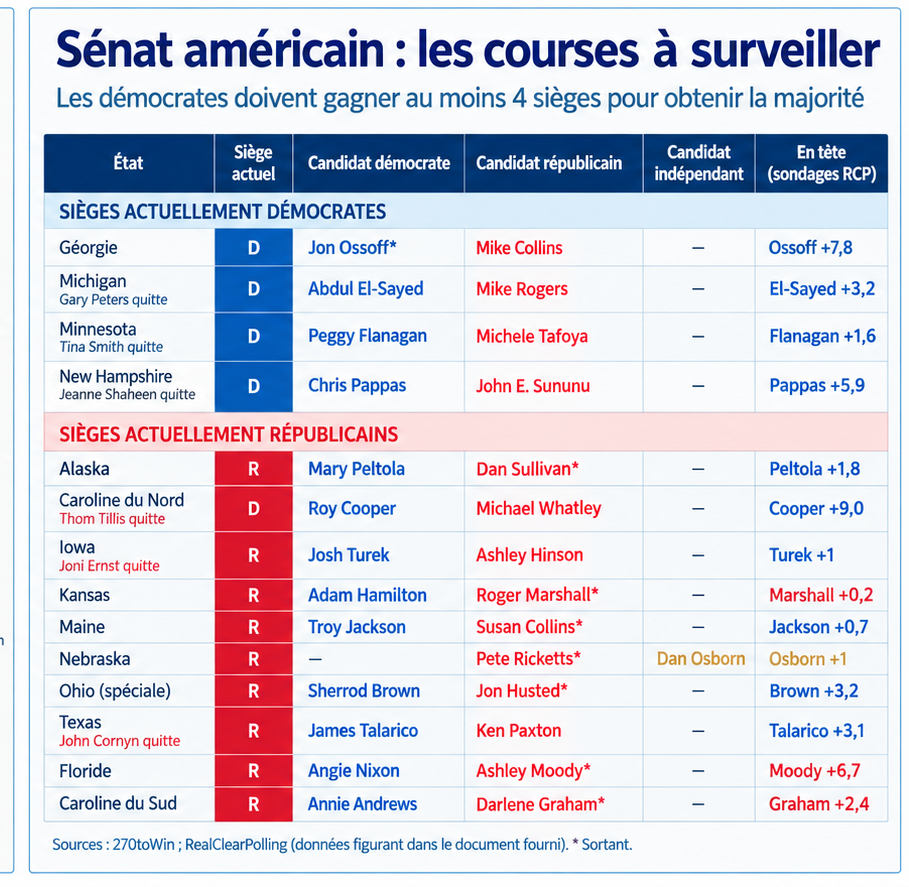
Two years after campaigning on the promise of swift improvements, Americans are finding that his policies have failed. Meanwhile, the billionaire president openly describes their struggles with housing affordability as a “hoax” (Harwood, 2026). Rural voters and farming communities, Republican strongholds, have been particularly hard hit by tariffs and the price of diesel, which partly explains the surprising competitiveness of Democratic candidates for the Senate and for governor in states such as North Carolina, Ohio, Texas, Maine, Iowa and Alaska (see Table).
Former President Barack Obama said he was pleasantly surprised by the announcement from the specialist website DecisionDesk HQ, which put the opposition party’s chances of retaking the Senate majority at 75%, and stated : “There are states in play right now that I would never have imagined being competitive “ (Huffpost, 2026). Trump’s falling popularity and his economic record should translate into substantial gains for the Democrats, including in regions where, a year ago, most observers would not have imagined a Democratic victory (Scher, 2026).
What if the blue wave materialises ?
What will become of Donald Trump if he loses the midterm elections ? “He will be a lame duck”, according to Jean-Éric Branaa’s analysis (Verro, 2026), meaning he will have less power. If the Democrats take control of Congress, this could lead to potential gridlock. With control of the purse strings, they would have the power to block the administration’s policy initiatives. It would also give them the right to set up committees of inquiry, which would force the representatives of institutions to exercise restraint. Impeachment proceedings are also possible. They would not succeed, but Donald Trump has already faced two impeachments over his two terms. He will nevertheless be able to take decisions by executive order, as he has done extensively so far.
Donald Trump’s intentions are hard to pin down, so freely does he lie, delude himself and make false promises. He has plenty of reasons for wanting to see out his term: pomp and ceremony in an outsized new ballroom, the settling of personal scores, above all with the heads of certain media groups, immunity from prosecution, and considerable personal enrichment through the White House’s powers to punish or reward. Faced with a Democratic victory, might a fresh act along the lines of the storming of the Capitol be feared?
This businessman, ruined and riddled with debts and losses before his first term, revealed in his 2025 financial disclosure a profit of $1.1 million an hour for a 40-hour week! He will probably rake in even more dollars in 2026, which he has had exempted from tax by the US Internal Revenue Service (IRS).
References
- Alter, Jonathan, The red undertow in the midterms, Washington Monthly, 28 September 2026, https://washingtonmonthly.com/2026/09/28/the-red-undertow-in-the-midterms/
- Brabant, Justine, and El Azzouzi, Rachida, Iran: an illegal war and, already, possible war crimes, MEDIAPART, 10 March 2026, https://www.mediapart.fr/journal/international/100326/iran-une-guerre-illegale-et-deja-de-possibles-crimes-de-guerre-0
- Chambon, Caroline, Trump: what he really did in 100 days at the White House, Challenges, 29 April 2025, https://www.challenges.fr/monde/trump-ce-quil-a-vraiment-fait-en-100-jours-a-la-maison-blanche_603440
- De Vergès, Marie, Under pressure from Donald Trump, G7 announces release of 100 million barrels of oil, Le Monde, 2 October 2026, https://www.lemonde.fr/economie/article/2026/10/02/sous-pression-de-donald-trump-le-g7-annonce-un-deblocage-de-100-millions-de-barils-de-petrole_6787218_3234.html
- Dormagen, Jean-Yves, “Gallup’s decision to stop measuring Trump’s popularity invites us to consider the freedom of a regime”, Le Monde, 28 March 2026, https://www.lemonde.fr/idees/article/2026/03/28/l-arret-de-la-mesure-de-la-popularite-de-trump-par-l-institut-gallup-invite-a-considerer-la-liberte-de-sonder-comme-un-indicateur-de-la-liberte-d-un-regime_6675041_3232.html
- France 24, With immediate effect: Trump announces ban on CNN and two other media outlets from the White House, France 24, 18 September 2026, https://www.france24.com/fr/am%C3%A9riques/20260918-avec-effet-imm%C3%A9diat-trump-annonce-bannir-cnn-et-deux-autres-m%C3%A9dias-de-la-maison-blanche
- Gibert, Vincent, Midterms: even Barack Obama cannot believe the Democrats’ chances of winning the Senate, Huffpost, 9 October 2026, https://fr.news.yahoo.com/sport/midterms-m%C3%AAme-barack-obama-n-140913423.html
- Harwood, John, Americans reject Trump’s economy – and rightly so, ZETEO, 11 October 2026, https://zeteo.com/p/americans-reject-trump-economy
- Le Clerc, Loic, Cancelling the midterm elections: Trump never “jokes”, Regards, 16 January 2026, https://regards.fr/annuler-les-elections-a-mi-mandat-trump-ne-blague-jamais/
- Le Parisien and AFP, “God is very proud of my work”: Donald Trump stands by his record, one year after his return to the White House, Le Parisien, 21 January 2026, https://www.leparisien.fr/international/etats-unis/dieu-est-tres-fier-de-mon-boulot-donald-trump-assume-son-bilan-un-an-apres-son-retour-a-la-maison-blanche-21-01-2026-BQ4VZOWJMVCGDOQ7SPGUXGYDEU.php
- Lu, Christina, Trump picks the wrong fight ahead of the midterm elections, Foreign Policy, 15 September 2026, https://foreignpolicy.com/2026/09/15/trump-beef-prices-imports-ranchers-agriculture-midterm-elections/
- Lumetta, Carolina, Vance heralds new fraud crackdowns, RealClear Politics, October 2026. https://www.realclearpolitics.com/articles/2026/10/09/vance_heralds_new_fraud_crackdowns_154576.html
- Martinez, Gabriela and Pérez-Carrillo, Melissa, 2026 Pennsylvania elections: Garrity and Shapiro’s positions on ICE detention and other immigration issues, SPOTLIGHT, 13 October 2026, https://www.spotlightpa.org/news/2026/10/pennsylvania-election-immigration-detention-warehouses-cdl-agriculture-deportation-elections/
- Maubian, Aurore, Russian diesel deal: Donald Trump criticised even within his own camp, L’Express, 12 October 2026, https://www.lexpress.fr/monde/amerique/accord-sur-le-diesel-russe-donald-trump-critique-jusque-dans-son-propre-camp-JJ6W5TX5E5HKBALZHVICQDSPZA/?cmp_redirect=true
- Nader, Ralph, Should Democrats win Congress, what could persuade Trump to resign?, Washington Monthly, 8 October 2026, https://washingtonmonthly.com/2026/10/08/should-democrats-win-congress-what-could-persuade-trump-to-resign/
- Rieselbach, Leroy N. (1995), “The Members of Congress: Securing a Place on Capitol Hill”, in Congressional Politics. The Evolving Legislative System, Indiana University, 2nd edn, Boulder: Westview Press, p. 389
- Scher, Bill, Why You Should Believe the Polls This Time, Washington Monthly, 9 October 2026, https://washingtonmonthly.com/2026/10/09/why-you-should-believe-the-polls-this-time/?utm_source=nl&utm_medium=email&utm_campaign=rcp-today-2026-10-11&mc_cid=c70490678b&mc_eid=94dcb4eed0
- Verro, Valentin, Midterms: What will become of Donald Trump if he loses the midterm elections? “He would be a lame duck”, La Dépêche, 4 February 2026, https://www.ladepeche.fr/2026/02/04/entretien-midterms-que-deviendra-donald-trump-sil-perd-les-elections-de-mi-mandat-il-serait-un-canard-boiteux-analyse-jean-eric-branaa-13202707.php
- Vigers, Benedict, Media freedom in the United States: perceptions hit a low, GALLUP, 29 September 2026, https://news.gallup.com/poll/715025/media-freedom-perceptions-hit-new-low.aspx?thank-you-subscription-form=1
- Walt, Stephen M, “What Machiavelli would say about Trump: the US President offers a guide to being a very bad prince”, Foreign Policy, 23 September 2026, https://foreignpolicy.com/2026/09/23/trump-machiavelli-leadership-military-iran-war-power-principles/?tpcc=recirc_more_from_fp051524
- Zito, Salena, What’s behind the simmering information war over polling?, WashingtonExaminer, 22 January 2025, https://web.archive.org/web/20250322030625/https://www.washingtonexaminer.com/opinion/3296764/reasons-information-war-polling/
Translated from French. The French original prevails.