In partnership with Chine Magazine
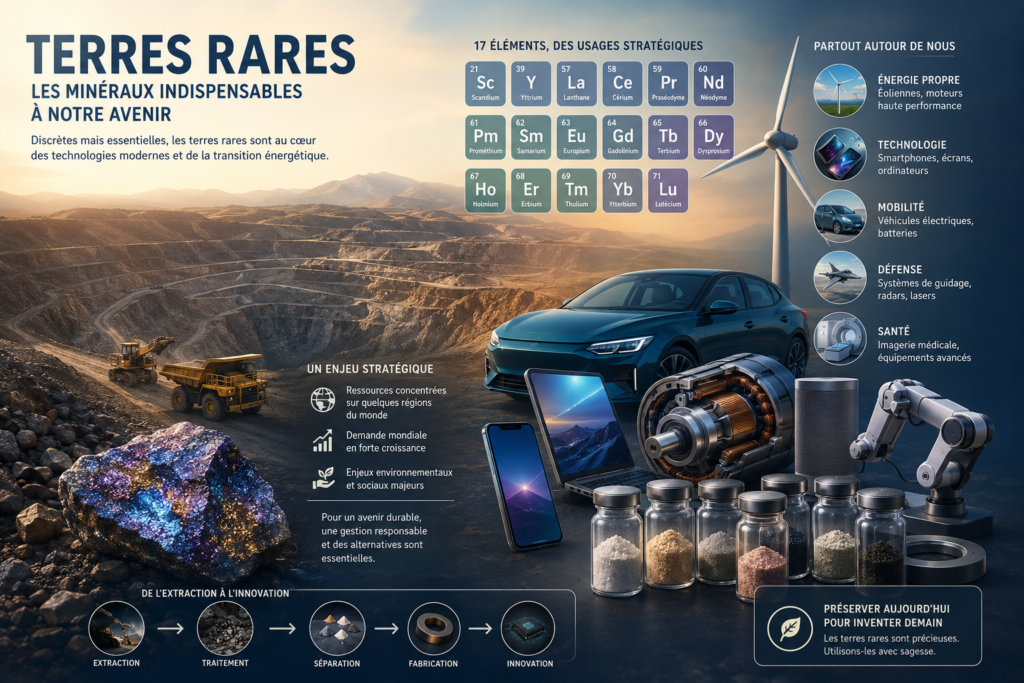
Gathered at the Palais Bourbon for a conference, industrialists, public officials and experts reached the same conclusion: critical raw materials are no longer a matter of competitiveness but of sovereignty and control, at a time when China has now locked down the entire chain. Faced with this shift, all are calling for a change of mindset: linking up the whole value chain, engaging upstream, downstream and the State, and acquiring the tools of an economy of scarcity.
A few weeks after the G7 Heads of State and Government set up an alliance for resilience and production in critical minerals and adopted a roadmap aimed at strengthening processing and recycling capacity and diversifying supply chains, the association “L’Hémicycle” brought together public officials, industrialists, experts and representatives of the sector at the National Assembly for the conference “Consolidating our industrial sovereignty – Minerals and critical metals, from access to the resource to end uses: what strategy for the next twenty years?”.
Over the course of the discussions, a shared conclusion emerged: industrial sovereignty no longer depends solely on access to resources. It now rests on the ability to master the entire value chain, from exploration through to industrial uses.
The Évian Summit: a change of scale
Opening proceedings, Sébastien Martin, Minister Delegate for Industry, noted that critical raw materials have become “a tool of diplomatic influence”: China can decide overnight, through its export licences, to suspend deliveries of rare earths and critical metals, putting entire value chains in difficulty.
It is against this backdrop that the G7 summit in Évian on 17 June takes on particular significance. Beyond the 195 projects identified, representing €64 billion of announced investment in critical mineral value chains, the seven most industrialised powers agreed that they would no longer rely on any single player for more than 60% of their supply, whereas China currently accounts for 85 to 86% of supply for many metals, mainly because of refining.
Common tools, yet to be defined, will be put in place to achieve this. The minister set out France’s response on three levels: the European Critical Raw Materials Act, which has identified a list of strategic metals and set a target of 10% of extraction on European soil; minerals diplomacy, led at national level by the DIAMMS (the interministerial delegation for the supply of strategic minerals and metals), which establishes contractual, strengthened relations with producer countries; and the rebuilding of industrial refining capacity, with the ramp-up of Solvay in La Rochelle, the Caremag project led by Carester in Lacq for the recycling and refining of rare earths, and MagREEsource in Grenoble for permanent magnets.
Sébastien Martin also confirmed that he had authorised core drilling in Brittany, standing by the political decision to prospect on French soil despite local reluctance.”The issue of critical raw materials has become a tool of diplomatic influence. Being able to rely on French companies, in which the State is moreover a shareholder, to support the diversification of our critical metal resources is one more ace up the sleeve of France and Europe.”
Sébastien Martin, Minister Delegate for IndustryIndustry calls for a European value chain to be rebuiltRepresentatives of the sector showed that this strategy was already under way on the ground. The discussions highlighted in particular the importance of securing the entire value chain, from extraction to refining and on to recycling, while giving manufacturers the conditions they need to invest for the long term.
Through its activities in lithium, nickel and manganese, metallurgical processing and the development of recycling, Eramet illustrated what is at stake in an integrated industrial strategy. Imerys presented the EMILI project, the first lithium mine in France in fifty years, combined with a processing unit, while A3M underlined the need for a stable framework, appropriate financing and better European coordination.
“Raw materials are no longer a question of competitiveness, but of sovereignty and control. We are not offering something more competitive: we are offering something more secure, which is not under the grip of another power. We need a change of mindset, and the downstream sector must shoulder its responsibilities: mining is a long-term business, and the long term is a matter for state strategies,” said Christel Bories, chair and chief executive of Eramet.
The French have grasped the new stakes
The conference was also an opportunity to present the results of a survey carried out by Norstat for the École de Guerre Économique. The study shows that critical raw materials are no longer the preserve of specialists: 65% of French people consider France too dependent on other countries for its supply of strategic raw materials, and 73% want to revive mining as well as France’s refining capacity.”The issue of strategic raw materials is moving beyond expert circles and establishing itself as a matter of public opinion. The French are not merely asking for a regulatory state, but for a state capable of acting, financing and protecting when assets deemed strategic are at stake,” according to Raphaël Clave, managing director of Norstat France.
In conclusion, Arnaud de Morgny, director of studies at the École de Guerre Économique, explained that global competition was no longer played out solely over the possession of natural resources, but over control of value chains, processing technologies and partnerships with producer countries. He also stressed that the balance of power was now shifting towards the industrial, diplomatic and informational dimensions.”We need a paradigm shift: we must stop thinking in terms of free trade agreements and think instead in terms of security-of-supply clauses. It is the state, as part of its overall diplomacy, that negotiates with other states. It is the return of bilateralism. If we do not return to bilateral diplomatic negotiations, we will be left watching the trains go by, and it will be our ore trains heading elsewhere. ” Arnaud de Morgny, director of studies at the École de Guerre Économique.
A shared conviction: sovereignty is at stake across the entire chain
By the end of the morning, a consensus had emerged among state representatives, manufacturers, the sector and experts: securing critical minerals cannot rest on a single lever. Diversifying supplies is essential, but will not be enough. France and Europe will also have to strengthen their capacity for exploration, extraction, refining, processing and recycling, while consolidating the companies able to invest for the long term across every one of these links.Speakers stressed that this strategy can succeed only through close cooperation between public authorities, industry, investors and international partners. All shared the same conviction: industrial sovereignty is no longer measured solely by the possession of natural resources, but by the ability to control the entire value chain that turns them into economic, technological and industrial power.
Translated from French. The French original prevails.