Between China, the Emirates and the coastal powers, the recognition of Somaliland exposes a competition for maritime access. Yemen forms the opposite shore and one of the main risk factors.
The communiqué issued on 22 October by China and Djibouti sheds light on the rivalries surrounding the Red Sea. In it, the two countries explicitly reject the recognition of Somaliland, back Somali sovereignty and defend freedom of navigation in the Bab el-Mandeb. The text shows that, in the region, the status of territories, access to ports and the security of trade routes are closely intertwined. [1]
Yet this is neither a fresh carve-up of the region between two neatly organised camps nor the herald of an inevitable war. Djibouti and Berbera, Somaliland’s main port, offer two different footholds on the African approaches to a vital passage between the Indian Ocean and the Mediterranean. China, the United Arab Emirates and neighbouring states are seeking to safeguard their interests there, with partners whose objectives do not always coincide with their own.
Understanding the geography before the alliances
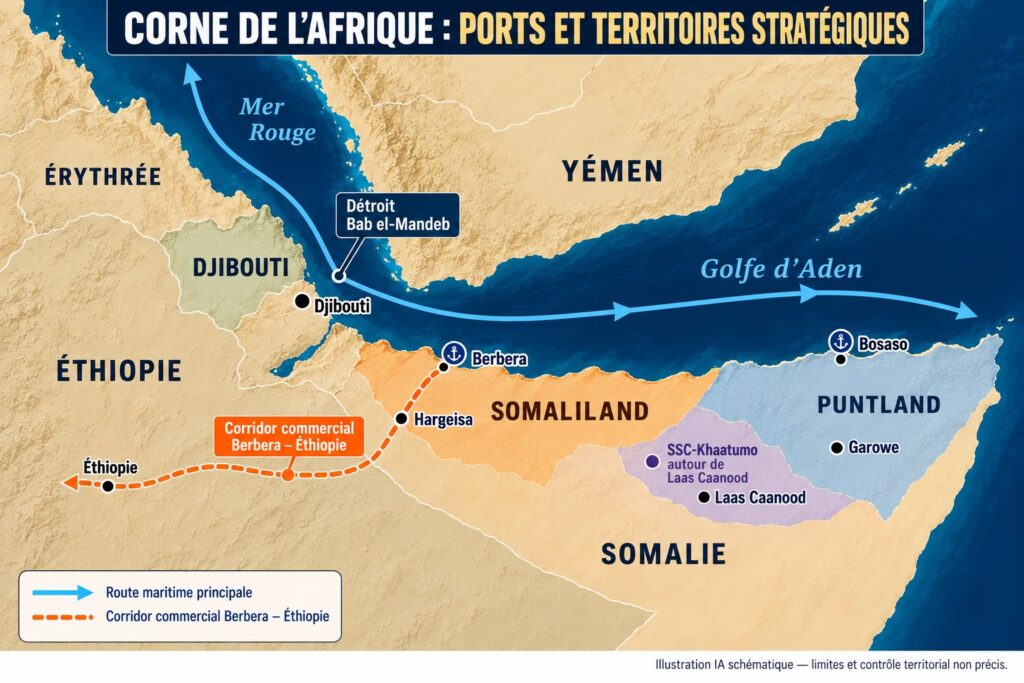
A ship arriving from Asia across the Indian Ocean enters the Gulf of Aden, passes through the Bab el-Mandeb, sails up the Red Sea and reaches the Suez Canal. It then emerges into the Mediterranean. Yemen borders the passage to the north-east; Djibouti and Eritrea lie on its African shore. Berbera, in Somaliland, lies further east, on the southern coast of the Gulf of Aden. The port is therefore not in the strait, and holding it does not confer control of it.
Bab el-Mandeb must also be distinguished from Hormuz. The latter controls the exit from the Persian Gulf; the former opens the route to Suez. The cargoes and routes involved do not entirely overlap. What they have in common is that coastal actors can threaten international traffic without controlling the whole sea or stopping every ship.
The vulnerability of a passage is thus measured by the costs that a threat imposes: insurance premiums, escorts, delays, extra fuel consumption and detours via the Cape of Good Hope. A strait can remain legally open while becoming economically prohibitive for some shipowners. It is this mechanism of coercion that we examined in our analysis of the threat of a “Houthi Hormuz” at Bab el-Mandeb. [2]
Somaliland and the question of recognition
Somaliland corresponds to the former British protectorate in northern Somalia. Having gained independence on 26 June 1960, it united on 1 July with the territory formerly administered by Italy to form the Somali Republic. In 1991, amid the collapse of Mohamed Siad Barre’s regime, its leaders proclaimed the restoration of its independence. This history explains the wording used in Hargeisa, Somaliland’s capital: its authorities present their move as the restoration of a pre-existing state rather than as a simple secession. [3]
Since then, the territory has had its own institutions and has held elections. But its authority does not extend over all the areas it claims, notably in the contested east. Somalia still regards Somaliland as part of its territory. The African Union supports this position, fearing that unilateral recognition would weaken the principles on which its members’ borders and sovereignty rest. [4]
Israel took the step of recognition on 26 December 2025. It should not be inferred that Berbera’s trading partners have done the same. A liaison office, a presidential meeting, the acceptance of a travel document or a port contract do not, in themselves, amount to diplomatic recognition. Recognition requires a decision by the state concerned. [5]
The rumour of a coordinated move by the United States, the Emirates, Morocco, the United Kingdom, Kenya and Ethiopia therefore cannot serve as a factual starting point. As of 24 October, no verified official announcement establishes any such coordination. Asked about Donald Trump’s recent remarks, the US ambassador to Ethiopia, Ervin Massinga, said in an interview published on 19 October that US policy had not changed. That rules out treating those remarks as recognition; it does not prove that no discussions will take place in future. [6]
Neighbouring Puntland and the disputed territories
To the east lies Puntland, whose capital is Garowe and whose main port is Bosaso. Established in 1998 as an autonomous region of Somalia, it is not pursuing the same project as Somaliland: its autonomy is framed within the Somali state, even though its relations with the federal authorities in Mogadishu have deteriorated sharply. In 2024, its authorities stopped recognising the federal government following a constitutional dispute. [17]
Puntland, too, holds port interest for the Emirates. A DP World subsidiary holds a thirty-year concession in Bosaso. After Mogadishu announced in January 2026 that it was ending its agreements with the Emirates, the Puntland authorities stated that their relations with Abu Dhabi would continue. The same operator is thus present in both Berbera and Bosaso, in two territories with differing status and political objectives. [11]
Between the claims of Somaliland and those of Puntland, the situation cannot be reduced to a border between two administrations. In the Sool, Sanaag and Cayn regions — the three names that make up the acronym SSC — SSC-Khaatumo forces fought those of Somaliland in 2023 and took control of Laas Caanood. This local administration rejects its incorporation into Somaliland and wishes to belong to federal Somalia. The federal government subsequently recognised a new North-East federal member state that emerged from SSC-Khaatumo. Territorial claims and effective control remain disputed; Puntland also contests this new administration. [18]
Puntland must also combat the Somali branch of the Islamic State group, which is active in particular in the Bari region. This threat adds a security dimension to port development and shows that investment alone does not guarantee the stability of a port’s hinterland. [19]
Djibouti gives China a lasting foothold
Djibouti combines several functions that should be distinguished. It is a sovereign state, a port complex, a major outlet for Ethiopia and a host country for foreign forces. American, French, Japanese and Chinese bases coexist there. Their presence on the same territory does not mean that they cooperate with one another, nor that Djibouti has given up its own diplomacy. [7]
The Chinese base became operational on 1 August 2017. Beijing presents it as a support facility enabling, among other things, the resupply of naval missions and support for its commitments in Africa. For a navy operating far from its shores, having maintenance and support capabilities changes how long and how regularly deployments can take place. This base gives military expression to China’s interest in the security of trade. [8]
The infrastructure linking Djibouti to Ethiopia adds overland depth to this maritime foothold. A port is only useful if goods can reach their customers: railways, roads, customs procedures and warehouses matter as much as the quays. On this reading, Berbera’s rise creates potential competition for trade flows. It is not enough, however, to show that China intends to block the port.
The China–Djibouti communiqué adds a separate issue: Taiwan, which maintains relations with Hargeisa. Beijing opposes any move likely to broaden the international legitimacy of the Taiwanese authorities. Its opposition to Somaliland thus combines its doctrine on territorial integrity with its regional concerns. This should be described as an explicit joint reaffirmation, not as a doctrine that suddenly emerged in October. [1]
UAE builds a trade network at Berbera
The Emirati presence rests first and foremost on an observable reality: port investment. DP World, the Dubai-based group, opened a new container terminal at Berbera in June 2021. The operator announced a capacity of 500,000 twenty-foot equivalent units a year. This unit, usually abbreviated to TEU (EVP in French), measures capacity in standard containers; it does not correspond to the traffic actually handled. [9]
The project links the terminal to an economic zone and to the road corridor running to Hargeisa and on into Ethiopia. The gamble is to attract businesses and a share of Ethiopia’s imports and exports. Performance will depend on the prices, transit times and reliability of the entire route. For an importer, a modern port does not necessarily make up for a slow border crossing or an unreliable road.
A recent development illustrates this gradual integration. Container News reported on 20 October that GT Lines was planning a direct service between Khor Fakkan, in the Emirates, and Berbera from November, with one sailing every fourteen days. At that date, neither the first sailing nor the vessels assigned had been specified. This is a commercial announcement, not a defence agreement. GT Lines belongs to the Gulftainer network: this operator should not be confused with DP World. [10]
A network of ports and maritime services makes it possible to build lasting relationships, gain a better understanding of markets and steer certain trade flows. It can increase a state’s influence without any transfer of sovereignty. But the economic ties between China and the Emirates make it impossible to reduce this local competition to an all-out confrontation between Beijing and Abu Dhabi.
Military projects require more evidence
Berbera airport is attracting the attention of powers with an interest in the security of the Gulf of Aden. The Somaliland authorities have offered military facilities to foreign partners. An offer, however, is not enough to establish that a basing agreement has been signed or that a joint base is operational. [12]
On 17 June 2026, Somaliland’s defence minister told Reuters that Israel was training its police and army, but that no negotiations were under way at that time to establish an Israeli base. The statement describes the situation as of that date; it does not prejudge future decisions. [12]
Yemen is the other half of the problem
The analysis would be incomplete if it stopped at the African shore. The Houthis, a Yemeni movement also known as Ansar Allah, have missiles and drones capable of threatening shipping. Their ability to impose costs on shipowners extends beyond their territorial control. A surveillance facility on the opposite shore can improve detection; it does not eliminate mobile launchers, supply networks or the political causes of the conflict. [13]
Our analyses of Yemen have also shown how fragmented the opposing camp is. The Southern Transitional Council, backed by the Emirates and pursuing a southern autonomist or secessionist agenda, does not share the same objectives as all the players in Yemen’s internationally recognised government. Riyadh and Abu Dhabi can fight the Houthis while backing rival Yemeni partners. It would therefore be misleading to extend onto the African map an “axis” assumed to be perfectly coherent. [14]
China, too, faces a contradiction between its maritime interests and the belligerents’ supply networks. On 31 July 2024, the US Treasury sanctioned individuals and companies based in China and Hong Kong, among other places, accused of facilitating the procurement of components for Houthi weapons. These are named US accusations, documented in a sanctions decision. They do not establish that the Chinese authorities personally authorised each delivery. [13]
This clarification ties in with our work on the energy vulnerability of China and other Asian economies. Beijing has an interest in secure shipping routes, but that interest is not enough to guarantee control over every intermediary operating from its territory. The diplomatic challenge is to turn statements on freedom of navigation into verifiable measures against the networks that feed the attacks. [15]
The region’s states still pursue their own objectives
Ethiopia has been seeking to diversify its access to the sea since Eritrea’s independence in 1993 left it landlocked. The memorandum of understanding concluded with Somaliland in January 2024 linked the quest for coastal access to the question of recognition, and sparked a crisis with Mogadishu. The Ankara Declaration of 11 December 2024 then proposed another path: commercial arrangements guaranteeing Ethiopian access under Somali sovereign authority. This diplomatic framework should not be mistaken for a fully implemented port agreement. [16]
For Somalia, more is at stake than port revenues: accepting that a territory it claims may freely conclude strategic agreements would amount to weakening its claim to sovereignty. For Turkey, which facilitated the Ankara process and supports Somali institutions, mediation offers regional influence without forcing it to choose a break with Ethiopia. The interests of these three actors therefore intersect without coinciding.
Egypt is keeping a close watch on the security of the Suez route, while remaining locked in a dispute with Ethiopia over the waters of the Nile. Eritrea is weighing its own security and its difficult relations with Addis Ababa. Saudi Arabia is looking first and foremost at Yemen and the eastern shore of the Red Sea. These concerns shed light on their positions, but they do not amount to proof of a joint military arrangement against Berbera. The condemnations of Israel’s recognition should be read as diplomatic acts, not as declarations of war. [5]
For Europeans, securing the passage is about more than escorts
For Europeans, securing the passage means protecting crews and monitoring developments in ports, infrastructure and political tensions on both shores. Naval missions can reduce certain risks to ships, but they do not settle territorial disputes. Practical contacts with local authorities are possible: their purpose and framework must be clearly defined, without confusing them with recognition of independence.
Three developments would signal a genuine change: formal recognition by a new state; a published agreement granting specific military rights; or a lasting shift in trade flows, confirmed by volumes rather than merely by the announced capacity of terminals. Conversely, a photograph of leaders or a visible construction site is not enough to establish an alliance.
The China–Djibouti communiqué strengthens the diplomatic expression of opposition to Somaliland, while investment and new links continue to integrate Berbera into Emirati networks. The two trends can advance simultaneously. The decisive question is whether they are compatible with safe navigation and with arrangements acceptable to the states concerned. Without compromise, every territorial dispute can complicate the protection of trade; with limited and verifiable agreements, diversifying access can instead reduce certain dependencies.
Follow the author on X: @Consulting4502
LTDN articles worth rereading
[2] Yemen — Riyadh and the risk of a Houthi Hormuz at Bab el-Mandeb
[14] Yemen — The Southern Transitional Council
[15] China, Japan and South Korea face the oil shock
Somalia — The release of the Lutuf and maritime security
Other references
[1] China–Djibouti communiqué of 22 October 2026
[3] Office of the Historian — Somali union in 1960
[4] African Union — Position on Somaliland
[5] Associated Press — Israeli recognition
[6] The Reporter Ethiopia — Interview with Ervin Massinga
[7] Reuters — China, Djibouti and shipping
[8] Chinese Ministry of National Defense — Djibouti base
[9] DP World — Berbera terminal
[10] Container News — Khor Fakkan–Berbera service
[11] Reuters — Puntland and port concessions
[12] Reuters — Israeli training and statement on bases
[13] US Treasury — Houthi procurement networks
[16] Turkish Ministry of Foreign Affairs — Ankara Declaration
[17] European Union Agency for Asylum — Puntland
[18] European Union Agency for Asylum — Sool, Sanaag and Cayn
[19] BTI 2026 — Somalia and security in Puntland
Translated from French. The French original prevails.