“Phase two” of the Gaza ceasefire is on everyone’s lips. Invoked by the US administration as a decisive shift from emergency to reconstruction, from the provisional to the political, it remains for now a conditional promise, suspended between ongoing negotiations and decisions whose effects have been slow to materialise.
According to Ramiz Alakbarov, the UN official tasked with advancing the Middle East peace process, the announcement by the United States two weeks ago that this second phase had begun “carries both great potential and considerable risk”.
A fragile truce, a phase still uncertain
The truce between Israel and Hamas, which came into force on 10 October, does indeed remain fragile. Strikes, gunfire and armed clashes persist across the enclave. “Hundreds of Palestinians have been killed since the start of the ceasefire, including many women and children,” the diplomat stressed, recalling a basic legal requirement: “Civilians must be protected in all circumstances.”

UN Photo/Eskinder Debebe
Ramiz Alakbarov, the UN envoy tasked with advancing the Middle East peace process, briefs the Security Council by videoconference.
On Thursday 22 January, on the sidelines of the World Economic Forum in Davos, US President Donald Trump officially launched the Board of Peace, presented as one of the pillars of this forthcoming stage. Mandated in November 2025 by the UN Security Council, the body is meant to support Gaza’s civil administration, coordinate reconstruction and assist the territory’s economic recovery.
The Board of Peace will include a National Committee for the Administration of Gaza, tasked with providing public services, facilitating humanitarian aid and laying the groundwork for reconstruction. Mr Alakbarov said he had recently met its members in Cairo to discuss how the UN could support their work. An Office of the High Representative for Gaza will also be responsible for overseeing and coordinating the process as a whole.
The reality on the ground
Diplomatically, the initiative aims to provide a framework for the “post-emergency” period. On the ground, it remains largely abstract. As long as humanitarian access remains restricted, insecurity persists and destruction continues, the second phase looks less like a turning point than a conditional promise.
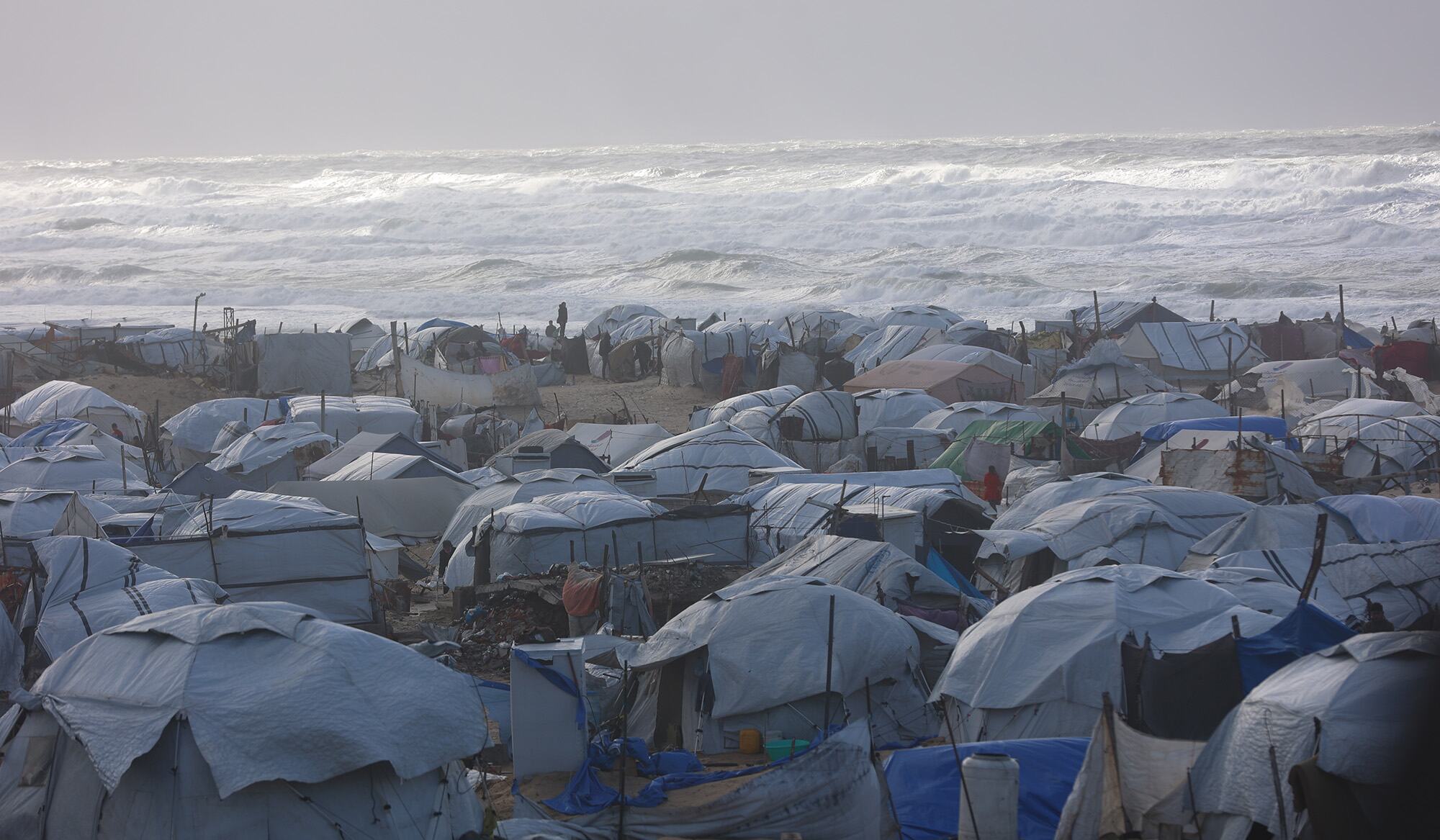
For the humanitarian reality remains overwhelming. Mr Alakbarov pointed out that almost the entire population of Gaza, some two million people, still depends on international aid. Winter has worsened an already extreme crisis, with most residents sheltering in makeshift shelters to protect themselves from the cold and heavy rain. The UN envoy describes families who “stayed awake all night, just trying to hold down the four corners of their tent”, and a little girl carrying stones to stop her shelter being blown away by the wind.
Two million people depend on humanitarian aid in Gaza
While he describes a society that has been bled dry, Mr Alakbarov has nonetheless glimpsed signs of renewal. Amid a landscape of ruins, he says he saw teenagers sitting their exams, farmers growing crops in makeshift greenhouses for lack of imported seeds, and traders improvising economic networks in a devastated market.
“The people of Gaza are ready and eager to lead the way towards a better and more stable future,” he insists. The will is tangible, but it comes up against systemic obstacles.
UN News
A camp for displaced people along the coast in Gaza.
Aid obstructed, reconstruction deferred
The housing crisis brings the deadlock into sharp focus. The restrictions that Israel still imposes on the entry of essential construction materials and technical expertise rule out any response on the scale of the enormous needs. Temporary relocation sites, the UN points out, should be voluntary, dignified and in line with humanitarian principles. In practice, they remain insufficient and unsuitable
Mobile homes, fuel, rescue equipment and medical supplies remain severely restricted
More generally, humanitarian aid continues to be obstructed across all sectors: persistent insecurity, customs delays, permits refused or delayed, and a limited number of actors authorised to deliver cargo. The Jordanian corridor, vital though it is, is operating at only a fraction of its former capacity. Since October, only 9% of the volumes processed have actually reached Gaza by this route. Mobile homes, fuel, rescue equipment and medical supplies remain severely restricted, endangering tens of thousands of displaced people and patients.
These material constraints are compounded by mounting political pressure on humanitarian organisations. Israel’s decision to suspend or not renew the registration of numerous international NGOs poses a direct threat to the emergency response. “Banning these NGOs will have a significant impact on the humanitarian response across the Occupied Palestinian Territory,” Mr Alakbarov warned, calling for the decision to be reversed immediately.
Against this backdrop, the launch of the second phase of the ceasefire remains theoretical for now. “This is a genuine opportunity to lay the foundations for a more stable and secure future for Palestinians and Israelis,” Ramiz Alakbarov concluded. An opportunity, yes – but one whose realisation depends less on international announcements than on lifting the obstacles that, in Gaza, continue to reduce life to day-to-day survival.
Source: UNOG
Translated from French. The French original prevails.