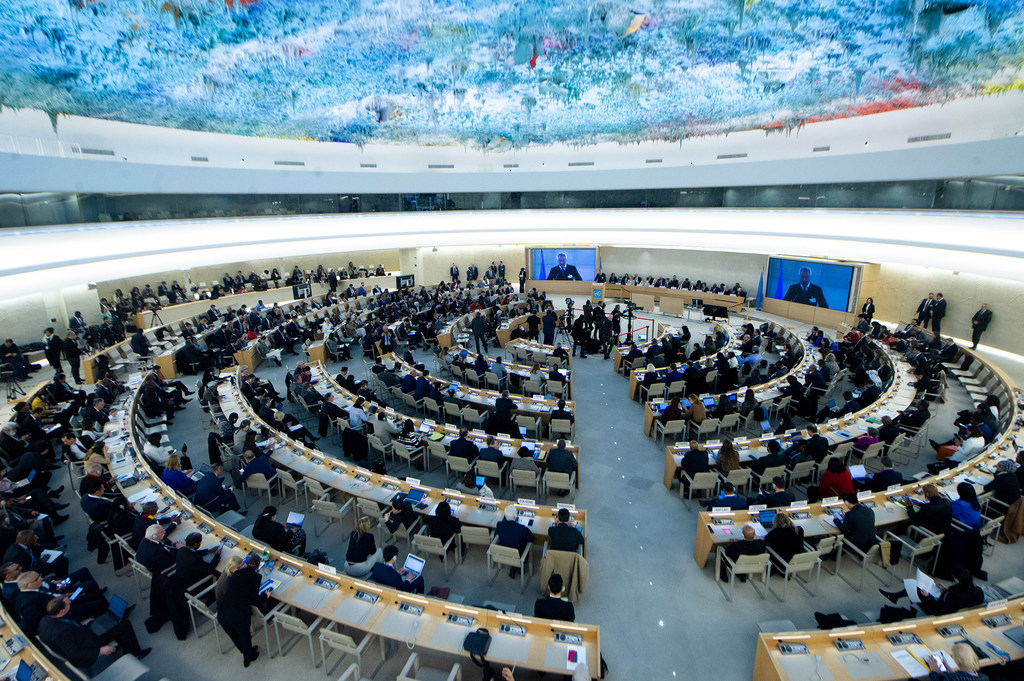
The United Nations Human Rights Council in Geneva (file photo). UN/Violaine Martin
States are playing with fire. Faced with an “extremely dangerous and unpredictable” situation in the Middle East, the UN human rights chief has called for an end to the conflict. Fearing a regional conflagration, Volker Türk urged influential powers to act without delay.
Opening an urgent debate of the UN Human Rights Council in Geneva on “Iranian strikes in the Gulf”, the UN High Commissioner for Human Rights voiced concern over a conflict that has sown “chaos across the region”, affecting Bahrain, Kuwait, Oman, Qatar, Saudi Arabia, the United Arab Emirates, Jordan and beyond.
More than three weeks after the first US and Israeli strikes on Iran, the conflict is spreading and intensifying in the region and beyond, and it is civilians who are its main victims.
High-risk conflict
“Across the region, families have celebrated Eid and Nowruz under bombardment, in fear and uncertainty, and are facing fresh hardships,” Mr Türk said in a video message to the session, which was convened by the Gulf States amid rising regional tensions. The High Commissioner spoke of the conflict’s “unprecedented power” to drag countries into its wake, transcending borders and affecting global stability. “A conflict can never be ordinary or commonplace (…). The complex dynamics could trigger new national, regional or global crises at any moment, with horrifying consequences for civilians and people around the world,” Mr Türk said.
The UN human rights chief urged all States, particularly those with influence, to use their power to end the conflict, stressing that diplomacy remains the only safe path to peace. His remarks underline the urgent need for international cooperation to resolve a crisis with far-reaching repercussions.
Strikes near nuclear sites
On the ground, the Israeli army announced overnight on Wednesday that it was once again bombing Tehran, after reporting Iranian missiles heading towards Israel. But for Mr Türk, many of the strikes carried out in this conflict raise serious concerns under international law, which prohibits attacks targeting civilians and their infrastructure.
In this regard, he expressed concern about strikes targeting areas housing nuclear sites in Iran and Israel, which risk posing an “immense danger”. “States are flirting with absolute catastrophe,” he insisted.
These latest developments come as media reports indicate that Washington is negotiating with Iran “right now”. The United States has reportedly passed a 15-point plan to Tehran in an attempt to end the conflict. Of these 15 points, five concern Iran’s nuclear programme, others require Iran to abandon its support for the pro-Iranian Lebanese group Hezbollah and the pro-Iranian Palestinian movement Hamas, and one point insists that the Strait of Hormuz remain open to shipping.
Tensions in Hormuz
On this subject, the UN human rights chief expressed alarm at the “very serious repercussions” of the conflict beyond the Middle East. “Iran’s disruption of shipping in the Strait of Hormuz is affecting global supply chains, with disastrous consequences for some of the world’s poorest people,” he argued.
Fossil fuels, medicines, foodstuffs and fertilisers are just some of the essential goods stranded at sea. This is disrupting global energy markets and supplies and risks triggering serious food and health crises. The effects are particularly devastating in low-income countries, notably in South Asia. Developing economies are generally less able to withstand price shocks.
“Several states have already introduced energy-saving measures. Bangladesh, for example, has closed universities and introduced fuel rationing, while the Philippines has declared a national energy emergency,” Volker Türk concluded.
Hospitals and schools targeted in Iran
During the debate, several Gulf states, including the United Arab Emirates, condemned the ongoing Iranian attacks, stressing that they had “never authorised” the use of their airspace to launch air strikes against Iran.
“What cannot be ignored is the contradiction between Iran’s rhetoric about good-neighbourly relations and Iranian practices on the ground, in particular Iran’s attempts to justify attacks on civilians and on civilian infrastructure such as airports, ports, oil facilities and tourism-related sites,” Ambassador Jamal Al Musharakh lamented at the Human Rights Council.
Meanwhile, the Iranian ambassador, Ali Bahreini, called on neighbouring countries to form a common front against Israel. “Do not embolden Israel by targeting Iran,” he said.
Resolution condemns Iran over Hormuz
Tehran also says that Israeli and US strikes carried out across the country since 28 February 2026 have destroyed nearly 45,000 homes, with 53 hospitals and 57 schools targeted and bombed.
At the end of the debate, the Council’s 47 member states adopted by consensus a resolution that “condemns in the strongest terms the heinous attacks” carried out by Iran, condemns Tehran’s actions aimed at closing the Strait of Hormuz and expresses “deep concern over Iranian attacks on energy infrastructure”.
The resolution also calls for “prompt” and “appropriate” reparations for the damage caused by Tehran.
Iran, China and Cuba have requested a further urgent session on the bombing of a girls’ school in Minab, in the south of the country, on 28 February, which killed more than 150 people.
Translated from French. The French original prevails.