UN Photo/Violaine Martin
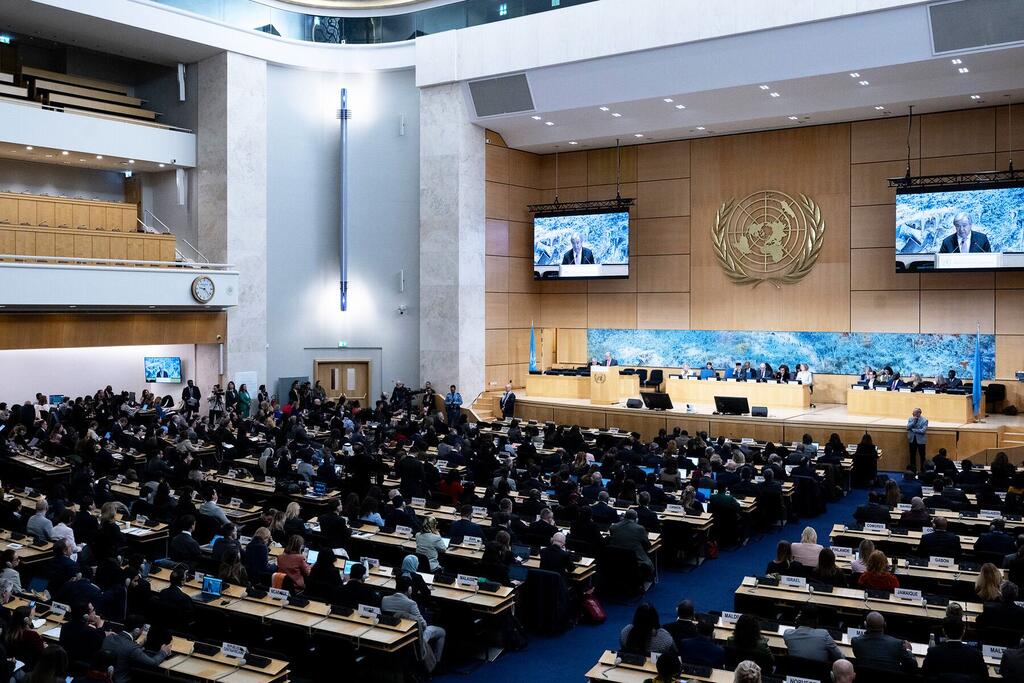
UN Secretary-General António Guterres speaks at the opening of the 61st session of the Human Rights Council at the Palais des Nations in Geneva, Switzerland.
Around the world, human rights are often “under attack” from “those with the greatest power”, the UN chief lamented in Geneva on Monday, noting that the rule of law is giving way to “the law of the strongest”.
In his final address to the United Nations Human Rights Council, the UN Secretary-General said that “this assault is being carried out neither in secret nor by surprise”. It is taking place in broad daylight, often led by the most powerful, António Guterres declared at the opening of the 61st session of the Geneva-based UN body. Yet “when human rights crumble, everything else collapses”, he added.
It was in the light of this warning that he expressed his outrage at Russia’s continuing war in Ukraine, where more than 15,000 civilians have been killed in four years of violence.
Democratic backsliding
Mr Guterres also highlighted flagrant violations of human rights and international law in the Occupied Palestinian Territories, stating that the two-state solution was “being swept away in broad daylight”. “The international community cannot allow this to happen,” the UN chief insisted.
In the same vein, he also dwelt on other crisis hotspots on the African continent, notably Sudan, the Democratic Republic of the Congo and the Sahel.
It was an observation that led him to broaden his remarks to the state of a world in which mass suffering is ignored and international law is regarded as a mere inconvenience, a world in which human beings are used as bargaining chips.
According to Mr Guterres, the crisis in respect for human rights reflects and amplifies every other global fault line, from soaring humanitarian needs amid collapsing funding to deepening inequality.
A chain of political choices that, in his view, is resulting in weaker protections and deeper vulnerabilities. In this coordinated offensive, human rights are the first casualties, with “a shrinking of civic space”. Democracies are eroding too. The right of peaceful assembly is being trampled, while the violent crackdown on protests in Iran has drawn fresh condemnation.
Human rights beyond geography
In the face of this accumulation of violations, a reminder is needed: human rights must not be “a slogan for the good times”. For the UN chief, the first task is to defend the Charter of the United Nations, the Universal Declaration of Human Rights and the international human rights law instruments, which must not be “an à la carte menu”. “Leaders cannot pick the parts they like and ignore the rest,” he insisted.
“A fierce competition for power, control and resources is playing out on the global stage at a pace and with an intensity unseen in 80 years”
The second area of work concerns strengthening international institutions, notably through reform of the Security Council and of the global financial architecture. Finally, the Secretary-General urged states to change course and let human dignity guide us. This means supporting the International Court of Justice (ICJ) and the International Criminal Court (ICC).
In the same vein, he recalled that human rights transcend geographical divides because they “are neither Western nor Eastern, neither Northern nor Southern”. It was a way of warning against the temptation to sacrifice these rights to political calculations or international rivalries. “Do not let power write a new rulebook in which the vulnerable have no rights and the powerful have no limits,” Mr Guterres argued.
The spectre of domination and supremacy
For his part, the United Nations High Commissioner for Human Rights echoed these concerns. Volker Türk warned of a “deeply worrying trend”, with “the return of domination and supremacy”.
“A fierce competition for power, control and resources is playing out on the world stage at a pace and with an intensity unprecedented in 80 years,” he warned.
In this grim climate, “the use of force to resolve conflicts between countries and within countries themselves is becoming the norm”.
Creating “a strong counterweight to the autocratic tendencies” seen today.
Mr Türk also lashed out at leaders, without naming them, who appear to believe “that they are above the law and above the Charter of the United Nations”. “They claim exceptional status, exceptional danger or exceptional moral judgement to pursue their own agenda at any cost,” he observed, stressing that “some are weaponising their economic influence”. “They spread disinformation to distract, silence and marginalise,” he insisted.
More broadly, “the machinery of global power is shifting”. Faced with the determination of some states to weaken multilateralism, Mr Türk called on people to unite to protect rights and to create “a strong counterweight to the autocratic tendencies” seen today.
Slow erosion
In the same spirit, the President of the United Nations General Assembly said that her speech today was a call to action, addressed to everyone.
“History teaches us that great systems rarely collapse in a single dramatic moment; they erode slowly, rule by rule, commitment by commitment, while those who should defend them choose to stay silent. Until the day when what seemed permanent simply disappears,” warned Annalena Baerbock.
Against this backdrop, she called on everyone to shoulder their responsibilities.
“We are not spectators with the luxury of standing back while injustice unfolds. Silence is a choice. Inaction is a choice, and it has consequences,” she declared.
There is, however, some good news: “action is also a choice, and it is in our hands”.
Translated from French. The French original prevails.