
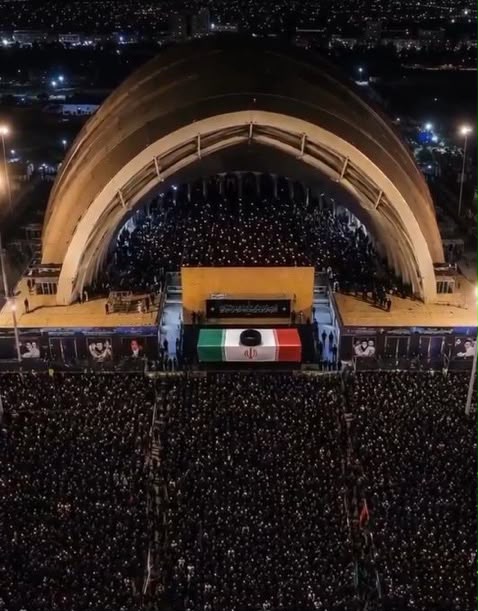
More than four months after Ali Khamenei was killed in an Israeli-American strike, Iran is holding a state funeral spread over several days across Tehran, Qom, the Shia holy cities of Iraq and Mashhad. But behind the staging of national mourning, several elements stand out: the continued absence of Mojtaba Khamenei, the mobilisation of the pro-Iranian regional axis, the official presence of the Iraqi state in Tehran, and the delicate position of the Iraqi Prime Minister, Ali al-Zaidi, whose personal attendance in the Iranian capital has still not been confirmed.
A funeral delayed by more than a hundred days
Ali Khamenei’s funeral is getting under way in Iran amid political tension and a heavy security presence. The Iranian Supreme Leader, killed on 28 February 2026 in an Israeli-American strike on the heart of Iranian power, is being buried more than a hundred days after his death. This exceptional delay, which runs counter to ordinary Islamic funeral practice, is officially attributed to the circumstances of the war, security constraints and the organisation of a large-scale national tribute.
For Tehran, the funeral is not merely a moment of mourning. It is a major political operation. The regime intends to show that the Islamic Republic has survived a decapitation strike, that its institutions are still standing and that its regional network remains mobilised around it.
Tehran, Qom, Najaf, Karbala, Mashhad: a geography of Shia power
The Iranian authorities are seeking to turn the funeral into a show of strength. The ceremonies are to last several days, with stops in Tehran and Qom, then in Iraq’s Shia holy cities, before the final burial in Mashhad, at the Imam Reza shrine. The choice of route is clearly no accident.
Qom is the religious heart of the Islamic Republic. Tehran is its political centre. Najaf and Karbala speak to the transnational roots of Shia Islam. Mashhad, finally, offers the regime a burial place steeped in sanctity. Carrying the body through these cities is intended to frame Khamenei’s death as a staged display of continuity, resistance and religious legitimacy.
Mojtaba’s absence: a major flaw in the choreography
Yet the funeral is also overshadowed by an absence: that of Mojtaba Khamenei. Presented as his father’s successor and now at the centre of Iran’s transition, Mojtaba has still not appeared in public. His absence is all the more striking given that he had already been missing from the funeral of his wife, Zahra Haddad Adel, who was also killed in the same strike.
No verified information makes it possible to state with certainty that he is dead or permanently incapable of exercising power. But in a system where the visibility of the Supreme Leader is a major political signal, his invisibility becomes a political fact in itself. If he is alive but prevented from appearing, his authority is weakened. If he is seriously injured, the question of his ability to govern arises. And if the regime is concealing more serious information, the entire Khamenei succession could be affected.
Iraq at the heart of the funeral sequence
The other notable element is the Iraqi dimension of the funeral. The passage of the coffin through Najaf and Karbala gives the ceremonies a significance that extends far beyond Iran’s borders. Shia Iraq remains one of Tehran’s main spheres of influence, despite American pressure, Iraq’s internal tensions and recurring debates over the role of the militias.
Figures and networks linked to Iraq’s Popular Mobilization Forces — the Hashd al-Shaabi — are naturally associated with this sequence of events. Their participation, whether direct or indirect, is a reminder that Iran continues to rely on a powerful politico-military network in Iraq. But the real political question does not concern the militias alone. It concerns the stance of the Iraqi state itself.
President in Tehran, Prime Minister in the background: Iraq’s twofold signal
Iraq’s presence in Tehran takes on a major institutional dimension with the arrival of the President of the Republic, Nizar Amidi — sometimes transliterated as Nizar Amedi — who came to attend the farewell ceremony for Ali Khamenei. His presence symbolically commits Iraq at the highest level of protocol. It means that Iraqi participation is no longer confined to armed factions, networks close to the Hashd al-Shaabi, former officials or members of parliament: it now extends to the head of state himself.
Nizar Amidi is a Kurdish president from the Talabanist tradition of the Patriotic Union of Kurdistan. He embodies the protocol summit of the Iraqi state more than the real centre of executive power. Yet his presence in Tehran nonetheless alters the political reading of Baghdad’s position: even if Ali al-Zaidi sought to avoid travelling to the Iranian capital himself, the Iraqi state is now officially represented there.
Ali al-Zaidi’s personal presence in Tehran has still not been confirmed. A video circulated on social media purported to establish it, but it does not clearly show the Iraqi Prime Minister at Khamenei’s funeral. It should therefore be treated with caution, and possibly as a disinformation operation.
The distinction is crucial: al-Zaidi may yet stay away from Tehran, but the Iraqi state is already there. This formulation avoids attributing to him a presence that has not been established, while acknowledging that official Iraq can no longer be portrayed as standing outside Iran’s staging of events.
Faction leaders, a former Prime Minister and a minister: a highly political Iraqi delegation
Images circulated on social media also show an Iraqi delegation described as being made up of armed faction leaders, government officials and members of parliament. Among the names identified or mentioned are Akram al-Kaabi, Secretary-General of Harakat al-Nujaba; Abu Alaa al-Walai, leader of Kataeb Sayyid al-Shuhada; the former Prime Minister Adel Abdel-Mehdi; the Iraqi Communications Minister Mustafa Sanad; and the MP Ahmad Shahid.
If these identifications are confirmed, their political significance is considerable. The delegation would no longer be a matter of religious or diplomatic protocol alone. It would bring together, in a single sequence, the pro-Iranian armed factions, representatives of Iraq’s former leadership and at least one member of Ali al-Zaidi’s current government.
The reported presence of Mustafa Sanad is particularly sensitive. Even though the Prime Minister himself has not been confirmed as being in Tehran, the arrival in Iran of a minister from his government undermines the line of cautious distance he may have sought to maintain. Al-Zaidi can still avoid Tehran, but part of the Iraqi state apparatus is already there.
Iraqi Kurds and Sunnis: beyond the Shia axis alone
Another point deserves attention: the reported presence of Iraqi Kurdish and Sunni figures in Tehran. Among the names mentioned are Adham Barzani, a controversial Kurdish figure associated with Kurdish networks close to Iran; Rashid al-Azzawi, secretary-general of the Iraqi Islamic Party; and Mohammed Haji Mahmoud, known as Kaka Hama, leader of the Kurdistan Social Democratic Party.
This diversity of profiles broadens the political significance of the funeral. It shows that Tehran is seeking not only to mobilise its traditional Shia proxies, such as the Hashd al-Shaabi, but also to display its connections across other segments of the Iraqi political landscape: Kurds, Sunni Islamists and peripheral parties in Kurdistan.
If their presence in Tehran is confirmed during the official proceedings, it will reinforce the idea that Khamenei’s funeral is also serving as a showcase for Iranian influence across the whole Iraqi mosaic, and not only within its Shia camp.
Lebanon also sends an official delegation
Lebanon’s participation is now taking on even greater weight. The presence of the Amal movement had already shown the involvement of Lebanon’s Shia community in the ceremonies honouring Khamenei. But the arrival in Tehran of the Lebanese Minister of Defence, Michel Menassa, changes the nature of the political signal.
According to An-Nahar, Michel Menassa arrived in the Iranian capital to officially represent the Lebanese Republic at the ceremonies honouring the late Iranian Supreme Leader. His presence is more than a conventional diplomatic tribute. It comes at a time when Lebanon is under heavy pressure over the disarmament of Hezbollah, repeated Israeli attacks and Iran’s place in Lebanon’s internal balance of power.
For Tehran, the signal is useful: Iran can show that it receives not only delegations from allied movements but also official representatives of states where its influence remains decisive. For Beirut, however, the image is awkward. With Michel Menassa, it is no longer just Amal that is in Tehran; it is part of the Lebanese state.
Nasrallah and Mughniyeh families, symbols of Hezbollah’s loyalty
The Lebanese dimension of the funeral is not limited to the official presence of Michel Menassa or to the Amal movement’s delegation. Reuters also reports that members of the families of Hassan Nasrallah and Imad Mughniyeh attended the ceremony in Tehran.
Their presence carries strong symbolic weight. Hassan Nasrallah embodies Hezbollah’s political and religious leadership, while Imad Mughniyeh remains associated with the movement’s military and clandestine memory. A former Hezbollah military chief killed in Damascus in 2008, Mughniyeh remains one of the most important figures in the organisation’s operational history.
In Iran’s funerary choreography, the Nasrallah and Mughniyeh families therefore play a specific role. They serve as a reminder that the pro-Iranian axis rests not only on states, parties and militias, but also on a shared memory of struggle, sacrifice and loyalty to Tehran. Tehran does not merely summon delegations; it also summons the symbolic lineages of its regional axis.
Hezbollah, Houthis, Hamas and Islamic Jihad: caution over names
The presence of representatives of Hezbollah, the Houthis, Hamas or Palestinian Islamic Jihad has been mentioned in several accounts of the ceremony, but not all the leading names can be put forward with certainty at this stage.
A distinction must therefore be drawn between the symbolic presence of these movements within Iran’s regional architecture and the verified physical presence of their leaders. The personal attendance of Abdel-Malek al-Houthi, of a senior Hamas leader or of Ziyad al-Nakhalah, secretary-general of Palestinian Islamic Jihad, has not been confirmed. At a ceremony so politically charged, every name becomes a diplomatic signal. Any premature assertion should therefore be avoided.
A show of strength, but also of fragility
The funeral thus becomes a political stage. The Iranian regime uses it to showcase its martyrs, its institutional continuity and its transnational Shia roots. But this staging also has its flaws. The absence of Mojtaba Khamenei contradicts the narrative of stability that the authorities are seeking to impose. The presence of regional delegations underlines the persistence of Iranian influence, but it is also a reminder that this influence rests largely on militia networks that are contested in their own countries.
In Iraq, the Popular Mobilisation Forces (Hashd al-Shaabi) remain at the heart of the balance of power, but they are also still a source of tension between the Iraqi state, the armed factions and American pressure. In Lebanon, Amal and Hezbollah operate in a landscape weakened by war, economic crisis and the debate over disarmament. In Yemen, the Houthis remain powerful, but their actions have helped to further internationalise the conflict around the shipping lanes.
For Tehran, then, these funerals must prove that the pro-Iranian axis is still holding together. But they also expose the axis’s weaknesses. The Iranian leadership can gather its allies around a coffin. It has yet to show that it can still lead them with the same authority as before the death of Ali Khamenei.
Iraq: the test of Iranian influence
It is perhaps in Iraq that the most significant reading of these funerals will play out. If al-Zaidi confines himself to overseeing the Iraqi leg of proceedings in Najaf and Karbala, he will be able to argue that this was a religious and institutional tribute, not political alignment. Should he ultimately travel to Tehran, the message will be quite different: he will appear as an Iraqi head of government willing to take part in the political theatre of the Islamic Republic.
But the situation has already moved on. Even without confirmation that he will attend in person, the Iraqi president is in Tehran, a minister in the current government has reportedly been spotted there, leaders of armed factions are appearing there, and several figures from Iraq’s political mosaic are said to be present. The most accurate way to put it, therefore, is this: al-Zaidi can still avoid Tehran, but the Iraqi state and part of its political milieu are already there.
Three questions behind the coffin
Through these funeral rites, Iran wants to project the image of a leadership united around its martyrs. But three questions remain.
- Where is Mojtaba Khamenei?
- How far will Ali al-Zaidi agree to appear in this piece of stagecraft?
- And what really remains of Iran’s authority over its regional axis?
Also on La Tribune des Nations
• Will Iran revive the “axis of resistance” after sanctions relief?
• Facing the militias, Zaidi opens a front against corruption
• Hezbollah raises the spectre of civil war: who would really help the Lebanese army disarm it?
• Nuclear programme, Hormuz: Tehran and Washington do not speak the same language
Main sources
• Reuters — Tehran ceremony, funeral route, Mojtaba’s public absence, Nasrallah and Mughniyeh families
• IRNA — arrival of Iraqi President Nizar Amidi in Tehran
• An-Nahar — Lebanese Defence Minister Michel Menassa arrives in Tehran
• Alhurra — the Iraqi sequence, Najaf/Karbala and the al-Zaidi government’s delicate position
Translated from French. The French original prevails.





