The resumption of US strikes against Iran and the widening of Tehran’s retaliation have tipped the conflict into a new phase. Israel is no longer fighting alone alongside Washington: the Gulf monarchies and Jordan are now directly exposed. Behind the exchanges of missile fire, a lasting reshaping of the Middle East’s alliances, defence arrangements and energy routes is taking shape.
The war against Iran is no longer a series of strikes confined to a handful of military or nuclear facilities. It has become a regional conflict in which ports, bridges, power stations, desalination plants, US bases and shipping lanes have all become battlefields. The United States is seeking to reduce Iran’s ability to control the Strait of Hormuz, supply its forces and project power in the Gulf. Iran is responding by striking the countries that host US military assets, but also infrastructure on which their populations directly depend.
This shift confronts the Gulf states and Jordan with a reality they had long sought to avoid: they are no longer merely neighbours of a conflict between Iran, Israel and the United States. They have become participants in it, sometimes in spite of themselves.
Washington is no longer waging a campaign of retaliation
Since US operations resumed in July, the strikes have no longer been confined to Iran’s missile systems, radars and air defences. They are also targeting the infrastructure that enables the regime to move its forces, resupply its units and maintain its grip on the coastline of the Strait of Hormuz. CENTCOM describes these operations as a campaign intended to weaken Iran’s military and logistical capabilities and to safeguard freedom of navigation. The strikes have notably hit facilities in Hormozgan province, around Bandar Abbas, Chabahar and Iran’s main maritime access points. The US command has announced several consecutive nights of operations against Iran.
The logic is clear: to prevent Iran from closing Hormuz for any length of time, destroying a handful of missile launchers is not enough. The coastal radars, depots, port infrastructure, railway lines, bridges and command centres that allow the Revolutionary Guards to operate in the region must also be neutralised. The US campaign thus looks less and less like a one-off retaliation. It is taking the shape of a prolonged operation of shaping the Iranian military theatre.
This method involves gradually disrupting an adversary: first its air defences, then its offensive capabilities, its logistics networks and finally the infrastructure that sustains its war effort. The aim is no longer merely to punish Tehran, but to reduce its ability to rebuild its forces quickly.
Cutting off Iran’s coastline, but also weakening a sensitive periphery
The American strategy is not merely about destroying Iran’s naval and logistical capabilities. By striking the bridges, railways and routes linking the Gulf coast to the country’s interior, Washington is seeking to slow the movement of troops, missiles, fuel and equipment to the coastal provinces. But this campaign also has a political and territorial dimension.
Part of the western Gulf coast lies in Khuzestan, a strategic oil-producing region home to a large Iranian Arab population. For several decades, Ahwazi organisations have denounced economic marginalisation, linguistic discrimination and the inadequate redistribution of the oil revenues generated in the province. Some are calling for greater autonomy within Iran; others demand independence for a territory they call Al-Ahwaz or Arabistan.
Khuzestan occupies a singular place in the Iranian economy. It is home to a significant share of the country’s oil resources, refineries and industrial facilities, as well as access routes to Iraq and the Gulf. It is therefore both a vital energy base and one of the most politically sensitive peripheries of the country. By seeking to cut the coast off from the hinterland, the United States can thus achieve two simultaneous effects: disrupting Iranian military movements and deepening the isolation of regions where relations with the central government are already fragile.
This does not necessarily mean that local populations will support foreign strikes. On the contrary, the first reactions gathered in southern Iran suggest that the attacks may strengthen national sentiment and the rejection of outside intervention, even among residents who are highly critical of the regime. The stakes for Washington are therefore delicate. Weakening Tehran’s grip on its peripheries may hamper the Iranian war effort. But if the bombing causes water and power cuts or civilian casualties, it may also temporarily draw these populations closer to the central government.
Israel strikes at Iran’s strategic depth
Israel’s strategy complements that of the United States, but it also pursues its own objectives. For Israel, the central aim remains the destruction or lasting degradation of the Islamic Republic’s nuclear, ballistic and command capabilities. Research centres, underground facilities, Revolutionary Guards bases and the officials responsible for conducting the war are its main targets.
But the intensification of the conflict is broadening this strategy. Iran’s energy and industrial infrastructure is now vulnerable in turn. Reports of strikes on gas, petrochemical or nuclear sites should still be treated with caution when they have not been independently confirmed. Their growing number nonetheless points to a trend: the war is gradually reaching the economic pillars that enable the Iranian state to finance and sustain its military apparatus.
The International Atomic Energy Agency has said that it has suspended its on-the-ground verification activities in Iran since the start of the conflict in February 2026. This lack of oversight makes it considerably harder to assess the true state of Iran’s nuclear facilities and stockpiles. The paradox is plain. The more nuclear facilities are struck, the harder it becomes to know with any certainty what has been destroyed, moved or buried in underground networks.
Iran turns US bases into regional targets
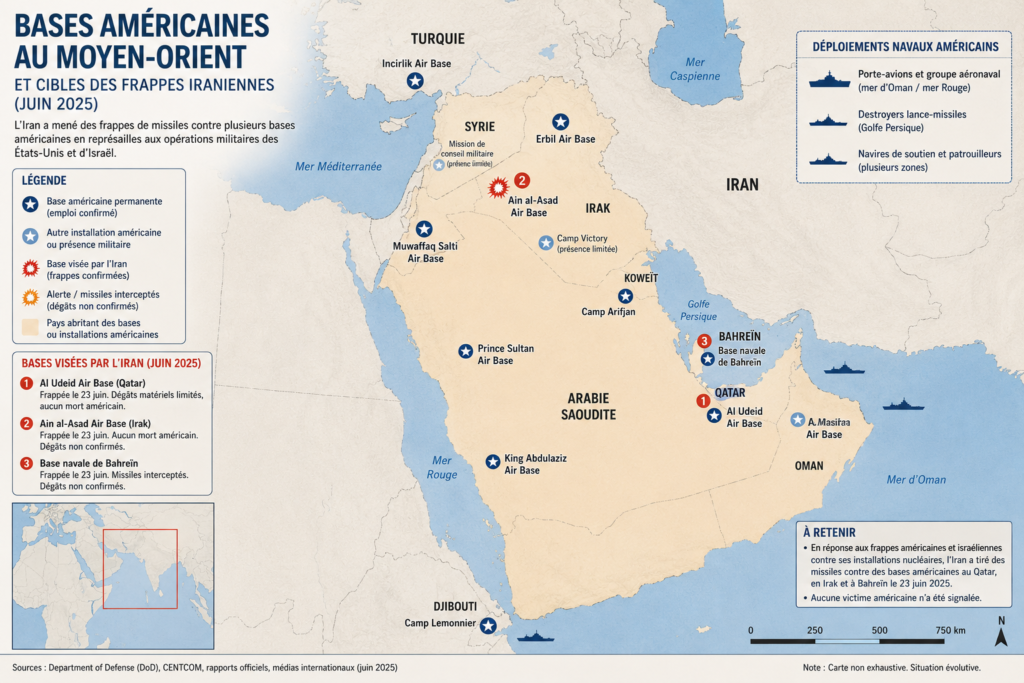
Tehran has adopted a response based on a simple principle: any country that hosts a US military installation can be regarded as taking part in the war. This doctrine directly exposes Kuwait, Bahrain, Qatar and Jordan. These countries host bases, command centres, air defence systems or logistical assets essential to US operations.
Iran has claimed attacks on US or allied installations in Kuwait, Bahrain, Qatar and Jordan. The Kuwaiti authorities reported intercepting ballistic missiles, cruise missiles and drones, while several military and civilian facilities were damaged. The problem is that the line between a military target and civilian infrastructure is becoming increasingly blurred.
A power station can supply a military base, but also hundreds of thousands of residents. A desalination plant may serve strategic facilities, but above all it provides drinking water to the population. A port can host warships while also handling a country’s food and energy imports. By targeting these networks, Iran is trying to raise the political cost of American involvement for Gulf governments. It wants to make them understand that their military cooperation with Washington exposes them to direct consequences.
Kuwait discovers the limits of diplomatic caution
Kuwait has long sought to strike a balance between its alliance with the United States and a working relationship with Iran. This caution stemmed from its geography, from the trauma of the 1990 Iraqi invasion and from its determination not to become a battleground for regional powers. But Iranian attacks on its airspace, its military installations, its electricity grid and its desalination infrastructure are making that position increasingly difficult to sustain.
Kuwait has substantial defence capabilities and benefits from the American presence, but its lack of strategic depth is a major vulnerability. A handful of strikes on essential facilities can quickly disrupt electricity, water, transport and economic activity. The Kuwaiti government must therefore reconcile two conflicting imperatives: avoiding a direct escalation with Iran and demonstrating that an attack on its territory cannot go unanswered.
This situation also explains the reported discussions about strengthening military cooperation between Kuwait and Pakistan. According to Reuters, the two countries are considering a possible expansion of their defence agreements, although no decision on deploying Pakistani combat forces has been announced. This move reflects a profound shift: the Gulf monarchies no longer wish to depend on a single external protector.
Bahrain, front line of the US naval presence
Bahrain is in an even more sensitive position. The kingdom hosts the headquarters of the US Fifth Fleet, which is tasked with monitoring the Gulf, the Arabian Sea and several vital shipping routes. Any crisis around Hormuz therefore automatically places Bahrain at the centre of the confrontation. Iran’s attacks on the kingdom show that Tehran no longer necessarily regards the American presence as a purely defensive arrangement. For Iran’s leaders, Bahrain is one of the operational hubs from which Washington can conduct its naval and air operations.
The small size of Bahrain’s territory and the concentration of its infrastructure, however, increase the risk that a strike on a military target could cause significant civilian damage. The kingdom cannot easily give up American protection. But that protection is also what turns it into a target.
Jordan is no longer a sheltered hinterland
Jordan’s involvement is one of the most significant developments in the conflict. For years, Amman was regarded as a relatively safe platform for US forces. Its geographical position, between Israel, Syria, Iraq and Saudi Arabia, made it an ideal base for intelligence, air defence and regional operations. That relative security has vanished.
On 17 July, two US service members were killed in an Iranian attack in Jordan and a third was reported missing, according to CENTCOM and Reuters. Several other service members were treated for injuries. These losses are changing the American perception of the Jordanian theatre. Jordan is no longer merely a transit or support territory. It is becoming a front line.
For Amman, the risks are manifold. The kingdom must protect its territory, maintain its strategic alliance with Washington, preserve its security cooperation with Israel and prevent regional tensions from aggravating its economic and social fragilities.
Its air defences are also playing a growing role in intercepting projectiles that may cross its airspace. Some missiles aimed at US installations in Jordan may, depending on their trajectory or in the event of a malfunction, also threaten Israeli territory. Jordan’s security and Israel’s are therefore now more closely linked than they were before the war.
Gulf Cooperation Council moves closer to collective defence
The Iranian attacks have produced an outcome that Tehran was probably not seeking: they have heightened the sense of shared vulnerability among members of the Gulf Cooperation Council (GCC). The GCC has repeatedly condemned the strikes targeting its member states and Jordan, describing them as violations of their sovereignty and of international law. Its statements are gradually establishing the idea that the security of one member state can no longer be separated from that of the group as a whole.
This solidarity does not yet mean that a fully integrated air defence exists. Gulf armed forces use different equipment, rely on national chains of command and retain divergent perceptions of Iran. Oman maintains a tradition of mediation. Qatar seeks to keep channels open with Tehran. The United Arab Emirates prioritises its strategic autonomy. Saudi Arabia wants to protect its energy facilities without being dragged into an uncontrollable war. Kuwait remains committed to diplomatic caution. But Iranian missiles are narrowing the room for such nuances.
The Gulf states are being pushed towards greater intelligence sharing, better coordination of their radars and a more coherent regional missile defence. Cooperation with the United States remains central, but it could be supplemented by agreements with France, the United Kingdom, Turkey or Pakistan.
Hormuz and Bab el-Mandeb: the two jaws of the energy war
The conflict is not being fought solely in the air. It is also playing out on the sea lanes. The Strait of Hormuz remains Iran’s main strategic lever. Tehran can slow or disrupt commercial shipping there using coastal missiles, drones, fast attack craft, mines or operations against vessels. Nearly a fifth of the world’s oil normally passes through this waterway. Any closure, even a partial one, immediately drives up insurance costs and energy prices and puts pressure on the markets. But a second front has now opened up at Bab el-Mandeb.
The Houthis have announced a naval embargo against Saudi Arabia and threatened to expand their operations. Such a strategy would allow the Iranian axis to exert pressure simultaneously on Gulf exports and on the route linking the Indian Ocean to the Red Sea and the Suez Canal. Hormuz and Bab el-Mandeb thus form the two ends of a single battle.
In the east, Iran threatens the flows leaving the Gulf. In the west, the Houthis can disrupt the routes taken by ships bound for Europe. This twofold pressure explains why Saudi Arabia is seeking to increase its exports from Yanbu, on the Red Sea, and why plans for pipelines bypassing Hormuz are regaining strategic importance.
Iran can still strike, but it is losing its freedom of action
The Islamic Republic retains a genuine capacity to cause harm. It still has missiles, drones, asymmetric naval forces and allied networks in Iraq, Lebanon and Yemen. It can strike bases, disrupt maritime trade and force its adversaries to deploy costly air defence assets. But this capacity should not be mistaken for a position of strength.
Every attack on a Gulf state strengthens military cooperation between those countries and Washington. Every attempt to close the Strait of Hormuz justifies fresh US operations against Iran’s coastal infrastructure. Every strike on Jordan draws Amman ever closer to Western and Israeli defence arrangements.
Iran is thus succeeding in imposing a cost on its adversaries, but it is also helping to build the regional coalition that could curb its influence for years to come. The war also exposes the limits of its strategy of militias and indirect fronts. When attacks are claimed by the Revolutionary Guards or launched from Iranian territory, Tehran can no longer maintain the same ambiguity as before. The conflict is becoming more direct. And a direct war leaves Iran’s centres of power, its infrastructure and its economy more exposed.
Israel no longer stands alone against Iran
For several years, Israel had been trying to persuade Arab states that the Iranian threat should be regarded as a shared regional problem. The war is accelerating this shift, though without necessarily producing a formal political alliance. Arab public opinion remains deeply critical of Israel, not least because of the Palestinian question. Several Gulf governments are also unwilling to be seen as auxiliaries in an Israeli campaign. On the military front, however, their interests are converging.
Israel, Jordan, the Gulf states and US forces all have an interest in detecting Iranian launches quickly, sharing radar data and coordinating the interception of missiles and drones. This is not yet a “Middle Eastern NATO”. But an informal security architecture is taking shape through early-warning systems, command centres, bilateral agreements and operational cooperation. Israel thus enjoys a strategic environment different from the one that existed in the early 2000s. It remains politically contested, but it is less and less alone in facing Iran’s military capabilities.
Towards a new regional strategic architecture
The most significant transformation brought about by the war may not be measured by the number of missiles destroyed or facilities damaged. It will lie in the decisions taken after the conflict. The Gulf states will probably invest more in their missile defences, their power grids, their water reserves, the protection of their oil facilities and the diversification of their export routes.
Jordan will seek to strengthen the protection of its airspace and its bases. Israel will pursue its strategy against Iran’s nuclear and ballistic capabilities. The United States will try to maintain its role as guarantor of freedom of navigation while asking its regional partners to shoulder a greater share of their own security.
The GCC could deepen its military integration, even though internal rivalries will not disappear. Defence agreements with outside powers will multiply. Pipeline projects linking the Gulf, Iraq, Syria, the Mediterranean and the Red Sea will gain in importance.
As for Iran, it will have to choose between two strategies. It can continue to escalate, striking US bases and threatening energy routes, at the risk of hastening the destruction of its own infrastructure and its regional isolation. Or it can seek fresh negotiations, in the hope of preserving part of its military and nuclear capabilities before the balance of power tilts even further against it.
Ceasefire proposals continue to circulate and Pakistan could resume its role as mediator. But diplomacy is now subordinate to military developments and to the ability of the various actors to impose their terms. The war has therefore already had a lasting consequence: it has erased the line between the Iranian conflict and the security of the Middle East as a whole.
The Gulf states and Jordan can no longer keep their distance. Israel no longer operates in an entirely hostile regional environment. The United States is no longer conducting a limited operation. And Iran can no longer use infrastructure, straits and neighbouring countries as instruments of pressure without provoking the formation of a broader opposing front.
The Middle East that emerges from this war is likely to be more militarised, more integrated in defence terms and ever more dependent on the protection of its energy routes. By gradually cutting off the Iranian coast from the hinterland, Washington is seeking to reduce Tehran’s military capacity around Hormuz. But this strategy also affects Arab, Baluch and Sunni peripheries whose relations with the central government are long-standing, complex and at times fraught. The war could therefore weaken Iran’s territorial unity, without any guarantee that these populations will regard the United States or Israel as liberators. The question, then, is no longer simply who will win the next round of strikes. It is what regional architecture will survive the war.
Also on La Tribune des Nations
. Hormuz: negotiation gives way to armed intimidation
• Iran’s nuclear programme: Pickaxe Mountain, the mountain worrying Washington and Tel Aviv
• The Qatari paradox in the face of the war against Iran
Main sources
• Reuters
• CENTCOM
• International Atomic Energy Agency (IAEA)
• Official statements from the governments concerned
Translated from French. The French original prevails.