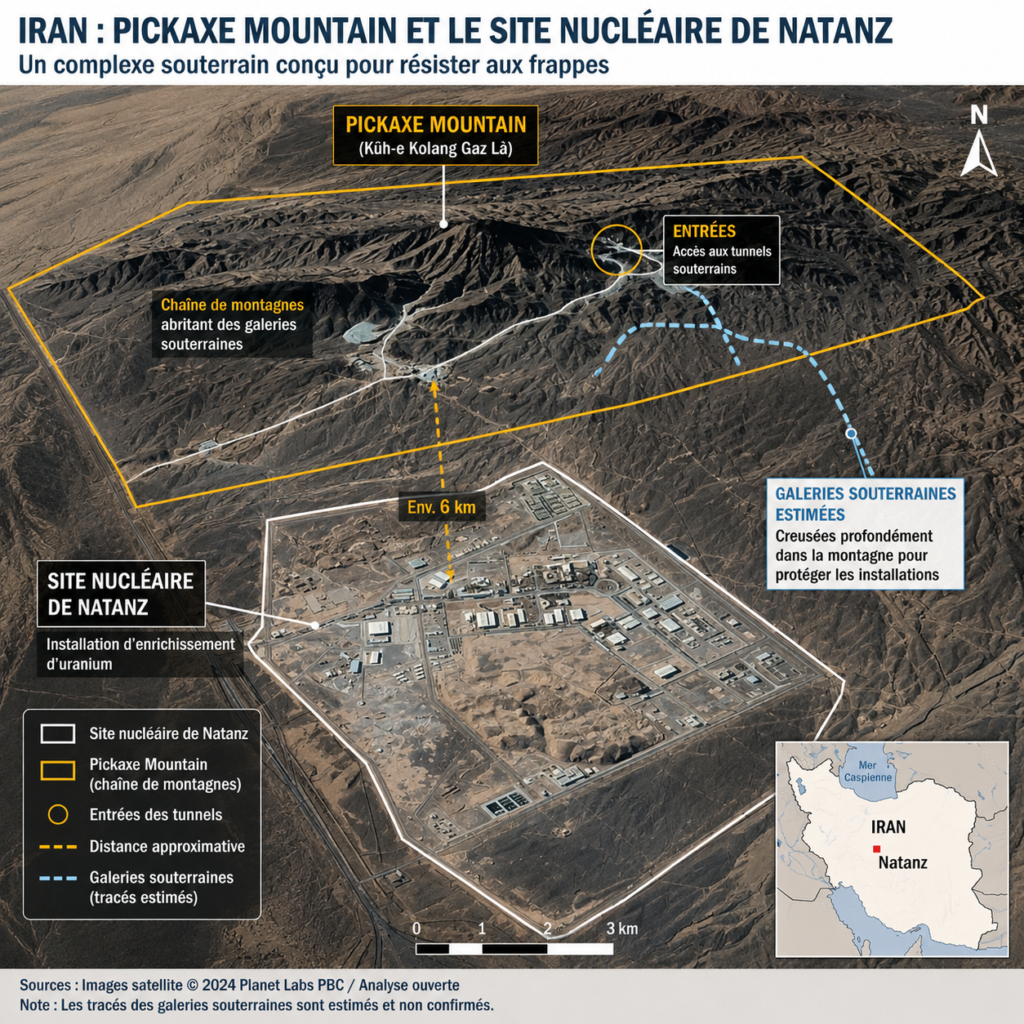
While Iran’s three nuclear sites at Natanz, Fordow and Isfahan remain paralysed or difficult to access, work is continuing at Pickaxe Mountain, a deeply buried complex near Natanz. There is no evidence that it already houses an enrichment plant or Iran’s stockpile of uranium enriched to 60%. But its activity, its opacity and the absence of inspections make it one of the main blind spots in the nuclear file. The site may be less the new heart of the programme than the place chosen to preserve its capacity to bounce back.
A known site, but once again a burning issue
Pickaxe Mountain is not a newly discovered site. Also known as Kuh-e KolangGaz La, this complex of tunnels dug into the mountain south of Natanz has been monitored for several years by proliferation specialists. Its proximity to one of the historic centres of Iranian enrichment places it within the same nuclear, industrial and logistical environment.
What is new is the contrast observed since the end of June 2026. The main known facilities – Natanz, Fordow and Isfahan – show no comparable resumption of activity, whereas vehicles, materials and construction work are appearing around the western entrances to Pickaxe Mountain. The visible electricity and ventilation infrastructure nevertheless still appears insufficient for a fully operational enrichment plant.
Analyses by the Institute for Science and International Security conclude that the visible activity relates mainly to the completion of construction, the reinforcement of access routes and improved security. It proves neither the installation of centrifuge cascades, nor the use of UF6 gas, nor the presence of enriched uranium.
This caution is essential. Pickaxe Mountain may not be the new Natanz. But it could become the post-Natanz site: a place for storage, for protecting equipment, for assembling centrifuges or for the future reconstitution of a nuclear capability.
The Islamabad memorandum and the works at Pickaxe Mountain
The Islamabad memorandum signed on 17 June 2026 commits Iran not to seek or develop nuclear weapons, provides for a negotiated mechanism for dealing with its stockpile of enriched uranium and requires it, pending a final agreement, to maintain the status quo of its nuclear programme.
The scope of this last provision is decisive. Work intended strictly to consolidate tunnels or secure a construction site can still be presented as compatible with the status quo. By contrast, the installation of new nuclear capabilities, the covert transfer of enriched uranium, the preparation of an enrichment plant or the concealment of equipment beyond the reach of any inspection would amount to a substantial change to the programme.
The Foundation for Defense of Democracies already considers that the continuation of the works violates the memorandum. This reading is politically coherent, but it goes further than satellite imagery alone can establish. To conclude, in legal terms, that a violation has occurred, one would need to determine the exact nature of the works and know what is being installed inside. The real test is therefore access for the International Atomic Energy Agency (IAEA). If Tehran refuses to let inspectors verify the site, the argument that this is merely a defensive construction project will become less and less credible.
Natanz and Pickaxe Mountain: two sites or a single complex?
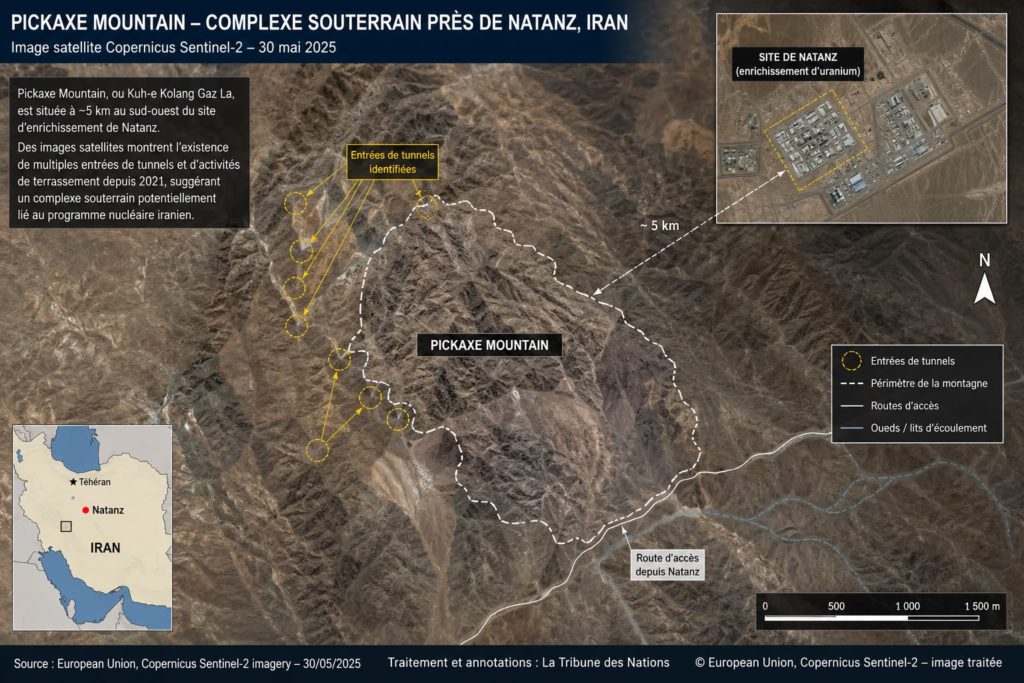
One hypothesis deserves to be raised: is Pickaxe Mountain merely a site neighbouring Natanz, or does it provide the complex with strategic depth to fall back on? The distance of two kilometres between the two areas would make an underground link technically feasible. Iran has long experience of buried infrastructure, from Fordow to military networks dug into mountains. No open source, however, proves the existence of a direct tunnel. This hypothesis must remain what it is: a technical and strategic possibility, not an established fact. The risk would be to turn a legitimate question into a certainty that cannot be proven.
The real question: where is the enriched stockpile?
The most sensitive question may not be whether Pickaxe Mountain is already enriching uranium. It is whether Iran has been able to move its most valuable assets there: enriched material, centrifuge components, specialised machinery, spare parts, industrial blueprints or the equipment needed to rebuild the programme. Before inspections broke down, the IAEA estimated that Iran held around 440 kilograms of uranium enriched up to 60%. That level remains below the weapons-grade threshold, generally put at 90%, but it would sharply reduce the time needed to produce weapons-grade material should such a decision be taken.
Isfahan remains the site most often cited for underground storage. Natanz and Fordow also remain at the heart of the questions. Pickaxe Mountain appears to be a less well-documented possibility, but one it would be unwise to rule out. Moving material would not require a visible plant: a protected route, secure spaces and strict access control would suffice.
Why has the United States not struck Pickaxe Mountain?
If the site is causing such concern, why did the United States not target it during the strikes of July 2026? The absence of a strike does not necessarily mean that Washington regards the complex as secondary. The US operation of 7 July was first and foremost a response to Iranian attacks on merchant vessels in the Strait of Hormuz. The stated targets were directly linked to that threat: air defence systems, command centres, coastal radars, anti-ship missiles and Revolutionary Guards boats. The nuclear programme was not among the declared objectives of that retaliation.
Striking Pickaxe Mountain would therefore have changed the nature of the operation. The United States would have moved from an action intended to protect shipping to a fresh offensive against Iran’s nuclear programme, with the risk of a far wider escalation. Another explanation lies in the uncertainty surrounding the complex. Satellites show construction work and reinforced access points, but they cannot establish with certainty what lies inside. A strike on an underground facility only makes sense if it is aimed at identified targets: centrifuges, sensitive stockpiles, power supply, ventilation or essential access points.
The site’s presumed depth also poses a military problem. Pickaxe Mountain could be harder to reach than Fordow. An effective attack would require highly precise geological intelligence, specific preparation and munitions capable of neutralising a network of tunnels, rather than merely sealing off a few entrances.
Finally, Washington may regard the complex as a deferred target. As long as it is not clearly operational, the United States may prefer to demand a halt to the work and access for the IAEA. Should Iran refuse, Pickaxe Mountain could become one of the priority targets of a campaign aimed specifically at the nuclear programme.
The absence of a strike therefore does not close the matter. It sharpens the central question: is Pickaxe Mountain still a construction site whose purpose remains uncertain, or a target that Washington is holding back for a later operation, better prepared and politically weightier?
Iran’s nuclear programme is more than buildings
Israeli and US strikes have dealt severe blows to Iranian facilities. They have destroyed equipment, crippled halls, hit electrical systems and sealed off some entrances. But a nuclear programme also rests on stockpiles, engineers, plans, components, machinery and an industrial memory built up over decades.
A building can be destroyed. It is far harder to eliminate the know-how that made it possible to build it. The more the visible sites are struck, the greater Tehran’s incentive to bury its capabilities, disperse its stockpiles and multiply opaque facilities. Bombs can thus push the problem into deeper ground.
Pickaxe Mountain sums up this limitation. The mountain offers more than a technical refuge. It creates political and strategic doubt: the United States and Israel can strike Natanz, Fordow or Isfahan without being certain that they have eliminated Iran’s nuclear option.
The post-Natanz site
There is nothing to support a public assertion that Pickaxe Mountain is currently an operational enrichment facility. Nor is there any proof that the enriched stockpile has been moved there. But the site’s proximity to Natanz, the depth of the complex, the continuing construction work and the absence of inspections make it impossible to rule out that possibility.
That is probably how the site should be understood: not as the new, visible heart of the programme, but as a strategic insurance policy. Should negotiations fail, strikes resume or the regime decide to restart its activities more openly, the complex could provide space for storage, protection or reconstitution.
Pickaxe Mountain is therefore not yet the new Natanz. But it could become the post-Natanz site.In this affair, the danger lies not only in what Iran is doing beneath the mountain today. It lies in what it may have kept there for tomorrow.
Also on La Tribune des Nations
• Nuclear programme, Hormuz: Tehran and Washington do not speak the same language
• Iranian nuclear programme: IAEA deems 2015 agreement obsolete
• Leaks on the deal with Iran: Washington faces a political and media storm
• Israel, Iran and the shadow of a major conflict
External articles
• Türkiye Today — Satellite view of Pickaxe Mountain and US statements
Translated from French. The French original prevails.