How Russia appropriated the legacy of Kyivan Rus’.
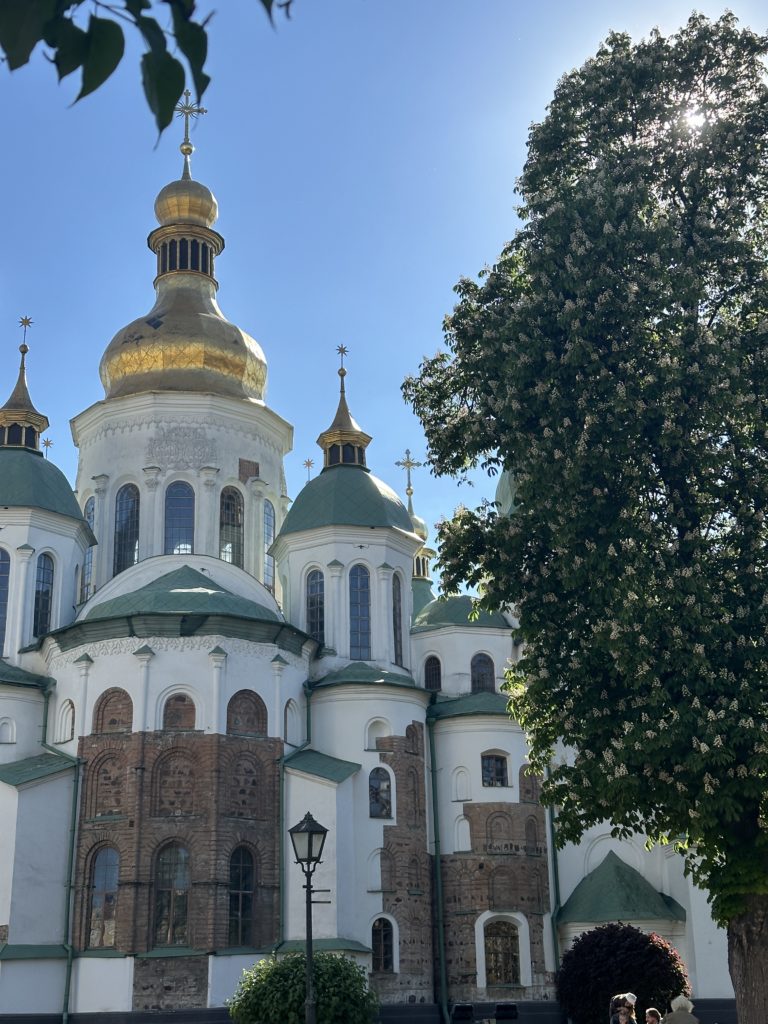
St Sophia’s Cathedral in Kyiv. Photo Kyiv May 2026 Victoria Gudzenko.
Empires are rarely content merely to conquer territory. Land can be lost. Peoples can rise up. Borders can shift. A true imperial power therefore aspires to more: it seeks to appropriate a past. For whoever appropriates history is also trying to appropriate the future.
For several centuries, Russia has waged wars not only for territory; it has also waged a war for memory. Its greatest trophy is Kyivan Rus’ — a state that took shape on the banks of the Dnipro long before a modest settlement appeared in the forests of the north-east and later became Moscow.
Contemporary Russian historical mythology strives to convince the world that Rus’ and Russia are one and the same. According to this narrative, Russia is the sole and direct successor to the ancient state of Rus’, while Ukraine is merely an accidental branch of the great tree of history. Yet the facts tell a very different story.
The struggle over the origins of history
In contemporary Europe, few historical controversies see politics intrude so openly into the past as the debate over the legacy of Kyivan Rus’. It might seem to concern nothing more than a state that disappeared more than seven centuries ago. Yet Rus’ remains, even today, at the heart of diplomatic statements, state ideology and even wartime propaganda. The reason is obvious: this controversy is not only about the past. It is about the right to define the present.
History is never a mere accumulation of facts. For any state, it serves a far more essential function: it explains why that state exists. Every political community needs a narrative that answers a fundamental question: where does it come from, and why does it have the right to be what it is today? That is why the struggle over a historical legacy almost always becomes a way of legitimising the present.
Seen in this light, the legacy of Rus’ holds a special place in the history of Eastern Europe. It is the oldest political and cultural foundation from which the various historical traditions of the peoples now living in the territories of Ukraine, Belarus and Russia developed. The question of Rus’ therefore inevitably becomes a question of succession. Who carried this tradition forward? Does it belong to everyone? Or can a modern state claim the right to proclaim itself not merely an heir, but the sole legitimate successor of Rus’? This is precisely where the real conflict begins.
In scholarly historiography, there is virtually no serious debate about where the political centre of Rus’ lay. Nor is there any doubt that today’s Ukrainians, Belarusians and Russians have each inherited certain elements of the political and cultural tradition of Rus’. The real controversy, however, concerns a different question: is this legacy shared, or can it be monopolised by a single state proclaiming itself not merely an heir, but the sole successor of Rus’?
When Russian political thought invokes “historical Russia”, it almost inevitably comes back to Kyiv. Whenever the conversation turns to the origins of the Russian state, the Orthodox tradition or Russia’s special civilisational mission, the story begins again on the banks of the Dnieper. This choice is far from innocuous. For the Russian state mindset, Kyivan Rus’ is the starting point of history; without it, the entire historical edifice loses its coherence. That is why, for the Kremlin, the question of Kyiv has never been purely historical. It has always been political.
The struggle over the legacy of Rus’ therefore extends far beyond the realm of academic research. In reality, it is a struggle for the right to define one’s own historical origins. And herein lies a paradox: the more importance Rus’ acquires in Russian state identity, the more central Kyiv becomes — a city that never belonged to historical Muscovy and that shaped a profoundly different political tradition.
To grasp the nature of this paradox, one must step away from contemporary political statements and return to the historical reality of Rus’ itself. Only then can one answer the question of what this state really was, why Kyiv became its undisputed centre and why the struggle over its legacy continues to this day.
Kyiv, the true centre of Rus’
If one sets aside the political interpretations that emerged later and considers the Rus’ of the 10th to 13th centuries as it existed in its own time, one conclusion is inescapable: Kyiv was not a symbolic centre forged by historical memory, but the true political heart of the state. It was there that power, legitimacy and the principal institutions of the first statehood of the Rus’ were concentrated.
THE HRYVNIA Its name has travelled down the centuries. The hryvnia is not merely the name of the Ukrainian currency: the word dates back to the era of Kyivan Rus’, when it first referred to a metal ornament, then to a unit of weight and of currency. In 1918, the name was adopted for the currency of the Ukrainian People’s Republic. Almost 80 years later, in 1996, the hryvnia became the currency of independent Ukraine.
THE TRIDENT A symbol more than a thousand years old. The Trident is attested as far back as the era of the princes of Kyivan Rus’: it appeared, among other places, on coins and served as a dynastic mark. In 1918, it became the emblem of the Ukrainian People’s Republic. After Ukraine regained its independence in 1991, it resumed its place as a symbol of the state. Today, the Trident is one of Ukraine’s most recognisable symbols around the world.
From the outset, the formation of the Rus’ was inextricably linked to control of the trade route “from the Varangians to the Greeks”, which connected the Baltic Sea to the Black Sea and opened up access to Byzantium. It was no accident that Kyiv became the centre of this system. Its geographical position allowed it to control the Dnieper, the main trading artery of the Rus’, which, through a network of rivers and portages, linked the two seas.
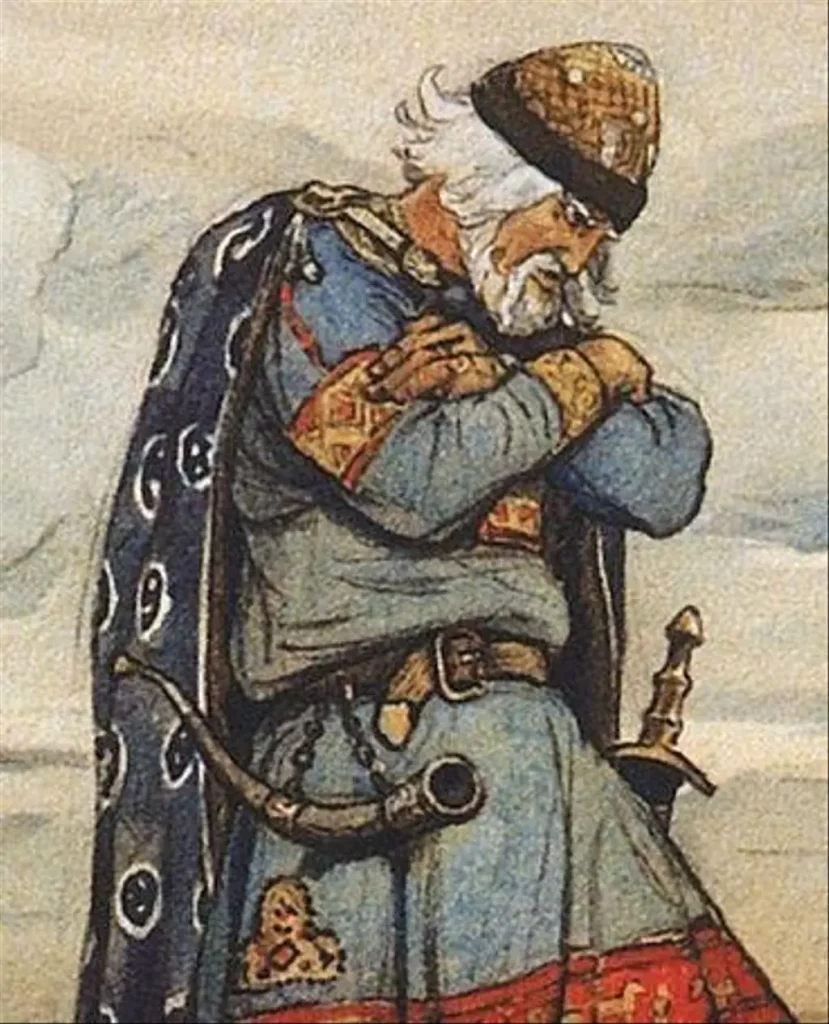
A drawing depicting Prince Oleg of Kyiv.
That is why Kyiv was not merely the largest city in Rus’; it became its natural political centre, capable of bringing vast territories together under a single political authority. The capture of Kyiv in 882 by Prince Oleg of Novgorod (c. 850/912–912/922, probably of Varangian origin) turned the city into the principal political centre of the Rurikid state. From then on, Kyiv became the residence of the grand prince and the centre around which the entire political system of Rus’ was organised.
In medieval Europe, a capital was not an administrative category in the modern sense of the term. It was the place from which the legitimacy of power emanated.
In 882, Oleg overthrew Askold and Dir, who ruled in Kyiv, and moved his residence there from Novgorod. This event is traditionally regarded as the founding act of the unified state of Rus’, since Oleg brought the northern and southern lands of Rus’ together under the authority of a single prince. According to the Chronicle, he proclaimed Kyiv “the mother of the cities of Rus'”.
The Christianisation of Rus’ in 988 further strengthened this status. With the adoption of Christianity, Kyiv became not only the political centre but also the spiritual centre of the state. Rus’ entered the Byzantine world, in which a prince’s legitimacy rested not only on force but also on his place in the Christian political order. Kyiv became the meeting point between secular power and the church hierarchy. It was from there that Rus’ made its entrance into the political and cultural sphere of Christian Europe.
Under the reigns of Volodymyr the Great (c. 970–988/990) and Yaroslav the Wise (983/987–1054), this model reached its zenith. It was in Kyiv that the Ruska Pravda, the first major code of law in Eastern Europe, was drawn up. It was there that St Sophia’s Cathedral in Kyiv was built – not merely a place of worship, but also the political symbol of a state aware that it belonged to the European Christian world. And it was from Kyiv, too, that Rus’ became part of the web of dynastic alliances with the greatest European powers.
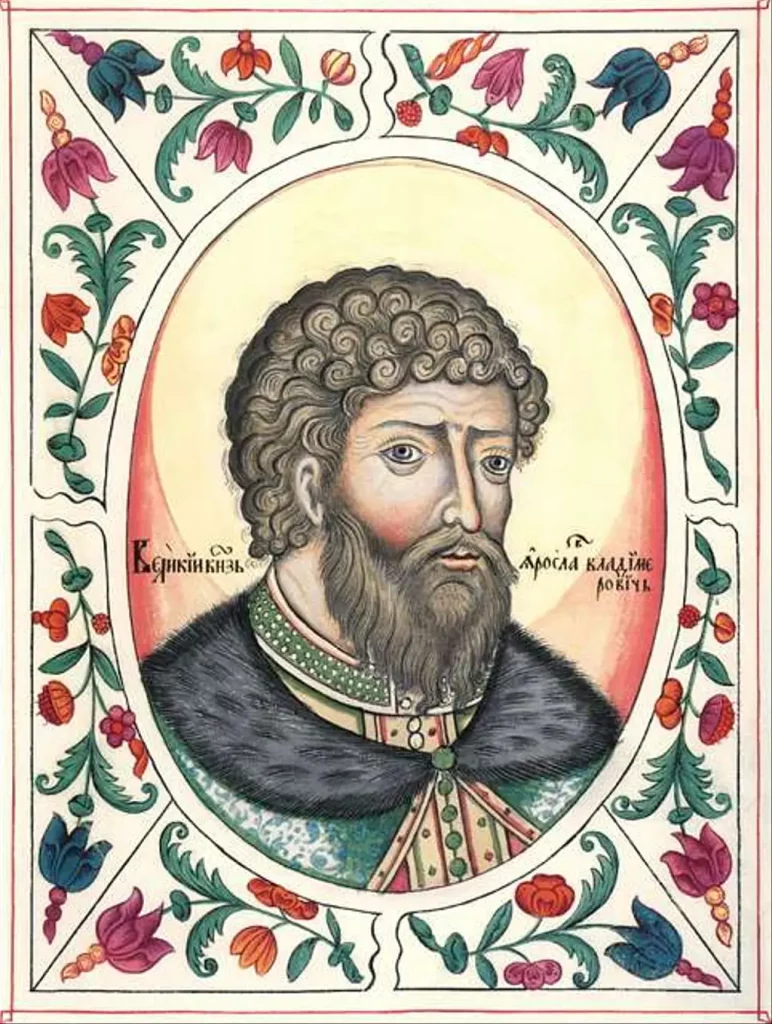
Illuminated drawing of Yaroslav the Wise.
In medieval Europe, marriage was not a private matter: it was an instrument of diplomacy. Royal dynasties did not form alliances with politically minor rulers. A marriage signified recognition of equal rank. If Yaroslav the Wise is nicknamed “the father-in-law of Europe”, this is not a title but a metaphor conveying the scale of his diplomatic system. Kyiv was seen as the equal of the other European monarchies. It was a state that was not seeking its place in Europe: it was already part of it.
These facts matter not merely as a list of historical achievements. They reveal something far more fundamental: Kyiv functioned as one of the great political centres of the Europe of its day. According to some historical estimates, it was among the largest cities on the continent and may even have exceeded Paris or London in population.
That is why, in the political culture of Rus’, the legitimacy of power was inseparably bound up with possession of Kyiv. Controlling the city did not merely mean controlling territory. It meant laying claim to supremacy over the entire political space of Rus’. Losing Kyiv therefore did not simply mean losing a capital; it amounted to losing the very source of legitimacy. That is why the struggles for Kyiv in the 12th and 13th centuries were not mere internecine wars between rival principalities. They were a struggle for the very heart of the state.
In the political system of Rus’, Kyiv was not one of several equivalent centres. It was the place from which the very idea of supreme authority was defined. That is why no reflection on the legacy of Rus’ can sidestep the question of Kyiv. It is not a secondary detail of history, but its foundation.
- Kyiv was the political centre of Rus’ between the 10th and 13th centuries.
- Moscow emerged later; its first mention in the chronicles dates from 1147.
- Moscow was not the political centre of Rus’ at the time of its formation.
- After the break-up of Rus’, no single, undisputed heir emerged; several political entities each inherited different elements of the tradition of Rus’.
This fact is essential to the rest of the story. At a time when the daughters of the prince of Kyiv were becoming queens of the greatest kingdoms in Europe, Moscow did not yet exist as a political centre and does not appear in the sources until 1147. Kyiv does not merely predate Moscow chronologically. It belongs to an entirely different political world: that of European diplomacy, the Christian state and dynastic alliances. History cannot be rewritten so that a capital appears before the state whose legacy it now seeks to appropriate.
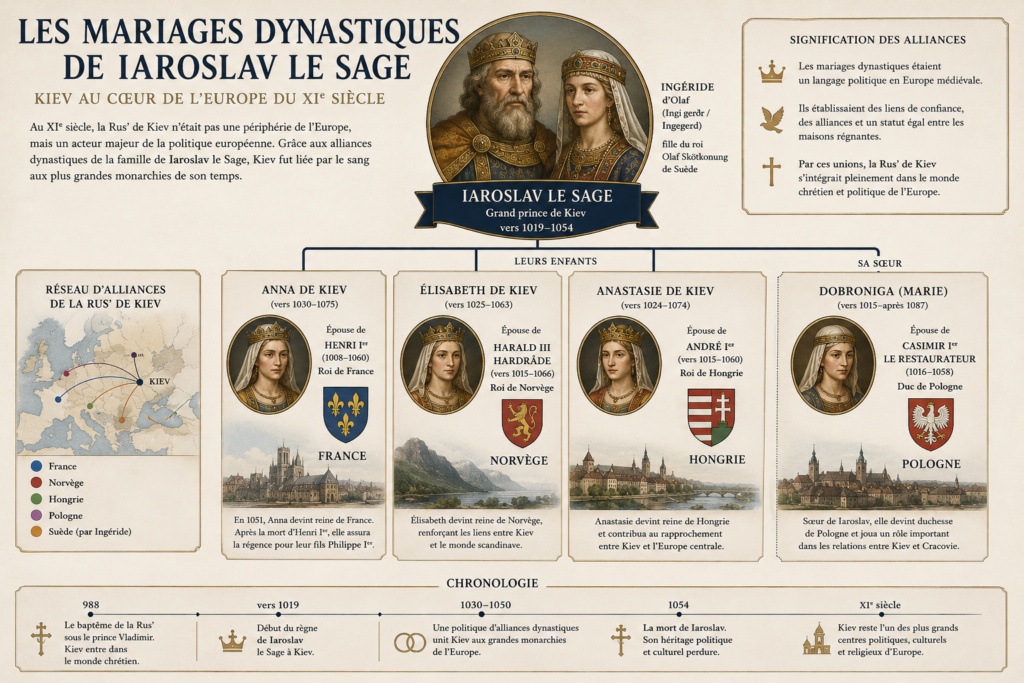
The daughters of Yaroslav the Wise became queens in several European capitals. Family tree created with AI.
The 13th-century rupture and the emergence of several legacies of Rus’
The Mongol invasion of the 13th century was not merely a military catastrophe for Kyiv. It marked the collapse of the political system that, for several centuries, had united the lands of Rus’ around a single centre. After the fall of Kyiv in 1240, Rus’ did not vanish overnight, but it ceased to exist as a unified political space with a universally recognised centre of power.
This moment was one of the most decisive turning points in the history of Eastern Europe. It did not give rise to a new centre that would automatically inherit the whole of Rus’. On the contrary, it opened up several distinct historical paths. From then on, several histories coexisted, each carrying forward, in its own way, certain elements of its political, legal and cultural legacy.
The southern and western lands of Rus’, including Kyiv, were gradually incorporated into the Grand Duchy of Lithuania. This did not mean a break with the tradition of Rus’. Quite the opposite: it was there that its political and legal foundations were largely preserved. Ruthenian remained the language of the state chancery, the law of Rus’ continued to be applied and the Orthodox elites retained their political and cultural influence. It was within this framework that one of the lines of historical continuity developed which would later form the basis of the Ukrainian and Belarusian traditions.
At the same time, the north-eastern principalities followed a different path. For nearly two and a half centuries, they remained politically dependent on the Mongols of the Golden Horde. This did not mean a mere replication of the Horde’s institutions, but this long interaction profoundly shaped the character of the future Muscovite state. Power became more centralised, the role of the sovereign as the sole source of political will grew stronger, and the political model of the future Muscovy gradually drifted away from the one that had developed in pre-Mongol Kyiv.
After the break-up of Rus’, the land of Novgorod also pursued its own historical path. Novgorod remained one of the largest centres of the world of Rus’, while retaining its own political model. Unlike most of the other principalities, the veche — the assembly of the city’s inhabitants — played a major role there: it invited or deposed princes and decided matters of war, peace and foreign policy.
In the 15th century, Novgorod became Moscow’s main rival in the struggle for the future of the lands of north-eastern Rus’. Following the campaigns of Ivan III (Ivan III Vasilyevich, 1440–1505, known as Ivan III the Great, Grand Prince of Moscow from 1462 to 1505), the city was finally subjugated in 1478. The veche was abolished, its famous bell — the symbol of Novgorod’s autonomy — was carried off, and much of the local elite was resettled in other regions of the Muscovite state.
It was under Ivan III that the title of “Sovereign of All Rus’” came into use, through which he laid claim to all the lands of Rus’, even though a large part of them still belonged to the Grand Duchy of Lithuania. It was also during his reign that the ideas began to take shape which, under his successors in the early 16th century, would give rise to the doctrine of “Moscow, the Third Rome”.
Later, in 1570, during the campaign of Ivan IV the Terrible (Ivan IV Vasilyevich, 1530–1584, grandson of Ivan III and the first ruler to officially adopt the title of “Tsar of All Rus’”), Novgorod was subjected to a sweeping wave of terror, described by contemporaries as one of the greatest tragedies in 16th-century Muscovite history. Thus was one of the alternative paths of development of the political tradition of Rus’ definitively eliminated.
For the future Muscovite state, its adversaries were not only to be found abroad. The other possible paths along which Rus’ might have developed posed a threat too. Thus, after the 13th century, the history of Rus’ is not that of a single heir. It splits into several historical trajectories. The Ukrainian and Belarusian lands carried on the tradition of Rus’ within the Grand Duchy of Lithuania; Novgorod retained its own political model until Moscow violently destroyed it; while the north-eastern principalities gradually gave rise to the Muscovite state, the bearer of an authoritarian political tradition.
Any later attempt to present the history of Rus’ as an unbroken line leading directly from Kyiv to a single present-day state therefore reflects not medieval reality but a political interpretation of the past. It reduces a complex historical development to a single narrative, turning a plurality of legacies into the story of one victor.
And it is precisely for this reason that the debate over the legacy of Rus’ did not end with the Middle Ages. It continues to this day. It echoes not only in university lecture halls and the work of historians, but also in presidential speeches, in state propaganda and, ultimately, on the battlefield. For the war being waged against Ukraine is also a war over the right to define where the history of Rus’ begins and to whom it belongs.
Translated from French. The French original prevails.