Ontario Premier Robert Douglas Ford
It is a Thursday evening in October, and Donald Trump is angry about a television advert. Not about a speech by a head of state, not about an economic sanction, not about a vote at the UN. About a 30-second advert, paid for by the government of Ontario, which uses an excerpt from a 1987 radio address by Ronald Reagan — in which the former president explains that tariffs always end up hurting American workers and consumers.
That evening, on Truth Social, Trump writes that all trade negotiations with Canada are terminated with immediate effect. He accuses Ottawa of knowingly distorting Reagan’s words to influence a forthcoming ruling by the US Supreme Court on the legality of his own tariffs. The Ronald Reagan Presidential Foundation, for its part, states that the Ontario government had neither sought nor obtained permission to use and edit those remarks. Ontario Premier Doug Ford, however, maintains that it is a complete, unedited excerpt taken from the public domain.
Doug Ford eventually withdrew the advertisement on Mark Carney’s advice, in the hope of restarting talks. Too late. A few days later, aboard Air Force One, a characteristically unrepentant Trump confirmed that he would not resume negotiations, despite the apology from his Canadian counterpart — adding that he liked Carney very much personally, but that what his country had done was wrong. A senior source in Ottawa later told Radio-Canada that the advertisement had genuinely angered the president, and that it was not merely a diplomatic pretext.
Cost of the advertising campaign: around 75 million dollars, broadcast on several American television channels during the World Series. Cost of the breakdown in negotiations: incalculable for Canadian industry. It remains, to date, one of the most revealing episodes of the entire trade war — and one of the least understood internationally.
The true face of this trade war
Because here is what few people realise: this episode is not an isolated anecdote. It is a symptom. An in-depth investigation into the current Canada–US relationship reveals a far broader — and far more troubling — pattern than the mere economics of tariffs.
Since Trump’s return to the White House, tariffs no longer serve merely to correct trade imbalances. They have become the president’s favoured instrument of political retaliation, used to punish countries that, in his eyes, made the wrong decision at the wrong time. The list keeps growing, and it is staggering:
● Brazil was hit with 50% tariffs and with sanctions against one of its Supreme Court judges, in explicit support of former president Jair Bolsonaro, who is being prosecuted by the Brazilian courts.
● Colombia had its foreign aid cut off and its tariffs raised after its president, Gustavo Petro, criticised US strikes in the Caribbean.
● South Africa was hit with severe tariffs, linked to the perceived treatment of white farmers and the country’s land reforms.
● Denmark and seven other NATO allies were threatened with tariffs for refusing to pressure Copenhagen into selling Greenland to the United States.
● India was slapped with an additional 25% tariff for continuing to buy Russian oil.
An analysis by ABC News sums up the situation in a single sentence that says it all: no country any longer knows for certain which decision, which policy or which misstep might offend the president and trigger new tariffs. Canada is therefore not an isolated case — it is the best-documented example of a new mode of American diplomacy in which trade becomes a weapon of political correction.
The other forgotten trigger: Palestine
There was also Mark Carney’s recognition of a Palestinian state in July 2025, following in the footsteps of France and the United Kingdom. Earlier that same week, Trump had said he was not opposed to London taking a similar position. Canada, for its part, immediately faced a hardening of tone: Trump wrote that the move would make it very difficult to reach a trade deal, barely a day before his own 1 August deadline. Mexico, meanwhile, was granted a 90-day extension for its own negotiations.
Around 91% of Canadian exports to the United States are subject to no tariffs at all, thanks to the exemptions provided for under the CUSMA. — RBC estimate
Here lies the paradox at the heart of this story: for all the noise surrounding the 35% figure, the vast majority of Canada–US trade continues to flow without any surcharge. The real battle, then, is not being fought on the media front line — it is being fought over the 9 to 10% of products that fail to comply with the agreement’s 245 pages of rules of origin, and over the very real sectoral tariffs on steel, aluminium and softwood lumber, which enjoy no exemption whatsoever.
The price paid by real people
This is where theory meets reality. In Lac-Mégantic, the Bestar factory has closed its doors. In Ontario, the concentration of auto parts manufacturing in the south-west of the province leaves the region particularly exposed. In Quebec, the average effective tariff rate has risen from just over 5% in July 2025 to 9% today — almost double.
For steel and aluminium producers, hit by 50% tariffs, the American market is now all but closed. Some Quebec aluminium smelters are managing to redirect their output towards Europe. But for the SMEs that turn these metals into parts for the aerospace, automotive or construction industries, the consequences are described as catastrophic by economic observers. These are not abstract statistics: they are jobs, mortgages and pensions hanging on decisions taken in offices in Washington.
The silent response: the great diversification
While tariffs dominate the headlines, Ottawa is quietly pursuing a far more discreet transformation behind the scenes — and one that is arguably more decisive in the long run: reducing, market by market, Canada’s structural dependence on a neighbour that has become unpredictable.
Between March 2025 and March 2026, Canadian exports to markets other than the United States rose from $18 billion to $24.3 billion, cutting the share destined for its American neighbour from 73% to 66.7%. It is not spectacular and it does not make the headlines — but it may well be Canada’s most strategic response to this crisis.

Screenshot.
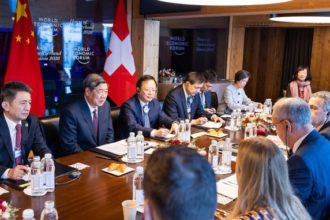
The boldest — and most controversial — move remains the rapprochement with China. From 14 to 17 January 2026, Mark Carney travelled to Beijing to meet President Xi Jinping: the first official visit to China by a Canadian prime minister since 2017, and a spectacular thaw after years of frosty relations dating back to the detention of Huawei executive Meng Wanzhou.
The upshot: China agreed to cut its tariffs on Canadian canola, which had risen as high as 84%, to a combined rate of around 15% by 1 March 2026 — a measure affecting nearly $4 billion in annual exports. In return, Canada opened the door to a quota of Chinese electric vehicles. Some economists, including Jim Stanford of the Centre for Future Work, believe China got the better end of the bargain. On the ground, canola growers remain divided: several lost their position as leading supplier to Russia while the punitive tariffs were in force, and the agreement does not immediately repair the accumulated damage.
Meanwhile, Canada is forging a growing number of partnerships on critical minerals — lithium, graphite, nickel, cobalt, copper and rare earths — with Germany, Australia, Saudi Arabia, Japan, Italy and the European Union. On 7 July 2026, Ottawa launched the Canadian Critical Minerals Accelerator, with a first strategic investment agreement with Teck Resources in British Columbia. At the G7 summit in June 2026, Carney also announced a partnership with Japan for a critical minerals processing plant in Kapuskasing, Ontario, and a $95 million Italian investment in a graphite mine in Quebec.
Then there is the Indo-Pacific, where Canada is banking on the Comprehensive and Progressive Agreement for Trans-Pacific Partnership and on ongoing negotiations with India, ASEAN, Thailand and the Philippines — a region expected to account for half of global GDP by 2040. None of this erases the current dependence on the United States. But the direction is clear: in ten years’ time, Canada wants to be able to tell a different trade story from today’s.
The court that could change everything
There is one final act to this play, still unfinished. In February 2026, the US Supreme Court struck down some of the tariffs imposed by Trump under the IEEPA — the emergency economic powers law he was using as the legal basis for his global trade war. The government was supposed to refund around $166 billion collected from more than 330,000 American companies. Trump immediately switched to another legal mechanism to keep up the pressure.
The legal battle over the real limits of presidential power on tariffs is far from over — and its outcome will determine whether this weapon of economic coercion remains available for the next diplomatic crisis, whatever it may be.
The real takeaway
This is not first and foremost a story about fentanyl, dairy supply management or softwood lumber. It is the story of a country discovering, advert by advert, statement by statement, that its most vital relationship can now be upended for reasons that have nothing to do with economics — an audio clip of Reagan, a diplomatic recognition, a domestic court ruling. Canada is not alone in this situation: Brazil, Colombia, South Africa, Denmark and India have all, in their own way, learnt the same bitter lesson over the same period.
What sets the Canadian case apart is the frequency and visibility of the incidents, and above all its response to them: rather than simply taking the blows, Ottawa is quietly redrawing the map of its economic alliances — towards Asia, towards Europe and even, not without some gnashing of teeth, towards Beijing. The story of this trade war will not end with an agreement signed in Washington. It will end, if it ends at all, with a Canada that no longer needs that agreement quite so much.
Didier Aubrais is President and Founder of Groupe DA Détection-Action, a business intelligence and specialist investigations firm (Laval, Quebec — Geneva), and President of the Cercle Canadien Francophone d’Analyse Géostratégique (CCFAG).
Sources and references
1. Zonebourse — “Ontario suspends anti-tariff advert”, October 2025. — Ontario suspends its campaign after the breakdown in negotiations triggered by the advert quoting Reagan. Source: zonebourse.com
2. Le Devoir — “Trump does not intend to resume negotiations”, October 2025. — Trump confirms he will not restart talks despite Carney’s apology for the Ontario advert. Source: ledevoir.com
3. Radio-Canada — “Trump breaks off trade negotiations”, October 2025. — A source in Ottawa confirms that the advertisement genuinely angered Trump and was not merely a pretext. Source: ici.radio-canada.ca
4. Noovo Info — “The advertisement that ended the negotiations”, October 2025. — Details of the $75 million campaign funded by the Government of Ontario. Source: noovo.info
5. Le Devoir — “Trump announces end to trade negotiations”, October 2025. — Trump describes the Canadian advertisements quoting Reagan as crude. Source: ledevoir.com
6. AOL / New York Post — “Trump terminates trade talks with Canada”, October 2025.— Trump accuses Canada of seeking to influence the US Supreme Court with the advertisement. Source: aol.com
7. Euronews — “Recognition of a Palestinian state: Trump’s threats”, July 2025.— Trump responds to Carney’s announcement on recognising a Palestinian state by threatening the trade deal. Source: fr.euronews.com
8. La Tribune — “Trump tempers hopes of a deal”, July 2025. — Mexico secures a 90-day extension while Canada faces a hardening of tone. Source: latribune.ca
9. Le Devoir — “Losing the first round” (column), August 2025. — An analysis of the political setback suffered by Carney after the failure of the 1 August negotiations. Source: ledevoir.com
10. Le Devoir — “Mark Carney face au risque de la reconnaissance palestinienne” (editorial), August 2025. — Draws a parallel with the US retaliation imposed on Brazil for similar political reasons. Source: ledevoir.com
11. CNN Business — “Trump’s unusual tariff strategy puts America’s allies in a near-impossible situation”, November 2025. — An overview of tariffs used as political retaliation: Brazil, Colombia, South Africa, Canada. Source: cnn.com
12. ABC News — “Tariffs are Trump’s favorite foreign policy tool“, November 2025. — According to this analysis, the rift with Canada is directly linked to the television advertisement. Source: abcnews.go.com
13. Congress.gov (Congressional Research Service) — “Presidential 2025 Tariff Actions: Timeline and Status“. — The official timeline of US tariff measures invoking the IEEPA against Canada, Mexico and China. Source: congress.gov
14. Wikipedia — “Tariffs in the second Trump administration”, updated 2026. — Overview of sectoral tariff rates and of the Supreme Court ruling striking down the IEEPA tariffs. Source: en.wikipedia.org
15. California Law Review — “Trump’s Tariff Wars and the Fracturing Global Economy”, April 2026. — Legal analysis of the use of tariffs as an instrument of economic coercion, with the case of Greenland and Denmark. Source: californialawreview.org
16. Reed Smith — “Trump 2.0 tariff tracker”, updated June 2026. — Detailed tracking of US tariffs by country and by sector, including the IEEPA refund process. Source: tradecomplianceresourcehub.com
17. The Trade War Playbook (Substack, N. Cachanosky), January 2026. — Historical context for the Trump tariffs set against the Smoot-Hawley precedent of 1930. Source: economicorder.substack.com
18. Global Affairs Canada — Departmental Plan 2026-2027. — Priorities for trade diversification and regional engagement in the Indo-Pacific. Source: international.canada.ca
19. Canada.ca — “Atlantic Canada broadens its horizons in theIndo-Pacific“, January 2026. — Review of Team Canada trade missions to the Indo-Pacific region in 2025. Source: canada.ca
20. Asia Pacific Foundation of Canada — ” Canada’s Indo-Pacific Strategy at Three “, September 2025. — Mid-term review of Canada’s Indo-Pacific Strategy. Source: asiapacific.ca
21. EDC (Export Development Canada) — “Diversifying your export markets”. — Official case for the importance of diversification in the face of dependence on the US market. Source: edc.ca
22. Canadian Chamber of Commerce — Statement on the Canada-China trade agreements, January 2026. — The business community’s reaction to the extension of reduced tariffs on canola, lobster and crab. Source: chamber.ca
23. CO24 — “Canada-China trade deal 2026 expands despite tariff deadlock”, January 2026. — Economist Jim Stanford believes China got the better end of the deal. Source: co24.ca
24. Le Collectif — “Thaw in Canada-China relations: a pragmatic shift”, February 2026. — Details of Mark Carney’s official visit to Beijing from 14 to 17 January 2026. Source: lecollectif.ca
25. EDC — “China’s tariffs and our canola exports”, June 2026. — Canada has lost its position as China’s leading canola supplier to Russia. Source: edc.ca
26. Canada.ca — “Canada secures renewed access to the Chinese market”, March 2026.— Chinese tariffs on canola reduced to 14.9% and a target of increasing exports by 50% by 2030. Source: canada.ca
27. Canada.ca — Canadian Critical Minerals Strategy, February 2026 update. — New cooperation mechanisms with Germany, Australia and Saudi Arabia. Source: canada.ca
28. Canada.ca — “First agreement under the Canadian Critical Minerals Accelerator”, July 2026. — Strategic investment with Teck Resources in the Trail smelter, British Columbia. Source: canada.ca
29. Office of the Prime Minister (PM.gc.ca) — 2026 G7 partnerships on defence and critical minerals, June 2026. — Agreements with Japan (Kapuskasing) and Italy (graphite mine in Quebec). Source: pm.gc.ca
30. EDC — “Canada-EU Critical Minerals Alliance”. — Canada is the world’s fourth-largest producer of aluminium, nickel and platinum. Source: edc.ca
Translated from French. The French original prevails.