The Chinese strategist Sun Tzu, author of “The Art of War”.
By Hassan Hami
History, nothing but history! Archives, nothing but archives! Manuscripts, nothing but manuscripts! If we wished to project ourselves into the future to escape the present by erasing the past, it would not work. The past catches up with us and the present challenges us. Some leaders deserve credit for referring to the history of international relations in order to help practitioners and the general public see more clearly — and sometimes to correct certain mistakes.
Thucydides, author of the history of the Peloponnesian War (431 to 404 BC) between Athens and Sparta, became famous with the general public thanks to the popularisation of the concept of the “Thucydides Trap” by the American political scientist Graham Allison (2011 and 2017).
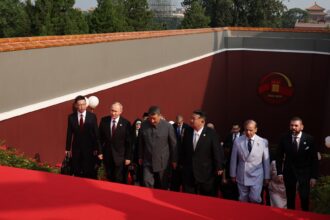
Recently, during US President Donald Trump’s visit to Beijing (13 and 14 May 2026), Chinese President Xi Jinping deftly invoked Thucydides to urge his American counterpart not to fall into the trap of a zero-sum game.
The Thucydides Trap refers to the dynamic of rivalry between a rising power and a dominant power that fears losing its advantage over its main competitor.
This reference to Thucydides prompts reflection on the significance of the diplomatic messages that political leaders sometimes send by quoting emblematic figures of philosophy and diplomacy who have left their mark on the history of humankind.
The aim is to assess the contribution of certain international relations theorists to the longevity of long-standing ideas that still resonate in contemporary geopolitics today and capture the attention of academic and media circles.
Setting the record straight
In this respect, four major international relations thinkers have enjoyed considerable visibility in the Arab media since the 1990s:
- Francis Fukuyama, with his thesis of the “end of history”;
- Samuel Huntington, with the “clash of civilisations”;
- Joseph Nye, with the “paradox of power”;
- Graham Allison, with the “Thucydides Trap” and his bureaucratic model of decision-making.
It would be difficult, even unfair, to rank these authors, so marked are their contributions by their analytical depth and forward-looking scope.
For the more adventurous reader, the reference to Henry Kissinger will no doubt arouse greater curiosity. His book “Diplomacy” (1994) remains a monumental work in which history sheds light on the missteps that great powers can sometimes face.
However, other thinkers are often overlooked by the Arab and Muslim media, notably because they keep their distance from political controversy. This is the case of James N. Rosenau (linkage politics), Robert Jervis (perception and misperception), Stanley Hoffmann (Gulliver’s troubles) and Kenneth Waltz (transnationalism).
The attention paid to academics thus depends largely on international events. They are sometimes invited on to television programmes or to major think tanks to provide their expertise. Some even serve as advisers to Democratic or Republican administrations.
When Xi Jinping invokes Thucydides, he is indirectly recalling Graham Allison’s work on sixteen major conflicts in world history. Yet in academic circles Allison is best known for his analysis of the bureaucratic model and of American decision-making.
His book “Essence of Decision” (1971), devoted to the Cuban missile crisis of October 1962, remains a major reference. In it, Allison shows how rivalries within organisations shape strategic decisions.
Arab media have often presented Xi Jinping’s reference to Thucydides as something new, overlooking the close relationship between academia and politics, particularly in the United States.
Resetting the compass
Other scholars have also used historical metaphors to analyse states’ foreign policy. Stanley Hoffmann, for example, drew on the character of Gulliver in Jonathan Swift’s work to reflect on the difficulties facing American power in a troubled world (“Gulliver’s Troubles”, 1968).
Hoffmann raises the question of the erosion of American power. The same concern drove Zbigniew Brzezinski in his book “The Choice: Global Domination or Global Leadership” (2004).
Brzezinski describes the dilemma facing the United States, torn between a hegemonic logic based on power and acceptance of a multipolar world. In his view, Washington must adopt a flexible approach to multilateralism in order to preserve its influence.
It is a pity that several Arab and Muslim intellectuals, such as Amin Maalouf, Ghassan Salamé, Abdelbaki Hermassi, El Mahdi El Mandjra and Abdellah Saaf, have at times been sidelined for challenging the dominant narratives.
This rift between the academic and political worlds remains a cause for concern, since scholarly research often unsettles decision-makers when it calls their choices into question.
Paradigms are no walk in the desert
Research centres attached to certain Egyptian and Lebanese universities have nonetheless helped to renew intellectual thinking.
Joseph Nye is one of the best-known examples. His concept of “soft power” is now ubiquitous in international debate. Introduced in the late 1980s, it refers to a state’s ability to obtain what it wants through cultural, diplomatic or ideological attraction rather than coercion.
With Robert Keohane, Nye also developed the notion of “complex interdependence” in “Power and Interdependence” (1977).
After the attacks of 11 September 2001, he took his thinking further in “The Paradox of American Power “(2002). In his view, despite its exceptional power, the United States cannot on its own resolve global challenges such as terrorism, nuclear proliferation or environmental degradation.
Questioning established narratives therefore becomes essential. Context and historical moment play a decisive role in the analysis of international relations.
In this respect, the notion of “deconstruction” put forward by Jacques Derrida in 1967 sheds valuable light. It invites us to question the seemingly self-evident meanings that structure dominant thinking.
Xi Jinping, Sun Tzu and the art of strategy
Xi Jinping’s reference to Thucydides is particularly shrewd. It no doubt rests on the idea that Donald Trump relishes negotiations and power struggles.
This approach could draw on the strategic thinking of Sun Tzu, which is more widely used in the business world than by many political leaders.
Henry Kissinger, architect of the Sino-American rapprochement and of Richard Nixon’s historic visit to Beijing in 1972, also offers keys to understanding. In “Diplomacy“, he stresses the historical cycles that see great powers rise and then decline.
In his view, each century is marked by the emergence of a state capable of imposing its vision of the international system:
- 17th-century France, with the nation state;
- 18th-century Great Britain, with the balance of power;
- Metternich’s Austria in the 19th century, with the Concert of Europe;
- the United States in the 20th century, with its pragmatism grounded in immediate interests.
A multipolar system still in flux
Kissinger stresses that the rise and decline of powers follow a natural cycle. This analysis recalls the image of Janus, the two-faced Roman god looking simultaneously to the past and to the future.
One might then ask whether Donald Trump is not himself adopting a Janus-like stance in response to Xi Jinping, who for his part would be drawing on the teachings of Sun Tzu.
Indeed, since independence in 1776, American foreign policy has historically oscillated between interventionism, isolationism and strategic retreat.
Imperial temptation and the quest for stability
To shed light on the current upheavals, Hassan Hami also draws on two other strategists:
- Kautilya, an ancient Indian thinker and author of the “Arthashastra“, often compared to Machiavelli;
- Alexander Svechin, a Russian strategist who developed the concept of “operational art” in his book “Strategy” (1927).
The author also mentions King Hassan II of Morocco, a keen student of history, who is said to have drawn inspiration from Machiavelli and Sun Tzu for some of his strategic decisions, notably in organising the Green March.
History and the management of time
François Mitterrand was fond of repeating the maxim “Give time time”, inspired by Cervantes. Similarly, as early as 1971 Alain Peyrefitte had declared: “When China wakes, the world will tremble“. China has indeed awoken, lending this prophecy particular resonance.
James N. Rosenau, for his part, in “Distant Proximities (2003), highlights the paradoxical coexistence of integrating and disintegrating dynamics within the international system. In his view, divergences should be seen not merely as threats but also as opportunities for rapprochement.
Conclusion
In the face of today’s geopolitical upheavals, analyses heralding the imminent collapse of the great powers or the swift advent of a new order dominated by the BRICS should be treated with caution.
History teaches that international transitions are long, complex and seldom linear.
The great strategic shift so often predicted has yet to happen. Thucydides, Sun Tzu, Janus, Kautilya and Gulliver still seem to be watching the contemporary world, reminding leaders that only a thorough understanding of history can keep humanity from sliding into anarchy and chaos.
Translated from French. The French original prevails.