Phan Dung Mai is the new Permanent Representative of Viet Nam to the United Nations Office at Geneva. He has held numerous posts, notably at UNESCO in Paris. Phan Dung Mai is a seasoned diplomat who speaks fluent French. His country is increasingly establishing itself as a partner in Asia that will have to be reckoned with in the future. His appointment coincides with this rise.
Many Asian countries, China in particular, attach great importance to the multilateral negotiations taking place in Geneva. Does Viet Nam also aspire to make Geneva a stronghold of its diplomacy?
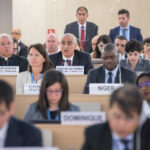
Multilateralism and international integration lie at the heart of Vietnamese diplomacy, and Viet Nam has always attached great importance to the multilateral mechanisms and forums of the United Nations, the World Trade Organization and so on. By taking a proactive part in multilateral negotiations in Geneva, notably as a member of the United Nations Human Rights Council for the 2023-2025 term, Viet Nam wishes to diversify its international partners and to strengthen a peaceful and stable international environment conducive to its development, which will help it not only to better defend its national interests but also to draw on external resources for the country’s sustainable development. Our country’s participation in multilateral negotiations also enables it to shoulder its dual responsibility by contributing to international efforts to resolve the many problems our countries currently face, and also by promoting peace and development in the world.
The multilateral system as it was built in the aftermath of the Second World War is now running out of steam. We can see this in the proliferation of conflicts. Do you think the system needs reforming? What form should that reform take?
The multilateral system established after the Second World War has played a crucial role in preventing wars, promoting peace and fostering international cooperation for the development of nations. Today, however, the global situation has changed considerably, placing new demands on the global multilateral system. Humanity must confront new challenges such as terrorism, poverty, food security, epidemics, natural disasters and climate change… The rise of many emerging countries has altered the balance of power. Moreover, advances in science and technology have transformed ways of thinking. Factors such as a lack of trust, protectionist tendencies, rampant nationalism and realpolitik are also undermining the multilateral system. Against this backdrop, reform of the multilateral system is proving not only necessary but urgent. This reform must be based on respect for the independence, sovereignty and legitimate interests of all nations. It must promote the democratic and equitable participation of nations in decision-making processes. A comprehensive overhaul of the multilateral system, covering security, the economy, development and finance, is essential to meet global challenges and strengthen the common interests of all nations. At the same time, it is crucial to modernise and optimise international organisations by improving their operational efficiency, streamlining budgets and cutting administrative costs. In so doing, we will be able to revive the multilateral system, respond better to the challenges of today’s world and promote global cooperation for the good of all.
You are a French speaker and know our language well. Does French remain a popular language among the Vietnamese, or has English taken over?
French enjoys a strong historical position in Vietnam. It is true that English has now overtaken French, but the language of Molière remains highly valued in our country. Today there are around 700,000 French speakers in Vietnam, or nearly 0.7% of the country’s population. In recent years, Vietnam has made significant progress in French-language teaching, with policies aimed at promoting its study from primary school to university, in recognition of its value on the job market. A report produced by the International Organisation of La Francophonie (OIF) in 2023 showed that French holds a prominent place as the second most studied foreign language after English. In 2021, bilingual classes had around 13,000 pupils and, beyond these, there are an estimated 60,000 learners of French across the various levels of education in Vietnam. However, the same OIF report reveals that, despite significant progress, the number of learners of French in Vietnam is still modest relative to the school population. Moreover, although French is valued for entering the workforce, real opportunities for French speakers remain limited. The links between French-language training and the needs of the job market should therefore be strengthened. Vietnam is an active member of La Francophonie, and we are currently working with our partners – the OIF, the Agence universitaire de la Francophonie (AUF) and the diplomatic missions in Viet Nam – to further promote French and to enhance the vitality and visibility of the language in Vietnam and across the Asia-Pacific region.
Interview by the Observatoire Géostratégique de Genève
Translated from French. The French original prevails.