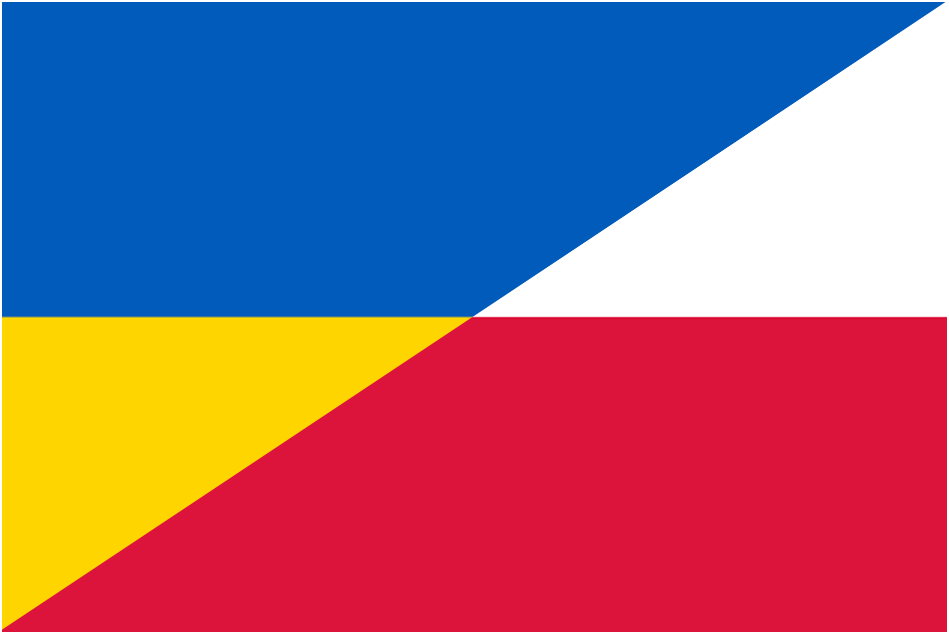
Central and Eastern Europe cannot be secure without a strong and free Ukraine. After the start of Russia’s full-scale aggression, Poland was one of the first countries to grasp this not as an abstract geopolitical formula but as a matter of national security. It is precisely for this reason that Poland opened its border to millions of Ukrainians, took in those fleeing the war and helped Ukraine by supplying it with weapons, equipment and humanitarian aid. This solidarity transformed Polish society. But the war is now entering its fifth year. And with war fatigue, the language used in Poland to talk about Ukrainians is also changing.
Only yesterday, the Ukrainian refugee was above all a person who needed to be saved. Today, he is increasingly becoming an object of political calculation. Political language tends to simplify. “Ukrainians”, “Ukrainian men”, “people eligible for mobilisation”, “the unemployed”, “draft dodgers”. When these words start being used almost as synonyms, what matters most disappears: the individual person and their individual responsibility.
From solidarity to debt
Since the start of the war in 2022, Poles have done an enormous amount for Ukrainians. However, solidarity must not turn into a perpetual debt. “We took you in – now you must…”: this logic is emerging ever more clearly in Polish political and social discourse.
Politicians are entitled to use harsh language. That is part of the political fray. The danger lies elsewhere: when society gradually grows accustomed to such language. And here the responsibility of the political elite is particularly great.
Part of the Polish right, along with President Nawrocki’s rhetoric of late, is increasingly actively shifting the question of Ukrainians away from the sphere of security and solidarity towards that of political mobilisation – through social benefits, migration, historical memory, military service obligations and questions of “fairness” towards Poles.
Political exploitation
This does not mean that politicians single-handedly created all anti-Ukrainian sentiment. It did not come out of nowhere. It is fuelled by genuine disputes, fears, economic interests, war fatigue and mutual grievances. But political rhetoric has the power to shift the boundaries of what is considered acceptable.
What only yesterday was regarded as an extreme position can today become the subject of a television debate, tomorrow an election slogan and, later still, an ordinary way of talking about an entire national group.
It is as if a door has been opened to what previously remained on the fringes: it is becoming ever easier to present a Ukrainian not as a real person, with their own story and their own responsibility, but as a problem – for the Polish welfare system, the labour market, historical memory or security.
In this sense, the Polish right risks provoking not merely discontent in society, but a far more dangerous phenomenon: the social legitimisation of hostility towards Ukrainians. And then the question will no longer be about Ukrainians. The question will be what kind of society is being built around them.
A society that forces an entire national group to constantly prove its moral irreproachability sooner or later ends up moving from solidarity to suspicion.
Public opinion turns
This shift now has not only political manifestations but measurable ones too. In the first half of 2026, Polish police recorded 180 hate-motivated crimes against Ukrainians – around 30% more than in the same period of 2025. It is important to stress that these are specifically recorded crimes, not the full spectrum of hostility or discrimination.
According to CBOS data published in July 2026, 52% of respondents said they were opposed to Poland taking in Ukrainian refugees, while 42% were in favour. It is the first time since these surveys began that opponents of taking them in have become the majority.
This does not mean that Polish society as a whole has turned hostile towards Ukrainians. But it does mean that the space for solidarity is shrinking, while the space for intolerance and the political exploitation of the Ukrainian question is widening.
History remains another fault line. Volhynia is not an abstract subject for Polish society. For many Polish families, it represents the memory of murdered relatives.
Ukraine acknowledges the tragedy of the Polish victims, supports the exhumations and speaks about the difficult chapters of its own history. There is, however, a fundamental difference between the historical responsibility of states and societies, on the one hand, and the personal responsibility of a present-day individual, on the other.
A person born decades after a tragedy cannot be personally guilty of it. Otherwise, historical memory ceases to be a path towards reconciliation. It becomes a mechanism for passing guilt from one generation to the next.
The Polish state is under no obligation to maintain a special regime for Ukrainians indefinitely. It has the right to change its social policy. It has the right to require legal employment and to expel those who are on its territory illegally. It has the right to protect its own labour market and its own national interests. That is the normal policy of a sovereign state.
But equal rules are one thing. National labelling is another. If a person breaks Polish law, they must answer for it. If they work illegally, the Polish state has the right to respond. But if the sole reason for suspicion is that the person is Ukrainian, then that is a different matter altogether. Not because Poland would become a different state tomorrow. But because society grows accustomed to the idea that a person’s rights can depend on their origin, their usefulness and their political convenience.
And it is precisely the ability to tell these things apart that will show whether the Polish-Ukrainian alliance remains an alliance between two societies – or whether it gradually turns into a relationship between those who demand gratitude and those who are forced to prove it constantly.
Neither war, nor history, nor political weariness should turn nationality into a presumption of guilt. For the moment a person begins to be held responsible not for what they have done but for what they were born as, it is no longer only the way Ukrainians are seen that changes. It is society itself that changes.
Translated from French. The French original prevails.