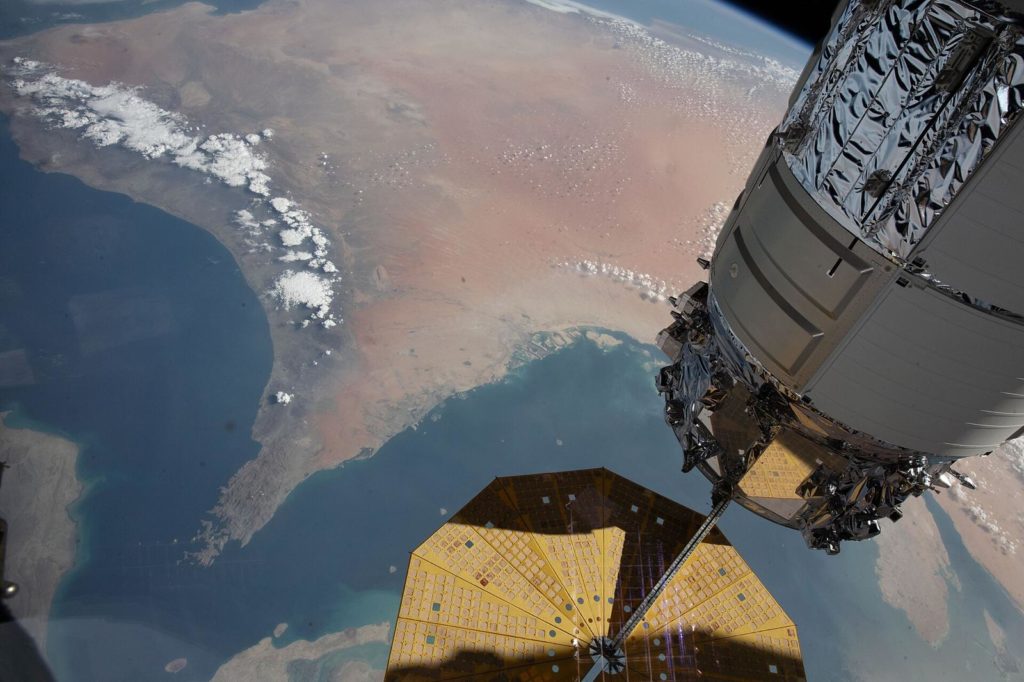
Satellite view of the strait.
A temporary corridor takes shape, but Tehran makes permanent reopening conditional on three US guarantees
Donald Trump knows that the National Iranian Oil Company is going through a severe liquidity crisis. Tehran, for its part, knows that five months of war have put heavy strain on US stocks of interceptors and precision munitions. The deadlock no longer stems from a lack of proposals, but from a mutual calculation: Iran holds the strait, while Trump holds the purse strings.
A deal announced, but still nowhere to be seen
No final joint statement has yet been issued. Iran and Oman have confirmed an agreement on the geographical coordinates of the new route. Esmaeil Baghaei, the Iranian foreign ministry spokesman, immediately made clear that this progress did not make the strait safe “in itself” and that the statement remained contingent on no obstacles being created by third parties. According to Al Arabiya, the expected text would announce a temporary corridor, to remain in force until permanent arrangements are completed.
This distinction between the provisional corridor and the permanent negotiations explains the mounting delay. Raghida Dergham, adviser to Al-Hadath on American and international affairs, stresses that Washington remains committed to the naval blockade of Iranian ports, while Tehran is letting no concession slip and is waiting to see what it can secure behind the scenes. Iran is publicly negotiating the geography of the passage with Oman, but is keeping the decisive question of what it gets in return for its indirect talks with the United States. The temporary statement could therefore be signed without the essential bargain being struck.
The delay, then, is not merely a drafting problem. Oman can negotiate a route and divide maritime responsibilities with Iran. It cannot, however, lift the US blockade, cancel the oil sanctions or unfreeze Iranian assets. The temporary corridor can be set up with Muscat; permanent reopening depends on Washington.
Oman draws the route but does not hold the key
The Iranian-Omani plan aims to replace the arrangements that have governed shipping in the strait for nearly sixty years. According to Iran’s Deputy Foreign Minister Kazem Gharibabadi, the two traditional lanes would be closed: the northern one, near the island of Larak, and the southern one, in Omani waters. A new route would run first through a large stretch of Iranian waters and then through part of Oman’s waters.
The information available does not yet make clear whether inbound and outbound vessels will use a single lane or two separate branches. It does, however, agree on one point: Tehran rejects a return to the pre-war regime. Iran wants the geography of the new route to guarantee it a lasting right of oversight, while Oman would retain its responsibilities in its own maritime zone.
Axios reported a provisional, renewable sixty-day arrangement, followed by the demining of a lane intended to pave the way for a permanent regime. Al Arabiya now speaks of a temporary corridor to remain in place until the permanent arrangements are completed, without specifying how long. The sixty-day timeframe should therefore still be presented as a working hypothesis, not as an adopted rule.
A temporary corridor outside Article 5
The most significant point concerns the legal framework claimed by Tehran. According to “Al Arabiya”, Iran denies that the temporary corridor amounts to the implementation of Article 5 of the Islamabad memorandum on the safe navigation of vessels. Instead, it is proposing a new model that redistributes shipping lanes between Iranian and Omani waters.
This distinction is not merely semantic. By detaching the interim arrangement from the memorandum concluded with Washington, Tehran avoids presenting passage as the fulfilment of an obligation it has already entered into. The corridor becomes a temporary arrangement negotiated with Oman; permanent reopening remains tied to American decisions.
What Tehran really wants from the United States
Permanent reopening is now explicitly conditional on three American guarantees: the lifting of the blockade, the cancellation of sanctions on Iranian oil and the unfreezing of Iranian assets. This wording reveals the true structure of the issue. The map is being negotiated between Tehran and Muscat, but the decisive bargain is being struck with Washington.
Iran wants more than a temporary halt to strikes or one-off exemptions. It is seeking to restore its exports on a lasting basis, secure payments and regain the use of its frozen resources. The United States, for its part, wants commercial traffic to resume without explicitly recognising an Iranian right to screen vessels or impose a toll on an international strait.
Reports of a one-page policy document, drawn up with the help of Qatar and Pakistan, have not been officially confirmed. They nonetheless describe a plausible compromise: Hormuz would be dealt with separately from the nuclear issue, with a permanent resumption of shipping traded for an easing of the US measures. The announcement of a temporary corridor would show precisely that this bargain has not yet been accepted by both sides.
Trump holds the purse strings
Iran’s vulnerability became visible on 5 August. The accounts of the National Iranian Oil Company were frozen by a state-owned bank because of mounting debts, according to the Fars news agency, quoted by Reuters. The National Development Fund estimates that the revenue expected from the Azadegan field will not enable the company to repay a debt of close to $17 billion.
These facts are not enough to establish that NIOC is bankrupt. They do, however, reveal a cash shortage affecting the country’s main source of revenue. Iran may have considerable reserves and continue to produce crude; that is not enough to turn this output into freely usable revenue.
This is Donald Trump’s trump card: the US measures prevent Tehran from freely converting its oil into cash. Iran controls part of the shipping route, but Washington retains broad control over the financial circuit. On this front, then, time is working against Tehran.
Iran bets on the weakness of US stockpiles
Tehran, however, has leverage of its own. According to Reuters, US forces used up virtually all of their available stocks of ATACMS and PrSM missiles during the war. The same campaign placed heavy demands on stocks of Tomahawk missiles and of Patriot and THAAD interceptors. The exact figures remain classified, but internal warnings are mounting about the ability to sustain several theatres at once for any length of time.
The Washington Post also revealed that US European Command was calling for an additional destroyer to continue protecting Israel against ballistic missiles. Without reinforcements, priority could revert to the defence of US territory. The warning shows that the constraint concerns not only the missiles themselves but also the platforms capable of detecting and intercepting them.
The strain on stockpiles is even said to have prompted a confrontation at the top of the US administration. According to the Washington Post, Donald Trump took Pete Hegseth to task during a meeting at Camp David, furious to learn that the munitions shortages he believed had been resolved were still limiting military options against Iran. The Secretary of Defense reportedly shifted the blame onto his deputy, Stephen Feinberg. The White House and the Pentagon categorically deny that the exchange took place.
Beyond this disputed episode, the strain on stockpiles narrows Washington’s options. A fresh campaign would force it to commit more piloted aircraft while using up interceptors that are hard to replace. This vulnerability sheds light on the Hormuz stalemate. Trump can maintain the blockade and wait for financial asphyxiation to force Tehran’s hand. But Iran can drag out the crisis, knowing that any resumption of strikes would expose the United States and its allies to a war of attrition that American industry could not quickly make up for.
Tehran is therefore betting not only on closing the Strait of Hormuz, but also on depleting American interceptors. According to Reuters, Iran has warned the Gulf states that a new US attack on its territory would trigger retaliation against vital energy infrastructure across the entire region. Tehran is thus seeking to change the regional calculus. The Gulf monarchies would no longer be mere bystanders or rear platforms for the American offensive. They would become the first victims of the Iranian response without having had any part in the decision that triggered it.
This threat gives full meaning to Mohammed bin Salman’s efforts to push for de-escalation. The Saudi crown prince knows that the United States can strike Iran, but that it cannot guarantee the simultaneous protection of all the kingdom’s strategic infrastructure. Iran is therefore turning the Gulf’s energy vulnerability into leverage over Washington.
Donald Trump hit back on Truth Social, saying that the United States had “massive” quantities of munitions and that production was increasing. Yet the threat of heavy prosecution against those behind the leaks does not answer the central question: are the munitions essential to defending all these theatres simultaneously available in sufficient numbers for another long war?
Iran is betting on this uncertainty. A new American campaign would trigger salvoes against Israel, regional bases and Gulf energy infrastructure. Even if a large proportion of Iranian missiles were intercepted, each salvo would consume munitions that are hard to replace quickly. On the military front, Tehran is therefore hoping that time will work against Washington. Tehran’s calculation is clear: an attack on Iran would not remain bilateral; the Gulf monarchies would pay part of the price.
Riyadh, Abu Dhabi and Baghdad most affected by Iranian-Omani plan
Saudi Arabia wants a swift resumption of traffic, but it has not publicly endorsed the proposed regime. Riyadh had called for security and freedom of navigation to be restored on pre-war terms. Yet Mohammed bin Salman urged Trump to avoid a new campaign against Iran, as the kingdom knows that its energy infrastructure would be among the first targets of any retaliation.
The United Arab Emirates have more room for manoeuvre thanks to the pipeline from Abu Dhabi to Fujairah. They nevertheless remain committed to the principle of an international passage that does not depend on Iranian authorisation. The Emirati Ministry of Foreign Affairs has already rejected an alternative route imposed unilaterally by Tehran. Abu Dhabi can sidestep part of the risk, but refuses to allow a provisional solution to grant Iran a permanent right of control over the entrance to the Gulf.
Iraq, for its part, is bearing the brunt of the uncertainty. Baghdad says it obtained an exemption for its oil from Masoud Pezeshkian, the Iranian president, but this guarantee has not been consistently honoured. Faced with this uncertainty, the Iraqi Ministry of Oil has decided to sell its cargoes FOB (Free on board): once the crude has been loaded, the buyer bears the transport and the risk of the passage. The New Region thus points out that Iraq is legally shifting the problem onto shipowners, but remains exposed to additional costs and refusals to load.
These three positions reflect the same concern. Iran’s neighbours want an end to the paralysis, but they fear that a provisional solution could turn control acquired by force into a new regional norm.
Eight ships do not make a reopening
Actual traffic remains the best indicator. On 4 August, only eight ships passed through Hormuz, compared with around 130 to 140 daily transits before the war, according to Kpler data cited by Reuters. Some tankers, however, are sailing without switching on their AIS, the automatic identification system that transmits their position. These include sanctioned vessels and ships seeking to reduce their exposure. This invisible activity does not change the picture: ordinary trade remains almost paralysed.
A credible reopening will be measured not by a communiqué but by the return of the major operators. It will require predictable rules and an Iranian chain of command capable of enforcing them without arbitrary interceptions.
The interim becomes the real deal
In the short term, the most likely outcome is no longer the full reopening announced by Washington, but a temporary corridor organised by Iran and Oman. This arrangement may ease the paralysis without restoring the previous regime. A permanent reopening will remain contingent on the three guarantees demanded of Washington. Conversely, the United States can keep up the economic pressure, but each new strike raises the cost of regional defence and accelerates the depletion of its most sensitive stockpiles. The difference is decisive: Iran’s financial constraint depends on an American decision, whereas the shortage of munitions can be remedied only at the pace of American industry, over several years.
The temporary corridor therefore does not end the deadlock; it organises it. Trump is waiting for financial asphyxiation to force Iran to give ground on control of Hormuz. Tehran is waiting for the shortage of interceptors to make a new campaign too dangerous for the United States and its allies. In between, Oman offers a provisional passage without being able to guarantee a permanent agreement.
This balance nonetheless remains hostage to the main unknown in the affair: Donald Trump’s decision. The Iranian-Omani communiqué will not change the nature of the deadlock; a sudden decision by Donald Trump, however, could break it at any moment.
The real negotiation is now a test of endurance. Iran holds the strait; Trump holds the purse strings. Each hopes the other’s weakness will show before their own.
Recommended La Tribune des Nations articles
• Trump suspends the next salvo, not the war
• Hormuz: negotiation has given way to armed intimidation
• Iran-United States: who can still stop the war?
• After Hormuz, Bab el-Mandeb: the new front in the energy war
External sources
• Reuters – Iran and Oman agree on coordinates for a route through Hormuz (5 August 2026)
• Al Arabiya – Temporary corridor in Hormuz, three Iranian guarantees and rejection of the application of Article 5 (6 August 2026)
• Reuters – NIOC’s accounts frozen over its debts (5 August 2026)
• Reuters – US stocks of precision missiles heavily depleted (4 August 2026)
• Washington Post – US European Command calls for an additional destroyer (August 2026)
• Reuters – Only eight vessels passed through Hormuz on 4 August (5 August 2026)
• Axios – Draft 60-day interim arrangement for Hormuz (5 August 2026)
• Saudi Arabia – Restoring security and freedom of navigation to their pre-war state
• United Arab Emirates – Rejection of the Iranian alternative route
• The New Region – Iraq sells its crude FOB and disclaims responsibility for passage through Hormuz
Translated from French. The French original prevails.