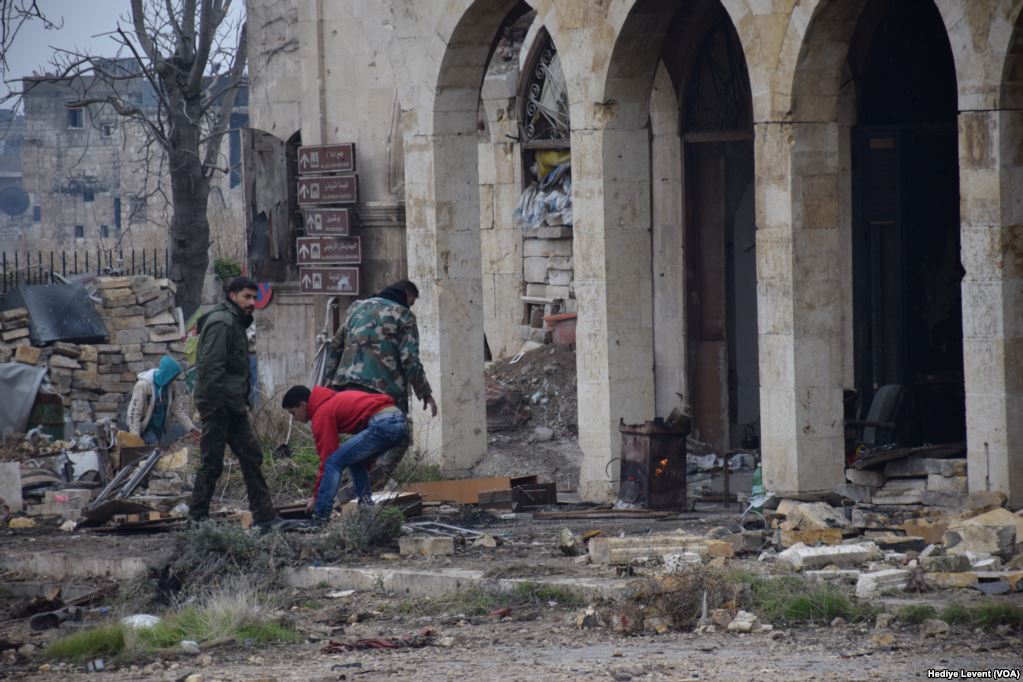
The old city of Aleppo in 2017, after the destruction of the war. Photo: Voice of America / Wikimedia Commons — public domain.
The reconstruction of Syria represents a market worth several hundred billion dollars. Paris is arriving with TotalEnergies, CMA CGM and its major infrastructure groups, but the capital lies mainly in the Gulf, while Turkey benefits from geography and considerable political influence. Italy, closer to Ankara and less showy than France, could become the European competitor Paris did not see coming.
Emmanuel Macron’s visit to Damascus was not merely diplomatic. Behind the speeches about stability and Syria’s return to the regional game, Paris came to stake out a position on one of the biggest economic undertakings of the coming decades. The exact figure remains disputed. The World Bank puts the cost of rebuilding the physical assets destroyed between 2011 and 2024 at $216 billion, with a high estimate of $345 billion. Assessments that also factor in reviving the economy, restoring networks, housing, health and accumulated losses approach or exceed $400 billion. Either way, Syria will not be able to finance its reconstruction on its own.
The real question, then, is not only which companies will rebuild the country. It is who will put up the money, who will set the priorities and who will turn the funding into political influence.
Paris arrives with its champions
Emmanuel Macron took French business leaders with him to Damascus, including CMA CGM and TotalEnergies. The message was clear: political re-engagement must open economic doors. CMA CGM is positioning itself in freight, dry ports and major logistics corridors. TotalEnergies is looking at offshore exploration and at infrastructure linking Iraq to the Mediterranean. Vinci, Bouygues and Eiffage can target roads, buildings and major civil engineering works; Veolia and Suez, water and waste; Alstom, transport; Schneider Electric and EDF, energy networks.
French expertise is there. But a company does not win a multibillion-euro contract because it has the best technology. It wins it because a funder guarantees the financing, because the local authorities open the door to it and because the political and security risks are insurable.
Those who pay will choose
Syria is ruined. Its public revenues are low, its banking system remains fragile and much of its energy infrastructure is out of action. Reconstruction will therefore depend on outside capital, public guarantees, multilateral loans and partnerships with foreign investors.
Saudi Arabia and Qatar have already shown that they can unblock the system. By settling Syria’s arrears to the World Bank, they made Damascus eligible for new financing once again. The sum was modest in relation to the country’s needs, but the gesture revealed what matters most: Riyadh and Doha can reopen doors that Syria cannot open on its own.
The United Arab Emirates also has considerable resources and companies specialising in ports, free zones, real estate, telecommunications and logistics. Its approach is to invest in infrastructure that provides access to trade flows and strategic chokepoints. In Syria, ports, airports and industrial zones will all serve as instruments of influence. Gulf money will not be neutral. Those who finance the power stations, ports, roads and housing will demand contracts, guarantees and a place in the country’s new political architecture.
The World Bank and Europe
The World Bank is expected to step in first on electricity, water, public services and the rehabilitation of government administrations. Its loans will come with oversight, tendering procedures and transparency requirements. These rules may limit misappropriation, but they also give donors a say over Syria’s priorities.
The European Union will be another key source of funding. It can support schools, hospitals, municipal networks, the return of refugees and the rebuilding of state capacity. France would do well to tap these European funds to secure work for its companies. Paris can win contracts thanks to Europe; on its own, it lacks the means to finance a French reconstruction policy.
Turkey: competitor and patron power
The main rival to France’s return remains Turkey. Ankara does not regard Syria as a foreign market. It sees it as a strategic space where its security, its regional influence and part of its economic future are at stake. Turkey has a direct border, established trade networks, a military presence and privileged relations with the new authorities. Its companies can quickly bring in cement, steel, machinery and labour. They are often cheaper and can combine construction, the supply of materials and bank financing.
The rivalry will also be political. Franco-Turkish relations remain marked by disputes in the Eastern Mediterranean, French support for Greece and Cyprus, Paris’s closeness to Armenia, differences over the Kurdish question and indirect clashes in Libya. Ankara therefore has the means to complicate French groups’ access to sectors it considers strategic.
This obstruction will not necessarily take the form of a public veto. It could come through tenders, the choice of local partners, technical standards, access to logistics networks or priority given to Turkish consortia. In Syria, administrative obstacles will also be instruments of power.
America’s overwhelming might
Another competitor to France’s return to Syria is not only Turkey, the Gulf monarchies or France’s past as the mandatory power. It is also American. By backing the reopening of the oil corridor between Iraq and the Syrian port of Baniyas, Washington is signalling that it intends to play a direct part in shaping Syria’s future economic architecture. The United States will also retain decisive power over the pace of investment through residual sanctions, the international financial institutions and its diplomatic influence.
France can hope to win contracts; the United States, for its part, is seeking to shape the economic architecture of tomorrow’s Syria.
Italy, the discreet competitor
France would be wrong to look only towards Ankara and the Gulf monarchies. Italy has solid assets: Eni in energy, Webuild in major infrastructure, Fincantieri in the maritime sector and a dense network of exporting SMEs.
Above all, Rome has calmer and more pragmatic relations with Ankara than Paris does. Turkey and Italy have strengthened their cooperation in trade, energy and defence. Giorgia Meloni and Recep Tayyip Erdoğan have also discussed Syria’s reconstruction together, as well as the removal of the financial obstacles that are holding back investment.
Italy can therefore opt for a strategy that France will find harder to adopt: entering Syria alongside Turkey rather than against it. Italian-Turkish consortia are conceivable in ports, power stations, motorways and rail networks. Where Paris risks running up against Ankara’s mistrust, Rome can offer partnerships.
Italy also benefits from a less showy brand of economic diplomacy. It lectures less, talks more about contracts and exposes itself less politically. In a Syria that is looking for capital without wishing to submit to new forms of public tutelage, this discretion may become an advantage.
China bides its time
For now, China remains cautious. Yet it has the capital, the public works groups and the experience needed to intervene on a large scale. Beijing could target ports, telecommunications, power stations and the corridors linking the Mediterranean to Iraq and Asia.
But China rarely invests heavily until security, legal guarantees and political stability are deemed sufficient. It can let the Gulf states and international institutions finance the early stages, then move in once the most profitable assets have been identified. France then risks being overtaken first by Turkey in fast-track works, and then by China in strategic infrastructure.
France’s real prospects
France’s prospects are neither negligible nor dominant. CMA CGM is well placed in logistics. TotalEnergies can play a role in offshore and energy networks. French groups in water, transport, electricity and engineering can win contracts financed by the European Union, the World Bank or the Gulf monarchies.France can therefore become a major builder. It will probably not be the banker, and it will not necessarily be the new Syrian authorities’ preferred European partner.
Rebuilding roads, power stations and buildings will not be enough if the state remains fragmented, if minorities are not protected and if confiscated property is not returned. Investors will demand stability, but stability can mean rebuilding a state governed by the rule of law or simply consolidating a regime capable of guaranteeing contracts.
Gulf donors will favour speed and order. The European Union will place greater emphasis on institutions and public services. Turkey will defend its security and economic interests. Italy will seek partnerships. Companies will want guarantees and profits. The Syrian people will be waiting for electricity, water, housing and jobs.
A geopolitical battle
Syria’s reconstruction will not merely be a competition between companies. It will map out the new spheres of influence in the Levant. Cranes, ports, power stations and motorways will all be markers of power. Emmanuel Macron is right not to leave the field to the Turks, the Gulf states, the Americans, the Italians or the Chinese alone. But France must not confuse presence with dominance. It can open doors, mobilise Europe and offer recognised expertise. It will find it far harder to set the rules.
In this battle, France may secure a share of the market. But those who pay for the reconstruction will also choose the political architecture of the building.
Read in La Tribune des Nations
• France seeks to return to Lebanon through the Syrian window
• Turkey, Syria, Israel: the Levant’s new strategic balance
Also read
• World Bank — Syria’s Post-Conflict Reconstruction Costs Estimated at $216 Billion
• Reuters — France’s Macron visits Syria with French business leaders
• DEİK — Turkish companies are ready to take part in Syria’s reconstruction
• Anadolu — Erdoğan and Meloni discuss urgent action for Syria’s reconstruction
Translated from French. The French original prevails.