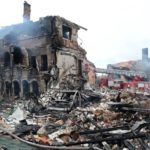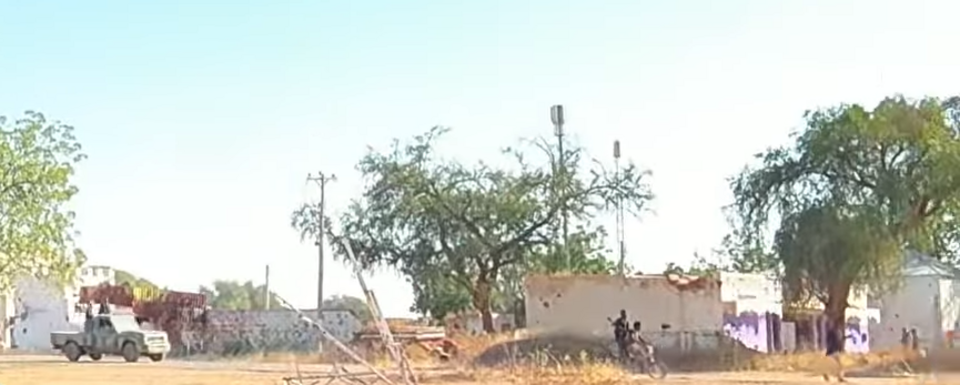
The Rapid Support Forces (RSF) paramilitary militia in El Fasher after the capture of the city in 2025.
Since 15 April 2023, an armed conflict has pitted the regular army, the Sudanese Armed Forces (SAF), under the command of General Abdel Fattah al-Burhan (in power since the October 2021 coup), against a paramilitary militia, the Rapid Support Forces (RSF). The RSF is made up of Janjaweed militias, which according to Human Rights Watch were responsible for war crimes during the war in Darfur from 2003 onwards. It is led by General Mohamed Hamdan Dagalo. The RSF militia is a mix of Sudanese Arab fighters and foreigners from neighbouring countries, chiefly Chad and Libya. The Janjaweed first emerged in 1988, after the victory of Chadian President Hissène Habré, backed by France and the United States, over the Libyan army, which put an end to Libya’s territorial ambitions and drove this armed militia back towards Darfur.
A BRIEF HISTORY OF SUDAN The modern Sudanese nation took shape slowly over the centuries through the convergence of intertwined sets of external and internal factors, rooted at once in the geography, the population and the history of the region. Anthropological and archaeological research indicates that during the Predynastic Period, the Upper Egypt of Naqada and Nubia were almost identical ethnically and culturally, and that they therefore developed systems of pharaonic kingship simultaneously, around 3300 BC.
The historian Grandin Nicole describes the complex relations between the peoples of the Sudan region, and with their close neighbours, which remain relevant today : ” Even in the most distant antiquity, this history appears to be bound up, to a greater or lesser extent, with the political history of the vast region formed by the whole of north-east Africa and the Arabian Peninsula. But above all it is bound up, in a special way, with the history of Egypt since pharaonic times, by virtue of the Nile and an ecological continuity[…]The Nile Valley concentrates all the economic life of the region and the river is the sole source of life […]The Nile has indeed been both the principal physical agent of the relations that were established, beyond the border zone, between the North and the South of Sudan, and the underlying motivation, on both the real and the mythical level, that determined the creation of those relations “.(Grandin, 1982).
After waves of Christian, Islamic and then British colonisation, an Anglo-Egyptian condominium was established in Sudan in 1899 – a hybrid and unprecedented legal status. In 1951, King Farouk took the title of King of Egypt and Sudan, and in 1953 an Anglo-Egyptian treaty was signed recognising Sudan’s right to self-determination. Since its independence from the Anglo-Egyptian condominium on 1st January 1956, Sudan has experienced a succession of military coups and civil wars. Even before independence was officially proclaimed, government forces were already clashing with rebels in the south, who were demanding autonomy, and with armed nomadic groups. Independence thus marked the end of colonial rule, but ushered in a lasting period of political instability. The First and Second Sudanese Civil Wars, together with the conflict in Darfur, destroyed any hope of one day seeing accountable civilian governance reborn.
During the 2003 insurgency led by the Sudan Liberation Army and the Justice and Equality Movement, the Sudanese government deployed the Janjaweed militias in the theatre of war, relying on this organisation to provide its repressive force. When Sudanese President Omar al-Bashir was ousted and imprisoned on 11 April 2019, this militia became the main opposition to the regular army. In reality, the Africa Center for Strategic Studies (ACSS) estimates that several dozen groups are active in the conflict. Made up of military and paramilitary forces, tribal militias, Islamist brigades, community self-defence groups, criminal gangs and foreign mercenaries, these armed forces display a wide diversity of motivations, chains of command, organisational structures and training (ACSS, 2026). This hardly makes it easier for the forces of the Sudanese Army to secure control of national security in a proxy-war environment.
The Emirates and the gold cartel
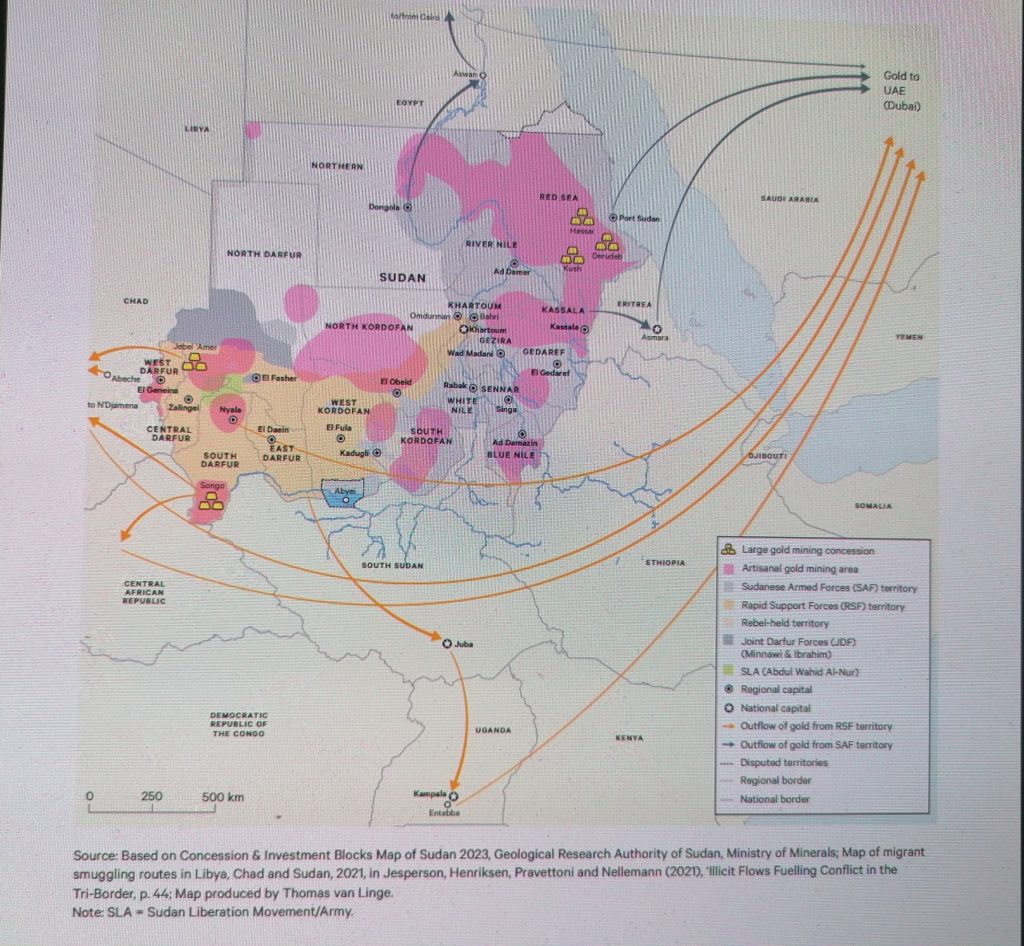
Even before the civil war began in 2023, the main belligerents in Sudan, the Sudanese Armed Forces (SAF) and the Rapid Support Forces (RSF), were vying for the country’s natural resources. Control of gold deposits and the management of smuggling are the main drivers of the conflict. Artisanal gold mining accounts for most of Sudan’s gold production, the bulk of which is exported to the United Arab Emirates, either directly or indirectly via neighbouring countries such as Chad, Egypt, Eritrea and South Sudan. The United Arab Emirates and Egypt wield considerable influence and back opposing sides in the conflict (Soliman and Baldo, 2025).
“According to the Central Bank of Sudan, the Emirates reportedly absorbed nearly 90% of Sudan’s official gold exports in the first half of 2025. Across the continent, the NGO Swissaid estimates that undeclared artisanal gold worth nearly 30 billion dollars makes its way to Dubai every year […] This transfer of stolen funds is not an isolated case. In October 2025, a US organisation, The Sentry, revealed the existence of a network of Dubai-based companies used to convert conflict gold into cash for financiers close to the RSF. The network is said to be run by a paramilitary leader, Mohamed Dagalo, known as ‘Hemedti’, who is believed to have built an empire around the gold trade, stretching into livestock, construction and banking ” (Hessoun, 2026).
A proxy war
The fighting since April 2023 has caused famine in North Darfur and Kordofan, with 34 million people in need of humanitarian aid and 13.5 million people displaced, according to United Nations estimates as of 15 July 2026 (UN, 2026). Each of the two warring parties receives support from foreign actors : Saudi Arabia, Egypt and Turkey for the SAF, and the United Arab Emirates and Israel for the RSF. This fuels and complicates the conflict, undermining mediation efforts.
On 6 July 2026, the UN Human Rights Council strongly condemned the RSF’s siege of and offensive against El Obeid, carried out with drone strikes on civilian infrastructure, and above all the use of sexual violence as a weapon of war, as well as the use of starvation as a method of warfare (UN Human Rights Council, 2026). The United States has never publicly denounced the role of the United Arab Emirates in financing the RSF’s weaponry, nor, above all, its establishment of a logistics base in Ethiopia, close to the main hydroelectric dam at Roseires in south-eastern Sudan.
However, it has condemned foreign intervention without naming the countries concerned. Washington’s attempt to find a way out of the Sudanese conflict, led since 2023 by the US Special Envoy, Mossad Boulos, appears unrealistic. And curiously, the RSF militia does not feature in the 2024 report on terrorism published by the United States, despite repeated condemnations from UN-affiliated organisations (US Department of State, 2026).
On 12 August 2026, the RSF militia announced that it had taken control of the town of Geissan, in Blue Nile State in south-eastern Sudan, on the border with Ethiopia. It is clearly seeking to regain the initiative in Blue Nile after its latest setbacks in Kordofan and Darfur (RFI, 2026).
Certain divergent positions taken by the United Arab Emirates suggest that a new political course has emerged in the Middle East, running counter to the countries of the region and at odds with the guidelines of the League of Arab States, the Organisation of Islamic Cooperation and the Gulf Cooperation Council. According to Saudi Arabia, it amounts to an axis of fragmentation. Examples include the UAE’s support for the Southern Transitional Council in Yemen since its creation in 2017, the restoration of diplomatic relations with the former Syrian government of Bashar al-Assad in 2018, its accession to the Abraham Accords in 2020, its support for the Rapid Support Forces (RSF) in Sudan in 2023, its withdrawal from the Organization of the Petroleum Exporting Countries in 2026, and its plan to build a secret military base for Israel and the United States at Berbera in Somaliland, revealed by the daily Le Monde on 7 July 2026.
“From Yemen to Somalia and Sudan, Riyadh accuses Abu Dhabi of pursuing a strategy of fragmentation by backing the formation of paramilitary groups that undermine the unity of states and regional stability. The Emirates sponsor the separatist movement in southern Yemen, the paramilitary force of General Mohamed Hamdan Dagalo, known as ‘Hemedti’, in Sudan, and the separatist territory of Somaliland” (Sallon, 2026).
Uncertain prospects and hopes for a resolution of the conflict
American and European policymakers must now recognise that Gulf politics is shaped by competition between two different approaches in Riyadh and Abu Dhabi. The region’s geopolitical future will be forged through the interplay between Emirati pre-emptive activism and the Saudi de-escalation process. Which of the two strategies will prove more durable in the face of persistent economic, security and international pressures? The question remains open. Managing this reality, rather than assuming convergence, is now a crucial analytical and operational challenge for those concerned with Gulf security, energy markets and regional stability (Hellyer, 2026).
Sudan’s neighbouring states and those of the wider region will always be part of its future, and the exploitation of mineral wealth, notably gold, will remain the ember fuelling Sudan’s insecurity. However, these regional dynamics and rivalries can be reduced through the application of a UN security and humanitarian policy combining both international mediation and a peacekeeping police presence.
The regionalisation of peace operations, the hybridisation of actors and the transformation of the UN into a coordinating and supporting body risk creating a security vacuum if the reconfiguration of how UN peacekeeping missions are implemented is not based on credible and appropriate processes (Liégeois, 2026).
It is becoming increasingly clear that the ambitions of Egypt and the United Arab Emirates in Sudan will lead to the fragmentation of Sudan, following the first North–South split of 9 July 2011, and to further war crimes. Diplomacy’s most crucial task is to ensure that the international community can engage with the African Union more coherently in implementing the United Nations’ processes for the peaceful resolution of conflicts. The aim is to enable the civilian populations of this part of the world to live free from violence financed by certain state powers, and to enable the State of Sudan to put an end to the activities of organised crime.
Translated from French. The French original prevails.