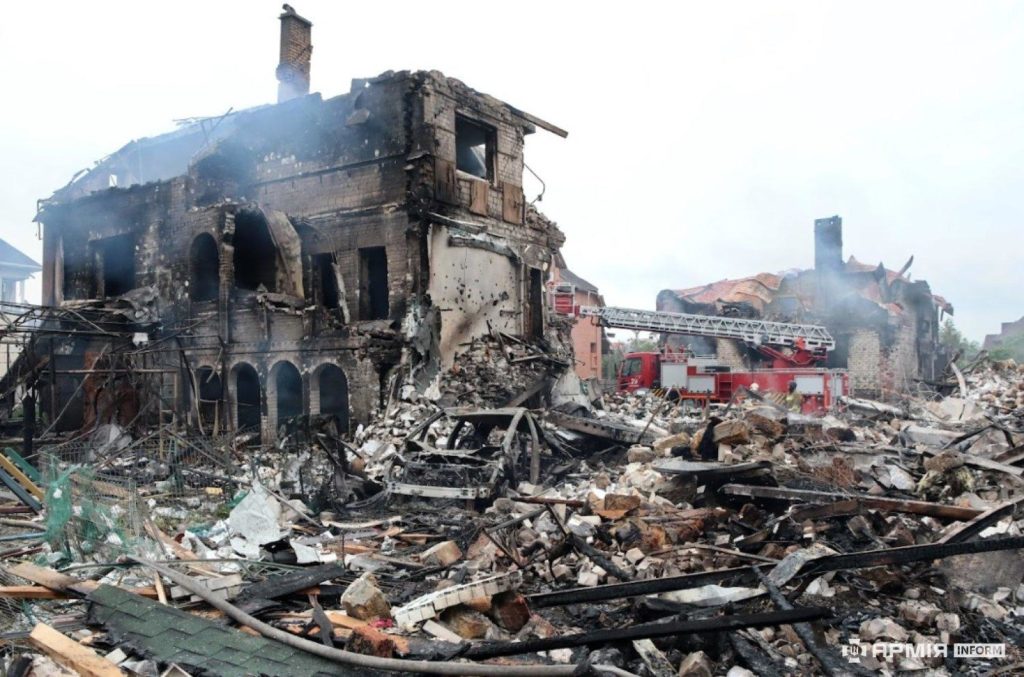
Novoplatonivka, Kharkiv oblast — 29 July 2025.
Four and a half years after Russia launched its “special operation” in Ukraine, neither side has managed to impose its will. Moscow retains the initiative in several sectors of the front and is pressing on with its goal of conquering the Donbas. But the map in the summer of 2026 no longer points entirely one way: in the south, the Ukrainian army has just completed a low-key counter-offensive that has enabled it to retake several hundred square kilometres and dozens of towns and villages. At the same time, Kyiv is taking the war ever deeper into Russia, striking refineries, military installations and logistics networks. This war of attrition is now compounded by an external factor: the conflict with Iran is diverting some of America’s attention and resources. Captured territory remains essential, but it is no longer enough to gauge strategic advantage.
The first mistake would be to view the war solely through the number of towns and villages changing hands. The second would be to stop looking at the map altogether. As of 24 August 2026, Russia retains the initiative on the ground in several sectors. Its main objective remains the Donbas and, more specifically, the fortified Ukrainian line linking Kostiantynivka, Kramatorsk and Sloviansk, among other towns.
Russian forces are seeking to improve their positions east of Sloviansk before attempting to close in on this “fortress belt”. But their advances remain essentially tactical. The Institute for the Study of War (ISW), which tracks changes along the front line daily using geolocated data, considers a rapid Russian advance towards Sloviansk highly unlikely given the terrain and Ukraine’s defences. That by no means suggests the situation is favourable to Kyiv.
According to ISW assessments, Russian forces now control around 80% of Donetsk oblast and practically all of Luhansk oblast. More broadly, Moscow occupies approximately a fifth of Ukrainian territory. Russia therefore holds a considerable territorial advantage. Yet it has still not achieved what would truly change the war: an operational breakthrough capable of disrupting Ukraine’s defensive lines over several tens of kilometres.
This is where the Russian paradox becomes apparent. After four and a half years of war, an army backed by a far larger population and industrial base is still capable of advancing locally, but at the cost of enormous expenditure of men and materiel for generally limited gains. The orders of magnitude nonetheless remain staggering. According to an estimate published on 1 July 2026 by the Center for Strategic and International Studies (CSIS), Russia suffered some 1.4 million military casualties — killed, wounded and missing — between February 2022 and June 2026, including 400,000 to 450,000 killed. Ukrainian casualties are put at between 525,000 and 625,000, including 125,000 to 150,000 killed. These estimates are not official tallies and remain subject to a considerable margin of uncertainty.
Volodymyr Zelensky also claims that Moscow is considering a fresh mobilisation of up to 300,000 men after Russia’s parliamentary elections in September. This Ukrainian claim, reported by Reuters, has not been confirmed by the Kremlin. If it proved true, however, it would indicate that Moscow itself believes that continuing its military effort will require substantial manpower for some time yet. Russia, then, has not been halted. But nor has it found the key to turning its quantitative superiority into decisive victory.
745 km²: the counter-offensive almost nobody saw
This is where the picture needs correcting. On 12 August, Volodymyr Zelensky announced that Ukrainian forces had retaken 745 km² and liberated 26 towns and villages in the Dnipropetrovsk, Donetsk and Zaporizhzhia regions. The operation had begun at the end of January, around the Oleksandrivka sector, as Russian forces were advancing in that direction. It continued for more than six months before ending on 12 August. These figures were reported and put into perspective by Le Grand Continent.
The ISW confirms most of the Ukrainian advance on the basis of geolocated images and videos, but puts the area actually retaken at around 627 km². Its deliberately cautious mapping methodology may, moreover, underestimate some of the gains. The difference matters when it comes to measuring precisely how much ground has been recaptured. It does not, however, alter the significance of the event.
According to Le Grand Continent, this is the largest Ukrainian advance since the summer of 2023. The 745 km² claimed by Kyiv is almost equivalent to the 806 km² the Russian army is believed to have captured in Ukraine during the first seven months of 2026. The ground war has therefore not suddenly turned in Ukraine’s favour. But nor is it a continuous and irreversible Russian advance.
The Oleksandrivka operation is all the more noteworthy in that it appears to have relied on different methods from Ukraine’s previous major counteroffensives. A few days after it was launched, the Starlink terminals being used illegally by some Russian forces were disconnected, degrading their communications capabilities. At the same time, Kyiv kept up its strikes on Russian logistics networks, enjoyed local superiority in the use of drones and improved its operational planning. But another factor probably came into play: silence.
Since 2022, the war in Ukraine has been documented almost in real time on Telegram and social media. Videos sometimes make it possible to follow an attack just a few hours after it has begun. In Oleksandrivka, almost nothing. The Ukrainians had every reason not to draw attention to their advance. The Russians, for their part, had every reason not to document their difficulties. Just a few hours after the end of the campaign was announced, the Ukrainian group DeepState thus confirmed the recapture of 19 settlements in one go, rather than reporting changes to the front line gradually.
It is not certain that the operation was conceived from the outset as a large-scale counteroffensive. It may also have developed gradually as the Ukrainians uncovered weaknesses in the Russian deployment. The former Australian general and military analyst Mick Ryan believes it was probably a combination of the two. Excessive conclusions should also be avoided. The scale of Ukrainian losses is not yet known, and there is nothing to suggest that Kyiv could quickly replicate a similar operation on other sectors of the front.
But Oleksandrivka demonstrates something important: despite its shortages of personnel and equipment, the Ukrainian army retains an offensive capability and can still exploit a Russian weakness when it manages to bring together intelligence, drones, surprise, logistics and a concentration of resources.
Ukraine is also taking the war behind the front line
This advance on the ground is no substitute for Ukraine’s strategy of deep strikes. It complements it.
Kyiv knows it cannot push back Russian forces along the entire length of a vast front at once. It is therefore also seeking to alter the strategic equation by striking what enables Russia to keep fighting: oil, fuel, logistics, air defences, military installations and industrial infrastructure. The Orsk refinery is a particularly telling case. Located in the Orenburg region, near the Kazakh border and some 1,470 kilometres south-east of Moscow, it processes around six million tonnes of oil a year. A Ukrainian attack severely damaged it in August. According to Reuters, repairs could take up to six months, not least because some of the parts required are hard to obtain owing to Western sanctions.
A few days later, the consequences were being felt as far away as the Moscow region. Petrol stations reintroduced limits on petrol purchases. Rosneft, Gazprom Neft, Lukoil and Tatneft imposed sales caps in various forms. At the same time, the Russian government banned certain fuel exports, relaxed quality standards and increased imports in order to safeguard domestic supply
The pressure is also beginning to hit exports. In the first half of August, oil shipments from Russia’s main western ports were around 15% below the volumes originally scheduled, owing in particular to disruption at Novorossiysk, according to Reuters.
This does not mean that the Russian economy is on the verge of collapse. Russia remains a vast hydrocarbons producer, has the means to redirect its flows and retains substantial industrial capacity. But something has changed: the depth of Russian territory is no longer the sanctuary it still was at the start of the war.
Kyiv is trying to make the hundreds or thousands of kilometres separating certain Russian facilities from the front line far less of a shield. Even when it cannot retake ground, Ukraine is thus seeking to steadily raise the economic and logistical cost of each additional month of war.
An economic war Ukraine could also lose
For balance, however, the other side of this strategy must be examined. Ukraine’s economy is much smaller than Russia’s and remains directly exposed to strikes. Russia is targeting Ukraine’s power facilities, railways, ports, industrial capacity and agricultural exports. Vladimir Putin has explicitly announced that Moscow would respond to attacks on the Russian economy by striking Ukraine’s most sensitive sectors.
Ukraine’s economy remains around 20% below its pre-invasion level. A survey of economists cited by Reuters cut the median growth forecast for 2026 to just 1.1%. Some 60% of public spending now goes on defence. According to Ukraine’s agriculture minister, Russian attacks on Black Sea port infrastructure could cost the farming sector between $1.5 billion and $3 billion this year.
The war has thus become a contest of mutual destruction of economic capacity. And in that contest, Ukraine cannot hold out without outside support. For now, Europe continues to provide that lifeline. On 24 August, the European Commission approved a further €6.1 billion for Ukraine’s defence, including for air defence systems, missiles, ammunition and radars. Norway plans to maintain aid of 85 billion Norwegian kroner, or around $9.2 billion, in 2027.
London also wants to help Kyiv further expand its domestic production of long-range missiles. France has agreed to speed up its deliveries of air defence systems and missiles, while Germany has raised its military support package for Ukraine to €11.5 billion for 2026. Berlin is making air defence a priority. This support narrows the asymmetry between the two economies. It does not eliminate it.
Men, missiles and drones: the battle of endurance
The central question, then, is becoming less “who has the best tank?” than “who can keep this up the longest?” Moscow can draw on its population, its military-industrial complex and partners capable of supplying munitions on a massive scale. North Korea has become a significant part of this equation. According to the South Korean Ministry of National Defense, Pyongyang is reported to have supplied Russia with more than 15 million shells as well as short-range ballistic missiles.
China occupies a different position. Beijing says it does not supply lethal weapons to Russia. Western states nonetheless accuse it of supporting Russia’s military-industrial base through trade and the supply of dual-use goods — microelectronics, machine tools and components — that can find their way into military production chains. The 21st package of EU sanctions accordingly targeted several entities based in China and Hong Kong.
Chinese support is therefore less directly military than Pyongyang’s, but it contributes to Moscow’s ability to sustain a long war. Ukraine counters this mass with a remarkable capacity for innovation. Naval drones, FPV drones, deep strikes, electronic jamming, autonomous systems: the war has turned the country into a vast military laboratory.
This adaptability is not, however, exclusive to Ukraine. Russia, too, has developed its drones and its electronic warfare, and has changed the way it uses its ballistic and hypersonic missiles, notably the Iskander and the Kinzhal, in salvoes combining drones and cruise missiles to saturate air defences. RUSI analyses this evolution of the air war. On both sides, the war has become a constant race between innovation and countermeasures. But innovation cannot replace everything.
Ukraine is still short of men, air-defence interceptors and money. Zelensky puts the shortfall in Ukraine’s defence budget for 2026 at $27 billion. The figure comes from the Ukrainian presidency and should be treated as a political estimate as much as a budgetary one, but its order of magnitude illustrates the problem: Kyiv can build more drones, but it cannot finance a war of this intensity on its own.
Iran enters the Ukrainian equation
Another change is far less visible on military maps. Since the start of the war against Iran, Washington has had to divide its attention, its diplomatic capacity and part of its military resources between several theatres. The case of Patriot interceptors is particularly telling. The war against Iran has severely depleted US stocks, and those of several Gulf allies, at the very moment when Ukraine is short of them to counter Russian ballistic missiles.
Reuters estimated in early August that almost 65% of the US stockpile had been used up between February and July 2026. Washington has not halted all support for Kyiv as a result, but its immediate room for manoeuvre has shrunk considerably: the same interceptor obviously cannot defend Tel Aviv, a US base in the Middle East and Kyiv at the same time.
German Foreign Minister Johann Wadephul announced on 24 August that he intended to ask US Secretary of State Marco Rubio to become more personally involved in the Ukraine file. According to Reuters, dialogue between Washington and Moscow has slowed markedly, not least since the war in Iran began absorbing part of America’s attention. The point goes well beyond diplomacy.
Every war is also a competition for the attention of allies. An anti-aircraft missile, a warship, a Marine unit, a satellite, a diplomatic official or simply the US president’s time cannot be devoted simultaneously to Europe, the Middle East and the Indo-Pacific. Iran is not fighting alongside Russia in Ukraine. But the war in the Middle East objectively places an additional constraint on those who support Kyiv.
This may be one of the most significant strategic developments of 2026: conflicts that still seemed separate are beginning to converge through their needs for manpower, weapons, energy, political attention and industrial capacity.
Peace remains out of reach
Finally, there is diplomacy. Russia still says it wants to negotiate. But Russian Deputy Foreign Minister Sergei Ryabkov reiterated on 21 August that any settlement would have to take account of the “realities on the ground”, according to Reuters. Behind this phrase lies a fundamental demand: Moscow wants its military conquests to be turned into lasting political gains.
Kyiv, for its part, says it has passed new proposals to the Americans and continues to call for a ceasefire backed by security guarantees. The problem, then, is not a lack of diplomacy. It is the considerable gap between the minimum conditions each side can accept.
Moscow does not yet regard the cost of the war as high enough to abandon its core objectives. Kyiv does not yet regard its military situation as desperate enough to accept Russia’s terms.
As long as this twofold perception persists, negotiations may yield contacts, proposals or mediation. They will find it far harder to yield peace.
So who is gaining the upper hand?
In terms of occupied territory, Russia retains a considerable advantage. But recent momentum is more favourable to Ukraine. For the first time in several months, the territorial balance has turned negative for Moscow: over the summer, and particularly in the Oleksandrivka sector, Ukrainian forces retook more ground than Russian forces captured.
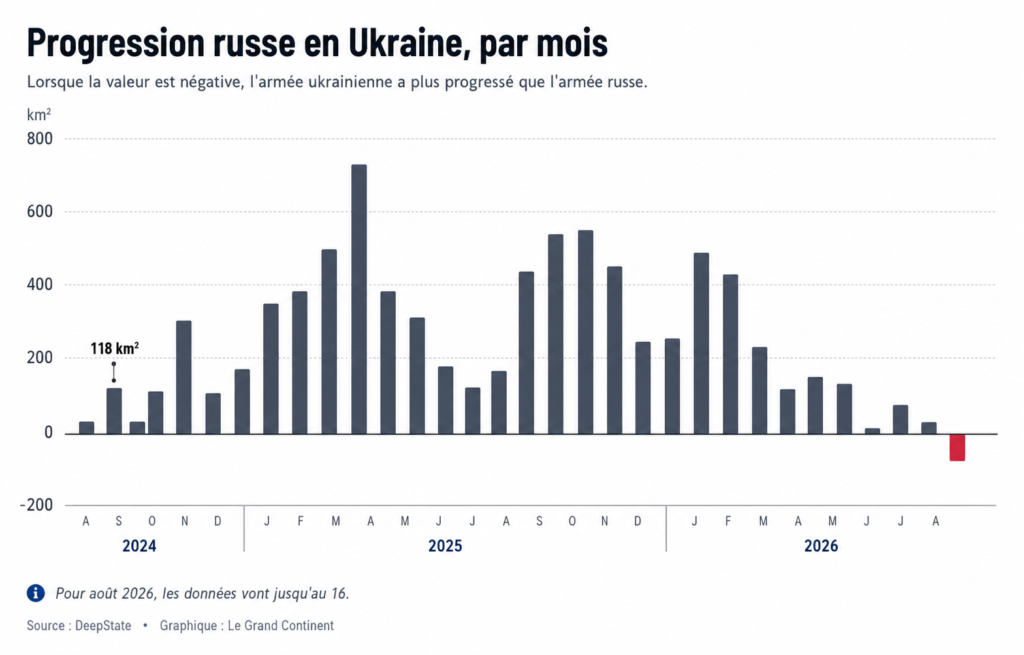
It would be premature to see this as a strategic reversal. The Ukrainian operation relied on particular circumstances, and there is no guarantee that it can be repeated elsewhere on the same scale. But it undermines the image of a Russian army advancing relentlessly along the entire front. Russia remains deeply entrenched in Ukraine; for now, however, it is losing ground in net terms.
In the strategic depth, Kyiv has also changed the nature of the conflict. Oil, logistics and military facilities located several hundred, or even more than a thousand, kilometres from the front are no longer out of reach.
In the economic war, no verdict is yet possible. Ukrainian strikes are beginning to cause tangible disruption in Russia, but the Ukrainian economy remains proportionally far more fragile.
In the war of attrition, Moscow still has superior resources. Kyiv partly offsets this gap through its technology, its capacity to adapt and European support.
And on the diplomatic front, no one has yet won, while American attention is gradually being drawn into another war.
The question, then, is perhaps no longer which of the two sides is currently winning.
It is which will be the first to make the cost of continuing the war politically, economically or militarily unbearable for the other.
After four and a half years of conflict, that is probably where the real front line now lies.
Read in La Tribune des Nations
Can Ukraine win the war? — 30 July 2026.
Ukraine’s war economy and its lessons for Europe — 9 June 2026.
Other sources
Le Grand Continent — How Ukraine quietly regained control of more than 700 km² of its territory, 17 August 2026.
Institute for the Study of War — Russian Offensive Campaign Assessment, 12 August 2026.
Reuters — Ukrainian strike and the Orsk refinery, 13 August 2026.
Reuters — US diplomatic slowdown on Ukraine, 24 August 2026.
Translated from French. The French original prevails.