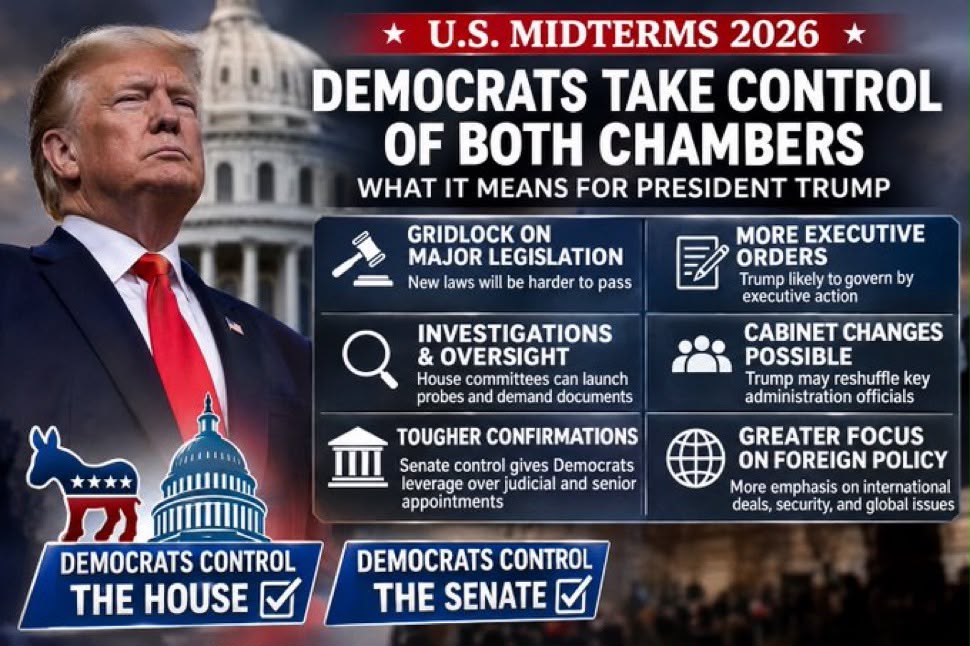
The heavy Republican defeat in the midterm elections still leaves Donald Trump two months before the new Congress takes office. He could use this window to strike Iran’s remaining nuclear capabilities, then leave the Gulf monarchies to negotiate with Tehran over Hormuz. The monarchies may welcome a weakening of the nuclear programme while fearing reprisals. Israel, busy forming a coalition, is likely to carry less weight over the diplomatic timetable. Frozen assets and the naval blockade would remain two American levers, without guaranteeing a deal.
The Democratic victory in the House of Representatives and the Senate, reported by Reuters on 4 November, shifts the balance of power in Washington. It does not yet determine the course of the war in the Gulf, as Donald Trump remains president and commander-in-chief. The new Congress’s terms begin on 3 January 2027. Between those two dates, he still deals with a legislature drawn from the outgoing majority.
It would be premature to infer an automatic de-escalation from the vote. A prolonged war may become harder to fund and to defend politically, whereas a brief operation retains its appeal for a president who wants to impose an outcome on the conflict. Strike hard, declare that the nuclear objective has been achieved, then negotiate or let regional partners take over: that sequence is one possible scenario. At this stage, no public order allows it to be presented as a settled decision.
An American window until January
Trump no longer has a presidential re-election campaign to prepare for. The political cost of a fresh offensive can therefore no longer be calculated as it was before the midterms. He may wish to leave his successors an outcome he could present as decisive, and the next Congress a situation that has already been transformed. His freedom is not absolute, however: any American casualties, energy prices, public opinion and divisions within his own camp would continue to weigh on him.
Until 3 January 2027, Trump retains a Congress with a Republican majority. From that date, the Democrats will be able to step up hearings, investigations and scrutiny of appropriations. A hostile majority does not strip the president of the day-to-day conduct of operations, nor is it enough, on its own, to halt a military campaign. But it can complicate its funding and raise the political cost of prolonging it. The current window is more favourable to a presidential initiative; it does not suspend any constitutional rule.
Within that timeframe, regime change in Iran appears beyond the reach of an operation whose duration and aftermath Trump would want to control. The military objective most compatible with this window would therefore be nuclear: an attempt to destroy the remaining capabilities and prevent them from being rebuilt. Even so, the goal of eliminating the threat must be distinguished from what strikes can actually achieve.
Pickaxe Mountain and the declared victory
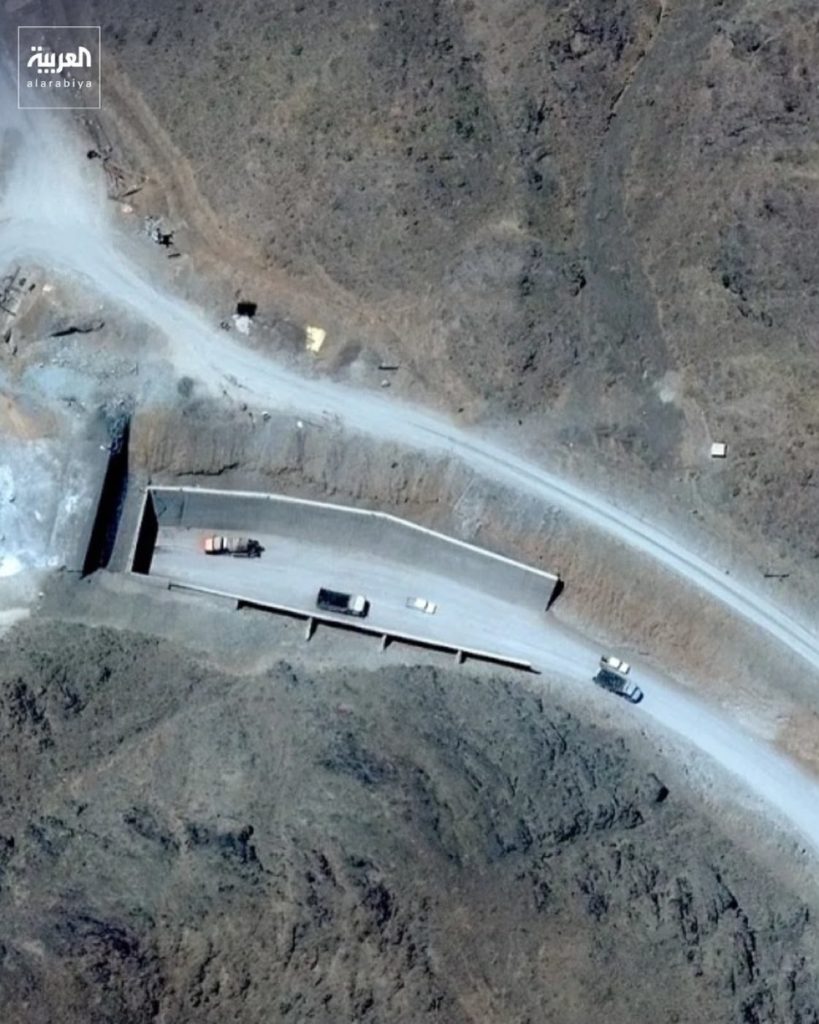
The underground complex at Pickaxe Mountain, south of Natanz, could become the emblem of such an operation. A satellite imagery analysis published on 9 September by the Center for Strategic and International Studies (CSIS), a US think tank, points to stepped-up construction work and external reinforcements. It confirms neither the presence of centrifuges in the tunnels nor their precise function. Reports attributed to Israeli intelligence have circulated, but no independent public confirmation allows them to be regarded as established. This uncertainty does not prove that US or Israeli intelligence services are unaware of what the site contains. The CSIS believes that destroying the complex would be difficult, even with the most powerful US conventional munitions.
A strike could therefore damage the site or halt its use without providing proof of its complete destruction. For Washington, the temptation would be to turn this military outcome into a declaration of victory. For observers, a distinction would need to be drawn between the damage observed, the capabilities rendered unavailable and the actual elimination of the nuclear threat. The fate of the enriched material, the know-how retained and the scope for rebuilding would remain decisive.
This gap would put inspections at the heart of the post-strike phase. If Trump wants to close the nuclear file and then pave the way for negotiations on Hormuz, independent verification would lend his announcement greater weight. Without verification, disagreement over Iran’s surviving capabilities could fuel a fresh crisis with Tehran and tensions with Israel.
Hormuz and frozen assets caught up in US political battle
Degrading the nuclear programme would not automatically resolve the question of maritime security. Tehran could retain the means to threaten shipping and regional infrastructure. Any negotiation over Hormuz would therefore centre on concrete commitments: an end to attacks, the terms of commercial passage, the future of the US blockade of Iranian ports and mechanisms for verifying reciprocal measures.
Trump could seek to separate the issues: claim a result on the nuclear question, then leave the Gulf monarchies to take greater responsibility for negotiating with Iran over Hormuz. The regional mediation efforts launched before the vote provide channels for this transfer of responsibility. Washington would nonetheless retain two levers of pressure: the naval blockade of Iranian ports and restrictions on Tehran’s assets. This would amount to a partial diplomatic disengagement.
The frozen assets are both a major lever and a stumbling block. Tehran wants access to its funds; Washington may wish to make that access conditional on verifiable concessions. But the president does not have uniform authority over all these assets. Sanctions imposed by executive order can be amended by the executive, within the limits of the law. For those that Congress has written into legislation, Trump can only use the waivers or suspensions provided for in the statutes. Repealing them through legislation requires action by Congress. Court rulings and the rules of the countries where the assets are held impose further constraints.
INARA, the US Iran Nuclear Agreement Review Act of 2015, adds a further procedure if a deal concerns the nuclear programme. It requires the agreement to be submitted to Congress and, ordinarily, a thirty-day review period during which certain statutory sanctions relief cannot be applied. A resolution of disapproval must become law, subject to a possible presidential veto. Even if a strictly maritime arrangement would not automatically fall within this framework, its content and any links to the nuclear issue would be decisive.
The main obstacle could be the gap between a US political promise and Iran’s actual access to its funds. If Tehran demands rapid releases of money before securing the passage, legal, banking and parliamentary procedures could slow down implementation. A lasting confrontation between Trump and the Democrats would further undermine the credibility of US commitments. A hostile majority would not doom every agreement, but it could make it harder to guarantee that the announced concessions will be applied and will last.
The US presence could become a bargaining chip
For the Gulf monarchies, the foremost concern remains the protection of their territory. A fresh offensive would expose their energy facilities, their ports and the bases hosting US forces. An analysis by Reuters published on 2 November describes this reversal: US military installations, meant to protect the host countries, could become targets and instruments of Iranian pressure. The question therefore goes beyond bolstering their defences: it concerns the usefulness and the cost of this presence.
The interests of the various monarchies are not identical. Riyadh and Abu Dhabi might welcome a weakening of Iran’s nuclear programme while fearing the consequences of a campaign decided in Washington. Doha and Muscat have their own mediation channels; Bahrain and Kuwait are particularly exposed by their geography and their military ties with the United States. It would be going too far to infer from this a shared desire to ask US forces to withdraw. However, the hypothesis that those forces are becoming a burden rather than a safeguard now deserves to be examined.
The cost of maritime insecurity, analysed in La crise pétrolière : des détroits à la rue, increases their interest in securing lasting stability. The mediation efforts described in Golfe : les diplomates s’activent pour éviter le pire show their determination to influence events. Their priority may be less to obtain more American troops than to reduce the risks created by the confrontation between Washington and Tehran.
In this regional game of skittles, the monarchies would thus seek to negotiate the terms of their own security. The size of the bases, their missions and the arrangements for using host territories could become part of a discussion with Washington, alongside the exchanges with Tehran. In the United States, the cost of protecting and rebuilding the installations could also become a subject of budgetary confrontation. At this stage, there is no public agreement providing for a general withdrawal: the American presence is a potential bargaining chip, not a concession already granted to Iran.
Israel negotiates its coalition while Washington is free to act
The Israeli timetable adds an asymmetry. The candidate tasked with forming a government has twenty-eight days, with a possible extension of fourteen days. If this fails, the procedure can continue through further stages. Two to three months of horse-trading is therefore a plausible scenario, though not a certain timescale. This period overlaps with the American window from November to January.
Israel would not, however, be left without an executive: the outgoing government remains in office until it is replaced. The transition does not paralyse the armed forces. It can, however, complicate long-term diplomatic commitments and make decisions binding the next government more open to challenge.
Netanyahu could seek to hasten American action against Iran, for strategic reasons and to defend his security record in the coalition negotiations. This is a possible incentive, not a proven intention. Trump, for his part, might prefer to press ahead without waiting for the Israeli majority to stabilise.
A military convergence could thus precede a diplomatic divergence. Washington and the Israeli government could back the same strikes, then clash over what guarantees are sufficient for dealing with Tehran. The United States might wish to settle for a nuclear outcome it deemed adequate; Israel might demand more lasting oversight of nuclear activities, of the stockpile of enriched uranium and of any scope for rebuilding. It might also want ballistic missiles to be included in the settlement. The next government would then inherit decisions taken while it was being formed, without the two allies’ objectives coinciding on all these points.
Tehran may choose to wait
Tehran is under no obligation to ease the exit from the war that Trump is seeking. It might prefer to wait for the new Congress, hoping to exploit American divisions and deny the president an immediate diplomatic success. Waiting would allow it to keep up the pressure on Hormuz. It would also prolong its own economic difficulties and would not guarantee a more conciliatory Democratic stance towards Iran. This is therefore a possible calculation, not a strategy that has already been demonstrated.
A new American offensive could thus have a limited objective: to destroy more of Iran’s nuclear capabilities and allow Trump to proclaim a result before January. It would not be enough to restore shipping through Hormuz on a lasting basis. Bab el-Mandeb, moreover, belongs to a different theatre, where the Houthis retain their own decision-making capacity and where an agreement with Tehran would not automatically mean an end to the attacks. Caught between Iranian demands, the interests of the Gulf monarchies and the political confrontation in the United States, the prospects for a swift maritime settlement therefore remain uncertain.
Follow the author on X: Seals Consulting
LTDN articles worth rereading
Gulf: diplomats step up efforts to avert the worst — 30 October 2026
The oil crisis: from the straits to the street — 22 September 2026
Sources and references
Reuters — Midterm election results — 4 November 2026
CSIS — Satellite analysis of Pickaxe Mountain — 9 September 2026
Congressional Research Service — Agreements with Iran and the INARA mechanism — 17 June 2026
OFAC — Legal framework for sanctions against Iran
Reuters — US bases and Gulf concerns — 2 November 2026
Knesset — Formation of the Israeli government
National Archives — Congressional terms begin on 3 January
Translated from French. The French original prevails.