In Montreal, Canada was promised a place that the European Union had offered to no one else. The signed text says nothing of it. That is precisely what makes the episode instructive.
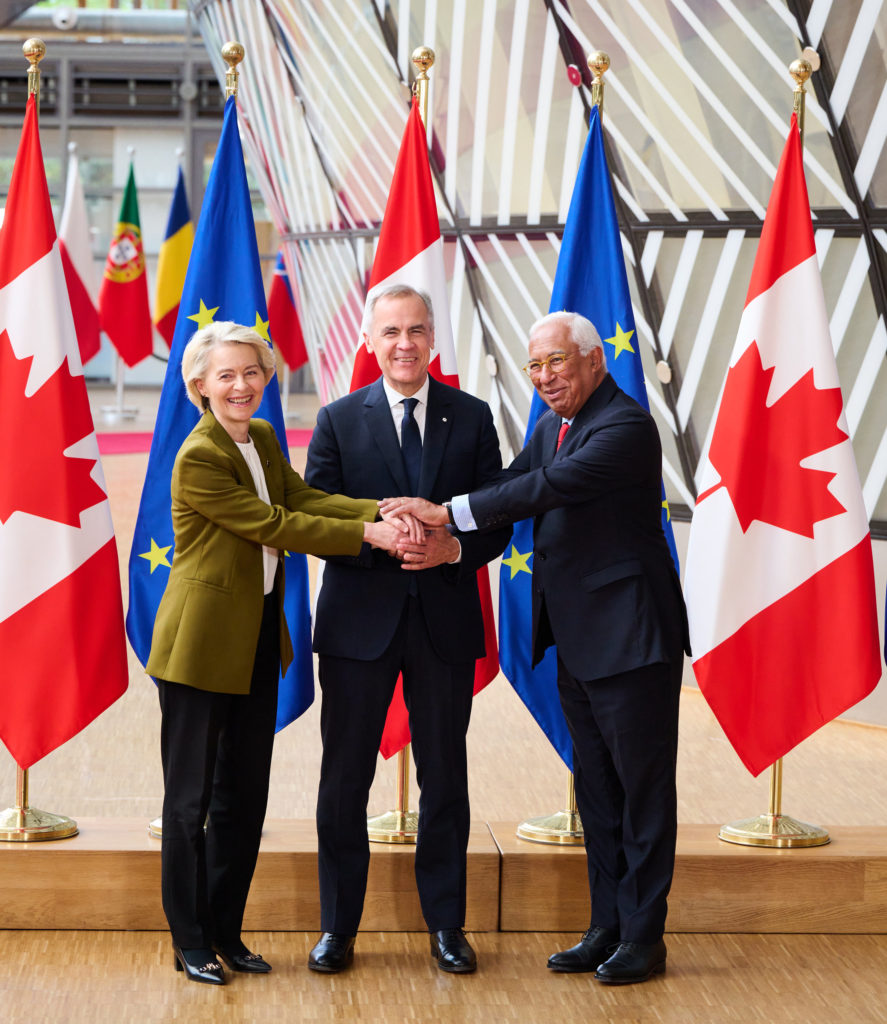
On 30 October, at the close of the 21st Canada-EU summit, Mark Carney appeared before the press flanked by Ursula von der Leyen and António Costa. The three leaders had just launched an “Alliance for the Future”. Carney added that Canada was working towards becoming the Union’s first associate member, in the closest possible partnership short of membership, since geography rules out anything more 1. The day before, he had started out saying something quite different.
On the eve of the summit, diplomats quoted by Reuters and DPA let it be known that the German Chancellor, Friedrich Merz, and several other European leaders had secured the removal of the words “associate member” from the draft declaration 5. Euronews reports that Berlin pushed for this a few hours before von der Leyen left for Montreal 4. The text now speaks only of an “ever closer” association 5. Questioned at the opening of the summit, Carney initially played the matter down: the name mattered little, he said; what counted was what the agreement would change for Canadians 5. That same day, addressing business leaders, he was already speaking of an alliance “with Canada as an associate member” 2. The following day, he repeated it from the podium.
This back-and-forth was no accident.
The idea came from the Commission. Von der Leyen floated it on 16 September in Strasbourg, in her State of the Union address, speaking directly to Carney, who was in the chamber as a guest 7. The Commission has not disowned it: its official page on relations with Canada still presents the country as the first to be invited to become an associate member 6. It is the capitals that are holding back. The Union may have association agreements with more than twenty countries, but no treaty has ever created an associate member status 7. Member states are being asked to endorse a category that does not yet exist. Berlin has said no, at least for now.
A third player has entered the debate. Donald Trump called the idea laughable and hinted that Washington might restrict its trade with Europe if it saw it as a hostile move 5. I do not know how much weight this threat carried in Germany’s caution. I simply note that Germany is, of all the large EU countries, one of the most exposed to a trade war with the United States.
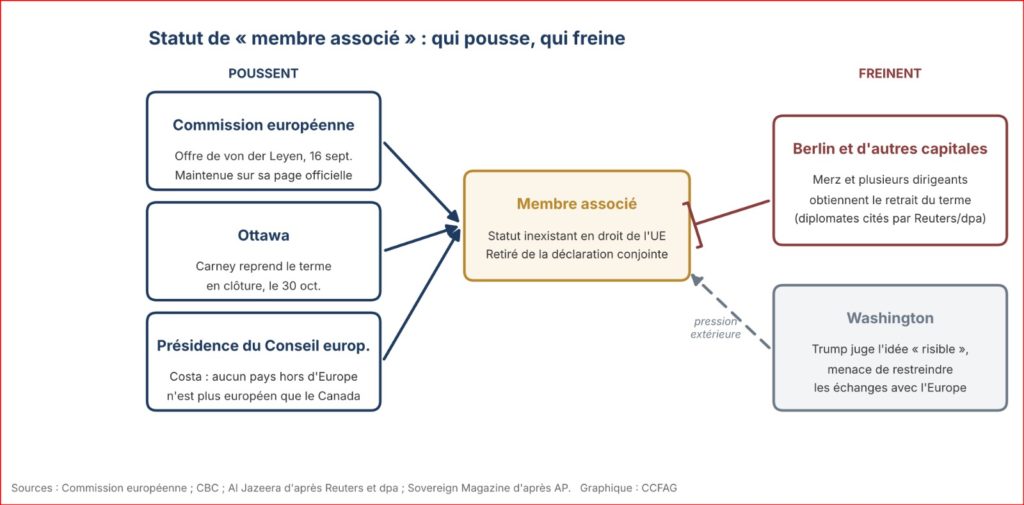
Chart: CCFAG. Sources: [2], [5], [6], [7].
Carney thus repeated in public a word that the text no longer contains. I do not see this as a blunder. A man who has run the Bank of Canada and then the Bank of England knows the value of a phrase repeated in front of the cameras: in time, it sets the terms of the discussion. His hosts did not contradict him on the podium. According to The Canadian Press, the two sides even committed to spending the next eight months negotiating this status, despite objections voiced on both sides of the Atlantic 3.
What was signed
The row over vocabulary should not obscure what really matters, which is more down to earth. Negotiations on a digital trade agreement and on a competition agreement have been concluded in substance. The European Investment Bank and Ottawa have finalised a mechanism designed to attract European capital to Canadian critical minerals 7.
Canada will also join the European high-performance computing initiative. Carney put forward a striking comparison: the German supercomputer JUPITER can do in a single day what Canada’s most powerful research machine takes six months to accomplish 7. The figure is his; I have not verified it.
Two projects deserve more attention than the student exchanges: a feasibility study on exporting Canadian liquefied natural gas to Europe, and a plan for submarine cables linking Europe, Canada and Asia 5. Energy and communications infrastructure. That is where the sovereignty everyone is talking about will be decided.
The defence strand, for its part, preceded the summit by several months.
On 14 February 2026, Canada signed the agreement with the Union that makes it the first non-European country to be associated with SAFE 9. This instrument, adopted in May 2025, makes up to €150 billion in loans available to member states to finance joint military procurement 8. The Council concluded the agreement in June 9, and it entered into force on 1 August 10. Ottawa will not receive a single euro of these loans, which are reserved for the Twenty-Seven. Canadian industry, however, can now take part in joint European procurement 8. If associate membership status materialises, it will simply put a label on an integration that is already under way.
The shadow of Washington
The summit took place just days before the US midterm elections on 3 November, amid a tariff war between Ottawa and Washington. On 1 November, Carney reported a “good conversation” with Donald Trump, who has announced a trade deal soon without specifying what it would contain 11. In the meantime, Canada has signed a trade agreement with the United Arab Emirates 11.
António Costa declared that no country outside Europe was more European than Canada. Von der Leyen argued that a country’s values matter more than its place on a map 7. The words are generous. They also betray a need: the Union is looking for a Western ally able to show that it is possible to stand up to Washington without breaking with it. Ottawa plays that role, and it does well out of it.
What could still go wrong
Let us be cautious. The Comprehensive Economic and Trade Agreement, CETA, has been provisionally applied since 2017, and several member states have still not ratified it 3. Will a Union that has not completed ratification of a free trade agreement with this partner invent an unprecedented legal category in eight months? I doubt it. All the more so because a status tailor-made for Ottawa would arouse envy. London, Oslo or Bern could legitimately ask why not them. I suspect Berlin has thought of that.
The timetable is tight. Canadian ministers and European commissioners will meet in March, Carney wants to conclude at the European Council in June 2027, and the 2027 summit is due to set the real scope of the association 7. Between now and then, elections and crises will have time to reshuffle the cards, in Ottawa as elsewhere.
Finally, a word for our Geneva readers. Switzerland spent years negotiating its new package of agreements with Brussels. It will be watching closely how quickly the Union is prepared to offer a country on the other side of the Atlantic a closeness that it has discussed at such length with its immediate neighbours.
The word was struck from the text, then uttered all the same. It remains to be seen which of these two gestures will carry more weight.
Didier Aubrais is the founding president of the Cercle Canadien Francophone d’Analyse Géostratégique (CCFAG) and president of Groupe DA Détection-Action. Trained in criminology and forensic science, he has nearly thirty years’ experience in state security and private intelligence. The views expressed here are the author’s own.
References
[1] CBC News, 30 October 2026. “Carney says, unequivocally, Canada seeking to become the EU’s 1st associate member”. https://www.cbc.ca/news/politics/european-union-canada-associate-member-von-der-leyen-9.7401989
[2] CBC News, 29 October 2026. “Carney says Canada is working to become an ‘associate member’ as he hosts EU leaders in Montreal”. https://www.cbc.ca/news/politics/european-union-canada-associate-member-von-der-leyen-9.7400922
[3] The Canadian Press (D. Baxter), 30 October 2026. “Canada, European Union close Montreal summit with ‘alliance for the future’ pact”. https://ca.finance.yahoo.com/news/canada-european-union-summit-montreal-080021074.html
[4] Euronews, 30 October 2026. “EU and Canada to seal broader, deeper alliance in Trump’s long shadow”. https://www.euronews.com/2026/10/30/eu-and-canada-to-seal-new-alliance-in-montreal-under-trumps-shadow
[5] Al Jazeera, 29 October 2026. “European Union backtracks on Canada becoming ‘associate member'” (based on reporting by Reuters and dpa). https://www.aljazeera.com/news/2026/10/29/european-union-backtracks-on-canada-becoming-associate-2
[6] European Commission. “EU-Canada relations”, official page. https://commission.europa.eu/topics/foreign-affairs-and-security-policy/eu-canada-relations_en
[7] Sovereign Magazine, 30 October 2026. “Canada and the EU Forge a Historic Alliance” (based on reporting by the Associated Press). https://www.sovereignmagazine.com/article/canada-eu-historic-alliance-associate-member
[8] Council of the European Union. “SAFE – Security Action for Europe”, official page. https://www.consilium.europa.eu/en/policies/safe/
[9] European Defence Industry, 15 June 2026. “EU formally concludes SAFE agreement with Canada”. https://defence-industry.eu/eu-formally-concludes-safe-agreement-with-canada-to-support-participation-in-joint-defence-procurement-programmes/
[10] Lovguiden, 10 July 2026, summary of the Official Journal of the EU. Entry into force on 1 August 2026; see also Decision (EU) 2026/444 on EUR-Lex. https://lovguiden.dk/en/det-offentlige/eur-lex-eu-tidende/2026-07-10-eu-canada-aftale-om-forsvarsindkoeb-under-safe-traeder-i-kraft-1-august-2026
[11] Al Jazeera, 1 November 2026. “Carney signals progress on Canada-US trade deal talks as midterms loom”. https://www.aljazeera.com/news/2026/11/1/carney-signals-progress-on-canada-us-trade-deal-talks-as-midterms-loom
Translated from French. The French original prevails.