AI-generated image.
The war in the Middle East can no longer be measured solely by the number of ships passing through the Strait of Hormuz or the Bab el-Mandeb. It is now reaching petrol stations, heating bills and public budgets. Asia remains the region most dependent on Gulf volumes, but Europe is suffering a shock that is harder to absorb: since the invasion of Ukraine, it has replaced much of its Russian oil and gas with seaborne supplies that come from further afield and are scarcer and more expensive. From France to Syria, the energy crisis is beginning to make itself felt on the streets.
Traffic through the strait has not stopped, but it remains well below its normal level. According to the International Energy Agency (IEA), oil flows through the Strait of Hormuz reached 7.6 million barrels per day in August, 13.1 million fewer than before the war. Cumulative export losses are approaching 2.8 billion barrels. The IEA now forecasts a fall in global supply of 5.7 million barrels per day in 2026, with a full recovery of Gulf output pushed back to 2027.
Producers have nonetheless restored some of the flows. Shuttle tankers cross Hormuz, sometimes switching off their transponders, then transfer their cargo off Oman onto very large crude carriers. This arrangement has brought exports back to almost 6.5 million barrels a day. It has also turned shipping into a second price of oil: freight can exceed $30 a barrel, more than a quarter of the value of the crude delivered. The crisis is therefore no longer merely one of quantity. It is becoming a crisis of distance, insurance and vessel availability.
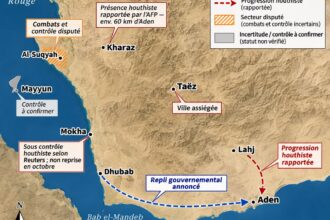
The tension is spreading to Bab el-Mandeb. Attacks on Saudi infrastructure and insecurity in the Red Sea are reducing the usefulness of the East-West pipeline and the Yanbu terminal. The Gulf is thus losing part of its main bypass route. The two straits no longer constitute two separate crises. They form a single system of constraints.
Asia loses volumes, Europe pays the premium
Asia remains the first physical casualty. Before the war, China, India, Japan and South Korea took about three quarters of the oil shipped through Hormuz. These economies nevertheless have several buffers: Russian purchases for China and India, substantial refining capacity, administered or subsidised prices, public stocks and long-term contracts. They are suffering, but their governments can delay the pass-through of the shock to consumers.
Europe is less directly dependent on Gulf barrels, but it has to buy the marginal cargoes it needs on a tight global market. It deliberately cut itself off from a large share of Russian energy after the invasion of Ukraine. Russia’s share of the European Union’s oil imports fell from 27% at the start of 2022 to around 2%. Its share of gas imports dropped from 45% to around 12%. That choice was driven by political and strategic necessity. It has, however, replaced dependence on pipelines with greater exposure to LNG tankers, terminals and shipping routes.
Energy Aspects puts Europe’s potential shortfall at 510,000 barrels per day in the fourth quarter of 2026, while the United States and Asia-Pacific would retain surpluses. Europe is already importing 129,000 barrels per day of South Korean jet fuel in September, the highest level since October 2022. Stocks at the major Amsterdam-Rotterdam-Antwerp hub have fallen to a seven-year low. A product refined in Asia is thus crossing the globe to fill a European gap. The price paid in Europe covers the crude, the refining, the freight and the war risk.
This geography confirms the mechanism already seen at Damietta in Egypt: the energy war that began in the Gulf is spreading to the Mediterranean and the Atlantic through ports, refineries and supply contracts.
One global barrel, national prices
Brent was still trading at around $102 a barrel on 21 September, having risen above $108 in mid-month. The price of crude, however, accounts for only part of the bill. Taxes, currencies, refining capacity and support mechanisms create considerable differences between countries.
In the United States, a gallon of petrol now averages $4.48, while diesel has passed $6.45. The peaks of $10 seen at a handful of filling stations do not reflect the national average, but they do expose local strains. The country produces a great deal of oil, but it cannot escape the global price of crude or the shortage of refined products. Diesel then passes the shock on to road haulage, agriculture and food prices.
Canada benefits from its domestic production and remains better protected against a physical shortage. That does not mean it is insulated: prices in the eastern provinces track Atlantic benchmarks, and the Canadian dollar makes imported products more expensive. The difference with Europe lies more in security of supply volumes than in the impact on consumers.
Emmanuel Macron has, moreover, cited Canadian liquefied natural gas projects among the solutions that could help diversify Europe’s supplies. Their contribution cannot, however, be immediate. LNG Canada, in Kitimat, has an initial capacity of 14 million tonnes a year, which could be raised to 28 million, but this Pacific terminal is geared primarily towards Asia. Ksi Lisims LNG could add 12 million tonnes a year; its first deliveries are not expected before 2031 and remain contingent on a final investment decision and on construction. Canada can therefore strengthen Europe’s energy security in the 2030s; it offers no answer either to current prices or to the winter of 2026-27.
In Japan, the import bill rose by 28% year on year in August. The weakness of the yen, close to 155 to the dollar, magnifies every rise in the price of a barrel. Beijing limits pass-through more effectively thanks to administered prices and its refining capacity, but China has to mobilise its state-owned companies, its stockpiles and its Russian and Iranian supplies. In India, the government is shielding domestic prices through excise duties and export taxes designed to keep petrol, diesel and jet fuel on the domestic market. This protection shifts the cost onto the public purse, refiners and the trade balance.
In Europe, the shock is more visible. In France, diesel averaged €2.41 a litre on 20 September, SP95-E10 €2.17 and SP98 €2.28. In Germany, diesel reached about €2.45 and E10 petrol €2.30. In the United Kingdom, diesel was approaching £1.94 a litre (€2.26) and petrol £1.71 (€1.99). Italy and Spain remain slightly better shielded by tax cuts and targeted measures, but no national measure can permanently remove the cost of scarce oil and more expensive transport.
Governments buy time
Governments are using four instruments: drawing on strategic stocks, cutting taxes, subsidising certain sectors and administering prices. The IEA has coordinated the largest release of emergency stocks in its history. According to its tracking of government responses, 94 countries have adopted some form of consumer support and 38 now resort to direct fuel subsidies, compared with 16 four months earlier.
Fuel, however, confronts governments with a difficult choice. Excise duty is generally set in cents per litre: when consumption falls by 5%, the revenue it yields drops by a similar proportion. VAT, by contrast, is calculated on the price, so its receipts per litre rise as pump prices climb. Keeping taxes in place may therefore preserve, or even increase, revenue in the short term, but it may also deepen the fall in purchases and thus reduce excise duty receipts.
In France, this mechanism is already visible. In August 2026, deliveries of road fuels fell by 6.6% year on year: –9.2% for diesel and –2% for petrol. Over the first eight months of the year, the decline reached 5% and remains concentrated mainly in diesel. This trend reflects at once consumers’ response to prices, the structural transformation of the vehicle fleet and the slowdown in sectors whose margins depend heavily on the cost of energy.
When hauliers, fishermen, farmers or certain industries scale back their activity because they cannot pass on the full rise in costs, their fuel consumption also falls. The contraction in volumes is therefore not merely an indicator of adaptation, but also a possible symptom of an economic slowdown. The fiscal dilemma is all the sharper as a result: the state can lose revenue both through the decline in the number of litres taxed and through the fall in the activity on which other levies depend.
In mid-September 2026, taxes still account for close to half of the final price of petrol in several European countries, compared with around 12% in the United States. These orders of magnitude combine excise duties and VAT or sales taxes; they vary with prices and with temporary relief measures. The European Commission publishes prices with and without taxes every week.
| Country | Petrol | Diesel | Tax benchmark |
| France | 48% | 41 % | High excise duty and 20% VAT |
| Germany | 44% | 35-40% | Before the cut announced for October |
| Italy | 48-52% | 42-47% | Temporary relief in place |
| Spain | 42-46% | 36 à 41% | Excise duties lower than in France |
| United Kingdom | 48% | 44% | Same excise duty on petrol and diesel |
| United States | 12% | 9-11% | Wide variation between states |
| Canada | 15-25% | 12-22% | Taxation varies by province |
| Japan | 23-26% | 18-23% | Provisional surcharge abolished |
| China | 30-33% | 27-31% | Regulated retail prices |
| India, Delhi | 28% | 23% | Taxation varies by state |
France has extended targeted support for the hardest-hit sectors, notably fishing, until the end of the year. TotalEnergies is also capping certain prices across its network. Germany has announced a temporary cut of €0.17 per litre from 1 October, of which €0.14 comes from energy tax and the remainder from VAT; the measure will cost around €2.5 billion. Spain has announced tax relief and Italy is maintaining temporary reductions on fuel. In the United Kingdom, the energy price cap will continue to protect households, but it will rise by 4% in October, to £1,723 a year for a typical household.
These policies do not make the cost disappear. They shift it from the pump to taxation, debt or the accounts of state-owned companies. Rich countries can buy more time. Importing economies with little fiscal headroom must raise prices more quickly. Bangladesh, for instance, has just increased the price of diesel by 17.4%, to 135 taka (€0.96) a litre, after public losses of $1.9 billion between March and August.
When the energy crisis spills on to the streets
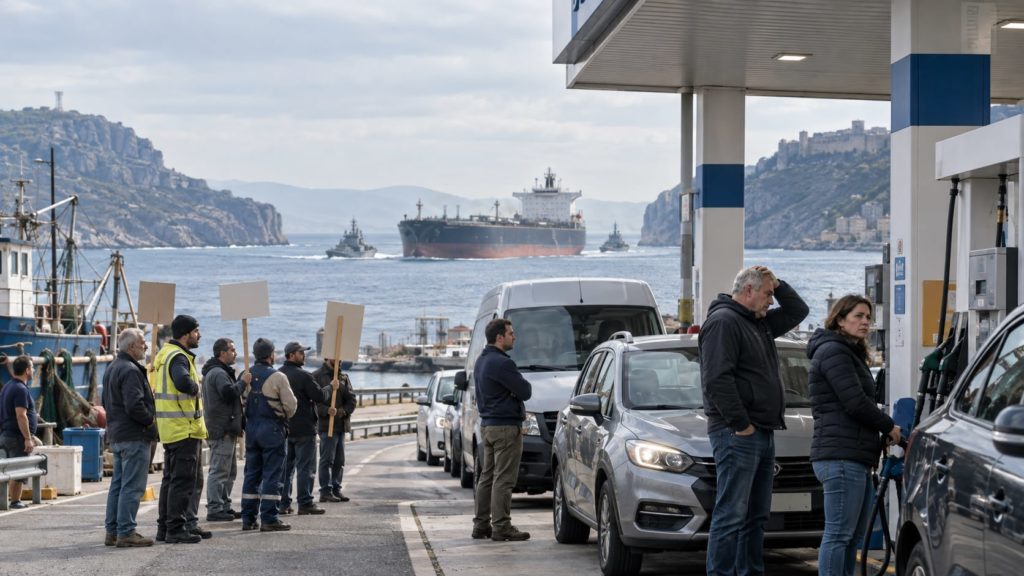
Protest movements have begun to emerge, but they are not taking the same form everywhere. In France, rising fuel prices are becoming entangled with the budget debate and concerns over wages. On 15 September, a cross-sector strike reduced activity at the Dunkirk LNG terminal and at several EDF facilities. Fishermen blockaded a fuel depot in the south of the country. The protests have not yet taken the form of a new “Gilets jaunes” (yellow vests) movement. However, a call to occupy roundabouts on 17 October 2026 has been issued in response to rising fuel prices. The choice of roundabouts harks back directly to the 2018 mobilisation. At this stage, it is a call whose scale remains uncertain, rather than an already established national movement. Indeed, the first call drew little support. Yet the social conditions that gave rise to that revolt are re-emerging: dependence on the car, a sense of fiscal injustice and a feeling that households are paying for a war over which they have no control.
In Syria, the link between prices and protest is direct. A 40% rise in the price of diesel and an increase of almost 30% in petrol prices sparked the most widespread demonstrations since the fall of Bashar al-Assad. Roads were blocked in Aleppo, Idlib, Raqqa, Hasakah and Homs. Tanker convoys were stopped. Syria imports around two-thirds of its energy; the temporary shutdown of the Baniyas refinery and reduced Russian supplies have compounded the impact of the global crisis. Since February, the price of 95-octane petrol has risen by 86% and diesel has more than doubled.
In the Philippines, drivers went on strike to demand subsidies and the abolition of fuel taxes; some fishermen in Manila Bay stayed in port. In Ireland, farmers had already staged protests against the price of diesel in the spring. Further tensions are likely in countries where governments cut subsidies that have become too costly. Three situations should nonetheless be distinguished: actual protest, calls to demonstrate and mere discontent as measured by opinion polls. Conflating them would lead to a premature announcement of a global wave.
The thermometer as a geopolitical actor
Winter will determine the scale of the next stage. The wholesale price of European gas has already risen by more than 140% year on year, while storage levels remain low. The European Central Bank estimates that in more than half of eurozone countries, rising gas prices now feed through into inflation within one to three months. A mild winter would help preserve reserves and contain LNG purchases. A harsh winter would put Europe in fiercer competition with Asia, at the very moment when Qatar is producing only a small volume of LNG and Hormuz remains under strain.
Europe has been able to replace part of its Russian gas with LNG. It has not eliminated its vulnerability: it has shifted it from pipelines to LNG terminals, shipping lanes and the weather. In this crisis, the thermometer could become a geopolitical actor.
The war that began in the straits is thus reaching consumers in stages. Dwindling flows push up the price of crude; military risk drives up freight and insurance costs; a shortage of refining capacity tightens diesel and jet fuel supplies; and governments, finally, try to cushion the blow. When they can no longer do so, the energy bill becomes a political issue. Consumers are neither the combatants nor the decision-makers in this war. Yet they are the ones footing the bill, through the price of fuel, heating, transport and food.
Read more in La Tribune des Nations
- Hormuz: Iran holds the strait, Trump holds the purse strings
- After Hormuz, Bab el-Mandeb becomes the new front in the energy war
- Egypt’s port of Damietta: the energy war reaches the Mediterranean
Sources
- International Energy Agency, Oil Market Report, September 2026
- Reuters, Europe’s jet fuel deficit and South Korean supplies
- Reuters, Syrian protests against rising fuel prices
Translated from French. The French original prevails.