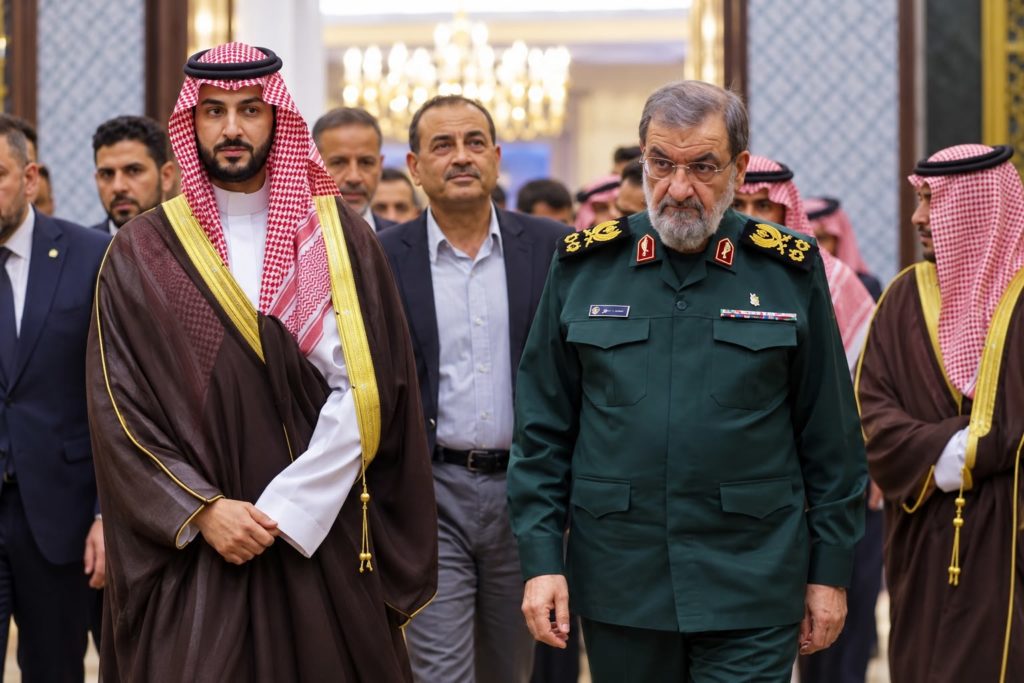
Khalid bin Salman (left) and Mohsen Rezaei (right).
With only days to go before the US elections on 3 November, mediation efforts are multiplying to prevent a resumption of hostilities between the United States and Iran. The meeting in Tehran on 26 October produced no agreement, while Qatar and JD Vance are seeking to revive negotiations. Time is running out: a fresh escalation would worsen an energy crisis that is already weighing heavily on the Gulf economies and on importing countries.
A visit to Tehran in the name of de-escalation
On 26 October, the Saudi Defence Minister, Khalid bin Salman, the Pakistani army chief, Asim Munir, and the head of Turkish intelligence, Ibrahim Kalın, met Iran’s leaders in Tehran. The three visitors represent the countries bound by the Mecca defence agreement. They were received by, among others, the Iranian President, Masoud Pezeshkian, and Mohsen Rezaei, Secretary of the Supreme National Security Council.
At the close of the meeting, the four countries merely agreed to continue their discussions on regional cooperation, peace and security. No date or venue was announced for a further meeting. No agreement was made public on the Strait of Hormuz, the US blockade of Iranian ports, Houthi attacks or the creation of a regional security mechanism. Mohsen Rezaei spoke of “very good discussions”; Riyadh said it wanted to open channels of negotiation to avert a fresh escalation and to support the mediation efforts of Qatar and Pakistan.
According to Pakistani officials quoted by Reuters, the talks covered, among other things, the negotiations between Washington and Tehran, Houthi attacks on Saudi Arabia, Hormuz and the US blockade of Iranian ports. One of them said that Asim Munir had presented a proposal with Donald Trump’s backing, without disclosing its content. According to an Iranian official, the nuclear issue was not on the agenda of this regional meeting. There is therefore nothing to suggest a compromise on substance.
The importance attached to this initiative at the highest levels of the Iranian state is clear from official statements on 27 October. According to Iranian media, Mohsen Rezaei met the Supreme Leader, Mojtaba Khamenei, after the four-way meeting. He reportedly stressed relations with neighbouring countries and control of the Strait of Hormuz, while restating Iran’s conditions for ending the situation of “neither war nor peace”. There is therefore nothing to indicate that Tehran is abandoning its demands. Reuters notes that the Supreme Leader has not been seen in public since his succession in March: this announcement does not amount to an independent and verifiable public reappearance.
Can diplomacy head off a new offensive?
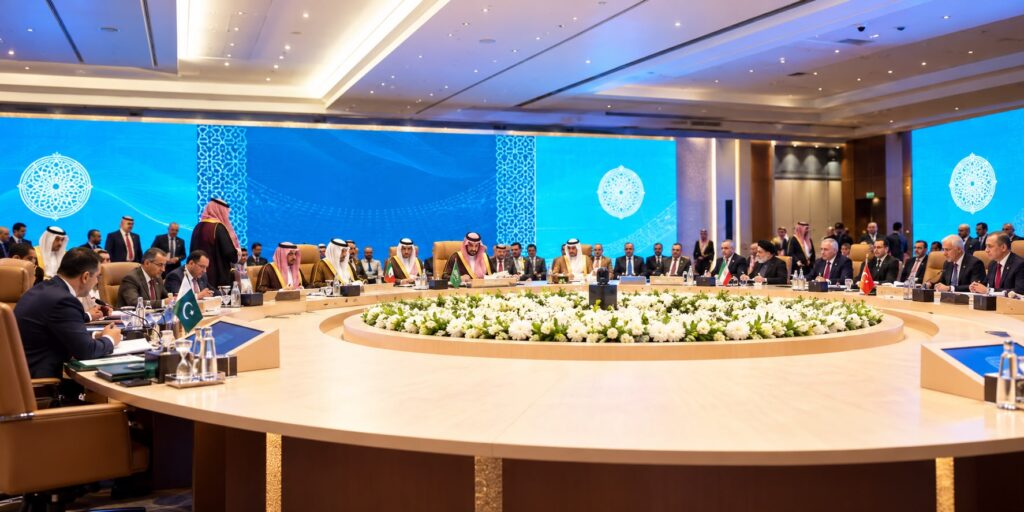
Time is running out. On 8 October, Donald Trump said that the United States would not launch fresh strikes on Iran before the midterm elections on 3 November, without ruling out a resumption after that date. Riyadh, Ankara and Islamabad are trying to avert a new conflagration whose consequences their countries would bear directly. Their visit opens a regional channel for dialogue without removing the military threat.
On 25 October Qatar submitted a proposal to Tehran which, according to Reuters, provides for seven days of reciprocal confidence-building measures. A response was expected before the end of the week. However, a senior Iranian official described the ideas put forward as “unacceptable”. This divergence illustrates how difficult it is to turn the mediators’ efforts into a concrete agreement.
The main obstacles concern the sequencing of concessions. According to the Guardian of 28 October, Tehran is reportedly considering shortening the time needed to reopen Hormuz once sanctions are lifted; Washington is first demanding guarantees on the nuclear issue. The Financial Times also mentions the blockade of Iranian ports, access to frozen assets and the security of maritime traffic. The fate of the stockpile of enriched uranium remains a major point of disagreement. On 27 October Doha called on Iran to stop threatening the Gulf states and to reopen the strait as a sign of goodwill.
On the Yemeni front, Mohsen Rezaei received Ibrahim al-Dulaimi, the Houthis’ representative in Tehran, on 27 October, according to the Guardian. The meeting underlines the place of the Yemen issue in the regional negotiations, but no suspension of attacks on Saudi Arabia has been announced. The various initiatives overlap without, at this stage, amounting to a comprehensive agreement.
Qatari mediators are also seeking, according to Axios on 28 October, to secure access for International Atomic Energy Agency inspectors to the bombed Iranian nuclear sites in exchange for targeted sanctions relief. As of 29 October, no new access to these sites had been confirmed. Rafael Grossi raised the possibility of reactivating the inspection framework negotiated in Cairo in 2025. Meanwhile, according to US and Israeli officials cited by Axios, the Israeli chief of staff, Eyal Zamir, spoke on 26 October with the commander of CENTCOM, Admiral Brad Cooper, to coordinate preparations for possible strikes. The outlet describes a scenario of roughly a week of intense raids; this is not an announced order to attack.
The US diplomatic track had taken clearer shape even before the meeting in Tehran. According to the New York Times and Axios, JD Vance had a message passed to Mohsen Rezaei via Qatar on 25 October, proposing direct negotiations and offering to lead the US delegation. Washington wants to discuss the nuclear programme from the outset, while Tehran is first demanding the lifting of the naval blockade, sanctions relief and access to its frozen funds. On 29 October, an Iranian official cited by Associated Press said the message had been received but that no reply had yet been given. A favourable reception reportedly seen in some circles of power therefore does not amount to an official acceptance.
The timing matters: Vance’s message was delivered on 25 October, and the Saudi, Turkish and Pakistani delegation travelled to Tehran on the 26th. According to Axios, its members also stressed the risk of strikes resuming after the US elections. No ceasefire, nuclear compromise or timetable for direct negotiations has been announced. The Saudi authorities are also reported to have asked Washington to give the mediation more time.
Hormuz: passage partially restored but still vulnerable
The clashes between the United States and Iran have severely disrupted shipping through the Strait of Hormuz, which links the Gulf to the Indian Ocean. Before the war, the strait was vital to oil and gas exports to Asia and Europe. Traffic has not come to a complete halt: escorts, ship-to-ship transfers and alternative routes have restored some of the volumes. These solutions remain costly, limited and exposed to fire and naval mines.
On 27 October, Reuters estimated flows through Hormuz at around 60% of their pre-war level, while crude exports from the Gulf had been falling for four weeks. Other estimates, based on different scopes or dates, put the recovery rate higher. Comparing them requires distinguishing between cargoes passing through the strait, the region’s total exports and the routes that bypass it.
Brent crude was trading at around $116 a barrel on 27 October, before falling back towards $113 on 29 October on hopes of a diplomatic resolution. Even when deliveries do get through, freight, insurance, transport risks and diversions are driving up the bill sharply. On 29 October, Iran claimed that three oil tankers had struck mines while taking an unauthorised route near Hormuz; Associated Press noted that this account and the identity of the vessels had not been independently verified. The Red Sea and the Bab el-Mandeb Strait also remain vulnerable to attacks.
This energy crisis now makes the search for an agreement urgent far beyond the region. Importing countries are under mounting pressure on prices, trade and their reserves. Iran is not spared, although its long experience of sanctions and of circumvention networks may allow it to hold out differently from an economy heavily dependent on imports of fuel or gas.
Iran: an economy under pressure, but no proven collapse
The pressure on Iran is particularly intense. According to Reuters, citing the Statistical Centre of Iran, annual inflation reached 73.6% in September. The agency also reports that the rial has lost nearly 35% of its value against the dollar since the US naval blockade was reimposed in July. For households, rising prices are affecting food, housing and imported goods, compounding difficulties that predate the war.
Oil provides the state with indispensable revenue and foreign currency. According to the tracking firm Vortexa, cited by Reuters, Iran’s seaborne crude exports fell to zero in the second week of September and remained there as of 5 October. This estimate covers flows tracked at sea: it does not allow the conclusion that all Iranian trade or every source of foreign currency has disappeared.
The fall in revenue narrows budgetary room for manoeuvre and makes it harder to finance imports. But the economic losses, though very real, demonstrate neither an imminent collapse of the regime nor an impending acceptance of American terms. The authorities retain instruments of control and can shift part of the shock onto the population.
Gulf monarchies: very uneven fortunes
For Gulf producers, a dearer barrel does not guarantee greater prosperity. They must still be able to extract, export and insure cargoes, protect installations and keep other activities going. The attacks, the fall in certain volumes and the uncertainty are also hitting tourism, transport and investment.
Qatar is particularly exposed because its liquefied natural gas exports depend heavily on Hormuz and because facilities have been damaged. On 27 October, Reuters reported that QatarEnergy had extended until the end of December the force majeure on its deliveries to the Italian company Edison. The contract in question amounts to 6.4 billion cubic metres a year, or about 10% of Italian consumption: this does not mean that Italy automatically loses this volume with no possibility of replacing it.
In September, QatarEnergy said that repairs to two liquefaction trains could take three years. The difficulties therefore concern both shipping routes and production capacity. Qatar’s financial resources give it the means to cushion the blow, but they can repair neither the facilities nor the interrupted contracts.
Saudi Arabia has the capacity to bypass the strait via the Red Sea, but it remains vulnerable to attacks on its infrastructure and to regional disruption. The Emirates benefit in particular from Fujairah, on the Gulf of Oman coast, although this access does not remove all capacity constraints. Kuwait and Bahrain remain heavily exposed to Gulf traffic. Oman, located at the entrance to the strait, is for its part seeking to preserve mediation and commercial stability.
In its forecasts of 22 October, the IMF projects a 1.3% contraction in 2026 for the Middle East, North Africa and Pakistan region as a whole. According to Reuters, Bahrain, Kuwait and Qatar are among the countries for which a double-digit fall in GDP is forecast. These are annual forecasts, not a final assessment; they depend, among other things, on how the conflict develops.
In Asia, security of supply comes at a price
China, India, Japan and South Korea remain particularly dependent on energy flows from the Gulf. Importers are seeking alternative suppliers, drawing on their stocks and adjusting their purchases. But cargoes available elsewhere are not necessarily comparable in price, quality or delivery time.
In India, the refiner BPCL says that Saudi and Emirati supplies recovered in the third quarter thanks in part to ship-to-ship transfers and alternative pipelines. According to figures cited by the Indian press, the share of five Gulf suppliers in India’s imports rose to 36.7% in September, from 26% in August, but remained below the 56.3% recorded in February. The rebound in volumes therefore does not eliminate the additional logistics costs.
As for gas, Reuters estimated Asian LNG imports at 23.31 million tonnes in October, the highest level since July despite high prices. China was preparing for winter, while Japan had more comfortable stocks. National situations diverge: South Korea, for instance, recorded GDP growth of 1% in the third quarter, buoyed by semiconductors, despite the energy shock.
Europe: gas and the winter risk
Europe must contend with Asian competition for LNG cargoes just as it seeks to secure its stocks. According to the Wall Street Journal, the European TTF benchmark price briefly reached €97.50 per megawatt hour on 26 October. The European Union’s gas reserves were 74.6% full as of 25 October, according to the newspaper. These figures vary daily and do not, on their own, mean that a shortage is certain.
The cost is gradually passing through to bills, transport and businesses, at different rates depending on contracts and national measures. In the United Kingdom, annual inflation reached 3.5% in September; fuel was 30% more expensive than a year earlier, according to official figures reported by Associated Press. The winter and the duration of the disruption will determine the scale of the shock.
In the United States, an economic and political bill
The United States is a major oil producer, but its consumers remain exposed to world prices. Rising fuel costs are eroding purchasing power and making transport more expensive. According to a study by the Centre for Research on Energy and Clean Air cited by Reuters, American motorists have paid an average of $471 extra on fuel since the war began. The figure is the organisation’s estimate, not spending recorded for every household.
Diplomacy has thus opened up several avenues, but has produced no reciprocal, verifiable commitment. Without a compromise on the nuclear issue, sanctions and freedom of navigation in Hormuz, the spectre of renewed fighting will continue to weigh on markets and on populations, in the Gulf and elsewhere.
Further reading from La Tribune des Nations:
– The oil crisis, from the straits to the street
– China, Japan, South Korea: the oil crisis
– Iran: fuel red alert threatens the army, the economy and the street
– Hormuz: Iran holds the strait, Trump holds the purse strings
Follow the author of this article on X: Seals Consulting
External links
Reuters, 28 October — New draft agreement presented by Qatari mediators
The Guardian, 28 October — Talks on Hormuz, the nuclear issue and Yemen
Associated Press, 28 October — Turkish parliamentary review of the Mecca agreement
Axios, 28 October — Mediation, nuclear inspections and military preparations
Axios, 28–29 October — JD Vance’s message to Mohsen Rezaei
Associated Press, 29 October — Tanker incidents near Hormuz
Reuters, 28 October — Qatari mediation proposal
Translated from French. The French original prevails.