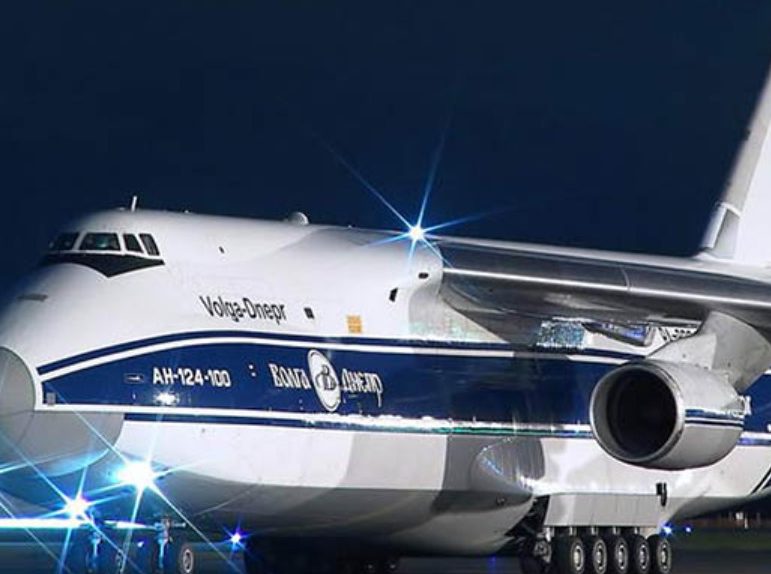
The Russian Antovov grounded in Toronto.
A Russian cargo aircraft grounded for four years on an Ontario tarmac has become the world’s first test of confiscating sanctioned assets. Ottawa has just won a round. But while Canada struggled to identify six owners, the targeted structure was quietly changing its own. The case says something uncomfortable about what states — and companies — really know about their counterparties.
On 13 August 2026, a judge of the Federal Court of Canada dismissed a challenge by Volga-Dnepr Airlines, Russia’s largest air freight carrier, to the continuation of Canadian sanctions against the company and its former president. Ottawa will see it as a victory. It is one. But it settles nothing, and the case it prolongs deserves the attention of every executive who deals with foreign counterparties. For it is worth grasping fully what is at stake on that tarmac.
Since 27 February 2022, an Antonov An-124 registered RA-82078 has been grounded at Toronto Pearson International Airport. It had landed there to deliver COVID-19 tests when Canada closed its airspace to Russian aircraft. It never left. It has run up more than C$1.5 million in parking fees and now appears on satellite views in Apple Plans and Google Maps — a 69-metre aircraft that has become part of the scenery.
Canada turned it into a symbol. In June 2023, it seized the aircraft. In March 2025, the Attorney General filed a forfeiture application with the Ontario Superior Court of Justice — the very first against the assets of a person listed under Canada’s sanctions regime. Ottawa has promised the aircraft, or its value, to Ukraine. Four years on, it has still not flown. And the reason is neither military nor diplomatic. It is corporate.
The sixth entity cannot be found
On 31 October 2025, on the sidelines of the G7 summit in Toronto, the Minister of Foreign Affairs, Anita Anand, provided, no doubt unwittingly, the key to the whole affair. The owners of the Antonov, she explained, had used complex corporate structures that took considerable time to unravel. The operational detail is more telling still than the phrase itself. To ensure procedural fairness, the Canadian government had to serve notice on six entities. By the end of the spring and summer of 2025, it had reached five. The sixth remained untraceable. Three and a half years after the seizure, one of the best-equipped states in the G7 was still trying to work out whom it needed to talk to.
The significance of this admission should not be underestimated. After all, the Canadian mechanism is formidable: unlike other forfeiture mechanisms, the Special Economic Measures Act does not require the government to prove that the asset was used to breach sanctions. It is enough for the owner to be listed. The tool is powerful. It simply presupposes that one can identify the owner.
While Ottawa was searching for its sixth entity, the adversary was moving ahead. On 30 December 2025, according to the Russian state register of legal entities, three divisions of the Volga-Dnepr group changed hands. The buyer is called Evraz Avia Service. It acquires the whole of Volga-Dnepr-Moscow and AirBridgeCargo, as well as 67% of Atran. Three facts deserve to be set side by side.
This company did not exist before February 2025. It was registered in Zhukovsky, on the outskirts of Moscow, with share capital of one million roubles — roughly fifteen thousand Canadian dollars. A shell had just absorbed what was once the world’s leading carrier of outsize cargo.
Ownership has changed only on paper. The structure remains encumbered by share pledges in favour of the former owners, who keep their management positions. The same men, the same office, a new company name.
The buyer has a track record. Evgeny Solodilin ran Zhukovsky airport from 2016 to 2022, then Red Wings Airlines from 2022 to 2024 — an airline owned by Rostec, Russia’s state-owned defence conglomerate.
None of this is illegal in itself, and no public evidence establishes any intention to circumvent Canadian sanctions. I will take care not to claim so. But anyone who has spent their career tracing chains of ownership will recognise the pattern. When a structure reorganises itself precisely while a state is exhausting itself trying to identify it, the question is no longer “Who owns this?” but “What does the new configuration make it impossible to establish?”
What The Hague will have to decide
The crux of this case is no longer being played out in Canada. It is being played out before the Permanent Court of Arbitration, where Volga-Dnepr Airlines is suing Canada under the bilateral investment treaty concluded between Canada and the Soviet Union in 1989. The airline is claiming some US$100 million if it does not recover the aircraft. Yet Canada’s defence, as it emerges from the published procedural orders, does not primarily concern the merits. Ottawa is raising an objection to jurisdiction ratione personae: Canada contends that the claimant is not an eligible investor and that the assets relied upon do not constitute an “investment” within the meaning of the treaty.
In other words, Canada’s entire strategy rests on the legal identity of the opposing party. And four months after that objection was filed, that identity changed hands. The consequences could go in two directions. Either the restructuring further weakens the claimant, which is no longer the economic entity that existed at the time of the seizure, and Canada’s position is strengthened. Or it opens a breach: an owner formally distinct from the sanctioned entities could present itself as a third party whose rights have never been examined. Ottawa would then have spent four years serving notices on six entities only to discover a seventh.
This is where European readers should sit up and take notice. Canada is the first G7 country to attempt the outright confiscation of a private Russian asset in order to transfer its value to Ukraine. Three other An-124s belonging to the same group are grounded in Leipzig. Two of the entities named in the Canadian seizure order are European — an Irish company and a Dutch company. And Europe is holding Russian assets in escrow on a scale out of all proportion to a cargo aircraft.
The arbitral award that follows will concern more than an aircraft on an Ontario tarmac. It will show European foreign ministries what an international tribunal accepts, or rejects, when a state confiscates rather than freezes.
The lesson for businesses
It would be comfortable to file this case under diplomatic curiosities. That would be a misjudgement. What the Antonov affair demonstrates, with a clarity few cases offer, is that beneficial ownership is not a stable fact. It is a momentary state. A register can be altered in an afternoon; serving a notice takes six months. Between the two opens the space in which structures that nobody manages to classify in time flourish.
The questions this affair raises for a state, it raises in exactly the same terms for a business. Who really owns my counterparty today — not when I signed? Has control changed hands since I last checked? Does my supplier still belong to the people I vetted? Due diligence carried out when a contract is signed and never revisited protects against nothing: it documents the past.
These are the questions that shrewd executives are asking themselves today. The rest will discover them in a sanctions notice, an account freeze or a courtroom. A G7 government has intelligence services, a revenue agency, a justice ministry and four years. It was not enough. A company that believes it can settle the question of beneficial ownership with a single search at the time of engagement is telling itself a story.
Seizing an asset requires a decree. Knowing who really owns it requires an investigation. And that investigation may never end.
Didier Aubrais is the founding president of the Cercle Canadien Francophone d’Analyse Géostratégique (CCFAG). A criminologist by training, he has nearly thirty years’ experience in state security and private intelligence. He also heads Groupe DA Détection-Action, a Quebec firm specialising in threat assessment, investigation and due diligence, founded in 2004.
Disclosure: the author heads a firm active in the fields of vetting and business intelligence discussed in the final part of this article.
REFERENCES
01 La Presse Canadienne / CP24 — ruling of 13 August 2026; Global Affairs Canada memo filed in the record; arbitration still ongoing; claim of around US$100m.
02 La Presse — French-language version of the wire report, 13 August 2026.
03 CBC News — statements by Anita Anand; five of six entities served, 31 October 2025.
04 Permanent Court of Arbitration — Volga-Dnepr Airlines LLC v. Canada, Case No. 2025-09; 1989 Canada–USSR treaty; 1976 UNCITRAL Arbitration Rules. pca-cpa.org/en/cases/357/
05 italaw — procedural orders; objection to jurisdiction ratione personae raised by Canada. italaw.com/cases/12957
06 Air Cargo News — Russian state register; shareholdings registered as at 30 December 2025.
07 Air Cargo Week — share pledges; capital and registration of Evraz Avia Service; fleet status, 9 January 2026.
08 McCarthy Tétrault — legal framework of the SEMA; February 2025 order; forfeiture application of 18 March 2025. mccarthy.ca/en/insights/blogs/terms-trade/lift-off-canada-initiates-expropriation-of-russian-aircraft
09 Kyiv Independent — parking fees; satellite imagery, 23 January 2026.
10 Global Affairs Canada — diplomatic appointments of 13 August 2026. canada.ca/fr/affaires-mondiales/nouvelles/2026/08/
CCFAG INDEPENDENT ANALYSIS · MONTREAL
Cercle Canadien Francophone d’Analyse Géostratégique
Translated from French. The French original prevails.