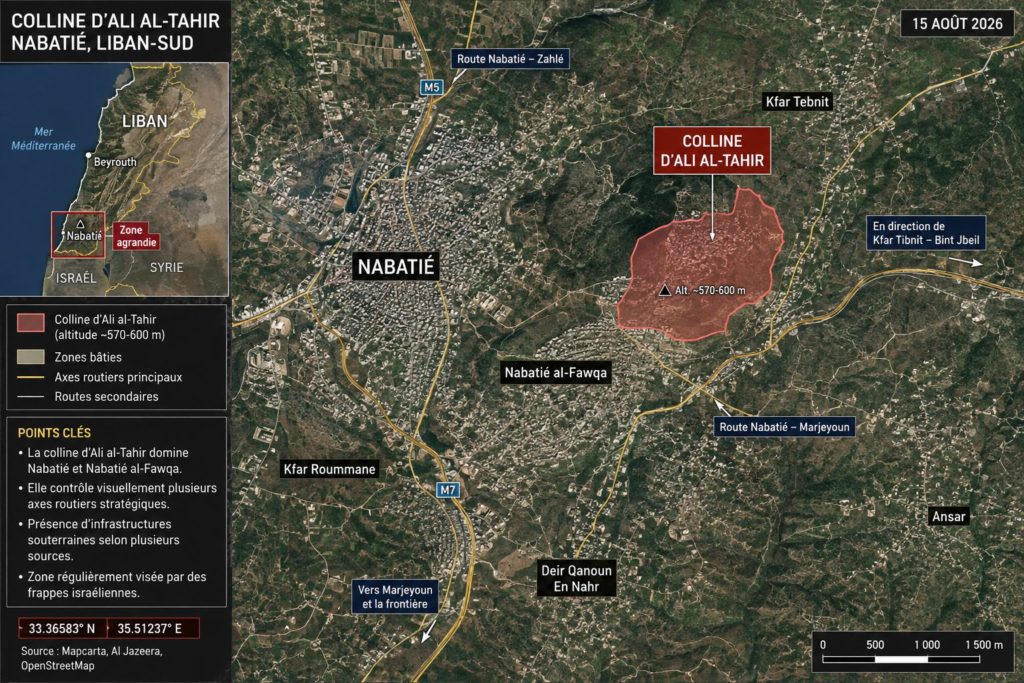
East of Nabatieh, the heights of Ali al-Tahir have become one of the most sensitive points in South Lebanon. Their value lies not only in the underground installations attributed to Hezbollah: rising to around 600 metres, the high ground overlooks Nabatieh, several roads in the eastern sector and a vast area stretching towards Iqlim al-Tuffah, a steep, mountainous zone of South Lebanon. Since the deadly strikes of 15 August, the issue has become as much a Lebanese matter as an Israeli-Lebanese one: Hezbollah has reportedly refused to hand the complex over to the army. But, at this stage, there is nothing to suggest that the Lebanese army has tried to enter it by force and been prevented from doing so. The deadlock lies before any confrontation, at the political and military level.
Ali al-Tahir hill is becoming a test of sovereignty. The Lebanese government has officially ordered that weapons and military activities outside the state’s control be placed under the authority of the legitimate institutions. The army has already begun applying this principle in certain sectors of the South. Yet, a few kilometres east of Nabatieh, an underground Hezbollah complex remains beyond its control. That is where the risk of a new battle is now concentrated.
High ground that commands much of South Lebanon
The Ali al-Tahir heights lie on the eastern outskirts of the Nabatieh area, near Kfar Tebnit and Nabatieh al-Fawqa, north of the Litani River. Their altitude, close to 600 metres, gives them an importance that extends far beyond the town of Nabatieh alone. Geographical and military analyses describe a vantage point overlooking large swathes of southern Lebanon, with lines of sight and axes of control running from Nabatieh towards the Iqlim al-Tuffah, Marjayoun and the transport corridors of the eastern sector.
This importance is heightened by the proximity of Beaufort Castle (Qalaat al-Shaqif), another commanding position taken by the Israeli army in the spring. From Beaufort, which overlooks the Litani valley and part of Upper Galilee, the view stretches as far as Kiryat Shmona and the “Galilee finger”. This geography explains the exceptional strategic importance of the Iqlim al-Tuffah heights. On the ground, Ali al-Tahir and Beaufort form a system of high points allowing observation, intelligence-gathering and control over several axes. Al Jazeera describes Ali al-Tahir as providing fire control over an area stretching from Nabatieh in the west to the Iqlim al-Tuffah heights in the east.
The site’s value is nothing new. The Israeli army and the South Lebanon Army held a position there during the occupation, before the Israeli withdrawal in May 2000. The Lebanese army was also present in the Kfar Tebnit area until it pulled back on 13 June 2026 in the face of advancing Israeli forces. Associated Press noted at the time that one of the likely objectives of this advance was to retake the strategic high ground of Ali al-Tahir.
Escalation on 15 August leaves eleven dead
Tensions crossed a new threshold on 15 August. Three Israeli soldiers were seriously wounded by an explosive drone in the Ali al-Tahir area, according to the Israeli army. The IDF responded with a series of strikes on Ali al-Tahir, Ansar and Deir al-Zahrani. The Lebanese Ministry of Public Health reported eleven dead and nineteen wounded, one of the heaviest tolls since the June truce. Associated Press confirmed that seven people had been killed in Ansar and four in Deir al-Zahrani.
Among the victims in Ansar was Ali Samir al-Hajj Hassan, a native of Shmustar, in the Bekaa, whom Israel described as a sector commander in Hezbollah’s elite Radwan force. Photographs circulated by supporters of the movement indicate that his wife, his three sons and his daughter were also killed, five members of his family in all. A seventh person died in the same strike. The Israeli army said that the family was not the target of the attack.
Prime Minister Nawaf Salam condemned the strikes and restated a fundamental principle: if illegal military infrastructure exists on Lebanese territory, dealing with it is a matter for the Lebanese state. That statement immediately places Ali al-Tahir at the heart of the question of the monopoly on the use of force.
Tunnels, elite fighters and an alleged Iranian presence
The available information converges on one point: Ali al-Tahir is reportedly not merely a Hezbollah position. Several Lebanese sources describe a network of tunnels and command infrastructure built into the high ground. An-Nahar refers in particular to elite fighters entrenched in the facility and asserts that Israel already controls some of the tunnel entrances. The presence of members of the Radwan Force is regularly mentioned. The death of a Radwan commander in Ansar on 15 August underlines the importance of this component in the local set-up, without, however, making it possible to state that the entire Ali al-Tahir complex is under the exclusive command of that unit.
A still more sensitive element concerns the possible presence of Iranian personnel. L’Orient-Le Jour and other Lebanese media have reported, citing security sources or Israeli information, that members of the Islamic Revolutionary Guard Corps are present in or around the complex. This presence has not been officially confirmed and must be treated as unverified. If it were established, however, it would lend an additional regional dimension to the refusal to hand over the site.
Hezbollah reportedly refused to hand Ali al-Tahir over to the army
This is the best-documented political aspect of the affair. According to An-Nahar, a proposal from the Lebanese official side was passed to Hezbollah through the few channels of communication still open between the movement and the presidency: the fighters entrenched in the tunnels could leave the position, while the complex and the heavy weapons would be handed over to the Lebanese army. In exchange, Israel would refrain from a large-scale attack on the position, all under American guarantees.
Hezbollah is reported to have refused. It is said to fear that a concession on Ali al-Tahir would pave the way for a series of similar demands targeting positions further inland, as far as Iqlim al-Tuffah. An-Nahar also reports that Hezbollah has reinforced its defences and sent additional fighters to the area around the high ground. The same logic emerges from reports published by Asharq al-Awsat: the complete evacuation of Ali al-Tahir and its handover to the army are said to have become a precondition for extending the Israeli withdrawal mechanism and the pilot zones.
Did the Lebanese army try to enter?
At this stage, the answer is: not according to the verifiable information available. No statement from the Lebanese army, no news agency dispatch and no solid report consulted as of 16 August documents an attempt by Lebanese forces to force their way into the Ali al-Tahir complex followed by an armed refusal from Hezbollah. Two formulations must therefore be distinguished. It can be written that Hezbollah refuses to hand Ali al-Tahir over to the army. It cannot yet be written that Hezbollah repelled the Lebanese army or physically barred its access after an attempt to enter.
Yet the government has given the army a particularly clear mandate. On 2 March, the Council of Ministers ordered a ban on Hezbollah’s military and security activities outside legitimate institutions and instructed the army to implement firmly its plan for a monopoly on weapons north of the Litani. The official text even calls for the use of the means necessary for this implementation.
The difficulty at Ali al-Tahir is therefore less legal than military and political. Going in without prior agreement could mean pitting Lebanese soldiers against Hezbollah fighters entrenched in a fortified network. The government says it wants to restore the monopoly on weapons without provoking a civil war; the army must therefore enforce a national decision while avoiding becoming itself the trigger for a confrontation with Hezbollah.
Elsewhere, the army has already begun to retake ground
The absence of an assault on Ali al-Tahir does not mean that the Lebanese army is remaining passive in the South. On 21 July, it entered Zawtar al-Gharbiyeh after an Israeli withdrawal organised under the “pilot zones” programme. Operational and engineering units secured the area and carried out reconnaissance.
The episode also exposed the fragility of the mechanism: Israeli forces still present nearby fired warning shots when Lebanese soldiers approached a neighbouring sector. Reuters describes Zawtar as the first concrete test of an arrangement under which Israel gradually withdraws while the Lebanese army takes control, and under which Hezbollah’s disarmament is to be verified.
Reuters singles out Ali al-Tahir as the next major test. According to Lebanese security sources cited by the agency, Hezbollah operates a command centre and weapons depots there. Retired Lebanese general Hassan Jouni sums up the choice: the problem will be resolved either by Israel seizing the high ground or by the Lebanese army moving in to empty Hezbollah’s depots. This framing shows just how close the issue has now come to the point of decision.
Ali al-Tahir: a test of the monopoly on weapons
Ali al-Tahir thus brings together several questions that have run through Lebanon for years: who decides on war and peace? Who holds the heavy weapons? Who controls the underground facilities? And above all, what can the state do when a heavily armed organisation refuses to hand a strategic position over to its army? The problem is compounded by geography. Losing Ali al-Tahir does not simply mean losing tunnels. The high ground overlooks a wide area of southern Lebanon and completes the defensive system formed by the Beaufort heights. For Israel, capturing it would further enhance its ability to observe and control the routes north of the Litani. For Hezbollah, abandoning it would set a major military and political precedent. For the Lebanese state, leaving it outside its control for any length of time exposes the practical limits of its sovereignty.
Three possible scenarios now
Three outcomes are taking shape. The first would be a negotiated handover of the complex to the Lebanese army, allowing Hezbollah fighters to withdraw and averting a battle around Nabatieh. This is the option favoured by Beirut and the mediators, but it would require Hezbollah to change its position.
The second would be direct intervention by the Lebanese army. There is no indication that such an operation has been decided upon. It would be of historic significance, but would carry the immediate risk of a clash between the army and Hezbollah – precisely the scenario the government has so far sought to avoid.
The third is no longer merely a working hypothesis. On 13 August, MTV Lebanon, citing a diplomatic source, reported that the Lebanese authorities had been informed that Israel’s political leadership had authorised the army to “blow up Ali al-Tahir “. The channel later stated, citing a Western source familiar with the Lebanese-Israeli talks, that the green light had indeed been given. On 15 August, MTV added that the Israeli army had told the political leadership it was in a position to enter the facility and that the operation could last up to two weeks. The channel also reported that Israel was refusing to move towards a renewal of the ceasefire until a series of demolitions had been carried out at Ali al-Tahir and at other sites. These reports do not amount to official Israeli confirmation, but they change the nature of the scenario: the destruction of the complex now appears to be a politically authorised option, rather than merely a military hypothesis.
On 16 August, air strikes and artillery fire resumed on Ali al-Tahir and the surrounding high ground. In this context, the question is no longer simply whether Israel will seek to contain the complex, but whether it will go ahead with the decision reported by MTV: to enter the underground network and then destroy it. A negotiated handover to the Lebanese army could still avert this sequence of events. Failing that, Ali al-Tahir risks becoming the place where both Israel’s determination to neutralise Hezbollah’s infrastructure and the Lebanese state’s real capacity to regain control of its territory are put to the test.
RELATED ARTICLES
• Israeli army takes Beaufort Castle and dominates region in southern Lebanon
• Hezbollah raises the spectre of civil war: who would really help the Lebanese army disarm it?
• Hezbollah refuses to disarm and threatens the Lebanese government
• What the ceasefire agreement between Israel and Lebanon provides for
Translated from French. The French original prevails.