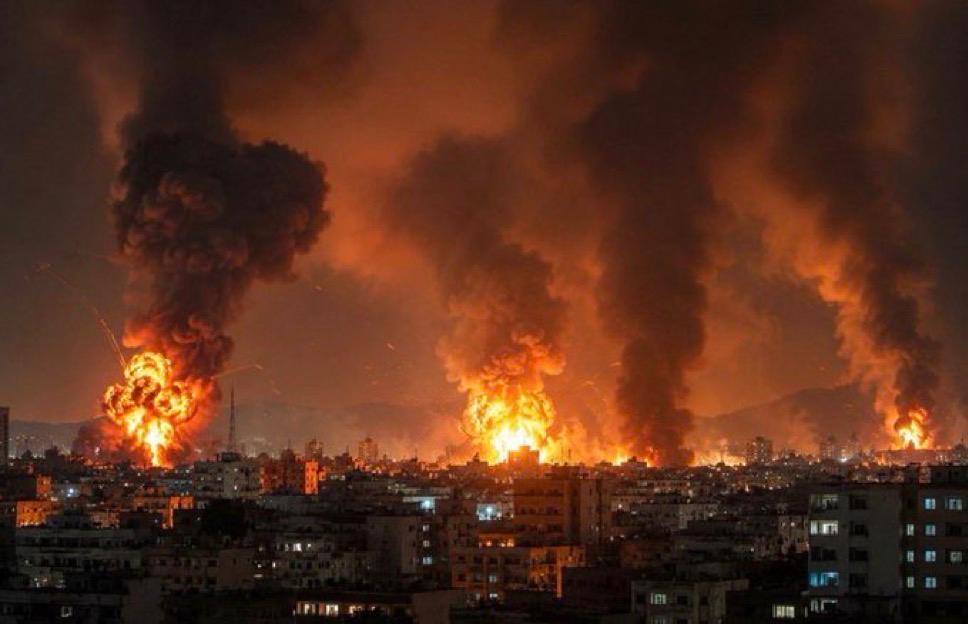
The United States has carried out a fresh wave of air strikes on several Iranian military installations, US Central Command (CENTCOM) announced, marking a new stage in the escalating tensions between Washington and Tehran. According to the US military, the operation was conducted on 11 June from 00:45 (Tehran time) on the orders of the US president and was presented as an act of “self-defence”.
According to the CENTCOM statement, the strikes targeted military surveillance capabilities, communication systems and air defence sites across Iranian territory.
The United States also claims to have destroyed one or more IRGC command and control centres during the strikes. The exact extent of the damage and the impact on the Iranian chain of command have yet to be independently confirmed.
US Air Force, US Navy and Marine Corps assets were reportedly deployed to destroy targets that Washington regards as a threat to US forces and to international commercial shipping in the region. Among other things, 49 Tomahawk missiles and more than 30 warplanes, including B-52s, were used.
The US military says the operation is a direct response to what it calls “continued and unjustified Iranian aggression”. Military officials added that US forces remained on high alert, ready to respond to any further threat.
On the ground, several Iranian and international media outlets reported explosions heard in various parts of the country overnight. In Tehran, residents reported intense military activity and loud detonations, fuelling fears of a fresh escalation of the conflict. Images circulating on social media show columns of smoke and air defence systems in action, although some of the footage has not yet been independently verified.
This new wave of strikes comes against an already extremely tense backdrop between the two countries. Observers now fear the conflict could spread across the entire Gulf region, with potential consequences for maritime security and global energy markets.
What could Iran’s next moves be?
In the wake of these US strikes, all eyes are now on Tehran and its possible response.
Military analysts are considering several scenarios. Iran could opt for a limited direct response against US installations or interests in the region, in order to demonstrate its capacity to retaliate while avoiding an all-out confrontation with Washington.
Another option would be to step up pressure on shipping in the Strait of Hormuz, a strategic passage for the global hydrocarbons trade. According to several media reports published today, naval clashes are said to have taken place between Iranian and US forces in the Persian Gulf and the Gulf of Oman, near the Strait of Hormuz.
Initial reports indicate that Iranian missiles and drones have been fired at US vessels operating in the area, as well as at two ships attempting to pass through the Strait of Hormuz. The world’s most important oil passage has thus become an open battlefield.
The Iranian authorities could also favour indirect action through their regional allies or resort to cyberattacks against infrastructure they consider hostile. Finally, some observers do not rule out a combination of military and diplomatic measures, with Tehran seeking to demonstrate its resolve while retaining room for political manoeuvre.
So far, the IRGC (Islamic Revolutionary Guard Corps) has launched 7 ballistic missiles targeting Muwaffaq Salti Air Base in Jordan, but the attack was foiled by US Patriot air defence systems.
Bahrain was also targeted on 11 June. Iranian missiles and drones struck US facilities in Bahrain, including Isa Air Base and, according to Iranian state media, the headquarters of the US Fifth Fleet. A child was reportedly slightly injured and several buildings damaged in the Manama area, according to the kingdom’s authorities. Iranian missile fire towards Kuwait has also been reported. This is a first phase, the Islamic Revolutionary Guard Corps announced.
With tensions reaching a level rarely seen in recent years, the international community now fears a spiral of reprisals that could set the entire Middle East ablaze. The coming hours could prove decisive in the course of this crisis, whose repercussions are global.
Translated from French. The French original prevails.