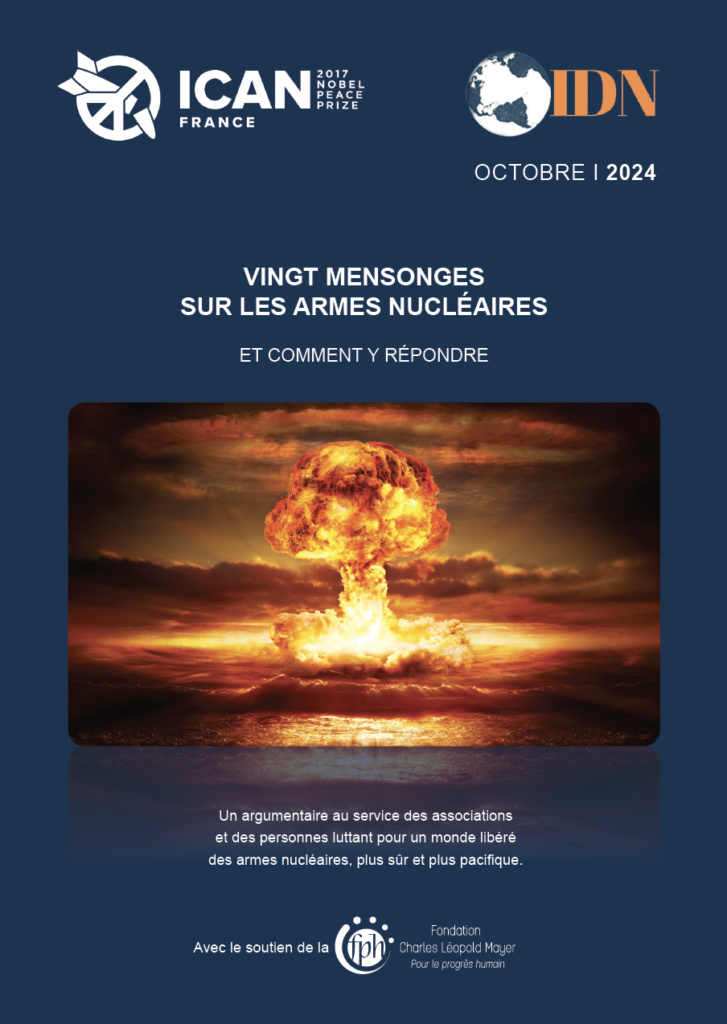
Although nuclear weapons are regarded as symbols of power and deterrence, they rest on a set of carefully cultivated myths. The document “Vingt mensonges sur les armes nucléaires” (“Twenty lies about nuclear weapons”), produced by disarmament experts from the association Initiatives pour le Désarmement Nucléaire (IDN) and ICAN France, the national branch of the International Campaign to Abolish Nuclear Weapons, offers a rigorous analysis that sets out to dismantle these received ideas and to promote an informed debate on nuclear disarmament.
One of the arguments most frequently put forward is that the atomic bombs dropped on Hiroshima and Nagasaki in 1945 brought the Second World War to an end. However, numerous historical studies show that it was chiefly the Soviet Union’s entry into the war against Japan, rather than the bombs, that hastened the surrender. The official accounts were shaped to legitimise the act and to conceal the geopolitical motives of the United States, notably the intimidation of the Soviet Union at the start of the Cold War.
Another persistent lie is that nuclear weapons guarantee peace and national independence. In reality, several historical examples show the opposite: nuclear powers have been involved in direct or indirect conflicts, such as India and Pakistan, or Russia and Ukraine. Moreover, most non-nuclear countries have not fallen victim to military aggression, which calls into question the role of nuclear weapons as a means of protection.
France’s nuclear deterrence doctrine is presented as strictly defensive. Yet the concept of a “final warning” incorporates the possibility of offensive use should deterrence fail. This raises questions about the risk of uncontrollable escalation, particularly with rival nuclear powers.
Beyond the direct victims of the atomic bombings, nuclear tests have left a massive legacy of harm. The tests conducted by France in Algeria and Polynesia, for example, contaminated entire regions, causing cancer, infertility and other serious illnesses among local populations and the military personnel involved. In the United States, thousands of workers employed in nuclear weapons production have suffered from radiation-related diseases.
Maintaining and modernising nuclear arsenals costs tens of billions of dollars every year. In 2022, the nine nuclear powers spent around $82.9 billion on their nuclear programmes, an astronomical sum that could be redirected towards global priorities such as health, education or tackling climate change.
Nuclear accidents, such as the explosion of a nuclear-powered missile in Russia in 2019, are a reminder of the persistent environmental dangers posed by nuclear weapons. Such incidents have long-term consequences for biodiversity and human populations.
Nuclear weapons violate the fundamental principles of international humanitarian law, notably those of distinction, proportionality and precaution. The Treaty on the Prohibition of Nuclear Weapons (TPNW), which entered into force in 2021, declares them illegal, even though powers such as France refuse to sign it. Deterrence doctrines rest on the threat of mass destruction, which runs counter to universal ethical principles. As Albert Camus said after Hiroshima: “Sooner or later, we will have to choose between collective suicide and the intelligent use of scientific conquests.” Contrary to the notion that disarmament is unachievable, precedents such as the elimination of chemical weapons show that it is possible to do away with an entire category of weapons. The TPNW provides a legal framework for achieving gradual disarmament, with growing support from civil society.
Global interdependence and multilateralism offer credible alternatives to nuclear deterrence. International cooperation and diplomatic initiatives must be strengthened to reduce tensions and prevent conflict. True security lies in a world rid of these weapons. The challenge remains immense, but the disarmament movement, backed by organisations such as ICAN and IDN, offers a path towards a safer and more peaceful future.
To explore these issues further and take action, visit ICAN France and IDN.
Translated from French. The French original prevails.