As France approaches its presidential election on 18 April and 2 May, for the first time in the history of the Fifth Republic a wave of social unrest has erupted in the middle of an election campaign. An explosive cocktail combining a Gen Z secondary-school and university student movement, a resurgence of the 2018 Gilets jaunes (yellow vests) movement, trade union demonstrations over purchasing power and the 2023 riots in deprived neighbourhoods, joined by rioters and revolutionary activists, is set to affect the course of the campaign.
Initially, the shock at the organised vandalism and looting of more than 3,000 shops in city centres, together with the scale of the popular mobilisation on 17 October, benefited the two parties, the RN and LFI, whose candidates saw their voting intentions rise by a few points, establishing themselves a little more firmly in the polls as the two likely contenders for a run-off.
The current government’s loss of control over policing and public safety has caused the candidates of the centrist bloc to slip in the polls, Edouard Philippe less so than Gabriel Attal, who bears the stamp of the rejection of Macronism. It has led voters to conclude that the party of order, usually the party in power, no longer is, and that the Rassemblement National now embodies it better in their eyes. Yet, in their desire for change, or even to upend the whole system, the French are expressing anger but do not want “la chienlit” (chaos), to borrow General de Gaulle’s phrase.
Their appetite for change, which has put the two extreme parties of the republican spectrum at the top of the polls, could be tempered by fears that, should Marine Le Pen be elected (if she were ultimately cleared to stand) or Jean-Luc Mélanchon, disorder might turn into civil war, with clashes between far-right activists and far-left activists that then draw in other supporters of either camp, or even racist attacks such as the one in Trappes, or violent reactions from communities marginalised, or even segregated, by a new anti-immigrant government.
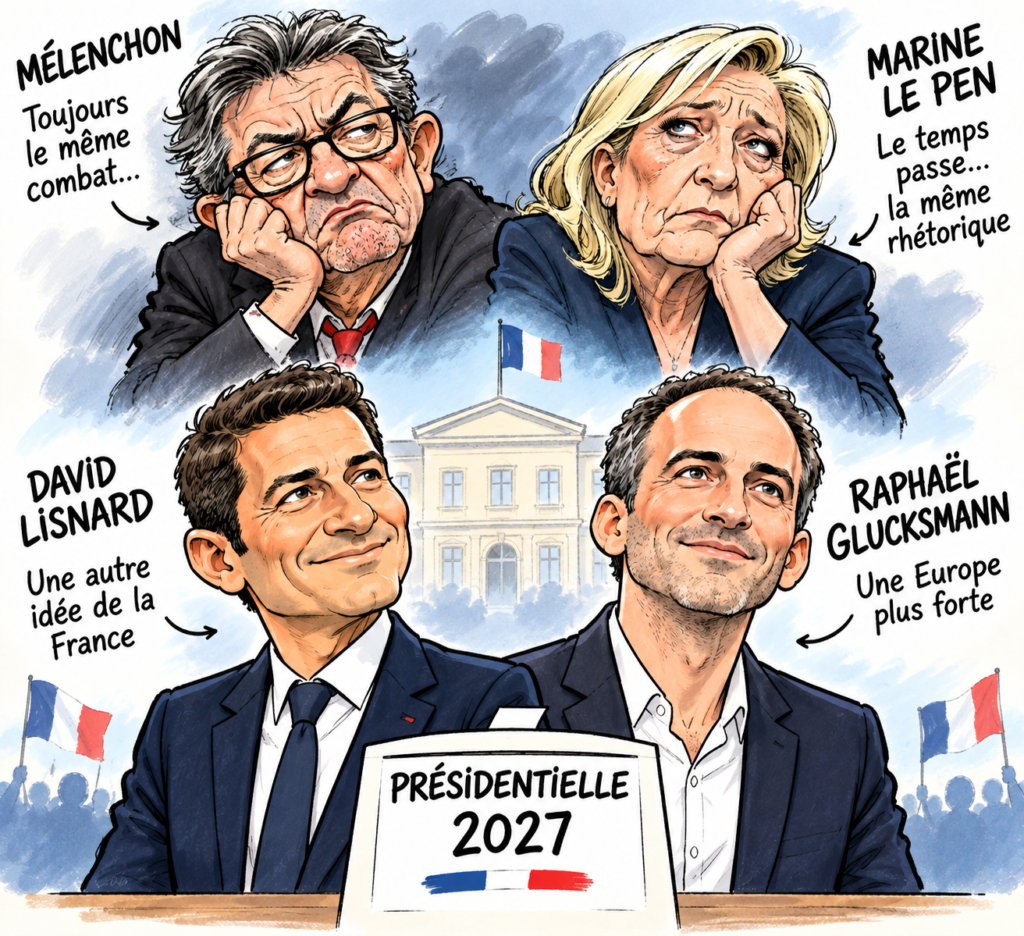
Jean-Luc Mélenchon for LFI and Marine Le Pen for the RN have in common that they are each running their fourth presidential campaign and already have long careers at the forefront of politics behind them. The French people’s desire for change could also take a new form, by entrusting their destiny to a new political figure without such a career, from a new generation. That, indeed, is what voters expressed when they first elected Emmanuel Macron in 2017, a man almost unknown to the public before the campaign. It was not so long ago.
The Glucksmann momentum
Among the new faces of the moment, two men who could hardly be more different, Raphaël Glucksmann and David Lisnard, have stood out in recent days. The first is co-president of a small political movement, Place publique, and has just emerged as the big winner of the social democratic primary, securing in the process the financial backing of the Socialist Party with a score of 66%, well beyond even the most optimistic forecasts. He now stands at between 12% and 16% of voting intentions in the latest presidential election polls.
His clear stance of refusing any alliance with LFI could also win him support from a centre-left, Macronist electorate should the candidate of the right and centre prove too firmly anchored on the right. Committed to social justice, a reformist and deeply European, rejecting the brutality and hypocrisy of the extremes as well as petty political deal-making, he is harassed by LFI during his public appearances. He fits into a tradition of alternation between the Gaullist and centrist right and the governing left, the main two-party configuration of French political life before the emergence of three-way politics following the rise of the Front National and the “neither left nor right” interlude of Macronism, which ultimately leaned to the right and weakened the two parties of government, the PS and the UMP, which later became LR.
David Lisnard’s breakthrough
Facing him, the surprise of this campaign is the emergence of a liberal candidate, in a country that has never really been liberal. Alain Madelin, who long championed this ideology, achieved his best result in 2002, winning 3.9% of the vote. But times have changed, and liberalism’s radical purge (freeing up entrepreneurship, simplifying public rules, social austerity, reorganising public authorities, slimming down the State and cutting the number of civil servants) could appeal to an electorate that realises the State has been living beyond its means for a long time, that the social model of the welfare state runs on credit and that the State’s over-indebtedness (which has become a major concern for the French) must be tackled if the country is not to slip further down the rankings and the next generation is not to be sacrificed.
As Mayor of Cannes, David Lisnard has another asset: he will find it easy to obtain the 500 signatures required to stand, since he chairs the Association of Mayors of France, even if his statements are causing ripples within the association of elected officials. For other candidacies, such as the entirely respectable one of the Gaullist Dominique de Villepin, polling at 2%, or that of the journalist Natacha Polony, a centre-left sovereigntist (1%), it will be more difficult.
David Lisnard is adept at playing social media (his mantra: “Something is happening”), drops knowing nods at every turn and is given to a plain-spoken bluntness that can be abrasive. Feeding pages of regulations into a shredder, he alludes to the chainsaw of Argentina’s Milei. By brushing off a young LFI supporter who questioned him about the deaths of Algerian FLN activists at Charonne metro station in Paris in 1962 with “I don’t care, I wasn’t born”, he shakes up the polished conventions of politics.
While he is unlikely to make it through to the second round, he is now being tested by pollsters and has been scoring better than Bruno Retailleau in recent surveys, at around 6%. That could change the equation on the right. He recently called on Éric Ciotti to rally behind him and distance himself from the Rassemblement National. Whether he will be heard is far from certain.
The RN and LFI therefore remain ahead in the polls, but the spread of violence could weary part of their electorate over the five months remaining before the vote, leaving the race more open than polls taken six months before an election suggest. Many will recall the opinion surveys that had Balladur elected, with Chirac on 10%, only for the latter to win the 1995 election against the Socialist Lionel Jospin.
Translated from French. The French original prevails.