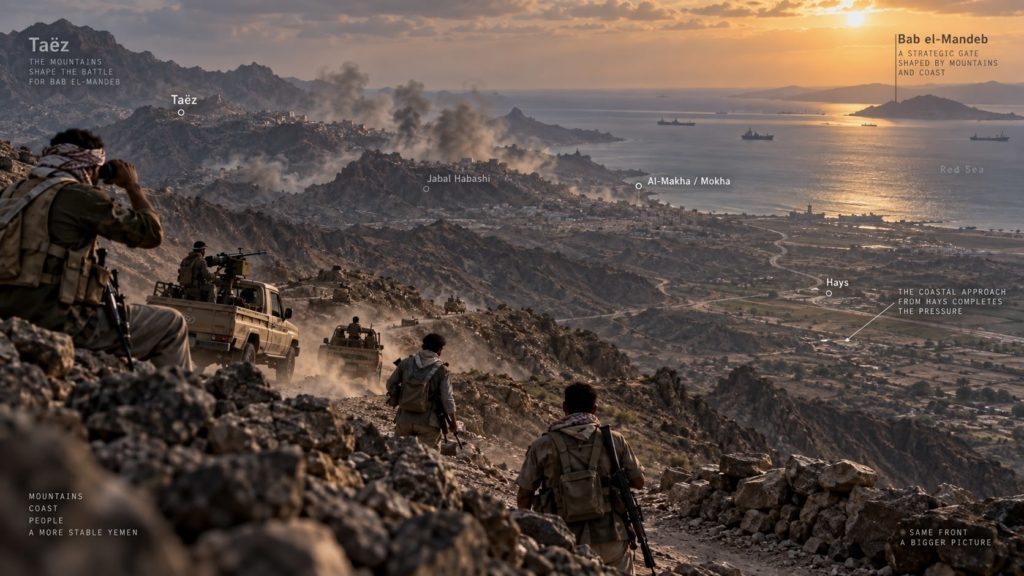
Illustration produced with AI.
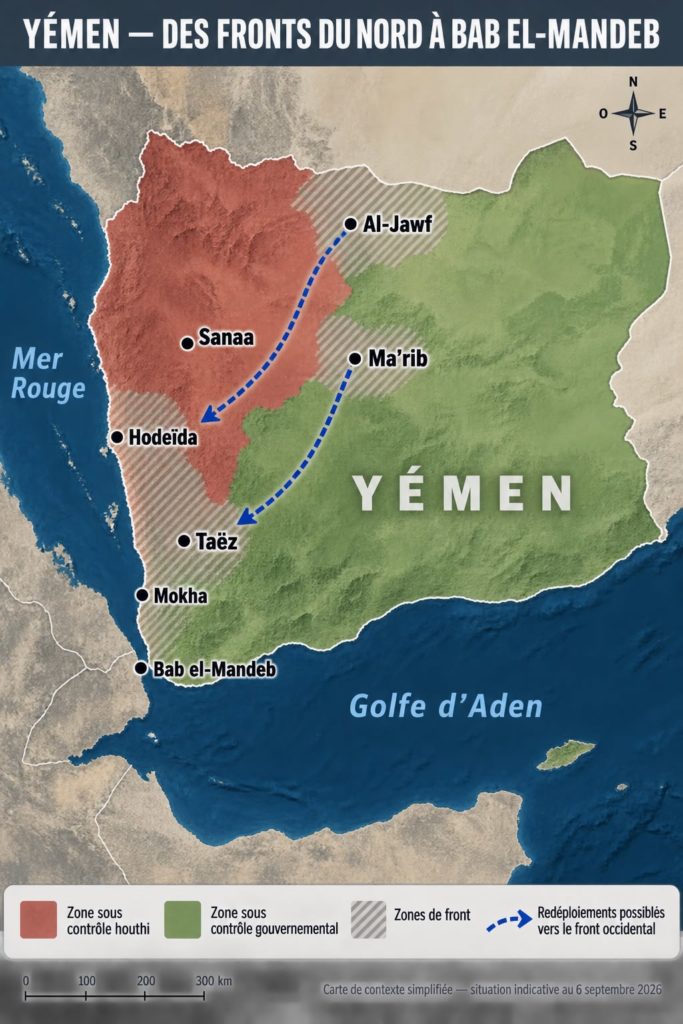
Within a matter of weeks, the de facto truce that had frozen much of the Yemeni front since 2022 has become a distant memory. Since 3 September, the escalation has crossed a further threshold: the Houthis have launched simultaneous attacks in western Taiz and southern Hodeidah, pushed into the strategic Al-Kadhah sector and at times cut the Taiz–Mocha road. Facing them, government forces, Tareq Saleh’s National Resistance, the Giants Brigades and the Shield of the Homeland are counter-attacking around Al-Kadhah and from Hays towards southern Al-Jarrahi. At the same time, the National Resistance says it has destroyed further explosive-laden boats targeting Mocha and Al-Khawkhah, though there has been no independent confirmation. The real issue now goes beyond the mere resumption of the civil war: it is whether the Houthis can turn their capacity to cause harm from a distance into combined coercion — on land, with ballistic missiles and at sea — capable of lastingly disrupting the security arrangements protecting Bab el-Mandeb, at a time when Iran is already exerting comparable pressure on Hormuz.
For several years, Saudi Arabia sought a gradual exit from the war in Yemen. The intervention launched in 2015 had neither removed the Houthis from power in Sanaa nor restored the authority of the internationally recognised government across the whole country. After the 2022 truce, Riyadh favoured a combination of negotiation, deterrence and support for allied Yemeni forces, with the priority of securing its southern border rather than resuming a large-scale military campaign.
That approach is now being called into question. On 27 August, the New York Times reported that Saudi Arabia appeared to be preparing for a fresh confrontation with the Houthis, after weeks of attacks on ships, airports and oil facilities. The newspaper does not say that a decision to go to war has already been taken; it does, however, stress that the kingdom and the Shia Houthi movement are once again edging towards the threshold of open conflict.
The distinction is crucial. Riyadh has no interest in simply repeating the 2015 war. But the context in 2026 is different: the Houthis no longer threaten only the Saudi border. They are seeking to bear down on the kingdom’s entire energy and maritime system, at a time when Hormuz remains unstable and the port of Yanbu has become an indispensable bypass route for crude produced in the east of the kingdom, carried to the Red Sea via the East-West pipeline.
Mocha, Taiz and the west coast: the ground war edges closer to the strait
The tipping point may lie less in Sanaa, the Yemeni capital held by the Houthis, than on the shores of the Red Sea. Since the beginning of August, the port of Mokha, held by anti-Houthi forces, has become a recurring target. On 15 August, its director announced the suspension of commercial activity after more than twenty-five missile strikes in the space of a few days, which left seven people dead and caused around $16 million in damage. The strikes then continued against Mokha and Al-Khawkhah, a coastal town in Hodeidah province to the north of Mokha, while ground clashes multiplied around Taiz and along the coast.
This pressure is being brought to bear on a sector that is far from neutral. Deployed around Mokha are the forces of Tarek Saleh – the Republican Guards and the National Resistance – which were formed and long backed by the United Arab Emirates. The Giants Brigades are not concentrated around Mokha to the same extent as Tarek Saleh’s forces: they nonetheless retain a presence on the Red Sea coast, notably in southern Hodeidah, while some of their units are deployed in the south of the country. Even after the Emirati military withdrawal, this architecture remains in place. Were the Houthis to attempt a sustained advance towards Mokha, and then Bab el-Mandeb, they would therefore come up, in part, against the military apparatus that the UAE had helped to build along this coast.
On 3 September, the front line crossed a threshold. The Houthis launched simultaneous attacks along several axes west of Taiz and south of Hodeidah. On 5 September, Al Jazeera, citing local and military sources, reported the capture of Qahban and Jabal al-Sheikh Said, two heights that command the routes linking Jabal Habashi, Maqbanah and the roads running down towards the coast. On 6 September, the same outlet reported that most of Al-Kadhah was under Houthi control and that the main paved road between Taiz and Mokha had been cut for several hours. The city of Taiz itself remains in the hands of government forces: it is its western approach and the link with Mokha that are now directly contested.
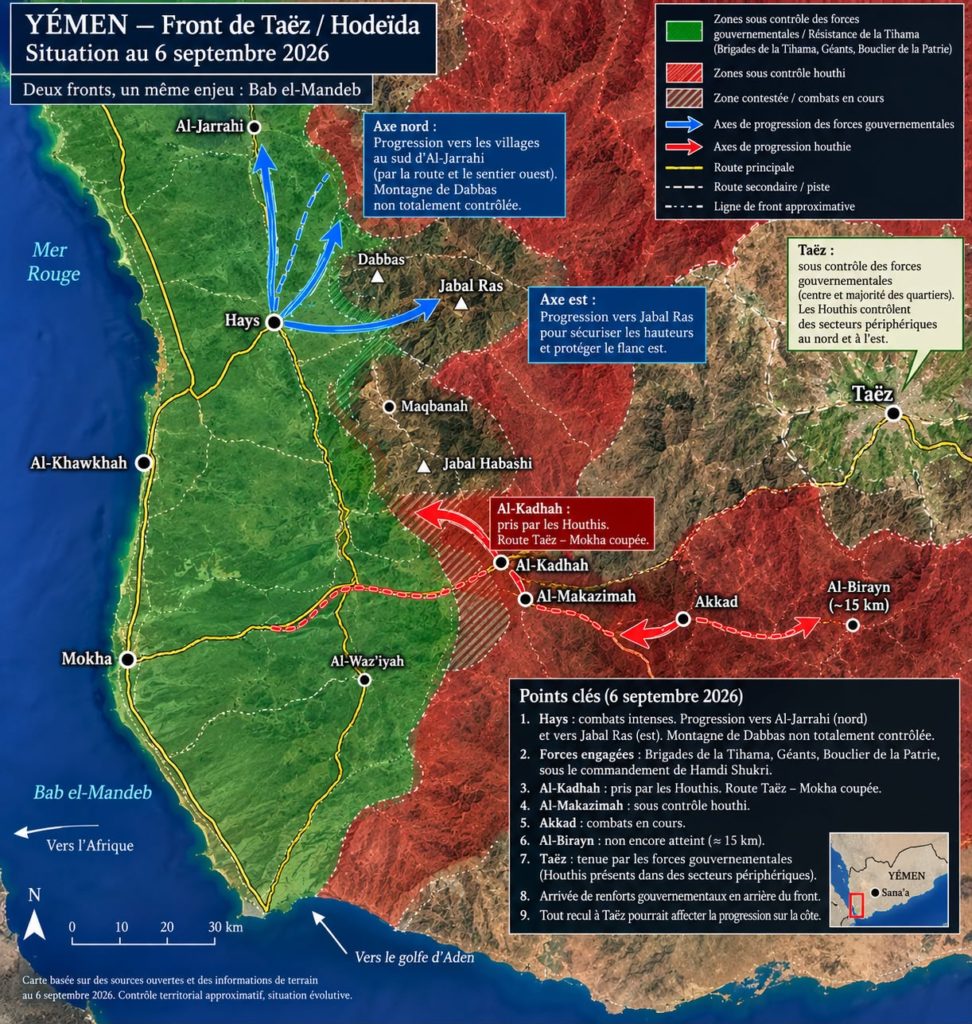
The situation remains fluid. On the afternoon of 6 September, government forces retook the Al-Sharaja position, but Al Jazeera was still reporting that the Houthis held Al-Makazimah and a newly established position at the junction serving Mokha, Maqbanah and Al-Birayn, while fighting was concentrated around Akkad. Al-Birayn, located some fifteen kilometres from the line of confrontation, had not been reported as captured. Neither side has published a consolidated map that would allow these reports from the ground to be turned into a definitive front line.
The government’s response, however, shows the strategic importance attached to this breakthrough. From 4 September, reinforcements from the Giants Brigades and the Nation’s Shield — Dira al-Watan, often translated as “Homeland Shield” — arrived on the Taiz and west coast fronts. The commander of the 4th Military Region, Hamdi Shukri, who is also linked to the Giants structure, travelled to Mokha to coordinate operations. On 6 September, Anadolu confirmed the official launch of an operation to retake Al-Kadhah and the Taiz–Mokha road. In other words, without having reached Mokha, the Houthis have already achieved an initial operational effect: forcing the coastal forces to divert reserves inland.
On the coast, the movement is in the opposite direction. After temporary Houthi gains around Hays, government forces announced that they had retaken the lost positions and then advanced northwards. On 6 September, Yemen Monitor, citing the military media outlet of the National Resistance, reported the recapture of Al-Fash and Wadi Nakhla to the east of Hays and of most positions in Dabas and Suqm to the north-east, as well as a ground offensive south of Al-Jarrahi backed by the Giants Brigades and drones. The Houthis had not commented on these losses. Field sources close to the government side also report a push towards Jabal Ras, east of Hays; this last axis is less firmly corroborated. Two opposing movements are therefore taking shape: the Houthis are seeking to strangle Mokha from the mountains of Taiz, while their adversaries are moving up from Hays towards the southern approaches to Hodeidah, while also pushing east towards the heights of Jabal Ras.
Bab el-Mandeb: maritime war intensifies
The battle can be read first and foremost in the shipping statistics. Following the Houthis’ announcement on 20 July of a blockade against vessels linked to Saudi Arabia, visible traffic through Bab el-Mandeb fell to around 32 transits a day, compared with about 50 previously. Reuters also noted that a growing share of loadings at Yanbu were now taking place with AIS (transponders) switched off or interrupted, to the point that estimates of Saudi flows diverge sharply between tracking firms. One signal in the opposite direction, however, serves as a reminder that the strait is neither closed nor paralysed: Reuters/Kpler counted 27 visible transits through Bab el-Mandeb on 31 August, a three-day high. Five involved Aframax or Suezmax tankers, but there were no VLCCs (very large crude carriers) or LNG carriers. These AIS data do not include vessels sailing with their transponders switched off, which makes it necessary to distinguish between visible traffic and actual flows.
Routes have been distorted too. A growing share of Saudi crude is travelling north up the Red Sea towards Suez or using the SUMED pipeline between Ain Sokhna and Sidi Kerir. By mid-August, loadings at Sidi Kerir had reached a record 2.17 million barrels per day, around 90% of it Saudi crude. Cargoes bound for Asia may therefore head north to the Mediterranean, be transshipped or transferred via SUMED, then set off again through Gibraltar and around Africa. For North-East Asia, this detour can add almost a month to the voyage.
Above all, the attacks show that the threat zone is widening. On 11 August, the attack on the cargo ship Tihamah in the Bab el-Mandeb killed four crew members and two rescuers. On 24 August, the Saudi tanker Amzan was hit off Yanbu; a fire was brought under control and nobody was injured. On 30 August, a Panamanian-flagged tanker reported being struck by a missile some 40 nautical miles west of Mokha; it continued under its own power, with no casualties reported.
On the same day, Yemeni government forces announced that they had pre-emptively destroyed a remote-controlled Houthi boat which, they said, was preparing to attack merchant vessels in the Red Sea. The operation was made public by the Yemeni government’s 5th Military Region. This sequence of events confirms that the struggle for the Bab el-Mandeb is no longer fought solely through missile interceptions: it now also involves the pre-emptive destruction of naval assets before they can be used.
The maritime front is now edging closer to the islands that command the approaches to the Bab el-Mandeb. On 27 August, the National Resistance announced that it had repelled five Houthi boats attempting to approach government-controlled islands, after shooting down a reconnaissance drone. The same day, ballistic missiles struck fishing boats near the Hanish archipelago, wounding several people according to pro-government forces. On 30 and 31 August, the pressure intensified: the Yemeni army says its naval and coastal defence units intercepted four remote-controlled, explosive-laden Houthi “kamikaze” drone boats which, at various times, attempted to approach the islands of Hanish and Zuqar. The Houthis have not commented on this account. During the night of 31 August to 1 September, Al Jazeera also reported, citing Yemeni media, that two ballistic missiles had been fired towards the area south of Al-Khawkhah. While this does not prove a land or amphibious offensive towards the strait, the repeated incidents now lend operational substance to what might be called a “battle of the islands” around the positions bordering the international shipping lanes.
That pressure has moved closer to the port itself. On 3 and 5 September, the National Resistance’s naval forces said they had destroyed several explosive-laden boats which, they claimed, were trying to reach Mokha and the Al-Fajra area, south of Al-Khawkhah. On 6 September Yemen Monitor carried the announcement that two of these boats had been destroyed. The Houthis have not claimed responsibility for these attempts, and no independent verification makes it possible to establish exactly how they unfolded. Their alleged repetition is nonetheless significant: at a time when the Taiz–Mokha road is being contested on land, the port of Mokha is also being portrayed as a target for remotely operated naval craft.
The Iranian dimension adds a graver uncertainty. On 31 August, Al Hadath reported, citing Yemeni pro-government and intelligence sources, that 75 Iranian military experts had reportedly arrived in waves in Houthi-held areas in June and July. The IRGC is said to have assigned them tasks covering naval operations, missiles, drones, remotely operated boats, mines, command and intelligence around the Red Sea and Bab el-Mandeb. The last wave, made up of 25 men and including, according to these sources, the former Iranian ambassador Mohammad Jalal Firouznia, is said to have landed in Hodeidah on 13 July aboard a Mahan Air aircraft. None of these details has, at this stage, been independently confirmed by any source outside the Yemeni government camp. If corroborated, they would directly link Iranian assistance to the very capabilities used to create a maritime exclusion zone.
This claim does, however, tie in with another sequence of events, better documented but whose interpretation remains disputed. The National Resistance announced that on 24 August it had intercepted a boat carrying advanced drone components from Djibouti to Hodeidah. The National Resistance spokesman, Sadiq Duwaid, claims that the two sailors arrested had already taken part in more than 13 smuggling operations from Bandar Abbas, transporting weapons, missiles and materials used in the manufacture of arms. This last claim rests on statements by the National Resistance and on interrogations of the network; it cannot therefore be treated as an independent finding. But it suggests that Bab el-Mandeb and the Horn of Africa also form a logistical artery feeding Houthi capabilities, and not merely an area where those capabilities are deployed.
The consequences are already spilling beyond the Red Sea. On 31 August, Reuters reported that Asian diesel exports to Africa had reached their highest level in four and a half years, partly because the war with Iran, the Houthi blockade and the attacks on the Jizan refinery had reduced Middle Eastern supply. Houthi pressure is thus beginning to alter energy flows far beyond Yemen.
Al-Jawf: tribal pressure on Sanaa’s lines
A second source of pressure has intensified in eastern Yemen. Since late June, tribes have been gathering in Al-Jawf governorate around the “Matrah al-Karama”, at the instigation of Sheikh Hamad bin Fadgham al-Hazmi. On 28 August, after an ultimatum issued to the Houthis expired, the organisers of the gathering announced that heavy goods vehicles and commercial traffic bound for Houthi-controlled areas would be blocked, while also calling for armed mobilisation. Belqees TV has published the text of the decision.
The mobilisation grew out of a specific tribal dispute, which rules out portraying it as a widespread political uprising. But Sanaa appears to be taking the threat seriously. Sheba Intelligence reported on 29 August that the Houthis were preparing drones in the Al-Saqiyah sector and had deployed specialists to the Al-Labnat command. The exact purpose of these preparations is not known, but their timing alongside the tribal movement suggests that the Houthis are anticipating either increased surveillance or strikes against gatherings and supply routes.
Footage released on 30 August also shows a large convoy of vehicles and equipment presented as Saudi reinforcements bound for Ma’rib and Al-Jawf. The sequence is consistent with a genuine military movement, but its date, geolocation and the exact origin of the equipment have not been sufficiently established to assert that it represents direct support from Riyadh for Sheikh Fadgham. This point therefore remains to be confirmed.
Marib and Taiz: drone warfare changes the logic of the ground war
In Ma’rib as in Taiz, the conflict has taken on a more pronounced technological dimension. Government forces are making greater use of quadcopters and tactical drones to strike Houthi gatherings, vehicles and command centres. The Houthis, for their part, have kamikaze drones, missiles and the Rajoum, a bomb-carrying multirotor first unveiled in 2021 but now being used more visibly in the new phase of the fighting.
On the evening of 31 August, this build-up took on a more concrete form. The armed forces’ media centre released new footage showing the 6th Drone Regiment striking what the army said were a Houthi field commander and a command-and-control centre on the Al-Kassara front, north-west of Ma’rib. Further strikes were claimed in Baqim, in Saada province, and in Al-Tina, in the Midi district (Hajjah). Al Hadath carried the footage on 1 September. The targets and damage remain as claimed by the government side and have not been independently verified; the geographical simultaneity of the operations nonetheless shows that the offensive use of drones is no longer confined to a single front.
This expansion continued on 5 and 6 September in Marib and Al-Jawf. Government sources reported a widening of air, drone and artillery strikes against Houthi positions, without any general ground offensive or confirmed change to the map of territorial control. In the east, then, the escalation remains for now a matter of pressure on capabilities and supply lines rather than a new battle for territory.
The simultaneous involvement in the strikes of the 2nd Division and the 7th Division of the Emergency Forces also shows that, despite reports of a reorganisation of some of their units, this formation remains operationally engaged against the Houthis.
The situation increasingly recalls certain lessons of the war in Ukraine: any sustained concentration of troops, vehicles or artillery immediately becomes a vulnerable target. Technology does not, however, remedy the main political handicap of the anti-Houthi camp: Reuters points to its persistent fragmentation, which remains one of its principal vulnerabilities.
This new reality makes any major offensive more difficult for both sides. A Houthi force intended to advance towards the coast would have to be dispersed, camouflaged and then regrouped at the last moment. A government force seeking to push north towards Sanaa would face exactly the same problem. The war is thus becoming mobile and deadly again without becoming fast again: technology increases destructive capacity while slowing territorial conquest.
The anti-Houthi camp remains its own weakest link
The strengthening of government forces does not mean that the anti-Houthi camp has become homogeneous. The regular forces, the Emergency Forces and the Homeland Shield, two formations backed by Riyadh, Tareq Saleh’s National Resistance, the Giants Brigades, the tribal formations, the structures linked to the Al-Islah party — one component of which is affiliated with the Muslim Brotherhood — and the Southern Transitional Council have neither the same chain of command nor the same political objectives.
This fragmentation goes a long way towards explaining why the Houthis have been the main beneficiaries of the war since 2014. A poorly coordinated offensive would allow them to concentrate their forces against each adversary in turn, exploit local rivalries and portray any government advance as foreign aggression. Conversely, the current simultaneous pressure — in Marib, Taiz, Al-Jawf, on the west coast and in the Red Sea — may begin to weigh on the Houthis if these efforts genuinely converge. On 30 August, the spokesman for the Yemeni forces stated precisely that coordination between fronts had been greatly improved and that government operations were now “unified and coordinated”. Arab News reports this development, which is naturally presented from the government’s point of view.
The fighting in September nevertheless provides a first concrete test of this coordination. The simultaneous arrival of the Giants and the Homeland Shield, the presence of the National Resistance on the Al-Kadhah axis and their parallel engagement around Hays point to an ability to move reinforcements between Taiz and the coast. This does not create a single chain of command, but it temporarily reduces the advantage the Houthis drew from the dispersal of their opponents.
The Hormuz parallel
This is where the parallel with the Strait of Hormuz comes into its own. Around Hormuz, Iran enjoys a structural geographical advantage: a long coastline directly abutting the passage, along with bases, radars, missile batteries, drones and naval forces capable of exerting almost constant pressure on shipping.
The Houthis do not yet have this advantage at Bab el-Mandeb. They can reach the strait with missiles, drones and explosive boats, but a crucial part of the coast remains in the hands of their opponents. Mokha and Al-Khawkhah therefore form a physical barrier between the Houthi territorial heartland and the shore of the strait. La Tribune des Nations had already highlighted this geographical handicap.
Were the Houthis to make lasting gains along this axis, the change would be qualitative. They would no longer merely project power towards Bab el-Mandeb from the outside: they could bring their surveillance, targeting and launch capabilities closer to the Bab el-Mandeb Strait. On their own scale, they would then be seeking to replicate Iran’s mechanism at Hormuz: turning a capacity to cause disruption into a capacity for coercion rooted in territory.
Yet the kamikaze attacks on the Hanish and Zuqar islands show that the Houthis do not need to capture Mokha to begin exerting greater pressure on the strait. Missiles and drones fired from areas under their control, combined with explosive boats around the islands, maritime supply networks and possible relays in the Horn of Africa, can already complicate navigation and force their adversaries to step up protective measures. Such a set-up would remain far less powerful than Iran’s at Hormuz, but it could be enough to raise the risk and cost of passage for the long term.
The battle of Al-Kadhah now adds a third dimension to this parallel. The Houthis do not need to occupy Mokha to achieve an interdiction effect: cutting the Taiz–Mokha road, even temporarily, bringing its approaches under fire and forcing the coast’s defenders to divert their reserves inland is already enough to raise the cost of defending the strait. The real “Houthi Hormuz” may therefore be less a territorial copy of Hormuz than a distributed system of coercion, combining high ground on land, missiles, drones, explosive boats, islands and the disruption of logistics routes.
Should Riyadh strike before forces concentrate?
Militarily, the Saudi dilemma is relatively simple. If intelligence detects a significant build-up of fighters, launchers, drones and logistical stockpiles ahead of an operation on the coast, it is less costly to disrupt it before the offensive is launched than to wait for those forces to seize and fortify new positions. Drone warfare further reinforces this logic of pre-emptive strikes.
Riyadh has already strengthened its territorial defences. On 27 August, a Patriot system operated by Greek military personnel intercepted a swarm of drones in the Yanbu region in coordination with Saudi systems; three missiles were fired. Reuters noted that this was the third combat use of the system since the start of the war with Iran. Protecting Saudi Arabia’s western seaboard has thus become a multinational effort. This Greek contribution is not, however, assured in the long term: Athens is now reviewing whether to keep the system in place and is considering bringing it home, as Greece seeks to preserve its own air defence capabilities; a short extension is also still under consideration.
The question now is whether this defence will remain strictly defensive — intercepting missiles and drones — or whether it will extend to strikes against Houthi capabilities before they can be used. It is precisely on this threshold that the New York Times article of 27 August takes on its full significance: the kingdom appears to be preparing military options without yet having announced a new campaign.
Turkey, Pakistan, Egypt: a new framework
Riyadh is no longer in the position it was in 2015. On 7 August, Saudi Arabia, Turkey and Pakistan signed a mutual defence agreement in Mecca under which an armed attack on any one of the three would be considered an attack on all three. The Mecca Agreement does not create an automatic obligation to go to war in Yemen, but it provides a framework for air defence, intelligence, logistics and coordination.
The framework is also beginning to take institutional shape. On 31 August, the foreign and defence ministers and military chiefs of the three countries met in Istanbul for the first session of the Strategic Political and Defence Committee. Reuters reports that they decided to establish a permanent secretariat of the Mecca Agreement in Saudi Arabia, to be headed for its first three years by a Pakistani secretary-general. This step still does not amount to a decision to intervene in Yemen, but it turns the 7 August agreement into a more concrete coordination mechanism.
Added to this is the multinational maritime defence coalition led by Riyadh to protect the Red Sea, the Bab el-Mandeb and the Gulf of Aden. Turkey, Pakistan and Egypt are major players within it. For Ankara, the stakes are also logistical: security in the Bab el-Mandeb determines the continuity of its sea route to Mogadishu and the TURKSOM base, where Turkey keeps personnel and receives military equipment. The recent episode involving the Lutuf, which was carrying a cargo bound for Mogadishu, illustrated this in very concrete terms. For Cairo, the stakes are immediate: the Bab el-Mandeb is the southern gateway to Suez and the SUMED system. A lasting deterioration in the strait would simultaneously hit canal revenues, the Mediterranean terminals and Europe’s supplies.
The Horn of Africa: the other side of the chokepoint
In June, a four-member Houthi delegation travelled to Jilib, the de facto centre of the territory controlled by Al-Shabaab, where it reportedly promised the jihadist movement’s leaders more sophisticated weapons and advanced training. According to a US military intelligence official quoted by the Wall Street Journal, at least a hundred Al-Shabaab fighters have travelled to Yemen for training, notably in making deadlier explosives and using advanced weapons. One group is also said to have spent three months in Saada learning to assemble drones and to use systems that allow the pilot to receive images directly from the on-board camera, while Houthi instructors reportedly travelled to Somalia to train Al-Shabaab fighters in drone operations. The Houthis are also said to be seeking the Somali movement’s help to install radar capabilities able to track shipping in the Gulf of Aden.
General Dagvin Anderson, the commander of AFRICOM, believes that this cooperation gives the Houthis new geographical depth around one of the world’s main economic corridors, with potential consequences for regional security, shipping and energy markets. Somalia’s national security adviser, Awes Yusuf Ahmed, for his part stresses that the war between Iran and the United States has added a new strategic dimension to a relationship that had until then been essentially transactional.
This is not proof of a permanent Houthi base on the Somali coast, still less of control over the far shore of the Bab el-Mandeb. But if this cooperation is consolidated, it could provide the Houthis with logistical relays, maritime intelligence and additional depth in the Horn of Africa. The comparison with Hormuz must therefore take one difference into account: lacking the territorial continuity that Iran enjoys, the Houthis may seek to partly offset this handicap with a more dispersed set-up — the Yemeni coastline, islands, remotely operated naval craft, smuggling networks and partners on the far shore of the Gulf of Aden.
The Emirates: officially absent, present in the architecture on the ground
The United Arab Emirates announced on 2 January 2026 the withdrawal of its last military personnel from Yemen. Yet its influence remains etched into the military geography of the west coast. Tarek Saleh and the National Resistance, along with the Giants Brigades, are the most visible legacy of that period. Reuters still describes these forces as essential components of the anti-Houthi camp.
Abu Dhabi also has a direct energy interest in preventing the emergence of a “Houthi Hormuz”. The UAE is investing in the Habshan–Fujairah pipeline to reduce its vulnerability to the Strait of Hormuz. On 24 August, TotalEnergies confirmed a project to expand this capacity. Yet, to reach Europe quickly, a cargo leaving Fujairah must still pass through the Bab el-Mandeb and Suez. A second strait subject to Houthi coercion would therefore erode part of the strategic advantage gained at Fujairah.
There is currently nothing to suggest that the UAE is preparing a direct military return to Yemen. But intelligence, surveillance, the supply of equipment, air defence or discreet support for its former partners would constitute forms of re-engagement less visible than a return of troops.
Europe, China, Japan: Bab el-Mandeb is already a global problem
Europe is already involved in protecting shipping. On 29 August, Operation EUNAVFOR ASPIDES announced escort and protection missions for merchant vessels in the Red Sea. The most likely European response to a worsening threat would remain the reinforcement of escorts, surveillance and air defence rather than participation in a ground campaign.
China is following a different logic. Beijing does not automatically side with Tehran or Sanaa and is above all seeking to secure its own shipping. As early as late July, Reuters revealed that China was negotiating directly with the Houthis over safe passage for certain oil tankers. At least four tankers had benefited from the arrangement. At the same time, the Chinese navy is maintaining its escort mission in the Gulf of Aden and has a base in Djibouti. Beijing therefore has both diplomatic and military levers, but its involvement in strikes against the Houthis remains unlikely.
Japan is even more dependent on Middle Eastern oil and gas. On 9 August, the Japanese Ministry of Defense deployed P-1 patrol aircraft to Djibouti for the first time as part of its anti-piracy and maritime intelligence missions. Tokyo thus has a direct means of observing the corridor, but its response is likely to remain based on surveillance, naval cooperation and diversifying its supplies.
And the United States?
Washington has the greatest resources for monitoring Houthi movements and striking the capabilities that threaten shipping: satellites, aircraft, drones, naval assets, precision missiles and air defences. But the United States also has an interest in avoiding turning Yemen into the theatre of a new ground campaign at a time when the confrontation with Iran continues to absorb a significant share of its resources.
The most coherent scenario would therefore be a division of roles: Yemeni forces to hold and possibly retake ground; Saudi Arabia to provide air cover, intelligence and logistical support; a maritime coalition to secure the approaches; Turkish, Pakistani and Egyptian partners to bolster certain capabilities; and the United States to handle high-technology functions and, should the political threshold be crossed, strikes against the most dangerous assets.
Riyadh’s real choice
Saudi Arabia probably has no desire to be drawn back into the war in Yemen. But the threshold that was still only hypothetical at the beginning of September has now been tested: the Houthis have indeed tried to redraw the map on the ground along the routes that control Mokha’s lines of communication. There is nothing, however, to prove that Riyadh has decided on direct military intervention. The reinforcements observed belong to allied Yemeni formations — notably the Homeland Shield and the Giants Brigades — and no fresh Saudi air strikes have been confirmed.
Riyadh’s dilemma is therefore becoming subtler than a simple choice between war and peace. If Yemeni forces manage to retake Al-Kadhah, secure the Taiz–Mokha road on a lasting basis and keep up their pressure from Hays towards Al-Jarrahi, the kingdom can continue to favour indirect support, intelligence, air defence and maritime protection. If, on the other hand, the Houthis consolidate their presence around Al-Kadhah, advance towards Al-Birayn or succeed in tying down Mokha’s military reserves for any length of time, the question of a more visible Saudi engagement will once again become far more pressing.
What is new in recent days, then, is less a decisive territorial victory than a change of scale. The Houthis have shown that they can simultaneously attack in the mountains of Taiz, threaten a vital logistics artery, keep up the pressure on Mokha and Al-Khawkhah and, according to government forces, use explosive boats against the approaches to the port. Their adversaries, in turn, have shown that they can concentrate reinforcements, counter-attack at Al-Kadhah and regain the initiative around Hays. As of the evening of 6 September, the battle remains undecided.
A possible “Houthi Hormuz” would not concern Riyadh and Washington alone. It would directly affect the Emirates and their strategy of bypassing Hormuz, Egypt and Suez, European trade routes, Japan’s energy supplies and Chinese oil flows. These actors have neither the same alliances nor the same methods, but their interests converge on one point: none of them has any interest in allowing Bab el-Mandeb to become a strait lastingly subject to coercion by Ansar Allah, the armed wing of the Houthis. Yet this week’s events demand that the scenario be refined: the danger is not only the capture of Bab el-Mandeb. It also lies in the Houthis’ ability to make its defence more costly by simultaneously disrupting roads, ports, islands and shipping. This scenario has not yet materialised; the battle of Al-Kadhah shows, however, that it is no longer theoretical.
Read in La Tribune des Nations
• After Hormuz, Bab el-Mandeb: the new front in the energy war
• Mecca Agreement: a new defence alliance redraws the Middle East
• Egypt’s port of Damietta: the energy war reaches the Mediterranean
• Saudi Arabia and the Houthis: a war of mutual encirclement
• After Hormuz, Bab el-Mandeb: the land front that could reshuffle the deck
• Yemen: a war on many fronts in which the Houthis remain the main beneficiaries
• Surrounded by hostile forces, Saudi Arabia bolsters its defences
• Somalia: with the Lutuf freed, Turkey extends its footprint to maritime security
Sources
• Reuters — Saudi Red Sea oil exports go dark as Houthi attack threat grows, 12 August 2026
• INGO Advisory / UKMTO — tanker hit 40 nm west of Mocha, 30 August 2026
• Arab News — How prepared is Yemen’s military to confront Houthi escalation?, 30 August 2026
• Reuters — Who is fighting in Yemen?, 2 January 2026
• Arab News — Yemeni forces thwart Houthi Red Sea attacks, seize drone components, 31 August 2026
• Al Hadath — Yemeni army drones strike Houthi positions from Saada to Ma’rib, 1 September 2026
• Al Jazeera — From Qahban to the coast: the Houthi escalation in western Taiz, 5 September 2026
• Al Jazeera — Clashes in Al-Kadhah and the situation on the Taiz–Mokha road, 6 September 2026
• Anadolu — Yemeni army launches operation to retake Al-Kadhah and the Taiz–Mokha road, 6 September 2026
• Yemen Monitor — Giants Brigades and Homeland Shield forces arrive on the Taiz and west coast fronts, 4 September 2026
• Yemen Monitor — Government gains around Hays and south of Al-Jarrahi, 6 September 2026
• Yemen Monitor — National Resistance says it destroyed two explosive-laden boats targeting Al-Khawkhah and the port of Mokha, 6 September 2026
Translated from French. The French original prevails.