In France, operations attributed to Iran, or suspected of being linked to it, no longer rely solely on agents sent from Tehran. The “Marco Polo” case, the plot to attack Bank of America and the precedent of Villepinte point to a model combining intelligence services, transnational intermediaries and locally recruited criminals. Germany confirms the operational dimension of this threat, while Italy and Switzerland reveal other facets of it: intimidation of the diaspora, surveillance and the memory of state assassinations.
For a long time, the Iranian threat in France was treated as an external matter: surveillance of opponents, pressure on the diaspora and operations conducted from the Middle East. The judicial proceedings opened since 2024 show that it has once again become a matter of domestic security. What is new lies not only in the return of assassination plots, but in the method used by Tehran: limiting the exposure of its own agents by entrusting the preparation or execution of violent acts to criminals recruited in Europe.
This development confronts France with a form of low-cost clandestine warfare. The alleged masterminds remain out of reach, the intermediaries move between several countries, communications are compartmentalised and those carrying out the acts are not necessarily ideologically motivated. An arson attack, the reconnaissance of a target or the planting of an explosive device can be entrusted to individuals lured by a few hundred or a few thousand euros. This outsourcing blurs attribution, slows down investigations and allows those who order the attacks to retain deniability.
Eurodif and Hezbollah: a long covert war in France
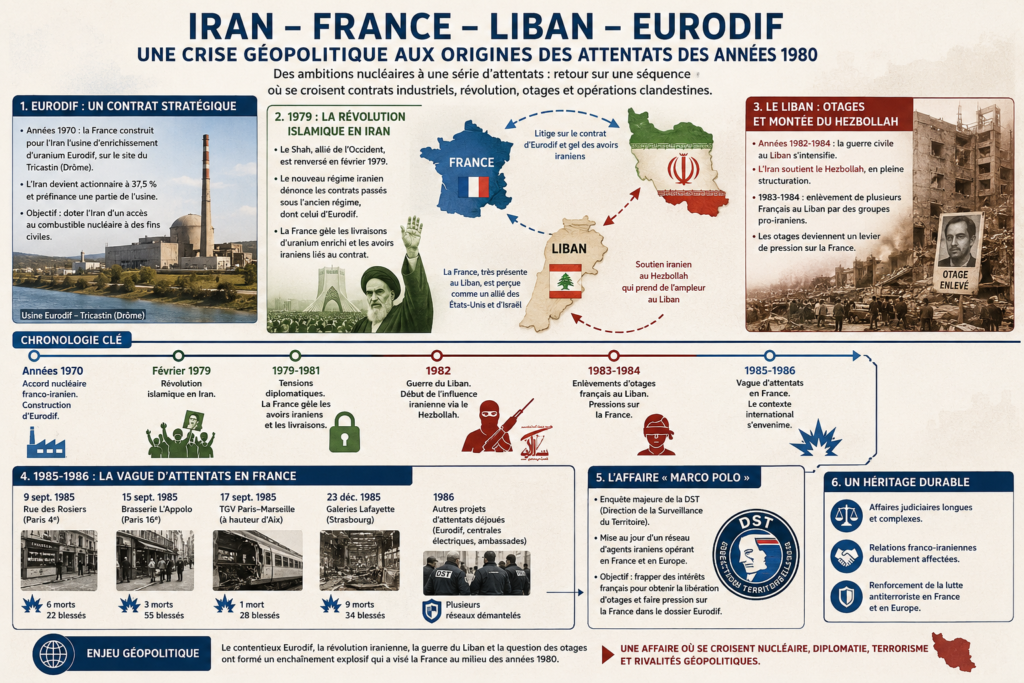
The Iranian threat in France does not begin with the “Marco Polo” affair or the plot to attack Bank of America. It is part of a far older covert confrontation, whose origins go back to the early years of the Islamic Republic and to the Eurodif nuclear dispute.
In 1975, Iran had granted the French Atomic Energy Commission (Commissariat à l’énergie atomique) a $1 billion loan to finance the Tricastin uranium enrichment plant. Through the Franco-Iranian company Sofidif, Tehran was to hold an indirect 10% stake in Eurodif and, in the same proportion, a right to take delivery of enriched uranium. After the 1979 revolution, repayment of the loan, the continuation of Iran’s stake and access to the uranium became a long-running dispute between Paris and Tehran. (Légifrance)
This nuclear and financial conflict overlapped with the Iran-Iraq War, during which France was providing substantial military support to Baghdad. According to the DGSI, Iran then sponsored attacks in France in retaliation for the various disputes between the two countries and for French aid to Iraq. In 1986, a network linked to Hezbollah, the Lebanese Shiite militia backed by Tehran, carried out ten bomb attacks that left fourteen dead and around 300 injured. The deadliest attack struck the rue de Rennes in Paris on 17 September 1986. (DGSI)
On top of this terror campaign came the taking of French hostages in Lebanon. Tehran could use its influence over Lebanese Shia organisations to put pressure on Paris, while the French government sought simultaneously to secure the release of its nationals and to settle the Eurodif dispute. Marcel Carton, Marcel Fontaine and Jean-Paul Kauffmann were not freed until 4 May 1988, after almost three years in captivity. (elysee.fr)
The affair also became caught up in the political rivalries of the first cohabitation. François Mitterrand was determined to preserve the Élysée’s prerogatives over foreign and defence policy, while Jacques Chirac, Charles Pasqua and their emissaries handled the approaches that fell to the government and the Interior Ministry. This rivalry between the Élysée and Matignon teams was all the more sensitive because the release of the last hostages came between the two rounds of the 1988 presidential election. The day after their return, François Mitterrand stated that cohabitation had worked properly on the matter, while pointing out that he had been informed of the outcome of the negotiations only a few minutes before the public announcement. (Institut François Mitterrand)
The methods have since changed. In the 1980s, Iran could rely on ideologically committed militants, structured networks and organisations linked to Hezbollah. Today, its intelligence services rely more on drug traffickers, criminal intermediaries, online recruitment and poorly paid operatives. But the underlying logic remains much the same: to strike in France while keeping several layers of distance between the Iranian sponsor and the person who actually carries out the operation.
“Marco Polo”: the return of targeted assassinations
The so-called “Marco Polo” case is the most revealing of the French investigations. A summary by the General Directorate for Internal Security (DGSI), dated early May 2024 and revealed by Mediapart, concluded that the Iranian intelligence services had, from 2015 onwards, revived a policy of targeted assassinations in Europe. According to this analysis, the aim was to strike at opponents of the regime, Jewish or Israeli individuals and business interests associated with Israel, while fostering a climate of insecurity within the targeted communities.
Three people were placed under formal investigation in 2024 for criminal terrorist conspiracy. The alleged cell is thought to have been coordinated by a drug trafficker from the Lyon area who may be in Iran. It is suspected of having prepared assassinations in France and Germany, notably targeting people living in Paris, Munich and Berlin, and of having taken part in four arson attacks on businesses owned by Israeli nationals in the south of France. Those under investigation deny the charges.
Above all, the case shows how porous the boundary is between organised crime and state operations. The Iranian services may no longer necessarily seek to send to Europe a team entirely controlled by their own officers. They can rely on a coordinator with connections in drug-trafficking networks, who then recruits operatives tasked with watching a target, setting fire to a shop or preparing an attack. Political violence is thus concealed behind the ordinary methods of organised crime.
Bank of America: the low-cost attack and the HAYI lead
On 28 March 2026, police foiled an attempted attack on Bank of America’s offices in Paris. Four people, three of them minors, have been placed under formal investigation. The teenagers were reportedly recruited for between 500 and 1,000 euros to plant, ignite and film a device combining a five-litre petrol can with a pyrotechnic charge. According to information reported by Reuters, the device was particularly powerful.
The National Anti-Terrorist Prosecutor’s Office examined a possible link with Harakat Ashab al-Yamin al-Islamiyya, or HAYI, a group that emerged in 2026 and has claimed or encouraged several attacks on American, Israeli and Jewish targets in Europe. This attribution had not been formally established at the time of the first charges. The French case nonetheless fits the pattern now feared by several European security services: remote recruitment of petty criminals, modest payment, a simple operation filmed for propaganda purposes, and those behind it shielded by several layers of intermediaries.
On 10 June 2026, a statement signed by twenty-four countries, including France, Germany and Italy, went further than previous texts. It explicitly denounced the operations of the Intelligence Organisation of Iran’s Islamic Revolutionary Guard Corps (IRGC), the Quds Force and the Iranian Ministry of Intelligence, as well as the campaign of attacks claimed by HAYI and supported by its proxies. The France Diplomatie statement does not, however, on its own constitute public proof of a direct chain of command between Tehran and each attack claimed by HAYI. It does, on the other hand, establish that Western governments now regard these actions as a coherent transnational campaign.
Three French proceedings over Iranian state terrorism
On 3 April 2026, the national anti-terrorism prosecutor, Olivier Christen, said that three proceedings relating to Iranian state terrorism were under way in France. Two had been opened in 2024. One concerns the “Marco Polo” case, involving several members of organised crime. The alleged cell is said to have been coordinated from Iran by a major drug trafficker from the Lyon area. Its alleged chief operative in France had, for his part, been convicted for his involvement in a killing in Marseille. The network is suspected of having prepared targeted attacks in France and Germany and of having taken part in several arson attacks on businesses owned by Israeli nationals in the south of France. The investigations reportedly made it possible to “trace things back to Iranian territory”. The third proceeding concerns the foiled attack on Bank of America. These statements, reported by Le Parisien among others, mark a shift in vocabulary: the French justice system is no longer dealing only with local perpetrators, but with possible operations ordered by a state.
The prosecutor also highlighted a troubling feature. Iranian operations do not target only opponents living abroad. They can directly affect part of the French population, notably Jewish citizens, people with links to Israel and employees of American companies. The line between transnational repression and domestic terrorism is thus becoming increasingly difficult to draw.
Villepinte: the precedent of direct attribution
France has a far more clearly attributed precedent. On 30 June 2018, a plot to bomb a rally of the Iranian opposition in Villepinte was foiled. Explosives were found in Belgium, and an Iranian diplomat posted in Vienna, Assadollah Assadi, was arrested in Germany. After an investigation carried out with several European partners, Paris froze the assets of Assadi, of Saeid Hashemi Moghadam, an official at the Iranian Ministry of Intelligence, and of that ministry’s Directorate for Internal Security. The statement from the Ministry of the Interior noted that such an act, planned on French soil, could not go unanswered.
Villepinte shows that the French services are capable of officially attributing an operation to an Iranian service and to Iranian officials. But that attribution required arrests, the seizure of explosives, European judicial cooperation and an unusually visible chain of command. Today’s methods, built on criminal subcontracting and online recruitment, are designed precisely to prevent such a chain from being reconstructed with the same clarity.
DGSI and DGSE: a threat handled in silence
France’s response remains far less public than that of the United Kingdom or, since 2025, Germany. The DGSI (domestic intelligence) appears in court proceedings, in formal charges and in analyses placed on case files. The DGSE (foreign intelligence) communicates almost exclusively through silence. The publicly available sources contain no document identifying the Iranian officers in charge of operations against France, locating their command centres or establishing the precise role of the Quds Force in each of the French cases.
It can nonetheless be inferred from the official division of responsibilities that the DGSE operates upstream and outside French territory: identifying those giving the orders in Tehran, monitoring officers of the IRGC and the Ministry of Intelligence, mapping intermediaries in the Middle East, tracking financial flows and liaising with partner services. The DGSI takes operational charge when the threat reaches national territory or people living in France. This description remains an institutional inference, not an account of a specific confirmed operation.
Germany, Italy, Switzerland: three levels of exposure
Germany: the case most directly linked to the IRGC
Germany currently provides the strongest point of comparison. On 21 May 2026, the German Federal Prosecutor’s Office announced charges against Ali S., a Danish national, and Tawab M., an Afghan national. Ali S. is suspected of having worked for the intelligence arm of the Revolutionary Guards and of having been in close contact with the Quds Force. He is alleged to have gathered information on Josef Schuster, president of the Central Council of Jews in Germany, and Volker Beck, president of the German-Israeli Society, as well as on two Jewish businesses in Berlin, with a view to possible assassinations or arson attacks. The indictment reported by the Associated Press describes a shift from surveillance to operational preparation, including a search for weapons and people to carry out the attacks.
Germany was already directly affected by “Marco Polo”, some of whose targets were in Munich and Berlin. In April 2026, HAYI also claimed responsibility for an attack on the Israeli restaurant Eclipse in Munich. The combination of court cases, surveillance of Jewish public figures and claimed attacks puts Germany at the forefront of European countries facing the Iranian threat.
Italy: signs of transnational repression, but few judicial attributions
The Italian situation is less well documented publicly. Rome did, however, sign the declaration of 10 June 2026 condemning plots attributed to IRGC operatives, the Quds Force and Iran’s Ministry of Intelligence. In January 2026, a question tabled in the Italian Senate relayed reports from Iranian activists, journalists and students based in Italy. They described targeted political emails, moral pressure and the monitoring of their social media activity, with some communications presented as linked directly or indirectly to Iran’s diplomatic mission.
At this stage, these elements amount to parliamentary reports rather than a judicial attribution comparable to the French or German cases. They nonetheless show that the threat does not always take the form of an assassination plot. The collection of personal data, digital surveillance, intimidation and pressure on relatives still in Iran are among the classic tools of transnational repression. Italy therefore appears to be an area requiring vigilance, but the public evidence of an Iranian operational structure there remains more limited.
Switzerland: the Rajavi precedent and an official warning in 2026
Switzerland bears the memory of one of the most emblematic Iranian assassinations carried out in Europe. On 24 April 1990, the opposition figure Kazem Rajavi was shot dead near his home in Coppet, in the canton of Vaud. The investigation implicated a thirteen-member commando travelling on Iranian service passports. In 2021, the Federal Criminal Court ordered the case to be reopened, ruling that the acts could amount to genocide or a crime against humanity and should therefore not be considered time-barred. The detailed account of the case by SWI swissinfo.ch shows that Switzerland has already been the scene of an operation attributed to the Iranian security apparatus.
The threat is also a present one. In its report “Switzerland’s Security 2026”, the Federal Intelligence Service considers that the war in Iran increases the likelihood of acts of violence against American, Jewish and Israeli targets in Europe and in Switzerland. This warning issued by the federal authorities does not mean that a specific operation has been uncovered. It does, however, show that Bern now regards the risk of reprisals or indirect action as a domestic threat, and no longer merely as a legacy of the 1990s.
France faces a threat turning inwards
Can the French cases be linked to Units 700 and 190? Not yet in any demonstrable way. The Villepinte case points mainly to Iran’s Ministry of Intelligence. The “Marco Polo” and Bank of America cases display methods consistent with those attributed to the IRGC’s logistics networks: subcontracting to criminals, intermediaries based in several countries, compartmentalised payments, masterminds who remain outside Europe, and possible crossovers between drug trafficking, clandestine logistics and violent action.
However, no public French source makes it possible to state that Unit 700 organised travel or that Unit 190 ordered an operation in France. The German indictment of May 2026 brings a European case closer to the IRGC Intelligence Organisation and the Quds Force, but it is not enough to attribute the French cases to a specific unit. This connection is a credible working hypothesis for the security services, not yet a fact that can be published as established.
France now faces at least four dimensions of the Iranian threat: assassinations and physical attacks, the recruitment of local criminals, the surveillance and intimidation of the diaspora, and the online relays used to recruit, direct or claim responsibility for actions. The French response relies more on judicial proceedings and investigations by the National Anti-Terrorism Prosecutor’s Office (PNAT) than on public disclosures by the intelligence services. This difference in doctrine does not necessarily mean that the French services have less information than their British or German counterparts.
The most worrying point is that all three building blocks of the model are already present on French soil or in French case files: alleged masterminds based in Iran, intermediaries linked to European criminal networks and locally recruited operatives. The question, therefore, is no longer whether Tehran can wage a clandestine war in France. It is how far up the Iranian hierarchy French investigators have already managed to trace the chain, and whether the next operation will once again be foiled before it is carried out.
Further reading
• Iran–United States: war redraws the strategic architecture of the Middle East – 22 July 2026
• Hormuz: negotiation gives way to armed intimidation – 15 July 2026
• Iran’s nuclear programme: Pickaxe Mountain, the mountain worrying Washington and Tel Aviv – 11 July 2026
• Iran: internal fault lines reawaken – 10 July 2026
REFERENCE ARTICLES AND DOCUMENTS
• “Marco Polo” affair: Iran planned assassinations in the French Jewish community – Mediapart, 5 September 2024
• State terrorism: eight investigations under way, three of them concerning Iran – Le Parisien with AFP, 3 April 2026
• Paris steps up security after foiled attack on Bank of America – Reuters, 2 April 2026
• Joint condemnation of Iranian state threats and attacks claimed by HAYI – France Diplomatie, 10 June 2026
• Follow-up to the foiled attack attempt in Villepinte – French Ministry of the Interior, 2 October 2018
• Germany charges alleged Iranian agent over Jewish targets – Associated Press, 21 May 2026
• Italian Senate question on the intimidation and surveillance of the Iranian diaspora– Italian Senate, 28 January 2026
• “Switzerland’s Security 2026”: heightened risk to American, Jewish and Israeli targets – Swiss federal authorities, 25 June 2026
Translated from French. The French original prevails.